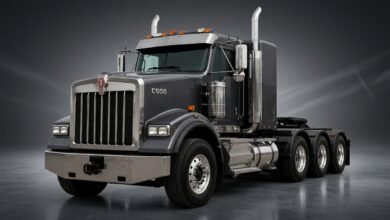
Freightliner 114SD Plus Design Power and Applications
A Detailed Look at the Powertrain, Chassis, Cab Design, and Vocational Capabilities of the Freightliner 114SD Plus

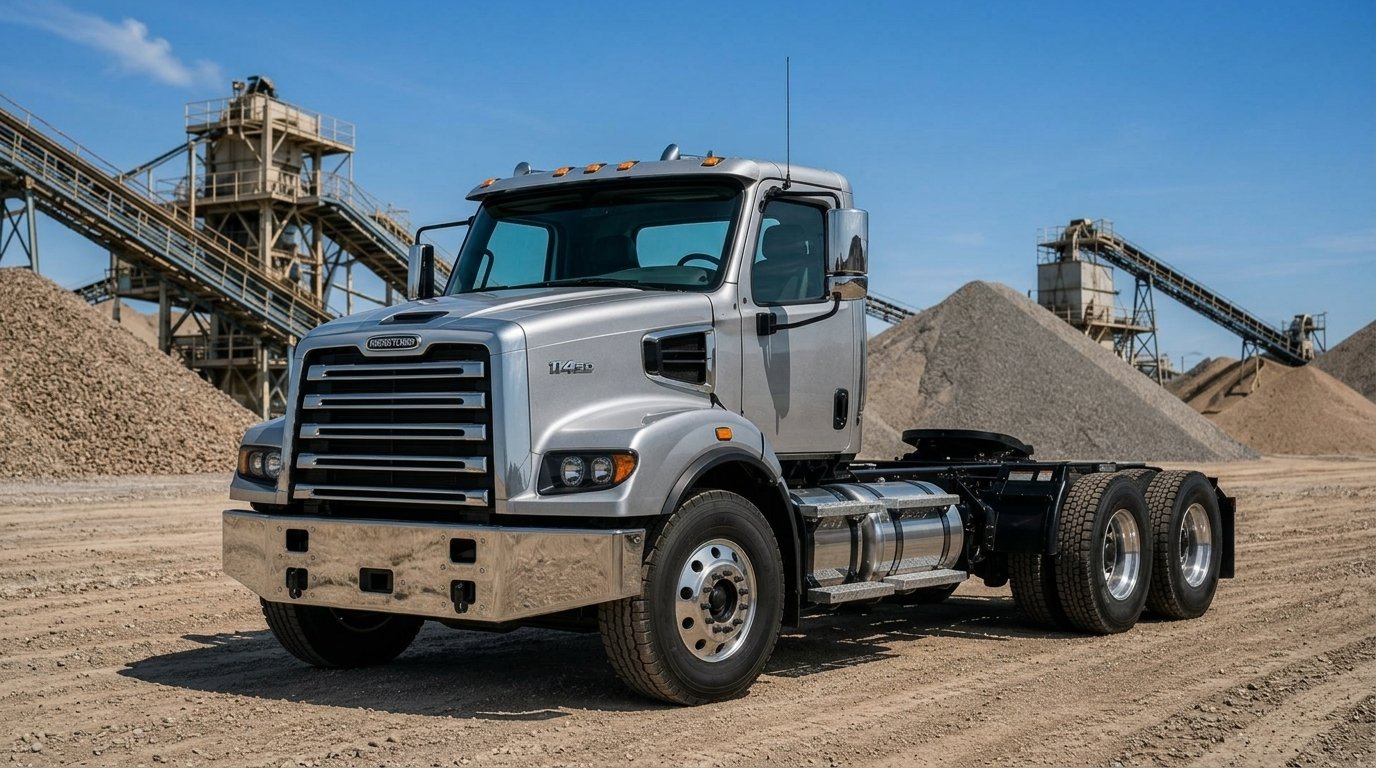
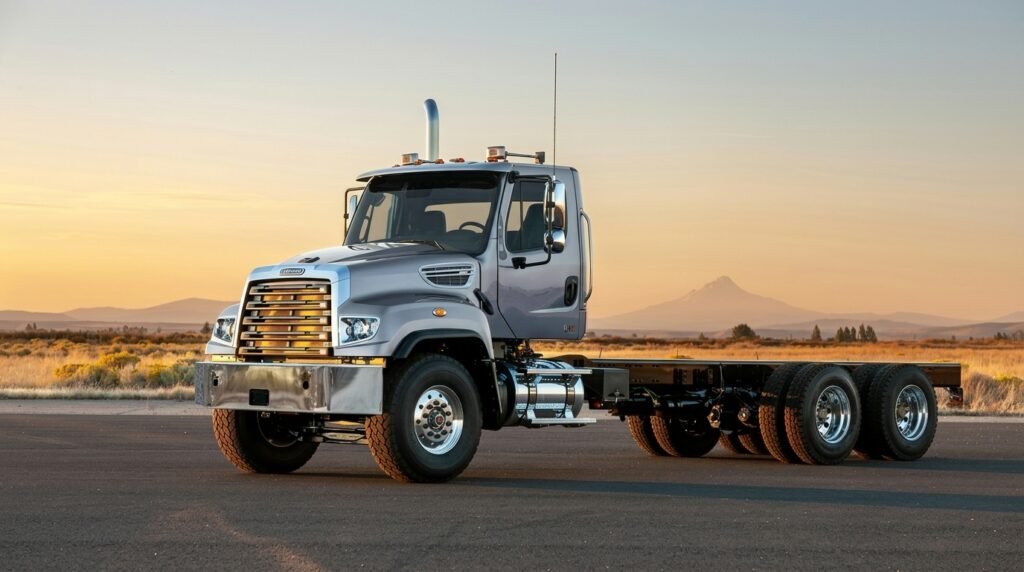
The Freightliner 114SD Plus is a severe-duty truck built for work that would punish a conventional highway tractor. A long-haul tractor is shaped around aerodynamics, sleeper comfort, and fuel efficiency at sustained speed. The 114SD Plus is shaped around frame strength, axle capacity, body mounting, and the demands of job sites where the pavement ends, the loads are heavy, and the truck spends much of its day maneuvering, idling, or powering equipment. It uses a conventional-cab, long-hood design rather than a cab-over-engine layout, and is intended to be configured around a specific job rather than purchased as a finished truck.
That idea of building up is central to understanding the truck. Freightliner offers the 114SD Plus in truck and tractor configurations, and the final role depends on the chassis length, drivetrain layout, axle and suspension choices, and the body or equipment that ends up on the frame. One build may become a dump truck hauling aggregate on a construction project. Another may carry a refuse body through residential routes, support a utility crew, or work an oil and gas field with a hydraulic system running off the engine. The same basic platform serves all of them, which is exactly why it deserves a closer look than a specification sheet allows.
This profile walks through the truck’s design, cab, powertrain options, drivetrain components, equipment integration, safety technology, and maintenance considerations. Where details depend on engine, transmission, model year, or configuration, the article says so, because few severe-duty specifications apply to every build.
Our Take
What stands out about the 114SD Plus is not any single number but the breadth of the choices behind it. Three cab lengths, a long list of axle arrangements, multiple engine families, manual, automated manual, and automatic transmissions, several suspension designs, and three power take-off locations all point to a truck meant to be specified around a job rather than around a catalog trim level. The cab-and-chassis approach, together with a multiplexed electrical system designed to ease body integration, shows that the manufacturer expects much of the finished truck to be completed by body builders and equipment installers. For an operator who knows exactly what the work demands, that flexibility is the main strength.
It is also worth being honest about the limits of that approach. A severe-duty platform is not automatically the right answer for every commercial operation. A fleet whose work is mostly steady highway freight will likely be better served by an aerodynamic tractor, and a business that needs only a light-duty or medium-duty body may be paying, in weight and cost, for capability it never uses. Suitability depends on the work, the required body, the operating environment, the vehicle weight, and the equipment that must be carried or powered. This assessment rests on the manufacturer’s documented features rather than on first-hand driving or ownership, and it is best read as a guide to what to ask before specifying one.
What the Freightliner 114SD Plus Is Designed to Do
Within Freightliner’s severe-duty range, the 114SD Plus is the platform for operators who need a heavy-duty vocational chassis with a modern cab and a wide choice of powertrain and axle components. Its intended work includes construction and dump-body hauling, refuse collection, municipal operations, utility services, and oilfield applications. Those jobs share a few traits: heavy and often uneven loads, frequent stopping and starting, tight or rough work areas, and equipment that depends on the truck for power.
The difference between a vocational chassis and a conventional highway tractor is mostly one of priorities. A highway tractor is optimized to pull a trailer efficiently for long distances, with a streamlined hood, a roof fairing, and often a sleeper. A vocational chassis puts its emphasis on a robust frame, high-capacity axles and suspensions, short-turn maneuverability, and clear mounting space for bodies and equipment. Fuel economy still matters, but it competes with durability and capability.
The 114SD Plus can be configured as either a truck or a tractor. A truck configuration carries its body on the chassis, such as a dump body or refuse packer. A tractor configuration is set up to pull a trailer, which is useful for heavy-haul or specialized trailer work. The word “can” matters here, because the selected configuration determines what the vehicle is actually suited for. A tractor-spec 114SD Plus is not the same thing as a dump truck build, and neither is a substitute for a purpose-built highway sleeper.
Chassis, Cab Design, and Configuration Options
The 114SD Plus uses a conventional layout with a cab behind a long hood and a severe-duty frame beneath. Freightliner lists three cab configurations: Day Cab, Extended Cab, and Crew Cab. They are described by their BBC dimension, which stands for bumper-to-back-of-cab. It is the distance from the front bumper to the rear of the cab, and it is not the same as the interior cab length or the wheelbase. The published figures are 114 inches (about 290 cm) for the Day Cab, 140 inches (about 356 cm) for the Extended Cab, and 162 inches (about 411 cm) for the Crew Cab. The Crew Cab configuration is tied to the set-back front axle arrangement. BBC is important to body builders, because it determines how much frame remains behind the cab for the body, hoist, or equipment.
Published axle configurations include 4×2, 4×4, 6×4, 6×6, and 8×6. The first number refers to total wheel positions and the second to driven wheels, so a 6×4 has six wheel positions with four driven, while a 6×6 drives all of them. A 4×2 is the lighter, simpler layout. Tandem and tri-axle arrangements spread heavy loads across more axles, and the all-wheel-drive layouts add traction for soft or steep ground at the cost of weight, complexity, and maintenance. Axle position and wheelbase also shape maneuverability: a shorter wheelbase generally turns more easily, while a longer one may be needed to carry a particular body or meet weight-distribution requirements. Frame strength and available reinforcement matter too, because the frame must carry both the body and the stresses of the job.
Freightliner lists front frame extensions of 12 and 24 inches (about 30 and 61 cm), along with a range of wheelbases. These matter when a vocational body or specialized equipment must be installed, because items such as front-mounted equipment, plows, winches, or certain pumps need physical space and mounting points ahead of or beside the cab. It is important to understand that these options are not necessarily available together on every build. A given cab, axle arrangement, engine, and frame choice may limit what else can be specified, so the final configuration should be confirmed through a dealer and the manufacturer’s current documentation, including the severe-duty chassis brochure.
Engine Options and Power Delivery
Freightliner’s current specifications page lists several engine families, and it helps to understand what horsepower and torque mean for this kind of work. Horsepower describes how quickly an engine can do work, which matters for sustained speed and for powering equipment. Torque is the twisting force an engine delivers, and it is what moves a heavy load from a standstill, climbs a grade at low speed, or keeps a hydraulic pump turning under strain. Vocational trucks often care more about torque at low engine speeds than about peak horsepower, although both figures matter and neither alone makes an engine suitable.
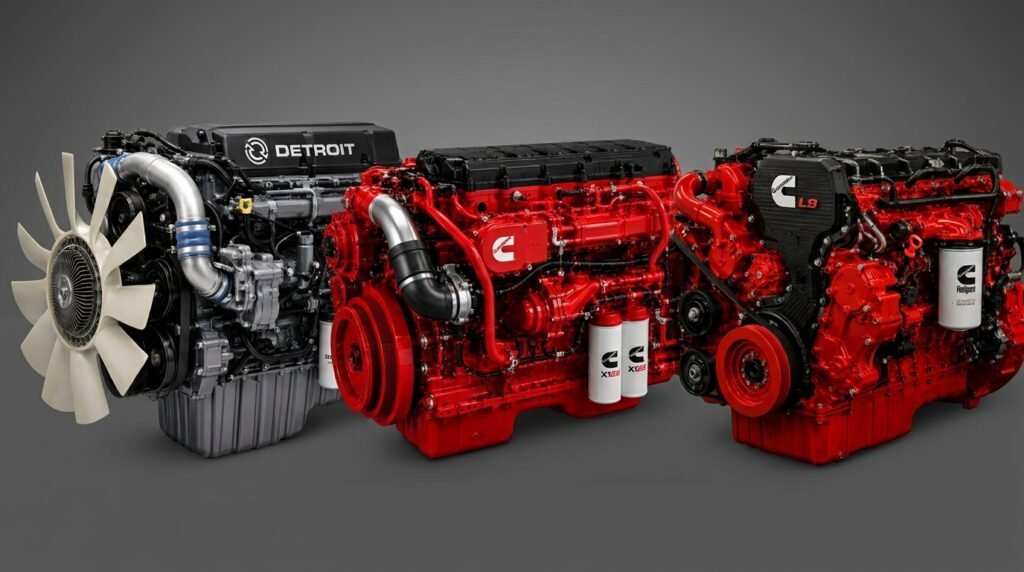
The Detroit Gen 5 DD13 is listed with ratings from 370 to 525 horsepower and from 1,250 to 1,850 lb-ft of torque (about 1,695 to 2,508 N·m). Detroit identifies the DD13 as a 12.8-liter inline-six diesel. Its vocational relevance lies in the wide spread of ratings, which lets a buyer match output to the job, along with options such as engine-mounted power take-off and an aftertreatment system that treats exhaust to meet emissions rules. Official documentation also addresses low-load operation, and operators who spend long periods idling or working at light load should review it, since aftertreatment behavior is affected by duty cycle.
The Cummins X12 is also listed, with ratings reaching 500 horsepower and 1,700 lb-ft of torque (about 2,305 N·m) in applicable configurations. Cummins documentation identifies its displacement as approximately 11.8 liters. The Cummins L9 appears as well, with selection depending on the truck’s market or domicile, and the Detroit DD8 is among the published engine options, though its exact rating and availability must be matched to the correct model year and configuration.
None of this means every engine is available in every market or model year. Natural gas is a separate matter, too. Freightliner documents the 114SD Natural Gas configuration separately, with engines such as the L9N and ISX12N, and those specifications should not be mixed with diesel builds. As of October 2026, Freightliner identifies the Detroit Gen 6 DD13 as scheduled to become available in January 2027, so it is best treated as an announced future option rather than something universally available today.
Choosing an engine affects more than pulling power. It influences how readily the truck moves a load, how it behaves at low speed, how well it runs attached equipment, how much fuel it uses, and what the maintenance plan looks like. No engine is categorically superior for every task, and a higher rating is not automatically better if the work does not use it.
Transmissions and Drivetrain Control
Freightliner lists several transmission families. Eaton Fuller manual transmissions are offered in 10-, 13-, 15-, and 18-speed configurations. Automated manual options include the Detroit DT12-V and DT12-VL, along with Eaton Endurant HD and Endurant XD Pro. Allison 3000 and 4000 Series automatic transmissions are also listed.
The practical differences are worth understanding. A manual transmission gives the driver direct control and can be appealing for its simplicity, but it demands constant clutch work, which becomes tiring in stop-and-go operations. An automated manual keeps the mechanical layout of a manual but handles the clutch and shifting electronically, reducing driver workload while retaining mechanical efficiency. A fully automatic uses a torque converter and is often favored where the work involves frequent stopping, slow maneuvering, and heavy equipment operation, such as refuse collection or job-site work, because it eases launches under load and makes low-speed control smoother. Which one is best depends on the application and on the driver’s experience.
Freightliner identifies several functions for the DT12-V and DT12-VL, including Power Launch, Hill Start Aid, Off-Road Mode, Rock-Free Mode, Creep Mode, and Paver Mode. Power Launch supports moving off under heavy load, Hill Start Aid helps prevent rollback on a slope, and Off-Road Mode and Rock-Free Mode adapt shifting behavior to loose or uneven ground, with Rock-Free Mode assisting if the truck is stuck. Creep Mode allows very slow controlled movement, and Paver Mode is intended for paving work, where the truck must move steadily at low speed alongside a paver. These functions are described for those automated manual transmissions and should not be assumed to appear on every transmission. Likewise, not every transmission is compatible with every engine, so the pairing must be confirmed during specification.
Axles, Suspension, and Weight Ratings
Axle selection is one of the most consequential decisions on a vocational truck. Freightliner identifies options from Detroit, Meritor, and Dana-Spicer, with Marmon-Herrington relevant to the available all-wheel-drive configurations.
Published ratings include steer axles from 12,000 to 22,000 pounds (about 5,443 to 9,979 kg), single drive axles from 21,000 to 38,000 pounds (about 9,525 to 17,237 kg), and tandem drive axles from 40,000 to 58,000 pounds (about 18,144 to 26,308 kg). Tridem drive axle sets are rated at 69,000 pounds (about 31,298 kg), and available pusher or tag axles run from 8,000 to 22,000 pounds (about 3,629 to 9,979 kg). These are component ratings that depend on configuration. They are not the payload the entire truck can automatically carry, because the frame, suspension, tires, legal limits, and body weight all enter the picture.
Freightliner lists a maximum GVWR of up to 92,000 pounds (about 41,730 kg) for the 114SD Plus, subject to the specified configuration. These weight terms are easy to confuse. GVWR, the gross vehicle weight rating, is the maximum a single vehicle can weigh when loaded, including the chassis, body, fuel, driver, and cargo. Payload is what remains for cargo after the truck’s own weight is subtracted. Axle ratings cap the load each axle can carry, and the sum of axle ratings does not necessarily equal the GVWR. GCWR, the gross combined weight rating, applies when the truck pulls a trailer and covers the truck and trailer together.
Suspension adds another layer. Freightliner lists families such as Taper Leaf, Flat Leaf Spring, AirLiner, TufTrac, HAULMAAX, PRIMAAX and FIREMAAX, and Chalmers. In general terms, the suspension affects how loads are supported, how long components last, how the truck rides empty and loaded, and how well it handles rough ground. Air suspensions tend to emphasize ride quality, while heavy-duty leaf-spring and walking-beam designs emphasize durability and articulation. The right one depends on the application, and the choice should be made with the body builder.
Freightliner specifies a wheel cut of up to 50 degrees, depending on wheel equipment. A greater wheel cut generally helps the truck turn more tightly, which is valuable in cramped yards and residential streets. Not every build achieves the same turning performance, since wheelbase, axle arrangement, and tire choices all influence it, and no turning-circle figure should be assumed.
Fuel System and Operating Range
Freightliner’s published specifications identify a 60-gallon (about 227 liters) cylindrical fuel tank in a listed configuration, while other cylindrical and rectangular aluminum tanks are available. That does not mean every 114SD Plus carries 60 gallons. Tank choice depends on the body, available frame space, weight targets, and the way the truck will be used.
Fuel capacity, vehicle weight, body installation, and intended operation all influence how the truck should be specified. A refuse truck that returns to the yard every night may need less capacity than a field truck working far from a fueling point, and a large tank adds weight that cuts into payload. It would be misleading to estimate a driving range here, because no defensible fuel-consumption figure exists for a specific engine, drivetrain, and operating configuration in the source material. Vocational fuel consumption varies widely with load, idle time, terrain, transmission, axle ratios, and auxiliary equipment such as pumps and compactors. A truck that idles through long hours of equipment operation may use fuel in a very different pattern from one that drives steadily, so owners should rely on their own duty-cycle data.
Bodies, Power Take-Off, and Equipment Integration
The 114SD Plus is designed to accept a wide range of vocational bodies, including dump bodies, refuse bodies, utility bodies, construction equipment, and other properly engineered commercial upfits. The chassis supplies the structure, drivetrain, and electrical architecture, and the body builder adds the working equipment.
Many of those bodies need power, and this is where the power take-off, or PTO, comes in. A PTO draws power from the engine or transmission to drive equipment such as hydraulic pumps, which in turn operate hoists, compactors, cranes, and other powered work systems. Freightliner lists front-engine, rear-engine, and transmission-mounted PTO options. Each suits different equipment, and the selected PTO must match the engine, transmission, and equipment requirements. A PTO that works well for one pump may be unsuitable for another, and not every PTO is available with every powertrain.
Freightliner describes QuickFit as its multiplexed electrical architecture designed to simplify body and equipment integration. In a multiplexed system, many electrical functions share a network rather than each requiring its own dedicated wire. For upfitters this can make equipment connections cleaner, provide more convenient access to power, simplify electrical configuration, and make the system easier to service. Still, no promise should be made that a particular body or auxiliary system can be installed without verifying chassis compatibility and upfit requirements with the manufacturer and the body builder.
Interior, Driver Comfort, and Visibility
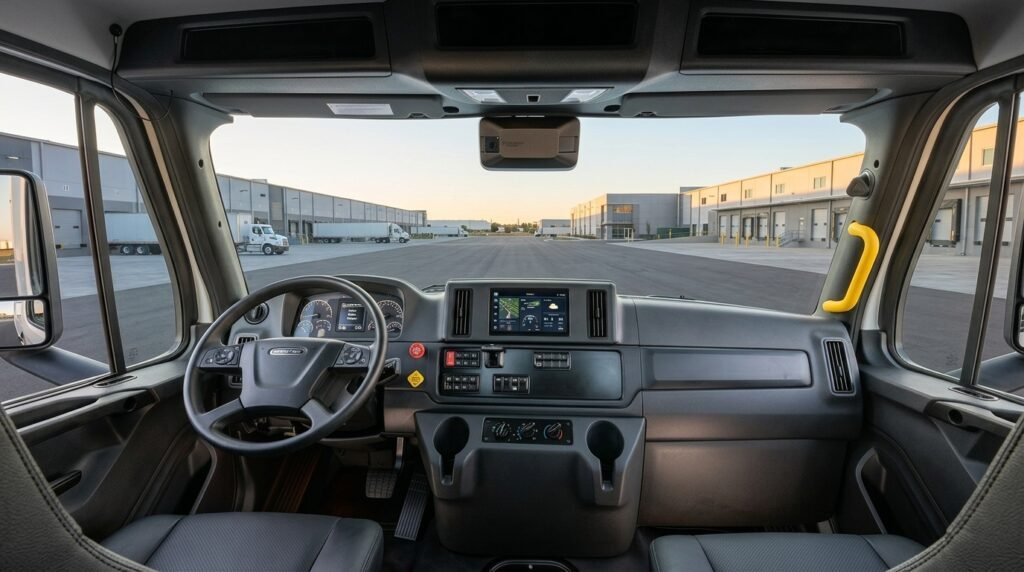
A vocational truck often serves as an office, and the 114SD Plus cab reflects that. Freightliner describes it as a lightweight aluminum structure reinforced with steel, an approach that helps manage weight while maintaining strength. The current model offers three interior trim levels: Professional, Elite, and Rugged.
Inside, the features include ergonomic seats, improved cab insulation to reduce noise, additional storage, and a redesigned dashboard. The Driver Command Center instrument cluster presents vehicle information to the driver, and a tilt-and-telescoping multifunction steering wheel lets drivers of different sizes find a comfortable position. Configurable switches allow controls to be arranged for the equipment on a particular build, and electric windows and door locks and LED cab lighting round out the working environment. On long days that involve repeated climbing in and out of the cab, details like these affect fatigue more than they might seem to.
Visibility is especially important on job sites. Freightliner identifies a windshield area of approximately 2,500 square inches (about 16,129 square cm) and a rear tinted window measuring 63 by 14 inches (about 160 by 36 cm). A large windshield and a well-planned cab layout can help the driver observe surrounding work areas, workers, and equipment. Even so, mirrors, camera systems, and a correct seating position remain essential, because a large truck always has blind spots.
The factory-listed backup alert arrangement includes a 7-inch interactive display, a rear camera, and a reverse proximity sensor. Whether this is standard or depends on the configuration should be verified for a specific build before it is treated as standard equipment. The 114SD Plus should also not be mistaken for a long-haul sleeper tractor. Its listed cab options are Day Cab, Extended Cab, and Crew Cab, and the Crew Cab is aimed at carrying additional crew members rather than at providing sleeping accommodations.
Safety Systems and Driver Assistance
Freightliner identifies several safety technologies for the 114SD Plus. Available Detroit Assurance features include Active Brake Assist, Adaptive Cruise Control, Lane Departure Warning, and Side Guard Assist. Active Brake Assist is designed to warn the driver of a potential collision and apply the brakes in certain situations. Adaptive Cruise Control helps maintain a following distance from the vehicle ahead. Lane Departure Warning alerts the driver when the truck drifts out of its lane, and Side Guard Assist is intended to help detect objects or road users along the side of the truck. These systems are aids. They do not eliminate collision risk or replace the attention of a trained driver, and they have limits in poor weather, on unmarked roads, and in unusual work-site conditions.
Freightliner also identifies Bendix IntelliPark as an available electronic parking brake system, and Bendix TPMS, a tire pressure monitoring system, among its equipment features. As with most items on this truck, availability depends on the powertrain, configuration, options, and model year. This article makes no claims about crash-test ratings or guaranteed accident prevention, since none are supported by the source material.
Performance on Roads and at Work Sites
The 114SD Plus is designed for demanding settings such as construction access roads, industrial sites, municipal operations, and similar working environments. How well it performs in any of them depends on how the truck is built. Drivetrain configuration and axle selection determine traction, since an all-wheel-drive layout will find grip that a 4×2 may not. Suspension and body weight influence stability, particularly with a high center of gravity or a shifting load. Wheelbase and wheel cut affect maneuverability, and engine output and transmission choice shape how readily the truck moves a load and holds speed on a grade.
It would be wrong to say that every version is suitable for unrestricted off-road driving. No ground-clearance, approach-angle, turning-circle, towing, braking-distance, or grade-climbing figures appear in the source material, so none are offered here. The completed configuration, from axles and tires to body and equipment, decides how well the truck suits the actual job, which is why site conditions should be discussed with the dealer before ordering.
Maintenance, Engine Oil, Fluids, and Long-Term Ownership
Severe-duty trucks tend to be hard on components, and maintenance is where long-term ownership is often won or lost. The basics are consistent across builds: follow the correct engine service schedule, check oil and coolant levels regularly, maintain the filtration systems, monitor tires and brakes, inspect the suspension and steering systems, and check chassis components, electrical connections, and body mounting points. Vibration, uneven ground, and heavy loads can loosen fasteners and wear connections, so the areas where the body attaches to the frame deserve regular attention. Official manuals and service information are available through DTNA’s technical literature portal.
For the Detroit DD13 Gen 5, previously reviewed engine documentation identifies an approximately 40-U.S.-quart service fill (roughly 38 liters) when changing the oil and filter. Detroit publishes DFS 93K222 and DFS 93K223 oil specifications for applicable operating requirements, and the two should not be treated as interchangeable in all circumstances. The relevant service manual should be checked before settling on a precise oil specification or service interval.
The Cummins X12 is different. Its maintenance and operation reference identifies a published lubrication capacity of 42 U.S. quarts (approximately 39.8 liters) for the referenced application. Oil pan and installation details can affect the applicable capacity, so the figure should be confirmed for the engine actually in the truck. The oil capacity of one engine should never be transferred to another, and no specific oil viscosity, oil capacity, cooling-system capacity, axle lubricant, transmission fluid, or service interval should be assigned to every 114SD Plus.
For Allison automatic transmissions, owners should consult Allison’s list of approved transmission fluids. Allison identifies TES 668 as an approved fluid specification for applicable 3000 and 4000 Series on-highway transmissions, but the exact recommendation must be confirmed for the installed transmission and its service documentation.
Beyond documented maintenance requirements, several general ownership factors deserve thought. Maintenance access affects how quickly routine work gets done, and parts availability and dealer support affect downtime, which in vocational fleets can mean an idle crew or a missed contract. Specialized equipment adds its own service demands, and fuel and tire costs are usually among the largest recurring expenses. Operator requirements matter as well, since a truck with a manual transmission, a PTO, or advanced safety systems calls for appropriate driver training. These are general considerations rather than documented specifications, and they will weigh differently for each operation.
Who Should Consider the Freightliner 114SD Plus?
The platform makes the most sense for operators whose work genuinely needs a severe-duty chassis. Construction fleets that haul material and work on rough sites, refuse operators who need durable chassis and body integration, municipalities that run a variety of equipment, utility contractors who need powered bodies, and oilfield or vocational fleets that rely on high-capacity axles and PTO-driven systems are all natural candidates, provided the truck is appropriately configured.
The key is matching the truck to the requirements: the required body, the drivetrain and axle ratings, the routes and terrain, the equipment to be powered, service availability, and the operating budget. A truck specified well for one purpose can be a poor fit for another. The 114SD Plus may be unsuitable where the primary task calls for a different truck category, or where an aerodynamic tractor optimized for sustained highway freight hauling would do the job more efficiently. Buyers should be wary of over-specifying, since extra capability brings extra weight, cost, and maintenance.
Conclusion
The Freightliner 114SD Plus earns its place by being adaptable. Its three cab configurations, wide range of axle and suspension choices, multiple engine families, varied transmissions, and power take-off and electrical systems let it become a dump truck, a refuse hauler, a utility rig, or an oilfield workhorse, depending on how it is built. The cab, with its insulation, ergonomic seating, visibility, and optional driver-assistance technology, recognizes that the driver spends long hours in a demanding environment, while the electrical architecture and frame options acknowledge that the chassis is only part of the finished machine.
The most useful way to think about the truck is as a starting point. The right specification depends on the work being performed: the loads, the terrain, the equipment, the duty cycle, and the support available when something needs service. Operators who define those needs carefully, confirm which options can be combined, and rely on the manufacturer’s current documentation for model-year and configuration details are in the best position to get value from it. Those who mainly need efficient highway hauling, or a lighter truck for lighter work, may be better served elsewhere. For the right severe-duty job, though, the 114SD Plus is a capable and flexible platform worth serious consideration.