International CV Inside the CV515 Medium-Duty Truck
A Closer Look at the Engine Chassis, Cab Design and Commercial Capabilities of the International CV515

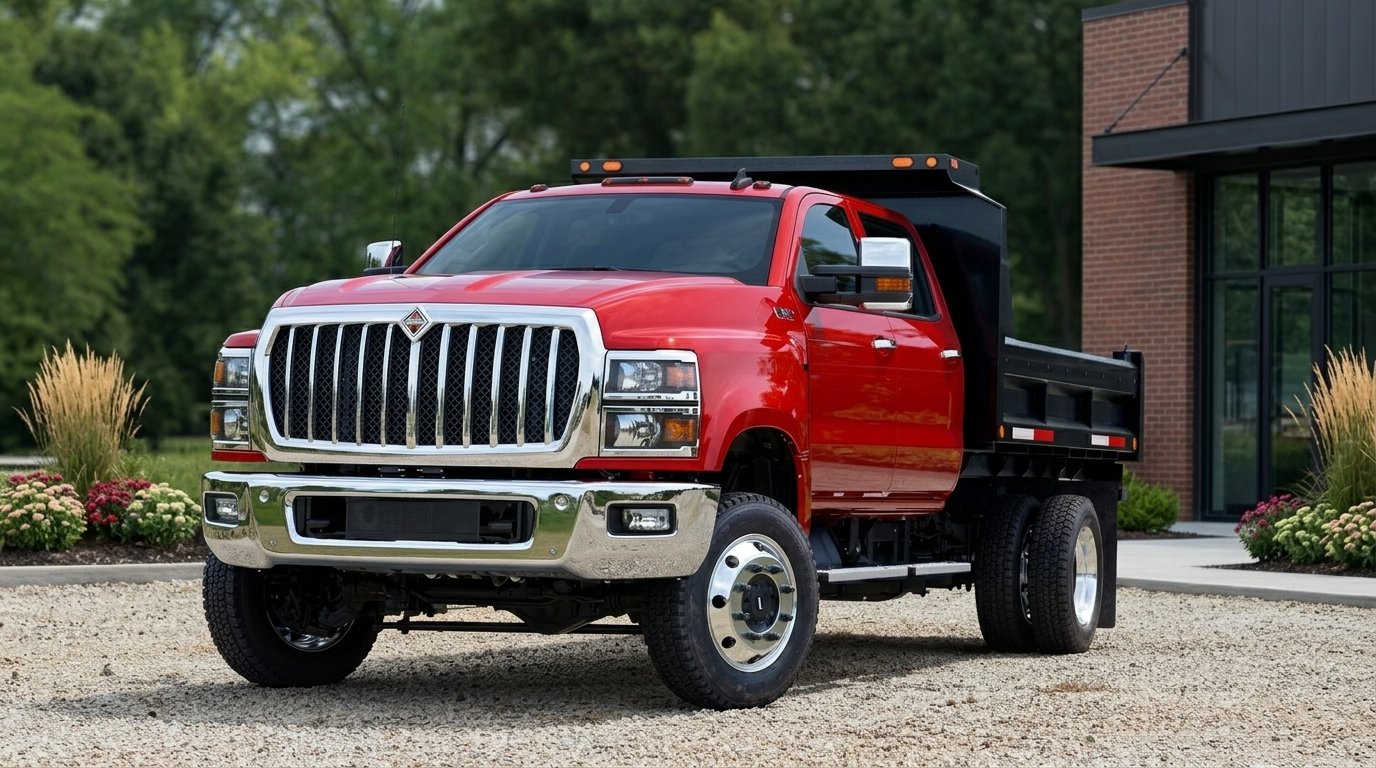
The International CV Series is a medium-duty commercial truck built around a body-ready chassis, a 6.6-liter turbocharged diesel V8, and an Allison automatic transmission. It is sold as a cab-and-chassis platform. Most CV trucks leave the factory without a finished cargo area and are completed by a body builder as a service truck, dump truck, rollback carrier, ambulance, dry-freight van, or similar vehicle. The CV515 configuration is the focus here. It aims to give businesses a commercial-grade frame and powertrain in a more maneuverable package than International’s larger vocational trucks.
That positioning suits work where a pickup is too light and a full severe-duty truck is more than the job needs. Delivery operators, utility crews, landscapers, snow-removal contractors, and towing and recovery businesses often want a chassis that can carry a purpose-built body, work in tight spaces, and hold up to daily use. The CV Series was designed with those jobs in mind, and its upfitting flexibility is a large part of its appeal.
It helps to be precise about what this truck is. The CV Series is a medium-duty commercial truck, not a long-haul sleeper tractor built to pull semi-trailers over interstates. Its regulatory class depends on the certified gross vehicle weight rating and the exact configuration. International’s current product page presents the CV Series as a Class 5/6 truck, while the original launch materials described its positioning differently. Those descriptions reflect different points in the truck’s life and should not be read as a single claim covering every model year. The sections below look at the chassis, engine, transmission, axles, fuel arrangement, equipment integration, cab, brakes, and the maintenance questions that matter to owners.
Our Take
The CV Series makes the most sense as a flexible commercial chassis rather than a finished product with one fixed personality. Its practical strengths are easy to identify from the published information: a high-strength steel frame with straight rails, a choice of 4×2 and 4×4 layouts, a 6.6-liter diesel V8, a six-speed Allison automatic, a forward-tilting hood for service access, rear suspension choices, and the freedom to accept a wide range of commercial bodies. Together they give a body builder and a fleet manager a lot to work with, and that adaptability is the platform’s real value.
A medium-duty chassis is also not the answer to every job. The right truck depends on the weight of the body and equipment, the load carried, the terrain, whether the truck will tow, and how it will be serviced. A buyer who specifies the chassis loosely and hopes the body will sort itself out is likely to end up with a mismatched truck. This assessment is based on published manufacturer documentation, not on driving or testing the vehicle, and it should be read as a guide to what to evaluate rather than a verdict on how any individual truck performs.
What the International CV Series Is Designed to Do
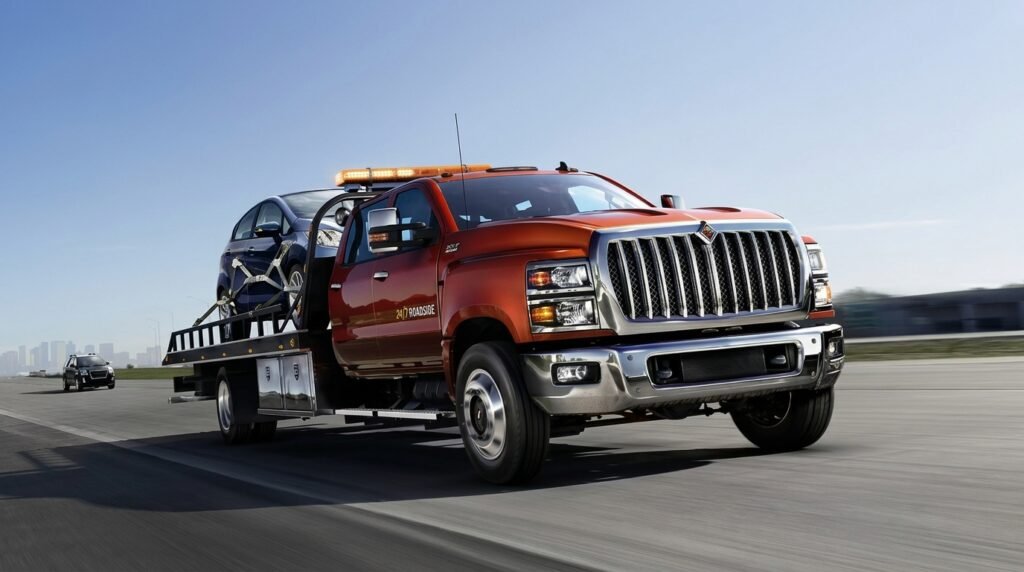
International documents a broad range of applications for the CV Series, including utility bodies, dry-freight vans, service trucks, towing and recovery vehicles, rollback carriers, ambulances, dump bodies, and snowplow configurations. The current product page also discusses landscaping, snowplowing, ambulance, utility, recovery, towing, and urban delivery work. That list covers very different duty cycles. A dry-freight van spends its day making stops and maneuvering at loading docks. A snowplow truck works in low-traction conditions with a heavy front-mounted implement. A recovery truck lifts and hauls disabled vehicles. A single chassis can serve all of them because the shared requirements are a strong frame, a dependable powertrain, and enough axle and suspension capacity for the intended body.
Each completed vehicle still has to be specified around its job. The same chassis that works well as an urban delivery truck may be a poor choice for a heavy dump body if the axle ratings, suspension, and wheelbase were selected for something else. The factory chassis is the starting point, and the finished vehicle’s capability reflects the choices made on top of it.
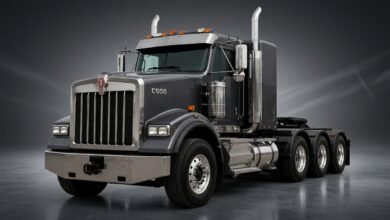
The difference between this kind of truck and a conventional Class 8 highway tractor matters here. A highway tractor is built around a fifth wheel and designed to pull semi-trailers over long distances. The CV Series is a cab-and-chassis truck whose purpose is to carry a body or equipment. It can be equipped for appropriate towing, but it should not be described as a fifth-wheel semi tractor or a long-haul sleeper.
Chassis, Cab Design, and Configuration Options
The CV515 uses a conventional-cab layout with a commercial frame intended to accept vocational bodies. International’s September 2025 specification sheet lists a 115-inch BBC dimension and a 34-inch BA dimension. BBC means bumper-to-back-of-cab, and BA refers to bumper-to-axle. Neither is the same as wheelbase or interior cab length, and body builders use both to plan how a body and its equipment will sit behind the cab.
The current published cab configurations are Regular Cab and Crew Cab. The 2025 specification sheet lists wheelbase options from 165 to 243 inches for the Regular Cab and from 175 to 235 inches for the Crew Cab. A Crew Cab provides additional passenger seating but is not a sleeper and does not include a factory sleeping compartment. Wheelbase choice has real consequences for the finished truck. A longer wheelbase can make room for a longer body and may help with weight distribution, while a shorter one improves maneuverability in tight work sites and city streets.
Axle configurations include 4×2 and 4×4. A 4×2 truck drives through the rear axle only, which keeps the driveline simpler and lighter and is well matched to delivery, service, and many utility applications on paved or well-maintained surfaces. A 4×4 adds a driven front axle and a transfer case, which improves traction on loose, wet, snowy, or uneven ground, at the cost of added weight and driveline complexity. That does not turn every 4×4 CV into an unrestricted off-road machine. It is a tool for improving traction in suitable working conditions.
The frame is described as high-strength, low-alloy steel with a published yield strength of 50,000 PSI. The straight frame rails and clear body-mounting area are intended to simplify vocational body installation. International has also described its painted chassis as an approach intended to improve longevity and corrosion resistance. What the truck can actually do depends on how wheelbase, axle ratings, frame layout, body mounting, and body weight work together. A strong frame helps, but the completed vehicle is limited by its weakest rated component.
Engine and Power Delivery
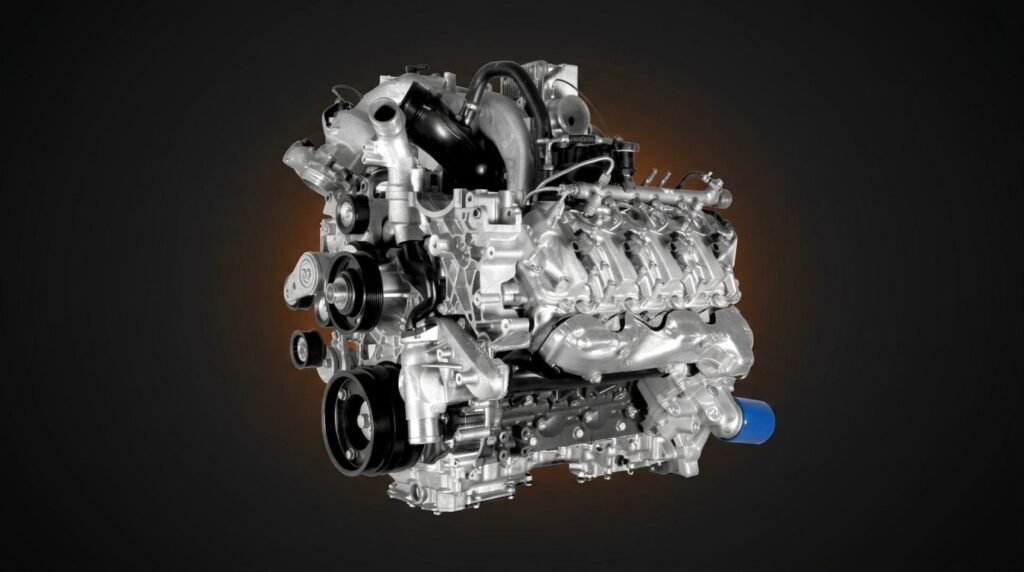
The CV Series is powered by the International 6.6-liter turbocharged diesel V8. The September 2025 specification sheet lists 350 horsepower at 2,700 rpm and torque of up to 750 lb-ft, and those are the headline figures supported by that document. Older launch materials list 350 horsepower and 700 lb-ft, and the live product page publishes torque and engine-speed figures that are inconsistent between sections. These differences are best treated as model-year or documentation differences rather than merged into a single universal rating. For that reason, no engine speed for peak torque is given here, since it should be verified against the documentation for the specific model year.
In practical terms, horsepower describes how quickly the engine can do work, while torque describes its twisting force, which matters most when starting a loaded truck, climbing a grade, or driving a hydraulic system. In a vocational truck, strong torque at moderate engine speeds is useful because much of the work happens at low road speed: pulling away with a loaded body, creeping through a work site, or operating equipment while stationary. Engine output also supports towing within approved ratings. It does not by itself determine payload or towing capacity, which are governed by the chassis, axles, brakes, frame, and certified ratings.
As a modern diesel, the engine is equipped with emissions control hardware. The exact configuration can change with the year of certification, so no universal aftertreatment layout, diesel exhaust fluid tank capacity, or emissions specification should be assumed. Owners and body builders should rely on the documentation for the specific truck.
International training material for the original CV engine documents a 10-U.S.-quart oil refill volume when changing the filter. That figure is an engine-specific reference from the relevant training documentation and is not a guaranteed fill quantity for every later model year. It is discussed again in the maintenance section.
Transmission and Drivetrain
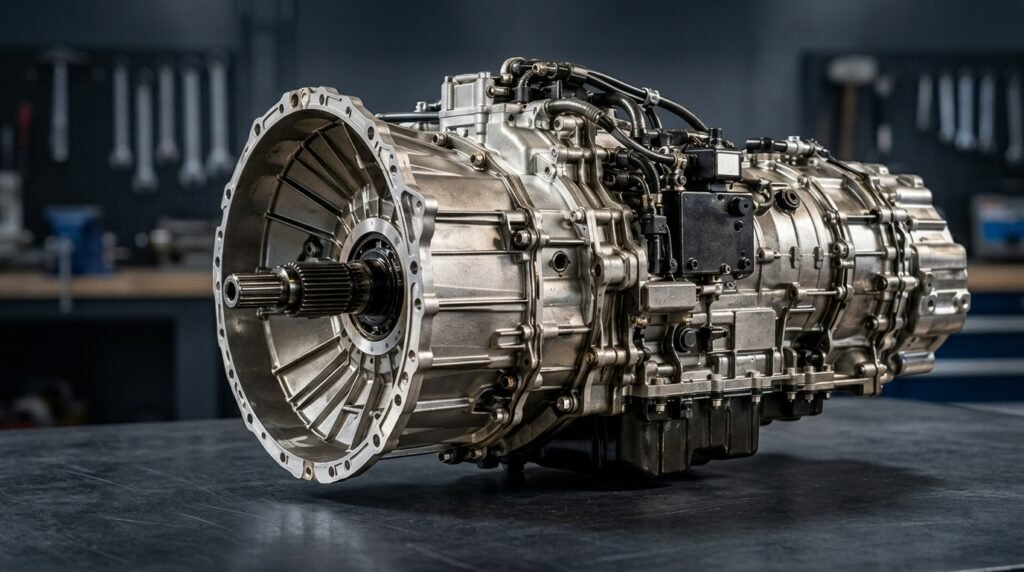
The 2025 specification sheet lists a six-speed Allison automatic transmission, with 1700, 1750, 2700, and 2750 Series options and vocational codes including HS, RDS, EVS, and MH. An automatic suits many medium-duty applications because the work involves frequent stops, tight maneuvering into loading locations, and demanding urban or work-site conditions. Without a clutch pedal to manage, the driver can focus on positioning the truck and watching the surroundings. Gear ratios, fluid capacities, shift characteristics, and service intervals are not covered here because they depend on the specific transmission model and must come from the correct documentation.
For 4×4 configurations, International lists a Meritor 3203 two-speed gear-driven transfer case with a stated capacity of 3,000 lb-ft, electric shifting, and an optional skid plate. The transfer case splits drive between the front and rear axles. The two-speed design offers a low range intended for slow, high-effort situations. Together with a driven front axle, this can help in suitable low-traction conditions such as snow, mud, or loose gravel. This equipment belongs only to the 4×4 configuration. It is not standard on every CV truck, and a 4×2 truck has no transfer case at all.
Axles, Suspension, and Weight Ratings
The September 2025 sheet lists front Dana-Spicer axle ratings of 6,250 to 8,000 pounds for 4×2 configurations and 7,500 pounds for the driving front axle in listed 4×4 configurations. Published single rear axle ratings range from 10,000 to 15,500 pounds. Rear suspension choices in the 2025 sheet include Vari-Rate spring suspension rated from 11,000 to 15,500 pounds, and International Ride Optimized Suspension (IROS), an available air suspension rated from 12,000 to 15,500 pounds in listed 4×2 configurations. Other suspension offerings vary by model year, and the current product page also identifies Liquidspring options.
The 2025 sheet lists GVWR ranges of 16,250 to 23,500 pounds for 4×2 configurations and 17,500 to 23,500 pounds for 4×4 configurations. The live product page shows somewhat different upper limits for some configurations. GVWR can reach up to 23,500 pounds, but the exact approved rating must be verified for the specific chassis and model year.
These ratings are not interchangeable. GVWR is the maximum allowed weight of the loaded truck itself, including the chassis, body, equipment, fuel, occupants, and cargo. Payload is what remains after the empty weight of the finished truck is subtracted from the GVWR, so a heavy body reduces the payload. Axle ratings limit the load each axle can carry, and a maximum axle rating should never be read as the truck’s legal cargo payload. GCWR is the combined weight rating for the truck and anything it tows. No universal trailer towing limit applies to the CV Series, because it depends on the configuration.
Axle and suspension choices shape how the truck behaves in service. Higher ratings support heavier bodies and loads. A spring suspension is a conventional, durable choice for many vocational jobs, while an air suspension can improve ride quality, which may matter for sensitive cargo or equipment. Traction comes from the drivetrain and tires as much as the suspension, but how weight is carried over the rear axle affects how well the truck puts power to the road.
Fuel System and Operating Range
Fuel tank information differs between the live product page and the September 2025 specification sheet. The 2025 sheet lists a single 40-gallon rectangular tank as standard, with a single 25-gallon tank and a dual arrangement combining 25 and 40 gallons as available options. The live page describes a different standard arrangement. The tank setup is therefore dependent on model year and configuration, and it should not be assumed identical on every CV truck.
Tank choice interacts with other design decisions. Tanks occupy frame space that a body or equipment may also need, and fuel adds weight, which reduces available payload when the tanks are full. A larger or dual-tank arrangement extends the time between fills for trucks that cover long routes or run equipment for long hours, while a smaller tank frees space and saves weight. No miles-per-gallon or driving-range figure is offered here, because no single verified fuel-consumption number applies across engine years, bodies, routes, axle ratios, loads, and duty cycles. Diesel exhaust fluid is part of the emissions system on modern diesels, but its tank capacity is not stated here because it should be confirmed for the specific truck.
PTO and Commercial Equipment Integration
The CV Series is best understood as a body-ready chassis. It can be built into a service truck, dump truck, tow vehicle, rollback carrier, utility truck, snowplow, ambulance, dry-freight delivery vehicle, or other approved commercial configuration. The straight frame rails and body-mounting provisions give body builders a consistent base, and optional equipment arrangements add further flexibility.
International lists transmission-mounted PTO availability on the right side, left side, or both sides, depending on the PTO-equipped transmission and approved configuration. A power take-off lets an approved auxiliary system draw mechanical power from the transmission to operate compatible equipment, commonly a hydraulic pump that drives a dump hoist, a crane, a lift gate, or other vocational machinery. That arrangement lets one engine move the truck and run the work equipment without a separate power source.
Compatibility needs to be confirmed before anything is promised. Not every body or auxiliary device can be fitted to every chassis, and the transmission, PTO provision, and frame layout all matter. Buyers should check with International and the body builder before committing to a configuration.
Interior, Driver Comfort, and Visibility
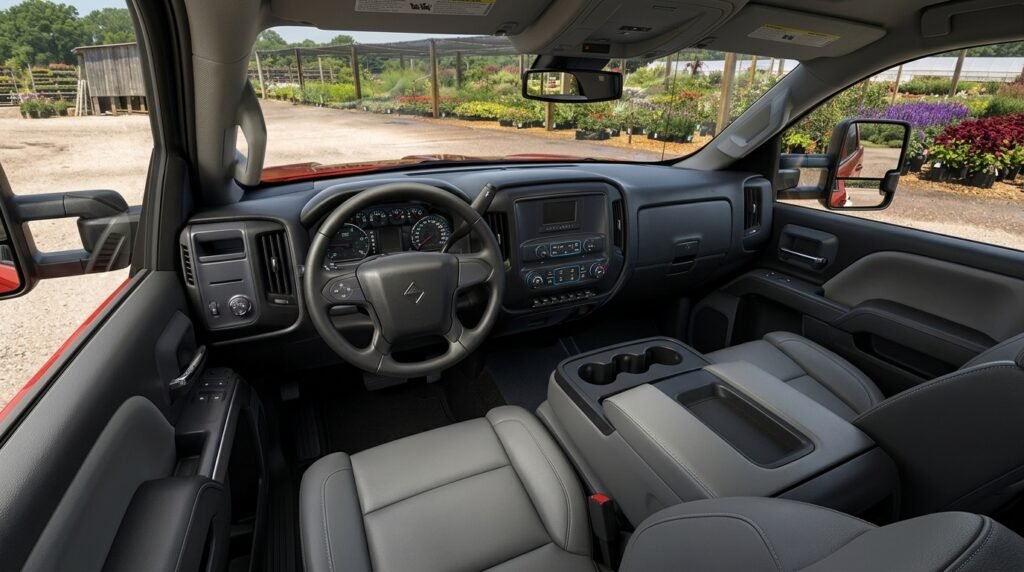
The Regular Cab suits applications that do not need extra passenger seating, such as many delivery, dump, and single-operator service jobs. The Crew Cab can accommodate a larger crew, which suits utility, landscaping, and municipal teams that travel together to a job site.
International’s DriverFirst philosophy emphasizes an ergonomic working environment, supportive vinyl seats with optional cloth seating, and accessible controls. A center console includes a multifunction armrest and storage space for a laptop or tablet, and the current product page identifies three cup holders and additional storage. A rear-view camera and a trailer brake controller are available equipment rather than universal standard features. International’s original launch material documented infotainment options including an 8-inch touchscreen with navigation and Apple CarPlay and Android Auto. Because equipment varies by year and trim, those items are examples that depend on model year, not guaranteed features of every CV truck.
The forward-tilting hood deserves attention because it affects maintenance. Tilting the hood forward gives access to the engine and routine service points that would be harder to reach in a more confined layout. The manufacturer also notes details such as a hood safety latch and headlight service designed to be straightforward. In delivery, utility, and service work, good visibility, convenient controls, a comfortable seat, and practical storage matter because drivers spend long hours in and out of the cab, often in crowded environments.
Brakes, Safety, and Driver Assistance
International identifies a Hydromax braking system with four-channel ABS and traction control on the CV Series. Its current product information also identifies electronic stability control and a Hydromax booster for trailer-sway control. Hydromax is a commercial hydraulic braking system, and it should not be confused with the air-brake arrangement found on many heavier trucks. The CV Series does not universally use air brakes.
The optional rear-view camera helps drivers see behind a truck whose body may block the mirrors. The optional trailer brake controller is useful when the truck tows a trailer with electric brakes. Both depend on how the truck is configured. No crash-test ratings are claimed here, and electronic systems should be understood as support for the driver. They do not replace proper training, safe operating practices, and regular inspections, and they cannot prevent every collision.
Road Use and Commercial Applications
The CV Series suits businesses that need a medium-duty commercial truck with a maneuverable footprint and a chassis designed for specialized bodies. In urban delivery, a dry-freight van body on a 4×2 chassis can handle stop-and-go routes where maneuverability and an automatic transmission are valuable. Landscaping operations might pair a dump or utility body with the capacity to carry equipment and materials. Towing and recovery operators can specify a rollback or wrecker body and use the PTO to run the hydraulics. Utility contractors can equip a service body with tools and compressors, while municipalities and snow-removal fleets may favor a 4×4 chassis with a plow for added traction. Ambulance builders use the platform as a base for a specialty body.
The CV Series is not the same type of vehicle as the Freightliner 114SD Plus. The International CV is a medium-duty chassis for service, delivery, and specialized bodies. The Freightliner 114SD Plus is a heavier severe-duty platform aimed at demanding vocational tasks. Knowing which category a job belongs in is the first step in choosing a truck, and treating the CV as a smaller version of a severe-duty truck would set the wrong expectations.
The 4×2 and 4×4 choice often decides the question. A delivery or service truck working on paved roads usually gains little from a driven front axle, while a plow truck or a utility truck that must reach unpaved work sites may benefit from it.
Maintenance, Engine Oil, Fluids, and Ownership
Maintenance for a commercial truck is shaped by how it is used. A delivery truck that idles at docks and a plow truck that works through winter will not wear in the same way, and the correct service schedule depends on the applicable maintenance program, the engine’s oil-life monitoring, operating conditions, and the approved service instructions. International’s official service information and the brochures, spec cards, and manuals are the right places to start.
International training material for the original CV engine, available in the CV engine training guide, identifies a 10-U.S.-quart refill volume for the 6.6-liter engine when changing the oil filter. That number is tied to the documented engine application. The installed engine, model year, and applicable maintenance manual must be verified before it is used as an instruction for a particular truck. No universal oil viscosity, oil-change interval, coolant capacity, fuel-filter interval, DEF capacity, transmission-fluid specification, or rear-axle lubricant is offered here, and each should come from the correct year-specific manual.
The same training material notes several service details of the original engine: the engine-mounted oil filter near the left-rear of the engine, a yellow-handled oil dipstick, an oil fill tube near the rear-left side of the engine, and an air restriction indicator that shows the condition of the air filter. These details help orient someone working on that engine, but older training illustrations do not prove that every later build is identical.
Practical maintenance areas include engine oil and filter condition, fuel filtration, air filtration, coolant inspection, and the diesel aftertreatment system. The chassis also needs regular attention to tires, brakes, steering, suspension, rear axle components, and electrical connections, and any PTO-driven equipment needs its own inspection. For the Allison transmission, owners should use the documentation for the exact installed 1700, 1750, 2700, or 2750 Series model, and Allison provides current operator manuals and service information through its official publications library.
Ownership costs include fuel, maintenance, tires and brakes, service availability, body-specific repairs, and downtime. For a vocational truck, downtime can cost more than a repair bill, so access to qualified service is part of the decision. These costs are discussed qualitatively because no reliable model-specific figures apply to every truck.
The September 2025 specification sheet states warranty terms at the time of publication, including a 3-year/36,000-mile base chassis warranty, a 5-year/100,000-mile base engine warranty, and a 5-year/unlimited-mile transmission warranty. These terms should not be assumed to apply to all model years, customers, or configurations, and buyers should confirm the applicable warranty booklet and its exclusions.
Who Should Consider the International CV ?
The CV Series suits commercial delivery fleets, landscaping companies, utility contractors, service businesses, recovery operators, municipalities, snow-removal fleets, and operators needing an ambulance or other specialty body. What these users share is a need for a commercial chassis that will carry a purpose-built body in a package that is easier to maneuver than a larger vocational truck.
Selection matters as much as the platform. Buyers need to choose the correct GVWR, axle configuration, cab, wheelbase, suspension, body, equipment, and towing arrangement for the work, and to confirm those choices against the exact model-year documentation. Buyers primarily seeking a Class 8 interstate sleeper tractor should evaluate a different vehicle category. The CV Series should be judged according to its medium-duty vocational purpose.
Conclusion
The International CV Series combines a body-ready commercial frame with a 6.6-liter diesel V8, an Allison automatic transmission, 4×2 and 4×4 options, and a cab that can be configured for one operator or a larger crew. Its forward-tilting hood, PTO provisions, and choice of suspensions and wheelbases give body builders room to adapt it to delivery, utility, recovery, plowing, and specialty work. Those traits explain where the truck belongs: in jobs that need a capable medium-duty chassis and a maneuverable footprint, not in long-haul tractor service or severe-duty vocational work.
The headline figures matter less than whether the finished truck fits the job. A buyer should work out the combined weight of the body, equipment, and load, then match that to the GVWR, axle ratings, suspension, and wheelbase. They should decide whether the terrain justifies four-wheel drive, whether the work needs a PTO, and what cab size the crew requires. Because specifications and equipment change between model years, the right confirmation comes from the specific truck’s documentation, the body builder, and International’s service resources. A CV Series truck configured with care can be a dependable working platform, and one configured casually is likely to disappoint.