12V Refrigerators for Semi Trucks
Practical 12V refrigerator options for long-haul drivers, with the right balance of space, power, and sleeper-cab convenience.

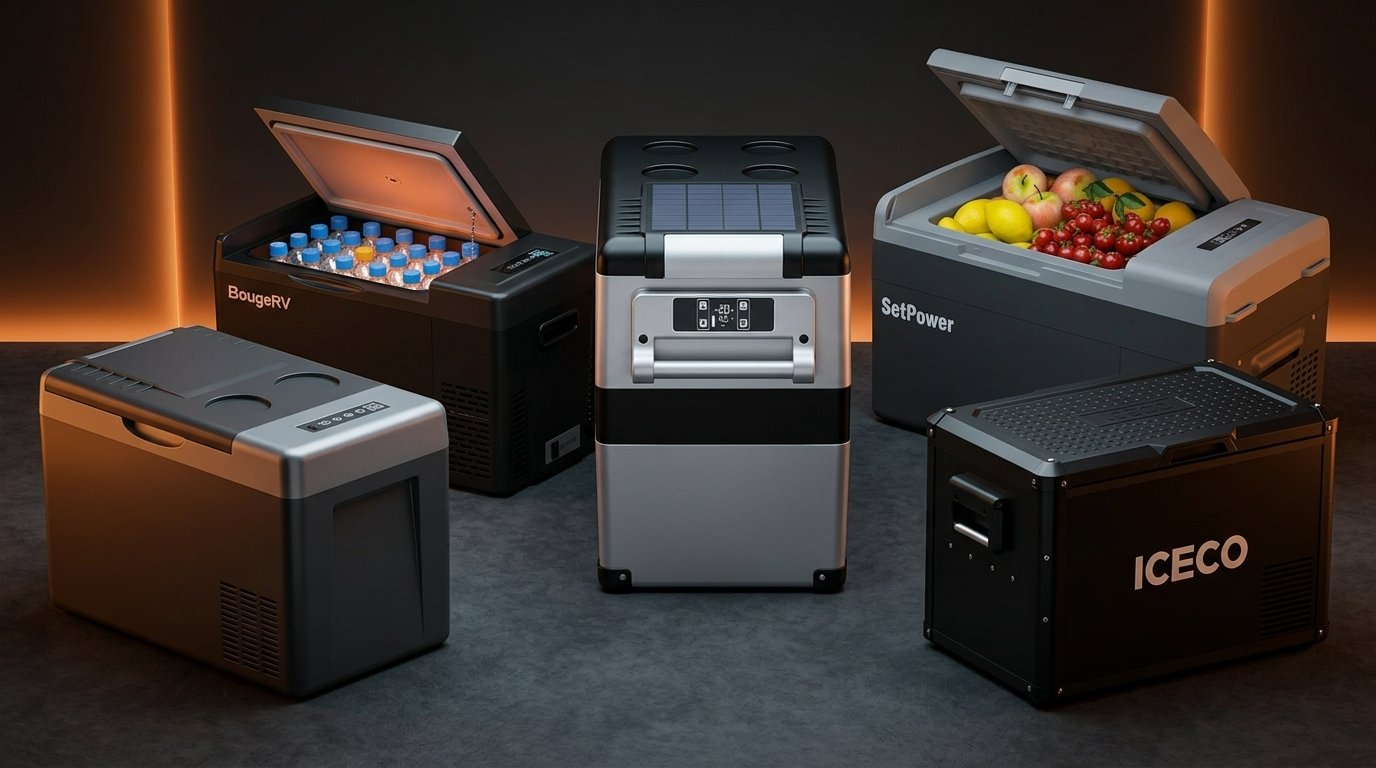
12V refrigerators for semi trucks can solve a problem that becomes obvious by day four of a long run. The cooler is usually the first thing to fail you. The ice has melted, the sandwich meat is sitting in lukewarm water, and the only real option left is another truck stop meal at whatever the kitchen is charging. A 12V refrigerator runs off the power your truck already produces, holds a steady temperature without ice, and lets you carry real groceries instead of surviving on gas station food.
The catch is that a sleeper cab is not a kitchen. Floor space is limited, bunk storage is contested, and the electrical system has to keep the engine starting after a night of parked rest. A refrigerator that looks great in a product photo can end up blocking the walkway or draining the batteries faster than expected. Picking well means thinking about the cab first and the appliance second. The sections below walk through what matters, what to check before buying, and how five specific units fit different kinds of drivers.
What Actually Matters on the Road
Capacity against cab space. These two pull against each other constantly. A big refrigerator holds a week of food, but it also takes floor area you might need for a standing path to the bunk. A small one slides into a corner but forces more frequent restocking. Most drivers land on a middle size and then discover whether their routine suits it.
Power behavior. A 12V compressor refrigerator cycles on and off to hold temperature, so its draw is intermittent rather than constant. That matters most when the engine is off. If you idle overnight or run an APU, the load is minor. If you sleep with the engine shut down, the refrigerator is competing with your starting batteries, and you need to know how the unit protects against draining them. Check the product manual for low voltage protection settings rather than assuming.
Cooling consistency. Heat soaks into a cab parked in the summer sun. A refrigerator that cools well on a mild day may work noticeably harder when the cab is hot. Compressor models generally handle this better than thermoelectric coolers, which only cool a set amount below the surrounding air.
Portability. Some drivers keep the unit in the cab permanently. Others carry it into a motel, a rental, or home between runs. Weight and handles matter more than they sound like they should when you are lifting something onto a bunk at 5 a.m.
Daily access. If you can only reach the lid by climbing over a seat, you will stop using the refrigerator for small things. Placement and lid orientation shape how often you actually open it, and that affects both convenience and efficiency.
Durability under vibration. A truck cab shakes for hours. Secure mounting, solid latches, and a design meant for mobile use are quiet but real reliability factors.
What to Consider Before Buying
How much capacity do you realistically need? Think in meals rather than liters. One person eating two refrigerated meals a day plus drinks usually does fine in the roughly 18 to 25 quart range. That fits a few days of lunches, a couple of cold drinks, and perishable basics. Once you start buying groceries weekly, carrying fresh produce, or feeding two people in a team setup, you move into the 45 quart and larger range.
When does compact make sense? If your cab is tight, or you restock every two or three days anyway, a compact portable refrigerator for a semi truck is more usable than a larger one you never fill. An underfilled refrigerator is also less efficient, since empty space has to be cooled.
When is larger worth it? Long stretches without grocery stops, special diets, or a cab with genuine floor space all justify a big unit. A 60 liter class refrigerator can hold a lot, but it also becomes a piece of furniture.
Power draw and your sleeping habits. Look at how you spend your off-duty hours. An APU, an inverter system, or an engine you idle changes the picture compared with a truck parked fully shut off. Also confirm whether a unit offers multiple battery protection levels. If you plan to run it from a separate house battery rather than your starting batteries, that is often worth considering, though the details depend on your truck.
Plug types. Some units accept both DC and household power. That flexibility lets you pre-cool at home or in a hotel before a run, which reduces the load once you are loaded and rolling.
When bigger becomes inconvenient. A large refrigerator can be awkward to lift, hard to secure, and slow to clean. If you carry it in and out, weight and shape matter more than a few extra quarts.
For a broader look at what tends to earn a permanent place in a cab, the guide to long haul truck cab essentials for drivers is a useful companion.
Useful Setups and Use Cases
Rather than ranking products by price tier, it is more honest to start with the situations drivers actually live in.
The tight sleeper setup. A small cab, often a day cab converted to occasional overnight use or an older sleeper, needs something that tucks into a corner or fits under a bunk edge. Here the smaller units, in the high teens to low twenties of quarts, make the most sense.
The everyday regional or mixed-schedule setup. You are home regularly and want a refrigerator that moves between truck and house. Portability and the ability to run on both DC and AC are the priorities.
The long-haul week setup. Out for a week or more, you want enough room for real meals, not just snacks. Capacity in the mid-range or higher starts to pay off.
The heavy-use, high-capacity setup. Team drivers, owner-operators with generous floor space, or drivers who prefer cooking from groceries benefit from the largest units.
The five products below map onto these setups in different ways, and some overlap. The EUHOMY 19QT and SetPower FC20 sit near the compact end. The BougeRV 23 Quart sits slightly above them, and the EUHOMY 48QT and ICECO VL60 ProS cover larger-capacity territory.
Product Analysis
EUHOMY 19QT 12V Refrigerator

- Package Inclusions & 2 Year Tech Support; EUHOMY electric cooler is equipped with 100/240V AC and 12/24V DC adapters and…
- Powerful Compressor & APP Control; The compact and portable 12v cooler boasts a large 19Quart capacity. It can function …
- Magnetic Sealing Design & Excellent Thermal Insulation; The 12v refrigerator’s lid features a unique magnetic design tha…
The EUHOMY 19QT is the sort of unit that fits when space is the real constraint. At 19 quarts it holds a couple of days of meals and drinks, which is what most solo drivers who restock every few days actually need. The listing also references 110 to 240V operation alongside 12V, so it can plug into a wall outlet at home or a motel before you leave, letting you start the run with food already cold.
What it does best is stay out of the way. A refrigerator this size can sit on the cab floor, on a seat, or in a corner without turning the sleeper into an obstacle course. The trade-off is straightforward: it cannot carry a week of groceries, and a driver who restocks infrequently will outgrow it quickly. It makes the most sense for a driver whose priority is a tidy, flexible setup rather than maximum storage.
EUHOMY 48QT 12V Refrigerator
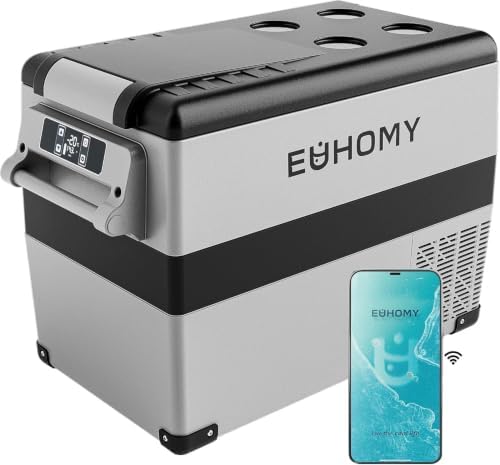
- Fast, Stable Cooling: Powered by an advanced compressor, this electric cooler cools from 68°F to 32°F in about 15 minute…
- Large Capacity for Every Trip: Built for more than a few cans, the spacious 48QT interior of this car refrigetaror holds…
- AC/DC Power Anywhere: Includes both 12/24V DC and 110/240V AC adapters, so you can power this 12 volt refrigerator in SU…
Jumping to 48 quarts changes what the refrigerator is for. This is a unit for drivers who want to carry food for the long stretch rather than for the next couple of days. That capacity can hold bulk groceries, larger drink supplies, and the kind of meal prep that saves money over weeks of truck stop eating.
The price of that capacity is space and weight. A refrigerator this size needs a dedicated spot, and moving it in and out of the cab is a two-handed job rather than a casual carry. It also means more volume to cool, which matters if you tend to leave it half empty. It is a stronger choice for owner-operators or team drivers with real floor room and a routine that justifies filling it, and a weaker one for anyone working with a compact sleeper.
BougeRV 23 Quart 12V Refrigerator (Black)

- What You Get: The CR22 12V refrigerator comes with a 2-year Tech Support. If you have any questions about the product, p…
- Fast Cooling Down to 32℉: With Compressor refrigeration technology, this 12v car refrigerator could achieve 15 min fast …
- 60W Low Power Consumption: With ECO energy saving mode, this 23 Qt portable refrigerator’s operating power is about 45W….
The BougeRV 23 Quart lands in the practical middle. It gives a bit more room than the smallest units, enough for a few days of meals plus drinks without overwhelming a typical sleeper, while still being manageable to move. The listing identifies it as a compressor model, which is the more relevant cooling approach for a hot cab than thermoelectric alternatives.
Its strength is balance. It is the kind of unit that suits a driver who is not sure which extreme fits their routine and wants a setup that works for both short and medium runs. Its compromise is that it does not specialize: it is not the smallest option, and it does not offer the sort of storage a week long run calls for. For many solo drivers, though, that middle ground is exactly the point.
ICECO VL60 ProS

- Reversible Lid – The lid is designed to be open from each side without reassembly, or can be completely taken off for ea…
- Convenient Plugs – 12/24V DC ports are installed on both sides of the fridge. 2 USB outlets designed for charging mobile…
- Humanized Design – Designed with drain hole, waterproof baffle, LED lights and removable handles. The package also comes…
The VL60 ProS belongs to the 60 liter class, roughly 63 quarts, which places it at the high end of this group in capacity. That is a lot of refrigerator for a sleeper, and it is better understood as a fixed installation than as something you carry around. Drivers who go with a unit like this are usually planning around it: a spot is reserved, the unit is secured, and the cab is organized around having plenty of cold storage available.
The upside is freedom from frequent grocery stops. A driver who wants to carry fresh food for an extended run, or who shares the truck with a partner, gets the most headroom here. The downsides are clear too. It takes meaningful floor space, it is heavy to relocate, and the draw on the electrical system needs more attention in a truck that sits shut down overnight. It is a better fit for heavy-use setups than for anyone who values portability. Because specifications vary, check the current listing for exact dimensions and power details before committing.
SetPower FC20 20L / 21QT Portable Refrigerator
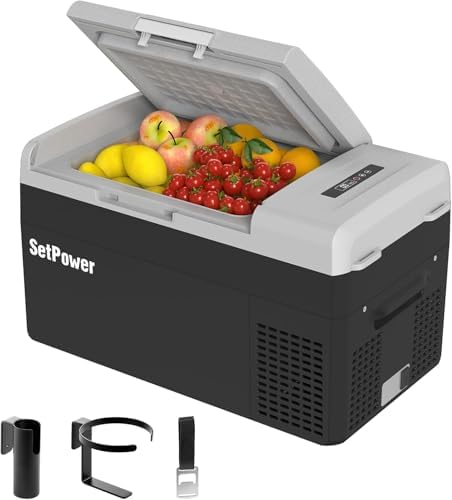
- Support And Service: Setpower 12 volt refrigerator comes with 1 year tech support on the compressor and the other parts….
- Compact Capacity And 42dB Low Noise: Setpower FC20 12 volt electric cooler has a compact capacity of 21 quart (20 Liter)…
- 3 Level Voltage Battery Protection: Setpower portable fridge provide three (H/M/L) level for battery protection to preve…
At 20 liters, or about 21 quarts, the SetPower FC20 sits close to the EUHOMY 19QT in size, and the comparison between them is more about handling than capacity. As a portable refrigerator for a semi truck, its appeal is flexibility: small enough to move between the cab and elsewhere, and large enough to carry a few meals and drinks.
It suits drivers who treat the refrigerator as a travel companion rather than a permanent fixture, taking it into a hotel on a layover, or carrying it between the truck and home. The compromise is the same one that applies to any compact unit: restocking has to be regular, and it will not support a long self-sufficient run. For drivers who value being able to grab it and go, that is an acceptable trade.
Real-World Comparison
The five products divide most clearly by how you answer one question: do you want a refrigerator that disappears into the cab or one that anchors it?
The EUHOMY 19QT and SetPower FC20 are the closest pair. Both are compact, both favor drivers who restock often, and both keep the cab walkable. The practical difference is in how you plan to use them: the EUHOMY’s AC and DC flexibility makes it attractive if you want to pre-cool at home, while the SetPower’s portability emphasis suits a driver who moves the unit around more often. Neither will carry you through a long stretch without grocery stops.
The BougeRV 23 Quart sits between them and the larger units. It trades a small amount of the compacts’ tidiness for extra room, which can be the difference between a few days of food and five or six. For a solo driver on typical over the road schedules, it is often the most balanced of the five.
The EUHOMY 48QT and ICECO VL60 ProS represent a different philosophy altogether. They favor drivers who want to stock up and stay out. Between those two, the VL60 ProS is the larger commitment in space, while the 48QT is more approachable if you want serious capacity without going to the extreme. In both cases, convenience of movement is sacrificed for storage, and the electrical load deserves more thought.
If you picture a spectrum, it runs from daily portability at one end to long haul self-sufficiency at the other. Space and power consumption rise as you move along it, and flexibility falls.
Setup and Usage Tips
Position it where you can reach it. A refrigerator you have to climb around to open will be used less. A spot near the bunk edge or against a cab wall often works, as long as it does not block the path.
Secure it every time. Loose appliances become projectiles under hard braking. Use straps, tie-downs, or a purpose built mount, and make sure the lid latches hold.
Leave room for airflow. Compressor units need to shed heat. Pressing a refrigerator tight against a wall, bedding, or luggage can force it to work harder and shorten its life. Check the manual for recommended clearances.
Pre-cool when possible. If your unit supports AC power, start it at home or in a hotel and load pre-chilled food. This reduces the work the unit has to do once you are on the road.
Manage your electrical load. If you sleep with the engine off, learn how your refrigerator’s battery protection works and set it conservatively. Pairing it with an auxiliary power setup can help, and the broader gear discussion in choosing the right gear for long haul trucking covers the thinking behind these decisions.
Keep it full, but not packed. A well-filled refrigerator holds temperature better, though stuffing it solid blocks air movement inside. Use containers that stack neatly and keep frequently used items near the top.
Clean it before problems start. Wipe spills quickly, air the unit out between trips, and leave the lid slightly open during storage to prevent odors. Basic upkeep is easier than a deep clean after a leak.
Think about the cab as a system. Airflow, cooling, and clutter all interact. A good cab fan helps with heat, which in turn helps the refrigerator, and the guide to sleeper fans for long haul truck drivers is worth a look if summer heat is a recurring problem.
Recommendations by Driver Type
Limited sleeper space: the EUHOMY 19QT or SetPower FC20. Both keep the footprint small, with the EUHOMY leaning toward flexible power sources and the SetPower leaning toward easy movement.
Drivers who want a flexible, everyday setup: the BougeRV 23 Quart. It offers more room than the compact pair without crossing into bulky territory.
Drivers who spend many days on the road: the BougeRV 23 Quart for solo drivers with moderate restocking, or the EUHOMY 48QT for those who want to stretch time between grocery stops.
Drivers who prioritize capacity or carry lots of food and drinks: the EUHOMY 48QT, or the ICECO VL60 ProS if floor space and power allow.
Drivers who want easier portability: the SetPower FC20 or EUHOMY 19QT, both easier to carry than the larger models.
For more on building out a cab around choices like these, how to choose the right accessories for a long haul truck helps keep the whole setup coherent.
Final Thoughts
Choosing among 12V refrigerators for semi trucks comes down to how you actually live and work inside the cab. A solo driver who restocks every few days can usually get by with a compact unit in the 18- to 25-quart range, while longer runs, team driving, or regular grocery storage make a 45-quart or larger refrigerator more practical. The larger the refrigerator, however, the more space it claims inside the sleeper.
Power deserves just as much attention as capacity. A compressor refrigerator cycles on and off rather than running continuously, but it can still draw power during long periods with the engine shut down. Check the refrigerator’s low-voltage protection settings and consider how your truck is powered overnight before connecting it to a starting-battery system.
For a sleeper cab that gets hot in summer, a compressor refrigerator is generally more practical than a thermoelectric cooler because it is designed to maintain a target temperature rather than simply cool a limited amount below ambient temperature. Placement matters too. Keep the refrigerator somewhere that is easy to reach, properly ventilated, and securely held in place without blocking the walkway or interfering with bedding and other gear.
The five models in this guide serve different priorities. The EUHOMY 19QT and SetPower FC20 make the most sense when compact size and portability come first. The BougeRV 23 Quart offers a useful middle ground for drivers who want more room without committing to a large unit. The EUHOMY 48QT and ICECO VL60 ProS are better suited to drivers who spend longer stretches on the road and want enough capacity to carry a more substantial supply of food.
Some drivers may also value the ability to use the refrigerator away from the truck. Models that support both DC and AC power can be pre-cooled at home or in a hotel before a run, adding flexibility to the setup.
Ultimately, the right refrigerator is not the largest one you can fit in the sleeper or the one with the longest feature list. It is the one that matches your food routine, available space, and power setup without creating another problem to manage on the road.