Truck Maintenance Tools for Long Haul Drivers
Practical tools for diagnosing problems, checking tires, testing electrical systems, and handling routine truck maintenance on long haul routes.

Truck maintenance tools matter most when you’re hundreds of miles from home and something on the dashboard suddenly doesn’t look right. A dash light comes on somewhere in the middle of Nebraska, and the question isn’t whether something is wrong. It’s whether you can find out what, and whether it’s a “keep rolling to the next exit” problem or a “pull over now” problem. A small, well-chosen set won’t turn the cab into a repair shop. It gives you information, and information is what separates a calm decision from an expensive guess.
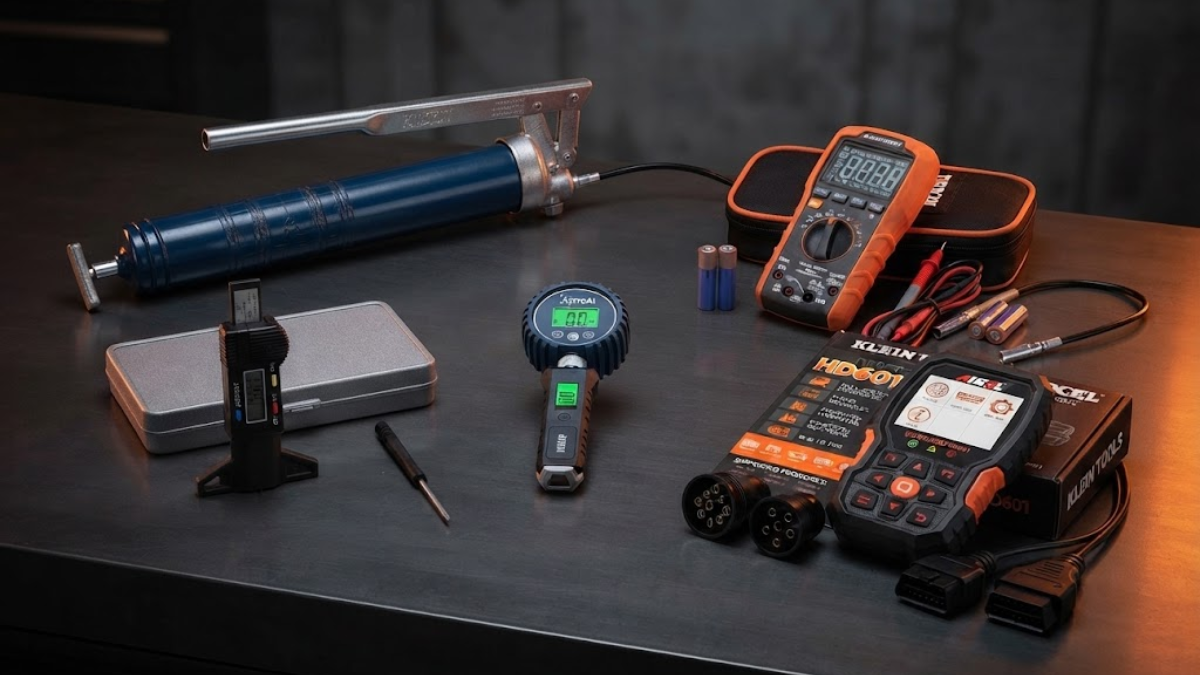
Cab space is limited, and most drivers have learned the hard way that a toolbox full of rarely used equipment is just dead weight. The tools below were picked for a narrower reason: each one answers a different question you might face on the road. What is the truck telling me? Is this circuit actually live? Are my tires where they should be? How much rubber is left? Is anything dry that should be greased?
If you’re still building out the rest of your kit, the wider picture is covered in our guide to choosing gear for long haul trucking. This piece stays on maintenance, diagnosis, and measurement.
Quick Comparison of the Five Tools
| Product | Main Use | Key Specification | Why It Is Useful on the Road |
|---|---|---|---|
| ANCEL HD601 Heavy Duty Truck Scanner | Reading fault codes and live data | Supports SAE J1939 and J1708/J1587; 9–36V | Gives you a starting point when a warning light appears |
| Klein Tools MM720 Digital Multimeter | Electrical testing | Auto-ranging True RMS; AC/DC voltage up to 1000V; CAT IV 600V | Helps confirm voltage, continuity, and resistance instead of guessing |
| AstroAI Heavy Duty Digital Tire Pressure Gauge | Tire pressure checks | 0–230 PSI range; backlit display | Readable in low light at a truck stop or roadside |
| GODESON Digital Tire Tread Depth Gauge | Measuring tread depth | Reads in 32nds, inches, and mm; up to 1 inch | Puts a number on wear instead of relying on eyeballing |
| Lincoln 1147 Lever-Action Grease Gun | Routine lubrication | 18-inch whip hose; coupler included | Lets you handle your own greasing without hunting for a shop |
Our Take Before You Buy
These five weren’t chosen to form a ranked shortlist, and none of them is meant to outrank the others. They cover five different jobs: diagnosis, electrical testing, pressure, tread wear, and lubrication. Most of them don’t overlap, which is the point. A scanner can’t tell you how much tread is left, and a tread gauge can’t tell you why a sensor is throwing a code.
The group also splits into two kinds of tools. The tire gauges are the sort of thing that fits into a routine walk-around, so they make sense for nearly anyone who wants a firmer grip on heavy-duty truck maintenance. The scanner, multimeter, and grease gun are more dependent on who is holding them. An owner-operator who does their own repairs and servicing will likely get real use out of all three. A company driver whose fleet handles diagnostics and lubrication may reasonably skip them, and there’s no shame in that. Carrying a tool you won’t use, or don’t yet know how to use safely, is just extra weight.
My advice is to read the sections below with your own situation in mind: what you’re responsible for, what the shop handles, and how much room you have. Buy the tools that match the work you actually do, not the ones that look good in a list.
ANCEL HD601 Heavy Duty Truck Scanner: Hearing What the Truck Is Trying to Say

- 【Extensive Compatibility】HD601 heavy duty truck scanner supports 12V & 24V commercial vehicles and all major truck model…
- 【 Full System Diagnostic】HD601 Diesel Scanner supports all system scans of heavy trucks compliant with standard protocol…
- 【Enhanced Diesel OBD Scanner】The HD601 Diesel OBD Scanner offers unparalleled diagnostic capabilities for heavy-duty tru…
Modern heavy-duty trucks log a lot of information, and most of it stays hidden until a warning lamp forces the issue. The ANCEL HD601 is a handheld scanner built for commercial vehicles. It has a 2.8-inch LCD and runs on 9–36V, which matters because heavy-duty systems don’t all share the same voltage. It connects through the main OBDII connector, with support for Diesel 6-pin and 9-pin connections, and it supports the SAE J1939 and SAE J1708/J1587 protocols that many heavy-duty vehicles use.
In practice, it can read fault codes, clear standard fault codes, retrieve vehicle information, and display freeze-frame and live data. Freeze-frame data is worth understanding. It captures conditions at the moment a fault was recorded, which can tell you whether a problem showed up under load, at idle, or while cold.
The value of a scanner on a long route is mostly about narrowing things down. A code isn’t a diagnosis, but it can turn “something’s off” into a specific system to look at. That helps when you’re describing the problem to a shop over the phone, and it can save you from paying for a tow when the issue turns out to be minor.
There are limits. ANCEL’s documentation says to check compatibility for your specific vehicle, and that’s advice to follow before you buy. The HD601 is also not a replacement for professional diagnostics. A dealer-level tool and a trained technician can see and do things a handheld scanner can’t. Treat it as a first look, not the final word, and be careful about clearing codes without understanding what caused them.
A code might point toward a wiring or sensor circuit, though, and that’s where a different kind of tool comes in.
Klein Tools MM720 Digital Multimeter: Checking the Electrical Side
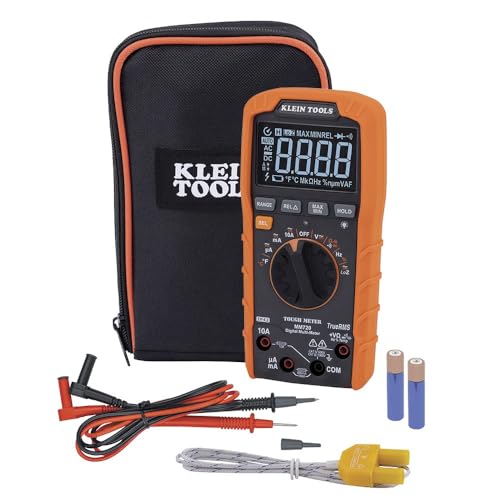
- VERSATILE FUNCTIONALITY: Measures AC/DC voltage up to 1000V, 10A AC/DC current, 60MΩ resistance; additional features inc…
- LOW IMPEDANCE MODE: LoZ mode for identifying and eliminating ghost or stray voltages
- REVERSE-CONTRAST DISPLAY: Large, high-visibility reverse-contrast LCD ensures improved readability in all lighting condi…
Electrical faults are among the most irritating problems because they’re invisible. A light goes out, a connector corrodes, a ground gets loose, and the symptom shows up somewhere unrelated. A multimeter lets you stop guessing.
The Klein Tools MM720 is an auto-ranging True RMS digital multimeter. It measures AC and DC voltage up to 1000V, AC and DC current up to 10A, and resistance up to 60 MOhms. It also covers temperature, capacitance, frequency, diodes, and continuity. One feature worth noting is the Low Impedance (LoZ) mode, which helps when testing circuits that can show misleading readings on a standard high-impedance meter.
To be clear, the MM720 isn’t a truck-only instrument. It’s a professional-grade electrical testing tool with a CAT IV 600V safety rating, and that broader design is part of its appeal. On a truck, the practical uses are the basics: checking battery and circuit voltage, confirming whether a wire has continuity, and testing a suspect connection. It’s designed to withstand a 6.6-foot (2 m) drop and carries an IP42 rating, which suggests it was built for rough handling, though that’s no reason to be careless with it. The reverse-contrast display with automatic backlight control also helps when you’re working in a dim spot.
The honest caveat is that a meter is only as useful as the person holding it. Truck electrical testing requires understanding what you’re measuring and doing it safely. If you’re not confident, it’s better to learn the basics first or leave the work to someone qualified. For drivers who are comfortable with it, a good meter pairs well with the items in a roadside emergency kit.
AstroAI Heavy Duty Digital Tire Pressure Gauge: The Routine Check

- Enhanced Visibility in Low Light: Features a green backlit LCD screen and integrated flashlight, allowing for clear read…
- Durable & Heavy-Duty Design: Constructed from robust stainless steel, specially engineered for RV and truck use. Helps m…
- Nozzle easily forms a seal with the valve stem giving quick and accurate readings in 0.1 increments; 4 settings with lon…
Tire pressure checks are about as unglamorous as maintenance gets, and they matter every single day. Pressure affects wear, handling, and heat, so the habit is worth building even if it feels tedious.
The AstroAI gauge reads from 0 to 230 PSI and is designed for applications that include trucks and RVs. That range is the main reason it belongs on this list, since many standard automotive gauges aren’t made for heavy-duty tire pressures. It has a digital display, a backlight, and an integrated light, which is handy at 5 a.m. in a poorly lit lot. It’s also built with heavy-duty construction, which suits a tool that gets tossed in a door pocket.
A digital readout removes some of the squinting and interpretation you get with analog dials. Still, a gauge is only a measuring device. It doesn’t guarantee tire safety, prevent blowouts, or substitute for a proper walk-around inspection. Use it alongside your visual checks, and compare readings against the pressure specified for your tires and load rather than a number you remember from somewhere else. Gauges can also differ from one another, so using the same one consistently makes your readings easier to compare over time.
GODESON Digital Tire Tread Depth Gauge: Putting a Number on Wear
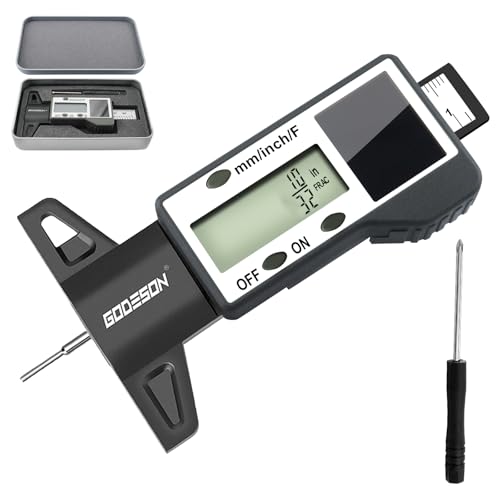
- 1.MULTI-MODE TIRE DEPTH GAUGE TOOL:Easily switch between MM, inch, and 32nds modes to fit various standards and needs
- 2.BATTERY & SOLAR POWER:Dual energy source design keeps your tire thread gauge always ready, in the garage or on the go
- 3.EASY OPERATION:Simple interface allows for quick measurements—Align the probe flush with the base and press ZERO, then…
Pressure tells you about the air in the tire. Tread depth tells you about what’s left of the tire itself, and that’s harder to judge by eye. Wear can be uneven, and a tire that looks acceptable from the driver’s side may look different from the other.
The GODESON digital gauge reads in 32nds of an inch, inches, or millimeters, with a measurement range up to 1 inch (25.4 mm). It’s designed for cars, trucks, motorcycles, and SUVs, and it’s compact enough to disappear into a pocket or door pouch. It uses a hybrid solar and battery power design, which is a small convenience if you don’t want to think about replacing a coin cell.
The real benefit is consistency. Measuring the same tires at regular intervals lets you see wear patterns develop, which can point toward alignment, inflation, or suspension issues worth investigating. As for what number is acceptable, that depends on the tire position, the applicable requirements, and the tire’s own specifications and condition, so check those instead of relying on a rule of thumb. A gauge gives you the measurement, not the verdict.
If you’re also thinking about add-ons and fittings for the truck, our piece on choosing the right accessories for a long-haul truck covers a different side of the planning.
Lincoln 1147 Lever-Action Manual Grease Gun: For Those Who Do Their Own Lubrication
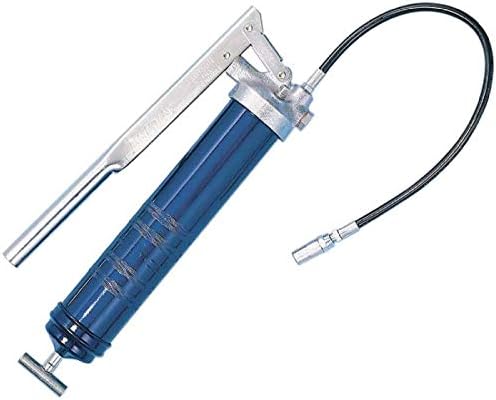
- HIGH-PRESSURE LEVER-ACTION: The Lincoln 1147 Grease Gun delivers consistent, high-pressure lubrication with it is precis…
- DURABLE AND RELIABLE CONSTRUCTION: Built to last with a cast pump head and premium dual lip follower, this grease gun wi…
- 18-INCH WHIP HOSE AND COUPLER: Equipped with an 18-inch whip hose and coupler, the Lincoln 1147 allows for easy access t…
Not every driver needs a grease gun. If your lubrication is handled at a shop or by a fleet maintenance team, this one may never earn a spot in your truck. But owner-operators who service their own trucks know that truck lubrication is the kind of job that’s easy to postpone and costly to neglect.
The Lincoln 1147 is a manual lever-action grease gun with an 18-inch whip hose and a coupler included. It has a heavy-duty pump head and heavy-duty follower springs, and the lever mechanism is described as jam-resistant. It can be loaded with cartridges or filled in bulk, and it’s suited to automotive, industrial, and agricultural lubrication work. That flexibility is part of why it makes sense in a mixed-use setup.
The long whip hose helps with fittings in awkward spots, and a manual gun needs no power source, so it works anywhere you can safely park and get under the truck. The tradeoffs are size and mess. It takes up room and it’s not a clean tool, so it needs a proper spot in a storage box rather than loose in the cab. And as with everything here, using it correctly depends on knowing your truck’s lubrication points and the grease it calls for.
Final Thoughts
The useful lesson here isn’t that every truck needs five more items. It’s that good long-haul truck maintenance starts with knowing your own situation. Your truck’s age and systems, your comfort with hands-on work, what your fleet or shop already handles, and how much space you can spare all shape what’s worth carrying.
A newer driver might start with the measuring tools, since pressure and tread checks build good inspection habits without requiring deep mechanical knowledge. Someone with more experience and full responsibility for the truck may add a scanner, a meter, and a grease gun as their skills and routine allow. And a driver who never touches a wrench can still benefit from simply understanding what these tools do, since it makes conversations with technicians sharper.
Buy for the work you actually do, learn each tool before you need it in a hurry, and leave the rest to professionals. Fewer, better-understood tools will serve you better than a bag full of gear you’re unsure how to use. For help deciding what belongs in the cab and what should be stored elsewhere, our guide to cab essentials for long-haul drivers is a good next read.
FAQ
1. What are the most useful truck maintenance tools for long-haul routes?
That depends on how much work you do yourself. Tools that measure and diagnose, such as a scanner, tire pressure gauge, tread depth gauge, and multimeter, tend to earn their space because they help you make decisions early. A grease gun is more situational and mainly suits drivers who handle routine lubrication on their own.
2. Can a truck scanner replace a visit to a shop?
No. A scanner can read codes and show live data, which gives you a starting point, but it can’t replace the equipment and expertise of a professional shop. It’s best used to understand what’s happening and to communicate clearly with a technician.
3. Do I need a multimeter if I’m not an electrician?
Not necessarily. A multimeter is most useful if you understand basic electrical testing and can use it safely. If you’re unsure, it’s reasonable to learn the fundamentals first or let a qualified person handle electrical diagnosis.
4. How often should I check tire pressure and tread depth?
Many drivers check pressure as part of their regular inspection routine, and measuring tread depth periodically helps you spot uneven wear. Follow your fleet’s procedures, tire manufacturer guidance, and any applicable requirements for specific intervals and acceptable measurements.
5. Should I carry my own grease gun?
Only if you do your own lubrication. If a shop or fleet handles it, a grease gun adds weight and clutter without much benefit. If you service the truck yourself, a manual gun gives you the flexibility to lubricate when and where it’s needed.