Diesel Engine Additives for Heavy Duty Trucks
A Practical Guide to Diesel Fuel Treatments, Injector Cleaners, and Engine Oil Additives for Long Haul Trucks

An owner operator is a few days from another long run. There is a maintenance schedule taped inside the cab and a mental list of everything that could go wrong between here and the delivery window. Fuel is the biggest recurring cost, and an unplanned day in a shop is the most expensive single event. Between those two worries sits a shelf of bottles promising cleaner injectors, better lubrication, higher cetane, and smoother running. Whether diesel engine additives deserve a place in a working truck’s routine is harder to answer than the labels suggest.
Part of the difficulty is that the category covers products that do very different jobs. A bottle poured into the fuel tank is meant to act on the fuel and the fuel system. A bottle poured into the crankcase acts on engine oil and the metal surfaces that oil protects. Each has its own dosing logic, its own limits, and its own way of causing trouble when misused. Commercial trucking adds large tanks, hundreds of gallons of fuel a week, emissions equipment that reacts badly to neglect, and engine builders with firm opinions about what belongs inside their engines. Pouring something in is the easy part. Knowing whether it should go in at all takes more thought.
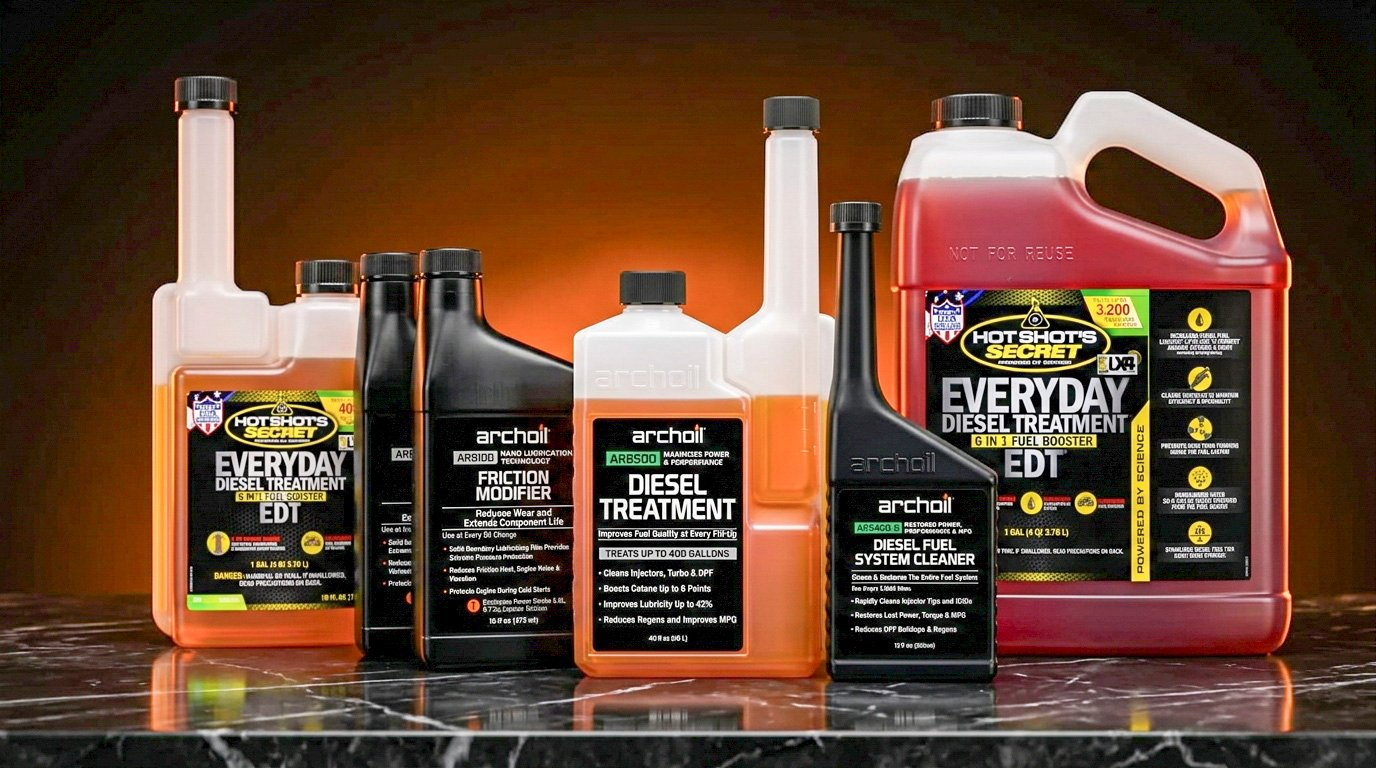
This guide explains how the main additive types differ and what each can reasonably be expected to do. It then looks at five specific products: two package sizes of Hot Shot’s Secret Everyday Diesel Treatment, Archoil’s AR6500 on its own and inside a two step kit, and Archoil’s AR9100 engine oil friction modifier. They are not five competing answers to one question, and the sections below treat them that way.
Our Take
No single additive suits every commercial diesel engine, and the products here prove it. A routine fuel treatment, a concentrated cleaner, a gallon jug sized for heavy use, and a crankcase friction modifier each solve a different problem. Comparing them on a single scale would be like comparing a tire gauge to a grease gun. Part of choosing well is knowing which category your situation belongs to. Often the answer is none of them.
Preventive use is where additives have the most credible role. A routine fuel treatment added at fill ups is aimed at the conditions that cause trouble over many thousands of miles: marginal fuel lubricity, low cetane fuel, slow deposit formation, and moisture. That kind of use fits into diesel fuel system maintenance as a supplement to good filtration, quality fuel, and regular service. It does not replace any of them. A concentrated cleaner is a different tool, meant for occasional use when there is a reason to suspect fouling. Neither category repairs mechanical damage. An injector with worn internals, a high pressure pump that has lost its tolerances, a turbocharger with a failing bearing, or a DPF with a cracked substrate needs a technician and parts. An additive in that situation delays the diagnosis, and delay is the expensive part.
The engine manufacturer’s instructions come before any product label. Engine builders publish fuel and oil requirements, and some have specific positions on aftermarket additives. Before adding anything, check what your engine documentation says, confirm the product claims compatibility with your fuel system and aftertreatment equipment, and consider what your warranty terms say if the truck is still covered. A manufacturer stating that a product is suitable for diesel engines in general is not the same as an engine maker approving it for yours.
In practical terms, there are a handful of things worth weighing before a bottle goes in the cart:
- Treatment concentration. This is how many ounces per gallon the label calls for, which determines how long a container lasts on a truck with large tanks.
- Dosage accuracy. Measure rather than eyeball, because a missed ratio in either direction defeats the point.
- Intended purpose. Maintenance, cleaning, or lubrication each call for a different product type.
- Documentation. Look for clear instructions, stated limits, and technical data that can be traced to a test method.
- Added effort. Adding a step to the routine has to be justified by a benefit that is worth the extra handling.
The claims deserve measured skepticism. Fuel economy gains, horsepower gains, and fewer regenerations appear in marketing copy across the category, and they are the hardest claims to verify on a particular truck. Nothing in this guide promises that an additive will improve mileage or prevent a repair bill. Decide what you want the product to do, confirm that it was designed for that job, and be honest about whether it earns a place in the routine. Long haul work already involves enough equipment decisions, from choosing the right gear for long haul trucking to what lives in the toolbox, that every addition should have a reason.
Understanding Diesel Engine Additives
Fuel Treatments and Engine Oil Additives
The first distinction matters more than any other. A fuel treatment mixes into the diesel in the tank and travels through the lift pump, filters, high pressure pump, rails, and injectors before the fuel burns. Its chemistry is meant to improve something about the fuel itself, such as lubricity, ignition quality, or deposit tendency, or to clean surfaces the fuel touches on the way through. It stays in the fuel system and combustion chamber and gets consumed.
An engine oil additive stays in the crankcase. It circulates with the oil through the pump, galleries, bearings, valvetrain, and piston cooling jets, and it never comes into contact with the fuel system except through the occasional bit of fuel dilution. Its purpose is to change something about how the oil protects metal surfaces. Examples include friction behavior, wear protection, or resistance to breakdown.
These two types cannot be compared as though they do the same work. A friction modifier will do nothing for fuel lubricity, and a fuel cetane improver will do nothing for bearing wear. Using the wrong one for a given problem wastes money at best. At worst it adds an unnecessary chemical to a system whose designer did not account for it.
Diesel Fuel Lubricity
Diesel fuel does more than burn. In many fuel systems it is also the lubricant for the pump and injector components it flows through, particularly in high pressure designs where tolerances are extremely tight. When the industry moved to ultra low sulfur diesel, the refining process that removed sulfur also removed some of the compounds that naturally gave fuel its lubricating ability. Fuel specifications now include a lubricity limit, and diesel sold at US pumps is generally expected to meet it.
Lubricity is usually measured with a laboratory procedure such as ASTM D6079, which rubs a test ball against a plate in a fuel sample and measures the wear scar. A smaller scar indicates better lubricity. Manufacturers use this test to show what an additive does to a sample of base fuel, which is useful information. But a laboratory improvement is not a guarantee about your fuel in your truck. If the base fuel already meets the specification, the same additive may show a smaller practical benefit than it did on a deliberately poor fuel sample. When a manufacturer publishes a percentage improvement, it is worth asking what the starting fuel was.
Injector Deposits and Fuel System Cleaning
Modern injectors, especially in high pressure common rail systems, operate with extremely fine clearances and precisely shaped spray holes. Deposits forming on or inside an injector can alter spray pattern, delay needle movement, or affect fuel delivery. Detergent chemistry in fuel additives is designed to reduce deposit formation or help dissolve existing deposits, and that is a legitimate maintenance goal.
A cleaning product is not equivalent to repairing an injector. Deposits are one of several causes of poor injector behavior. Wear, cavitation erosion, a failed solenoid, a contaminated fuel supply, or an air leak on the suction side can produce similar symptoms. If the injector itself is mechanically damaged, no additive restores it. Proper diagnosis, such as cylinder balance testing, fuel pressure checks, and inspection of filters, tells you whether deposits are even a plausible cause before any money goes into a cleaner.
Cetane and Combustion
Cetane rating describes how readily diesel fuel ignites under compression. A higher cetane number means a shorter delay between injection and ignition, which generally supports easier starting, quieter combustion, and more complete burning, especially under cold or light load conditions. Pump diesel varies in cetane quality, and specifications set a minimum rather than a target.
A cetane improver raises the fuel’s cetane number by a measurable amount, depending on dose and base fuel. What that does for a particular engine is less predictable than the label suggests. Modern engines are calibrated around the fuel specification, and an engine already running comfortably on typical fuel may not show a meaningful change. Treat any claimed improvement in fuel economy or power as something that may or may not appear on your truck, and not as a promised outcome of a higher cetane number.
Cold Weather Protection
Fuel gelling and fuel filter icing are cold weather problems with their own chemistry, and they are separate from routine injector cleaning. Gelling happens when paraffin wax in the diesel crystallizes at low temperatures and clogs filters. Cold flow improvers are designed to address that. Icing occurs when dissolved or free water freezes at the filter, which calls for water management, not wax modification.
Not every general purpose treatment addresses either problem. Archoil’s published guidance states that its winter diesel product, AR6300, is the one intended for cold weather, which indicates that AR6500 is a different kind of product. Moisture dispersal, which Hot Shot’s Secret mentions for its treatment, is not the same as anti gel protection. If the route takes you through freezing temperatures, read the product’s own documentation for cold weather instructions and use a product built for that purpose where the label points you to one.
DPF, EGR, and Turbocharger Considerations
Many additive labels mention cleaner operation or help managing deposits in the exhaust and air systems. The reasoning is that cleaner combustion produces less soot, and soot is what loads a diesel particulate filter and fouls an EGR system. That reasoning is sound as far as it goes. The additive can influence what leaves the combustion chamber. It cannot take the place of the emissions system working correctly.
A DPF cleans itself through regeneration, which requires correct exhaust temperatures, sensor readings, and duty cycle. If regeneration is failing, running too often, or being interrupted, that points to something that needs diagnosing, such as a sensor, a dosing component, or an upstream fault. Ash accumulation is a different matter. Diesel particulate filter ash is noncombustible material derived primarily from lubricant oil and fuel additive sources. It differs from soot, which can be oxidized during appropriate regeneration. Ash is not removed by normal regeneration and requires the proper cleaning procedure when indicated. EGR coolers and valves clog from soot and oil mist and sometimes fail mechanically. Turbochargers, particularly variable geometry types, can stick from carbon or fail from bearing wear. A fuel additive may help limit one contributing factor. It does not fix a mechanical or electronic fault, nor can ordinary fuel treatment remove accumulated noncombustible ash or replace proper DPF servicing.
Engine Oil Additives
Engine oil is a carefully balanced package of base oil and additives, including detergents, dispersants, anti wear agents, and viscosity modifiers. Heavy duty engine oils are developed to meet service categories and engine builder specifications, and the engine maker’s recommendation on viscosity, specification, and drain interval is the foundation of the lubrication plan.
An aftermarket oil additive adds a further chemistry to that balance. A friction modifier, as an example, is meant to change how surfaces behave under boundary lubrication conditions. Whether it fits depends on the engine, the oil in the sump, and the manufacturer’s guidance. Important points to check include compatibility with your oil specification, dosage relative to the sump capacity, and whether the product’s own documentation covers heavy duty applications like yours. Using an additive does not justify stretching a drain interval or using a cheaper oil than the engine requires.
Five Products Worth a Closer Look
Hot Shot’s Secret Everyday Diesel Treatment, 16 oz

- EVERYDAY TREATMENT: Keep your diesel engine in top condition with our EDT that is designed to improve performance & main…
- BOOST FUEL ECONOMY: Enhance your vehicle performance with our diesel additive that boosts cetane levels by up to 7 point…
- FUEL INJECTOR CLEANER: Cleans both internal & external injector deposits, enhances the lubricity of fuel to safeguard th…
This is a routine fuel treatment meant to go into the tank at fill ups, not a one time cleaning event. The manufacturer describes it as covering injector cleanliness, fuel lubricity, cetane improvement, and moisture handling. Its published material cites a lubricity improvement of up to 26 percent and a cetane increase of up to 7 points. Those are the company’s maximum figures from its own testing, and they say nothing about what will happen in a specific truck on specific fuel.
Published guidance has been one ounce per 25 gallons of diesel, which lets a 16 ounce bottle treat up to 400 gallons at that ratio. The company also publishes a higher dose of two ounces per 25 gallons, which cuts the coverage in half. Which dose applies to which situation is a question for the current label, and more product is not automatically better. As an illustration, a truck taking on 150 gallons would use 6 ounces at the lower rate, so one bottle covers a little under three fill ups.
A smaller container has practical appeal for an individual owner operator. It is easy to store in a side box or the cab, and it is a quantity that can be measured without handling a large jug. That is a packaging advantage and says nothing about performance. Hot Shot’s Secret has sold this size in a squeeze bottle with a built in measuring chamber, so check what the listing shows and what is in the box.
An everyday treatment is built for maintenance. It is not the same as a concentrated cleaning product, and it is not meant to remove established fouling. It also does not restore worn injectors or repair a damaged fuel pump. If a truck already has a mechanical fuel system problem, the right step is diagnosis.
Before using it, confirm the dosage on the current label and read the manufacturer’s stated compatibility with DPF equipped and Tier 4 engines for yourself. Compare that with the engine maker’s fuel guidance. Compared with the Archoil products below, this one leans on a lower concentration per bottle and does not position itself around DPF or turbo deposit control.
Archoil AR6500 Diesel Treatment, 40 oz

- EASY USE AT EVERY FILL-UP: Add directly to the fuel tank at each fill-up. The long neck and measuring chamber make treat…
- FOR ALL DIESEL ENGINES: Suitable for use in all diesel vehicles and equipment – light-duty, heavy-duty, pickup, SUV, van…
- IMPROVES LUBRICITY (ASTM D6079): Tested to improve lubricity by 43% to help protect fuel system components, including we…
AR6500 is a standalone fuel treatment intended for regular use. Archoil describes it as suitable for diesel engines including heavy duty applications and modern high pressure common rail systems, and markets it for fuel lubricity, injector cleaning, cetane improvement, and control of deposits tied to the DPF and turbocharger.
The standard rate published by Archoil is one ounce per 10 gallons of diesel, which is where the 400 gallon coverage per 40.6 ounce bottle comes from. A second, higher rate of two ounces per 10 gallons is also published. At that standard ratio, a truck fueling 100 gallons uses about 10 ounces, so the bottle covers roughly four such fill ups. That is a higher concentration per gallon than the Hot Shot’s Secret ratio, which matters when comparing bottle sizes and treatment capacity.
The manufacturer’s published lubricity figure comes from ASTM D6079 testing. Archoil reports a wear scar of 614.5 microns on base fuel it describes as out of specification, and 347.5 microns after treatment. It calls that a 43 percent improvement. That is a clear claim with a stated test method, and it should be read for what it is. The improvement was measured on a poor sample, and a fuel that already meets the specification may show a smaller practical benefit. Archoil also states that AR6500 can raise cetane by up to eight points. These are manufacturer results and not guarantees about your truck.
Claims about injector cleanliness, DPF performance, turbo deposits, and fuel economy deserve the same caution. The company publishes fuel economy results from its own testing, but they are not a reason to expect a particular mpg change. As a regular treatment, AR6500 plays a different role than a concentrated cleaning procedure. It is a maintenance dose, intended to be used at every fill up.
Dosing accuracy and a clean measuring system are the practical points. A dirty measuring cup can introduce contamination into a system that is intolerant of it. Check the label, confirm that the product’s compatibility statements fit your fuel and emissions systems, and note that it is not a cold weather product. This standalone bottle differs from the kit described next only in that the kit adds a second, concentrated cleaning component.
Archoil Diesel Fuel System Kit, AR6400-D plus AR6500

- TWO-STEP FUEL SYSTEM RESET: Includes AR6400-D Diesel Fuel System Cleaner + AR6500 Diesel Treatment (40 oz) for a complet…
- HOW IT WORKS: Use AR6400-D first for a deep clean (12 oz treats 30-40 gallons), then use AR6500 at every fill-up for ong…
- FOR ALL DIESEL ENGINES: Suitable for all diesel vehicles and equipment, including modern HPCR systems
The kit pairs two products. AR6400-D is a 12 ounce concentrated fuel system cleaner, and AR6500 is the same 40 ounce diesel treatment covered above. It is not a different or upgraded formula. That means the real question is whether the added AR6400-D bottle justifies choosing the kit over AR6500 alone.
The intended approach is two steps. AR6400-D is the cleaning step, and AR6500 follows as the ongoing treatment. Archoil’s current product information states that one 12 ounce bottle treats 40 gallons of diesel. The company’s own pages describe the schedule in two ways. One says to use AR6400-D every 5,000 miles. Another says to use it once for a deep clean and then follow with AR6500 at each fill up. Those are different maintenance philosophies, and the label on the bottle you receive is the authority.
The logic of splitting the work between two products is straightforward. A concentrated detergent can act more aggressively than a treatment designed for continuous use, so it makes sense to reserve it for occasional use and keep the daily dose gentler. The sequence and the dosage matter. Add each product as the label describes, in the order the label describes, and do not stack additional products on the assumption that more chemistry means a cleaner result.
There is a practical question the kit raises for a Class 8 truck. A 12 ounce bottle is sized for about 40 gallons of fuel, while a tractor commonly carries well over 100 gallons across its tanks. The treatment quantity must be matched to the amount of fuel being treated using the current label’s instructions. If the total fuel volume exceeds the quantity a bottle is designed to treat, one bottle will not cover all of it. Before using it, find out how Archoil intends the dose to be applied to a larger tank setup instead of improvising a ratio.
The kit makes the most sense for a truck with an unknown fuel history, such as a used purchase, or for an operator who wants a documented cleaning step before starting regular treatment. It does not make sense as a reflex purchase for a truck running well. Archoil describes AR6400-D as formulated to remove soot and carbon from the DPF, which is a manufacturer claim and not a substitute for correct regeneration or filter service. A truck with persistent performance problems should be diagnosed. Repeated rounds of cleaner can hide a developing fault, and no cleaning product corrects injector or pump damage.
Archoil AR9100 Friction Modifier, Two 16 oz Bottles
- HEUI STICTION FIX (6.0L & 7.3L Power Stroke): Eliminates injector stiction that causes cold start misfires, rough idle, …
- NOT JUST FOR POWER STROKE: Suitable for all diesel and gasoline engines – ideal for owners who want anti-wear protection…
- TREAT RATE: Engines, limited slip differentials and motorcycles: 1.2 oz per quart of conventional or synthetic oil. Gear…
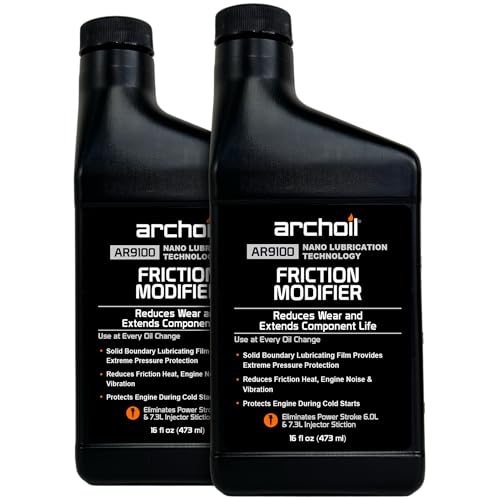
AR9100 is an engine oil additive and does not belong in the fuel tank. It is not a fuel tank injector cleaner like AR6400-D, a fuel lubricity treatment, or a DPF cleaner, and it does not replace the oil your engine requires. Archoil markets it for friction reduction, anti wear protection, and smoother operation, and describes its chemistry as a nanoborate friction modifier carried by organic esters.
The listing leans heavily on 6.0L and 7.3L Power Stroke applications. Those engines use hydraulically actuated injectors that run on engine oil pressure, and Archoil’s pitch for them centers on stiction, a sticking condition in the injector valves. That is a different mechanism involving engine oil, and it must not be generalized to all diesel injectors. Those are light duty pickup and Super Duty engines, not Class 8 power. The application does not establish suitability for a Detroit, Cummins, Paccar, or Volvo engine in a tractor.
The dosage arithmetic shows why caution is needed. Archoil’s published product guidance specifically identifies a 16 ounce treatment for Power Stroke applications, while its general engine treatment guidance uses a rate of 1.2 ounces per quart of oil. Many Class 8 engines hold well over 30 quarts. At 1.2 ounces per quart, a 32 ounce two bottle pack treats roughly 26 quarts, so it may not cover a large sump at the published rate. Archoil’s published examples center on smaller engines, and I found no documentation establishing suitability for a particular heavy duty engine or oil specification.
This is where engine manufacturer guidance becomes decisive. Cummins has published technical guidance stating that it does not recommend the use of aftermarket oil additives. Cummins explains that present high quality fully additive engine lubricating oils are very sophisticated, with precise amounts of additives blended into the lubricating oil to meet stringent requirements. Aftermarket lubricating oil additives are not necessary to enhance engine oil performance and in some cases can reduce the finished oil’s ability to protect the engine. That position concerns engine oil additives specifically, not diesel fuel additives. Readers operating Cummins engines must follow Cummins guidance and must not be encouraged to use AR9100 contrary to their engine manufacturer’s recommendations. This product should not be presented as a universally suitable choice for Class 8 semi trucks, and the distinction between the manufacturer’s marketing claims and verified approval for a specific commercial engine and oil specification must be kept clear.
Before using it, confirm the product for your exact engine, check it against the oil specification in the crankcase, and calculate the dose from the actual sump capacity. Do not assume that mixing additives is harmless. Archoil also claims extended drain intervals, but your drain interval comes from the engine maker and oil analysis, not an additive claim. This product addresses a different system from the other four and should be judged on its own terms.
Hot Shot’s Secret Everyday Diesel Treatment, 1 Gallon

- EVERYDAY TREATMENT: Keep your diesel engine in top condition with our EDT that is designed to improve performance & main…
- BOOST FUEL ECONOMY: Enhance your vehicle performance with our diesel additive that boosts cetane levels by up to 7 point…
- FUEL INJECTOR CLEANER: Cleans both internal & external injector deposits, enhances the lubricity of fuel to safeguard th…
This is the same Everyday Diesel Treatment as the 16 ounce bottle, in a 128 ounce container. There is no stronger formula or different performance profile here. The manufacturer’s description of injector cleanliness, fuel lubricity, cetane improvement, and ongoing fuel system maintenance carries over unchanged. At the published ratio of one ounce per 25 gallons, a gallon treats up to 3,200 gallons of diesel.
Container size becomes a logistics question. A truck fueling about 300 gallons a week would use 12 ounces at the lower rate, so a gallon lasts a little over ten weeks. That suits a high consumption operation or a fleet with a dispensing procedure. A single driver who fuels less may not finish the container before wanting to replace it, so the value depends on how much fuel you will run through in a realistic period and how the product is stored. Whether the gallon is cheaper per treated gallon depends on current purchase terms, which change, so run the numbers at the time you buy instead of assuming.
Storage and measurement deserve more attention with a large container. Keep it sealed, labeled, and out of heat and direct sun. Use a clean, dedicated measuring device, and check whether the listing includes a pump or measuring cup. Pouring one ounce from a gallon jug by guesswork is how dosing errors happen. In a fleet setting, a written dispensing procedure and a record of who added what cuts down on mistakes.
The same boundaries apply as with the smaller bottle. It is a routine treatment, not a repair, and it does not restore worn injectors or fix a failing pump. The reader choosing between this and the 16 ounce bottle is deciding about packaging, not about chemistry.
Choosing by Maintenance Objective
These five products fall into four categories, and the first step is to match the category to the objective. Regular fuel conditioning means a treatment used at fill ups to maintain the fuel and the system. A concentrated cleaning step is an occasional, deliberate procedure for a truck with a reason to suspect fouling. A larger package for frequent use is a logistics decision about the same treatment. An engine oil friction modifier belongs to the lubrication plan and has nothing to do with the fuel tank.
They are not direct substitutes. The 16 ounce and gallon Hot Shot’s Secret products are the same product in two sizes. The Archoil kit already contains the AR6500 covered separately. AR9100 sits apart from all of them. The reasonable question is which of these jobs, if any, your truck needs done.
A few practical points apply across the board. Read the current label for dosage, because treatment rates differ from product to product and can change. Decide on a frequency you can follow consistently. Keep the documentation, including the label and any technical data sheet, with the truck’s maintenance records. Check what the engine maker says before adding anything. Confirm the product’s stated compatibility with your emissions equipment. Store containers sealed and labeled, and measure every dose.
Symptoms need extra care. Hard starting, reduced power, rough running, higher fuel consumption, warning lights, and unusually frequent regenerations each have several possible causes. They include failing injectors, a restricted filter, an air leak, a sensor fault, a boost leak, a clogged EGR, a failing turbo, or a DPF problem. An additive is a poor way to find out which one you have. A diagnostic scan and a mechanic’s inspection are the better first step, and a well chosen set of truck maintenance tools for long haul drivers can help you catch early signs before they turn into a breakdown. If the fault is real, a bottle will not fix it. If the fault is not real, the bottle is probably unnecessary.
Final Thoughts on Diesel Engine Additives
Long haul operation rewards planning more than improvisation. The trucks that stay on the road are usually the ones maintained against a schedule, fueled from sources the driver trusts, and inspected before small problems become large ones. Additives can have a place in that approach, as a measured supplement to the basics and not as a shortcut around them.
Starting with the engine manufacturer’s requirements and a clearly defined objective protects you from the most common mistake, which is assuming more additives mean better performance. A routine fuel treatment, a concentrated cleaner, and a crankcase friction modifier answer three different questions. Fuel products act on the fuel and the fuel system. Oil products act on the lubrication system. They cannot stand in for one another, and combining them without understanding each one adds variables to a system that is already complicated.
The practical habits count for as much as the product choice. Measure the correct dose every time, use the product as directed, keep records, and treat a persistent symptom as a reason to seek qualified diagnosis. A bottle can support preventive maintenance. It cannot repair a worn injector, a tired pump, or a damaged filter, and the cost of confusing the two shows up in downtime.
The most useful way to think about any additive is the same way you think about any tool in the truck. It earns its place by doing a specific job you actually need done, and it stays in the routine only as long as that job remains real.