Mack Anthem Review Engine Cab and Regional-Haul Performance
A close look at the redesigned Mack Anthem, from its MP13 powertrain and shortened front end to cab choices, safety systems, and the ownership questions that matter before you order or buy.

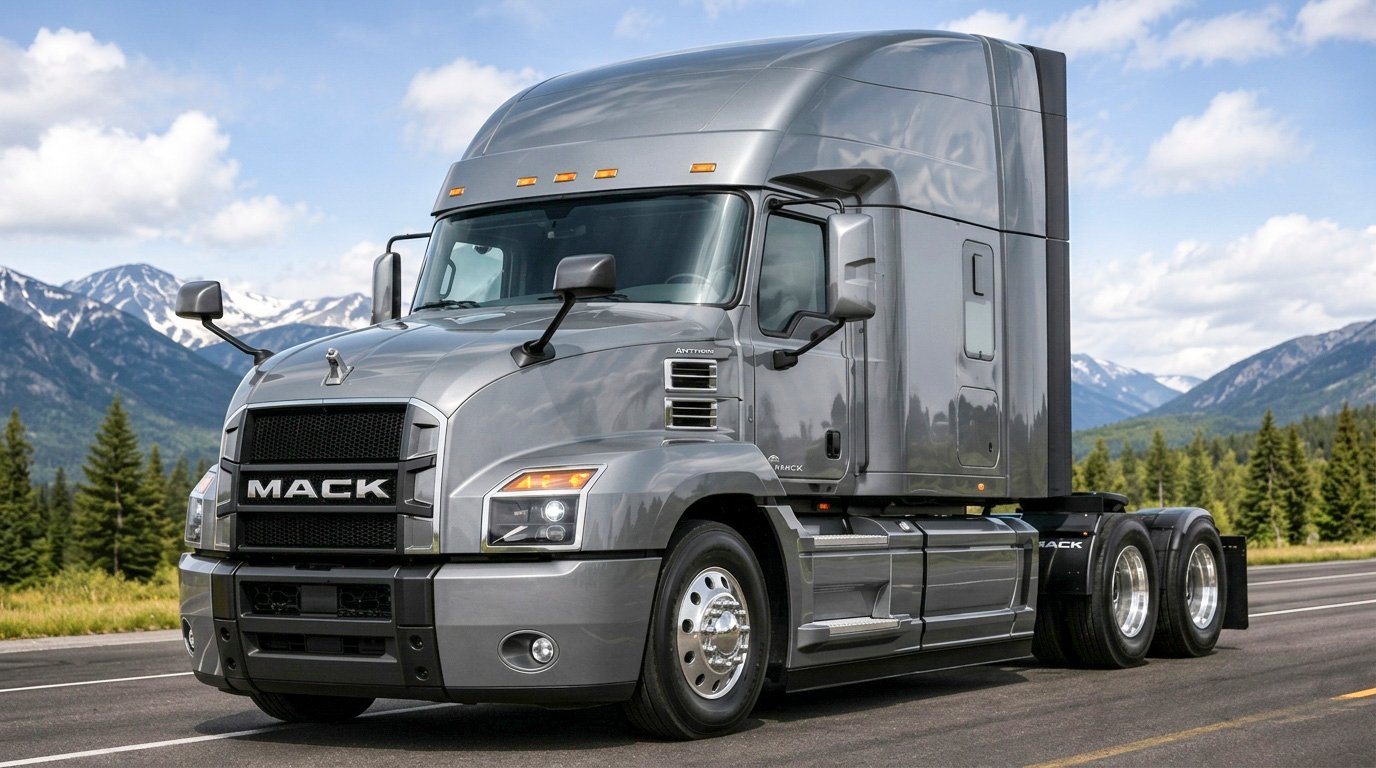
The Mack Anthem is a Class 8 tractor built around the realities of regional freight: dense traffic, tight docks, repeated stops, and drivers who sleep in their own beds most nights. It serves fleets that move product between distribution centers, food and beverage depots, industrial yards, and customer sites within a day’s reach. Those jobs reward a truck that turns well, sees well, carries its payload efficiently, and keeps the driver comfortable through a long shift of climbing in and out of the cab.
The name now covers two different generations. The original Anthem arrived in 2017 with MP7 and MP8 engines. Mack introduced a completely redesigned Anthem in June 2025, opened orders that summer, and began production in January 2026 at its Lehigh Valley plant in Macungie, Pennsylvania. The newer truck uses the Mack MP13 engine, a cab nine inches wider than before, and a front end shortened to a bumper-to-back-of-cab length of 113.5 inches. Mack developed it alongside the Pioneer long-haul model and shares that truck’s interior.
This review concentrates on the redesigned generation and flags where earlier trucks differ. It relies on Mack’s documentation and trade reporting, and it treats the manufacturer’s performance figures as claims rather than test results. Nothing here is a driving impression.
Our Take
The Anthem is best read as a statement of priorities. Mack built the Pioneer for maximum fuel efficiency and large sleepers, then built the Anthem around maneuverability and payload sensitivity, with efficiency close behind. Mack’s own executives describe the split plainly: the Pioneer for efficiency, the Anthem for maneuverability. That candor points to a real engineering trade-off rather than a slogan.
What makes the design compelling is how little the driver appears to give up inside the cab. The Anthem shares the Pioneer’s interior dimensions, seating options, and finishes. The only concession is sleeper size, since the largest sleepers stay with the Pioneer. For fleets that struggle to keep regional drivers, who can change employers more easily than most, a premium workspace works as a recruiting tool as much as a comfort feature.
The powertrain is also persuasive on paper. A modern 13-liter engine, a faster-shifting mDRIVE transmission, and aerodynamics inherited from the Pioneer together support Mack’s claim of up to 10 percent better efficiency than the previous Anthem. Most regional buyers will not need the top engine ratings, so the real value lies in the integration rather than the peak numbers.
Several points deserve scrutiny. The 10 percent figure and the roughly $5,000 annual savings estimate are Mack’s projections for typical regional haul, and a duty cycle with heavy urban traffic or light highway mileage may look very different. The short front end helps maneuvering but affects packaging, so axle and fifth-wheel setups should be checked against your trailer. And because production only began in 2026, long-term durability data does not exist. Mack’s track record with engines and transmissions is strong, but the redesigned components have no field history yet.
Model year adds a further layer. A buyer ordering today chooses between the original MP13 and an EPA 2027-compliant version aimed at model-year 2028 trucks. Knowing which one you are buying is part of specifying the truck correctly.
Mack Anthem Design, Dimensions, and Maneuverability
The redesigned Mack Anthem truck is not a lightly updated predecessor. The cab has a wedge-shaped profile with a steeply sloped windshield, and the hood and bumper are shaped to manage airflow as much as to protect the front end. Mack also moved the cab forward and trimmed the front overhang. Trade reporting describes the cab shifting forward 8 inches and the overhang shrinking 4 inches relative to the Pioneer’s layout.
BBC stands for bumper to back of cab. It is the distance from the front of the bumper to the rear wall of the cab, and it matters because it influences both turning behavior and how much of the legal combination length the tractor consumes. Mack publishes 113.5 inches for the Anthem day cab against 125.5 inches for the Pioneer. Sleepers lengthen the figure. Dealer-listed specifications put the 44-inch sleeper near 157 inches and the 64-inch sleeper near 177 inches, which is consistent with adding sleeper length to the day-cab number, though buyers should confirm exact values on the official sheet for their configuration.
BBC describes only the front of the truck. Wheelbase, axle layout, fifth-wheel position, and tire choice all shape overall length and turning, so a short-BBC day cab on a long wheelbase will not maneuver like one on a short wheelbase. Compare complete specifications rather than BBC alone.
Visibility completes the argument. The redesigned hood lets drivers see closer to the front bumper than earlier designs did, which helps near dock doors, parked vehicles, and pedestrians. Mack’s materials express the improvement inconsistently, with the launch announcement citing about 12 feet and the production announcement citing about 12 percent, so the exact magnitude should be treated cautiously. Mack also says the shorter BBC reduces weight and allows additional payload, a modest benefit that depends on specification.
Regional work differs from long-haul work in what it demands. A regional tractor spends its day backing into docks, threading through yards, and working in traffic where front-corner visibility matters. Long-haul operations care more about sleeper space and sustained highway efficiency. The Anthem is shaped by the first set of needs, and it is not a severe-duty truck. The Kenworth C500 review covers a very different machine built for oilfield and specialized heavy-haul work, where chassis strength dominates the design.
Mack MP13 Engine and Power Delivery
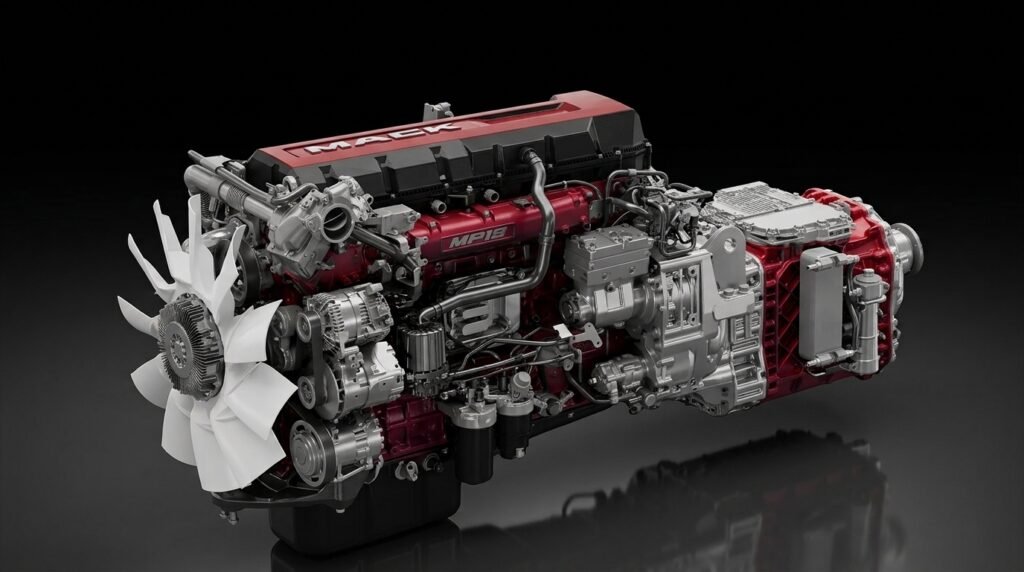
The Mack MP13 is a 13-liter six-cylinder diesel engine offered in multiple power ratings. In the redesigned Anthem, the standard MP13 is available with up to 515 horsepower and 1,900 lb-ft of torque, while the separate MP13 HE version delivers up to 505 horsepower and 1,950 lb-ft of torque. The EPA 2027-compliant MP13, intended for model-year 2028 trucks, raises the maximum output to 540 horsepower while retaining 1,950 lb-ft of torque. These ratings belong to different engine versions and should not be treated as interchangeable specifications.
Torque and horsepower do different jobs. Torque governs how well the truck launches a loaded trailer and holds speed on a grade without constant downshifting. Horsepower reflects the rate of work and matters more for sustained speed. Regional trucks that start from a stop many times a day benefit most from strong low-speed torque, which makes loaded acceleration less demanding on both driver and transmission.
The hardware is built around efficiency. Mack lists a variable geometry turbocharger with a water-cooled actuator that adjusts boost across the rpm range, and a variable-speed oil pump that reduces friction by matching flow to demand. A wave piston and new combustion chamber geometry account for about 3 percent of the engine’s efficiency gain. Mack describes the fuel system only as direct injection diesel in the materials reviewed, so deeper claims about injector design would go beyond the documentation. A higher-efficiency MP13 HE with turbo compounding, rated up to 505 horsepower, also appears in Mack’s engine lineup.
Engine braking matters as much as output on loaded regional routes. The original MP13 carries an integrated brake rated at up to 434 horsepower at 2,100 rpm or 505 horsepower at 2,400 rpm, controlled from the shift stalk. Stronger retarding reduces service brake wear and improves control on long descents.
The EPA 2027-compliant MP13, announced in May 2026, is a separate version. Mack rates it at up to 540 horsepower and the same 1,950 lb-ft, with up to 3 percent better fuel efficiency than previous MP13 engines and engine braking up to 630 horsepower, more than 20 percent above the earlier engine. It has an optimized torque curve with peak torque as low as 900 rpm, a more efficient turbocharger, predictive software that smooths throttle response, and a new aftertreatment system. It supports renewable diesel (R100) and biodiesel up to B20, up from B10 on the previous MP13. Orders opened in August 2026, with production timed to model-year 2028. Those fuel and efficiency details belong to that version and should not be assumed for the original MP13 or earlier MP7 and MP8 Anthems.
mDRIVE Transmission and Drivetrain
The mDRIVE is Mack’s automated manual transmission, engineered with the engine as an integrated powertrain so the two coordinate torque and shift timing. For the redesigned Anthem Mack lists 12-, 13-, and 14-speed direct and overdrive versions, a 13-speed overdrive that supports Dynamic Overdrive, and 13-speed creeper and multi-speed reverse options. The mDRIVE HD variant adds a 14-speed ultra-low creeper for heavier work. Mack says shift speeds are about 30 percent faster than before, which shortens the interruption in driveline torque and helps the truck keep momentum on grades.
Dynamic Overdrive shifts between Economy+, Economy, and Performance modes depending on conditions. In practice the transmission lets the engine run slower when load and grade allow, then changes strategy when the truck needs response. That only works if the engine has torque in reserve, which is why the MP13’s low-speed torque and the transmission’s gear spacing are designed together.
Direct drive versus overdrive is a route decision. Overdrive favors fuel economy on steady highway stretches, while direct drive suits lower speeds, heavier loads, and steeper terrain. Rear axle ratio is part of the same decision because it sets engine speed at a given road speed. Creeper gears and multi-speed reverse also help in yards, where a heavy tractor must be positioned slowly and smoothly.
Aerodynamics and Fuel Efficiency
Mack Anthem fuel efficiency is the center of the economic case. Mack claims up to a 10 percent improvement over the previous Anthem and says that can mean roughly $5,000 per truck per year in typical regional haul. These are manufacturer projections, not measured results. Mack breaks the gain into about 3 percent from the engine and combustion changes and about 7 percent from aerodynamics, including the wedge-shaped cab. That is one package described two ways, not separate savings to add together.
Optional equipment adds to it. A factory FlowBelow kit smooths airflow around the rear axles, and ground effects and chassis fairings extend the treatment. The optional digital mirror system is credited with roughly 1 percent additional savings. Mack also lists predictive cruise control, Eco-Roll coasting on descents, idle shutdown features, and an optional battery-powered auxiliary power unit. Trade reporting notes that Mack puts the Pioneer about 1 percent ahead of the Anthem when both carry comparable aerodynamic content.
Real consumption depends on variables no brochure captures. Aerodynamic drag climbs steeply with speed. Load weight and terrain set the energy needed to accelerate and climb. A poorly matched trailer can undo the tractor’s aero work, and idle time, axle ratio, tires, and driving behavior all contribute. A steady highway operation with a well-matched trailer will see different results than stop-and-go urban delivery. Treat Mack’s figure as a comparison point for your own duty cycle, not an MPG rating.
Cab Design, Sleeper Options, and Driver Comfort
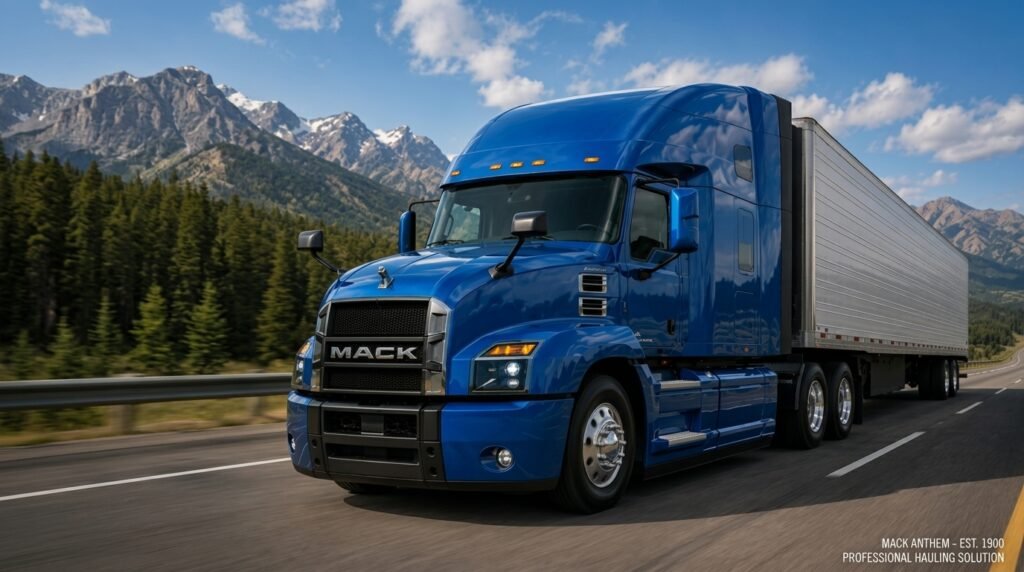
The Anthem is offered as a day cab, a 44-inch sleeper, and a 64-inch sleeper. A day cab fits operations where drivers return to base daily. The Mack Anthem sleeper cab matters when routes occasionally mean a night away, with the 44-inch version suiting occasional use and the 64-inch version giving more room. Mack says the stand-up sleepers provide enough headroom to stand upright and describes premium mattresses and blackout curtains. Heavy overnight use is a different matter. The Pioneer keeps the largest sleepers and Mack’s integrated parking cooler, so drivers who live in the truck should compare it.
Seating is a major focus, developed with Sears Seating. Driver seats can be specified with an air-suspended swivel base, memory and shock adjustment, four-chamber lumbar support, heating, cooling, ventilation, and massage, and upholstery runs from cloth to leather. These are options and trim choices, so a base truck will not match a fully loaded one.
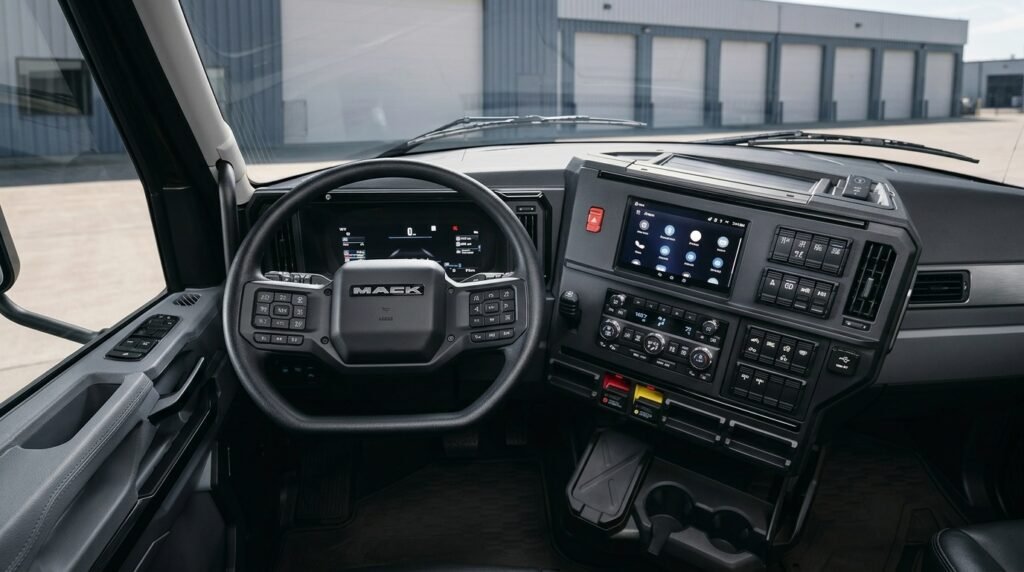
The controls were reorganized around the driver. Mack describes a flat-bottom multifunction steering wheel, higher gauges, and HVAC controls and the transmission shift pad moved closer to hand. A 12-inch CoPilot display anchors the dash, and a seven-inch infotainment screen offers TomTom truck navigation, Apple CarPlay, and satellite radio, depending on equipment. Mack cites up to 27 cubic feet of storage, including an under-bunk system with three lifting trays, and the MyMack app can pre-heat or pre-cool the cab.
Regional drivers climb in and out dozens of times a day, so entry geometry, seat swivel, noise, and climate control all affect how a shift feels. Mack says regional drivers spend nearly 11 hours a day in the cab and argues comfort supports alertness. That is a reasonable premise, but it is not a medical claim a brochure can prove.
Axles, Suspension, Braking, and Chassis
The Anthem comes in 4×2, 6×2, and 6×4 layouts. A 4×2 is lightest and suits modest loads. A 6×2 drives one rear axle and is popular with efficiency-minded fleets, trading some traction for lower weight and rolling resistance. A 6×4 drives both rear axles, giving the best traction for wet roads, grades, and heavy starts at the cost of added weight. Mack displayed both a 6×2 day cab and a 6×4 sleeper in 2026.
Suspension choices for the redesigned truck should be confirmed on the current build sheet. Mack says the new suspension rides more smoothly, and its Pioneer materials list the mRIDE spring suspension. Earlier Anthems offered Camelback, Mack AL, Twin Y, and Hendrickson options, which should not be assumed on the new generation. Disc brakes appear on some dealer-built trucks. Gross vehicle weight, gross combination weight, axle ratings, and payload depend entirely on the approved configuration, so the data plate and build sheet are the authority.
Mack Command Steer is an available driver-assist steering technology that adds electronic assistance to conventional power steering. Mack’s earlier Anthem materials claim it cuts steering effort by up to 85 percent and strain by 30 percent. Those figures were not independently verified and should be confirmed for the redesigned truck. The practical benefit is easier low-speed maneuvering and less steering fatigue in yard work.
Safety Technology and Driver Assistance
Mack Protect, the company’s proprietary driver assistance system, debuted on the Pioneer in July 2025 and is available on the Anthem in three levels. The base package covers forward-looking functions: forward collision warning, adaptive cruise control, automatic emergency braking, lane departure warning, traffic stop-and-go support, forward pedestrian detection, road sign recognition, and frontal airbags. Collision warning alerts the driver to a closing gap and emergency braking can intervene if there is no response. Adaptive cruise holds a following distance, including in congestion.
Mack Protect Pro adds side protection: lane change and blind spot support on both sides, side pedestrian detection, and side curtain airbags. The passenger side is where a tractor driver’s view is weakest, so side radar addresses a real gap. Premier adds active steering with lane-keeping assist. These are assistance systems, not automation, and the driver remains responsible. Mack also describes an Integrated Curtain Airbag for rollovers, but its documents differ on whether it is standard or optional, so confirm how it is packaged.
The optional digital mirror system replaces conventional mirrors with camera pods and in-cab displays. Mack says it reduces blind spots and drag. Drivers need time to adapt, and performance in rain, dirt, and low light deserves an in-person check.
Mack reports a 43 percent reduction in near-miss incidents during controlled testing. That measures near misses in a test setting. It is not a 43 percent reduction in crashes.
Connectivity, Maintenance, and Ownership Costs
Mack Connect is the telematics platform for performance data, location, analytics, and diagnostics. GuardDog Connect monitors for faults and sends service data to the dealer, so a shop may know the likely problem and have parts ready before the truck arrives. Over-the-air programming handles software updates without a service visit. Mack says its Integrated Uptime bundle, covering these services, is complimentary for five years, and buyers should verify terms and what follows. The MyMack app lets drivers check fluid levels and tire pressures, and the Digital Driver Guide, launched in April 2026, generates a chassis-specific manual from the last six VIN digits. Mack reports a 20 percent reduction in unplanned stops and a 37 percent reduction in overall downtime versus previous-generation trucks. Those are manufacturer results, not guaranteed outcomes, and they depend on whether a fleet acts on alerts and has a responsive dealer.
Maintenance follows the official schedule for the specific engine, transmission, and axle configuration, and this review does not quote intervals. Aftertreatment deserves particular attention because degraded systems cause costly downtime, and the EPA 2027 MP13 uses a new system whose service needs should be understood before ordering. Brakes, suspension, and tires wear faster in stop-and-go regional work, and a 6×2 with a liftable axle adds its own inspection tasks.
Ownership cost combines fuel, scheduled service, repairs, tires, downtime, warranty, and residual value. Fuel is usually the largest variable, which is why Mack stresses efficiency. Warranty terms should come from Mack’s documentation for the specific truck. Reliability cannot be settled by a manufacturer’s durability message. The engineering looks sound, but the redesigned Anthem has no long field record, so a cautious fleet might start with a few units and track downtime, fuel use, and service history.
Applications and Who Should Consider the Anthem
Mack lists bulk hauling of fuel, chemicals, and food-grade products, dry bulk, food and beverage distribution, general freight, pickup and delivery, and less-than-truckload service. These share a pattern: tight facilities, frequent stops, and sensitivity to weight. Food and beverage routes benefit from the short BBC and forward visibility, and dry bulk and tank work gain from any weight savings. Regional carriers with predictable routes and daily returns to base can use the day cab or 44-inch sleeper well, and an owner-operator with occasional overnights may find the 64-inch sleeper adequate.
Fleet managers focused on driver retention have a reason to look as well, since the shared Pioneer interior is a strong workspace for a regional truck. Whether it reduces turnover is something to test.
Vehicle class and workload matter. The Freightliner 114SD Plus design, power, and applications article shows how severe-duty vocational trucks differ from highway tractors in chassis and priorities, and the Anthem belongs on pavement and in logistics yards rather than rough sites. At the other end, an operation whose loads never approach tractor-trailer weights should ask whether a Class 8 tractor is the right tool, and the International CV515 medium-duty truck review explains why class and workload matter.
The Anthem can run highway miles, but it is optimized for regional hauling. Drivers away most of the week should compare the Pioneer, which offers larger sleepers and Mack says is slightly more efficient with comparable aero. Prioritize the Anthem when tight facilities and frequent stops dominate, and look elsewhere when sleeper space or heavy vocational duty is the priority. Risk tolerance matters too. A new-generation truck brings modern technology without a long record, so some fleets will phase in the purchase.
Buying a Used Mack Anthem
The name covers more than one truck. Most used Anthems available now belong to the original generation, built from 2017 with MP7, MP8, and MP8HE engines. The redesigned MP13 generation only entered production in 2026, so its used market is still very young. Features such as the wider cab, Mack Protect, and the MP13 should not be assumed on older trucks.
Start with model year, engine version, drivetrain, and the VIN, which confirms the actual build. Ask for service records, with special attention to aftertreatment repairs, regeneration problems, and software updates. A pre-purchase inspection should include transmission operation, a diagnostic code scan, and a look at tires, brakes, suspension, and steering. Documented accident and repair history matters because cab or frame damage can affect alignment and durability. Verify configuration-specific specifications and warranty eligibility directly with Mack or a dealer, including any certified used program terms. This review does not quote used prices or current availability, which change quickly.
Final Assessment
The redesigned Mack Anthem is a focused answer to a specific problem. It pairs a modern 13-liter engine and a faster mDRIVE transmission with Pioneer-derived aerodynamics, a wider and more comfortable cab, layered driver assistance, and connected uptime tools, all in a package built for regional operations. Mack’s claims of up to 10 percent better efficiency, about $5,000 in annual savings, a 43 percent near-miss reduction in controlled testing, and meaningful downtime gains are significant if they hold up. They are still manufacturer figures that each fleet must judge against its own conditions.
The central trade-offs are clear. The Anthem gives up the Pioneer’s largest sleepers and a little efficiency for a shorter front end, better close-quarters handling, and a payload edge. It offers high power ratings that most regional operators will not need. Its safety and connectivity features vary by package, so the truck you evaluate may not be the one you order.
That makes configuration as important as the model. Engine version, transmission and axle ratio, axle layout, cab size, safety package, and trailer match decide whether the Anthem fits the work. A well-specified Anthem should be a capable, comfortable, efficient regional tractor. A poorly specified one is an expensive truck with a good name.