Best Truck GPS Navigation Systems for Long Haul Drivers
Compare five truck GPS navigation systems for long haul drivers. Explore truck routing. Screen size. Route planning. Traffic support. And practical features for life on the road.

Truck GPS Navigation Systems exist because a loaded tractor trailer does not move through the world like a passenger car. A car driver who misses an exit can usually turn around at the next corner. A truck driver who misses the right turn may end up on a narrow street with no place to turn around and a low bridge somewhere ahead. Navigation for a commercial truck has to account for height and weight and length. It also has to account for the legal routes that a vehicle of that size is allowed to use.
Unfamiliar routes are where the risk grows. Bridge clearances are fixed and unforgiving. Weight restrictions can close a road to a loaded truck that looked perfectly fine on a standard map. Some roads are restricted to trucks outright. Others are technically open but wind through sharp curves or drop down steep grades that demand a very different driving approach than a car needs. Construction zones can change a lane layout overnight. Then there are the daily practical needs. Truck parking fills up early. Fuel stops have to fit the truck and the schedule. Loading areas are often tucked behind other buildings or reached through gates that a passenger car map never shows clearly. Over a long distance run all of these small problems add up to lost time and stress and sometimes real danger.
Smartphone navigation is useful and many drivers keep it as a backup. It may not always be enough for professional driving though. A phone app that does not know the truck dimensions can send a driver down a road that suits a car but not a tractor trailer. Even when an app offers a truck mode the screen is small and the mount may be awkward and the phone is also handling calls and messages and battery drain. A dedicated truck GPS gives the driver a device built for one job. That job is getting a large vehicle from one point to another along suitable roads.
That only works when the device knows the truck. Where a unit supports truck specific routing the driver should enter the actual dimensions and weight rather than accept defaults. A device that thinks the truck is shorter or lighter than it really is can produce a route that looks smart and turns out to be wrong. The profile is only as good as the information put into it. It should also be updated when the trailer or the load changes.
Screen size matters more inside a cab than most people expect. The driver glances at the display for a second or two at a time. A bigger screen can make a lane guidance graphic or an interchange easier to read at a glance. Visibility also depends on glare and mounting position and how much windshield the device takes up. Ease of use matters just as much. Clear voice guidance lets the driver keep eyes on the road. Fresh maps reduce surprises. Traffic and weather information help on a route that crosses several regions in a single day. Truck specific points of interest make it easier to find fuel and parking and services that actually suit a rig.
Different drivers also want different things. A full time OTR driver who covers new territory every week may want every planning feature available. An owner operator who runs familiar lanes may want something simple and dependable that gets out of the way. This guide compares five truck GPS navigation systems and examines where each one fits best.
Truck GPS Comparison at a Glance
| Product | Screen Size | Truck Routing | Key Navigation Features | Best Fit |
|---|---|---|---|---|
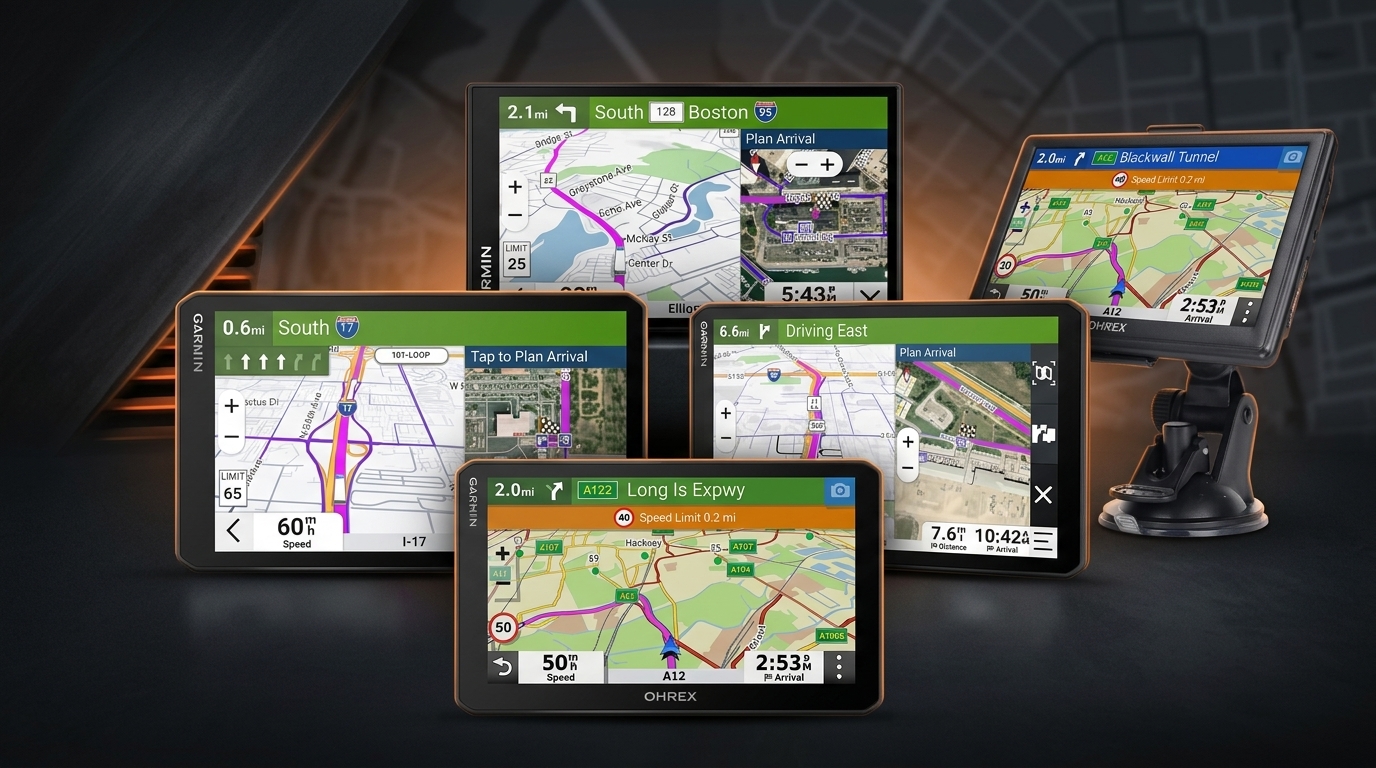
| Garmin dēzl OTR620 | 6 inch class | Custom truck routing | Truck specific warnings and truck services and map updates | Drivers who want a compact dedicated unit |
| Garmin dēzl OTR720 | 7 inch class | Custom truck routing | Bridge and weight alerts where supported and traffic and weather where supported and truck stop information | Drivers who want a balance of screen size and cab space |
| Garmin dēzl OTR820 | 8 inch class | Custom truck routing | Larger map view and truck points of interest and traffic and weather where supported | Drivers who want stronger visibility without going to the largest size |
| Garmin dēzl OTR1020 | 10 inch | Custom truck routing | Very large map view and route planning for fuel and parking and arrival | Drivers who value maximum visibility and have the dash space |
| OHREX N700 GPS Navigator for Car Truck RV | 7 inch class | Truck mode with vehicle settings where supported | Truck routing and driver alerts and map updates | Drivers who want a lower cost dedicated device |
My Take
These five devices do not sit on a single ladder. Four of them come from the same Garmin dēzl family and share a general approach to truck navigation. The fifth comes from a different brand and aims at a different kind of buyer. Comparing them honestly means looking at how each one fits a particular truck and a particular style of driving.
Screen size is the first thing most people notice and it is the easiest feature to overrate. A bigger display shows more map and makes text and graphics easier to read. That matters in a complicated interchange or a busy city. A bigger display also takes up more windshield and dash space and can be harder to place in a cab that already holds a radio and a logging device and other gear. A driver who sits tall in a conventional cab with open dash space may welcome a large screen. A driver in a tighter cab may find a mid size screen far more comfortable. The right size is the one that can be read quickly and mounted safely without blocking the view of the road.
Dedicated truck routing is the deeper question. A truck specific device is useful when it can use the vehicle profile to avoid roads that do not suit the truck. The Garmin dēzl line is built around that idea. It lets the driver enter truck details and then plans around them where supported. The OHREX N700 also offers a truck mode. The difference lies in how much a driver should trust and verify each system. Premium Garmin units carry a longer reputation in the trucking world and a broader set of truck services and planning tools. A lower cost device can still be useful but the driver should check its settings and map coverage carefully and keep reading posted signs.
Ease of use is another place where the products can feel different in daily driving. A driver who sets up the profile once and wants simple turn by turn guidance may care less about advanced planning features. A driver who plans several days ahead may care a great deal about route planning and stop information. Traffic and weather features matter more on long cross country runs than on short regional ones. Connectivity can also shape the experience because some features depend on a phone connection or a WiFi connection for updates. Drivers should confirm what each model needs before relying on it.
Map coverage and software updates deserve attention because roads change constantly. A device with outdated information can send a driver toward a closed ramp or an old restriction. Updating maps regularly is part of owning any GPS. Mounting and portability matter too. Some drivers move one device between trucks. Others leave it fixed in one cab. A stable mount and a reliable power connection keep the device useful on rough roads. A GPS also sits alongside other cab electronics such as the equipment covered in our guide to truck dash cams for long haul drivers. Planning the windshield and dash layout before buying anything helps prevent clutter and blocked sight lines.
The tradeoff between premium Garmin systems and the lower cost OHREX option comes down to confidence and budget. A driver who covers many states and wants a deep truck focused feature set may prefer to pay more for a Garmin. A driver who runs a limited set of routes and wants a dedicated device without a premium commitment may find the OHREX appealing. Neither choice is automatically right. The better choice is the one that matches the routes and the truck and the driver.
Garmin dēzl OTR620

- 6-inch touchscreen offers a bright, crisp, high-resolution display for easy in-cab viewing
- Get custom truck routing based on the size and weight of your truck (not available in all areas; always defer to posted …
- Approach loading docks, truck entrances and security gates with ease; expert arrival planning with BirdsEye Direct Satel…
The Garmin dēzl OTR620 is the most compact device in this group. It sits in the 6 inch class. That makes it the easiest of the Garmin models to place in a cab where space is tight. For some drivers a smaller screen is a real advantage. It leaves more windshield open and it can sit lower on the dash without competing with other equipment.
The core value of the OTR620 is custom truck routing. The driver can enter truck details such as dimensions and weight and the device can use them when planning a route where supported. That matters when a road is restricted by weight or vehicle dimensions. A general map might show a short direct path. A truck aware system can steer the driver toward a route that is more suitable for a tractor trailer. The benefit is only as strong as the accuracy of the profile so the driver should keep the settings current and accurate.
Truck specific warnings are the next layer. When a device can alert the driver to things like sharp curves or steep grades or certain restrictions ahead it gives the driver more time to prepare. A steep downgrade is not the place to learn that a long heavy combination needs extra caution. An advance warning can help the driver adjust speed and gear selection and following distance before the situation develops.
Truck services and points of interest matter during planning. Fuel and parking and rest stops are part of every long haul day. A device that shows truck relevant stops where supported makes it easier to plan around hours of service and fuel needs. The OTR620 also supports map updates so the driver can keep road data fresh. Updates matter because road restrictions and new construction change the real picture all the time.
In daily use the 6 inch class screen is easy to live with but it shows less map at once. A complicated interchange may take a little more attention to read than it would on a larger display. This size suits a driver who values a compact footprint and wants dedicated truck routing without a big screen. The main tradeoff is visibility. Drivers who often navigate crowded urban areas or who have trouble reading small displays may prefer a larger model.
Garmin dēzl OTR720

- 7-inch touchscreen offers a bright, crisp, high-resolution display for easy in-cab viewing
- Get custom truck routing based on the size and weight of your truck (not available in all areas; always defer to posted …
- Approach loading docks, truck entrances and security gates with ease; expert arrival planning with BirdsEye Direct Satel…
The Garmin dēzl OTR720 moves into the 7 inch class. That is a common size for truck navigation because it offers a visible map without taking over the cab. For many drivers it is the point where the screen feels comfortable at a glance and still mounts cleanly.
Truck specific routing remains the foundation. The driver enters the truck profile and the device plans around it where supported. Bridge height and weight restriction alerts can matter a great deal here. A low bridge warning matters when a tractor trailer is entering an unfamiliar industrial area at night or in bad weather. The driver may not have a good view of signs and the pressure to find a delivery address can lead to risky decisions. An alert in advance gives the driver time to find a safer option.
Route planning is another strong reason to consider a dedicated device. Planning a multi stop trip or checking the route before leaving helps the driver spot trouble ahead of time. A driver can look at the planned path and think about fuel and parking and the timing of arrival. That is far better than discovering a problem while moving at highway speed.
Traffic and weather information can also help where supported. Conditions change across a long route. A route that starts under clear skies may meet heavy rain or snow or a major slowdown a few hundred miles later. Knowing about it early lets the driver adjust the plan or choose a stopping point. Some of these features may rely on a connection so it is worth confirming how the device receives that data.
Truck stops and services matter as well. Fuel and food and parking decisions shape the day. The OTR720 supports truck oriented points of interest where supported which helps the driver find stops that suit a large vehicle.
The practical balance between screen size and cab space is where this model makes its case. It shows more than a small screen but it is not as dominant as the largest options. A driver who wants a dependable middle ground should consider it. The limitation is that a driver who truly wants maximum map visibility may still prefer a larger display. Drivers who value the smallest possible footprint may prefer a smaller one.
Garmin dēzl OTR820

- Large 8-inch touchscreen offers a bright, crisp, high-resolution display for easy in-cab viewing
- Get custom truck routing based on the size and weight of your truck (not available in all areas; always defer to posted …
- Approach loading docks, truck entrances and security gates with ease; expert arrival planning with BirdsEye Direct Satel…
The Garmin dēzl OTR820 steps up to the 8 inch class. It offers a larger display than the smaller dēzl models and that difference can be meaningful in a cab. A larger screen can matter for a professional driver because the driver reads the display in short glances. When the map is bigger the lane guidance and street names and surrounding roads are easier to understand quickly.
A large screen can matter when the driver needs to read a complicated interchange at a glance. Multi lane exits and tight city intersections and merging ramps leave little time to think. A clearer view helps the driver choose the right lane early and avoid last second moves that are dangerous in a heavy truck.
Custom truck routing remains central to the OTR820. The driver can build a truck profile and use it for route planning where supported. This helps keep the route aligned with roads that fit the vehicle. Navigation visibility also benefits from the larger display. In bright light or at a distance a bigger map can be easier to see. Drivers should still think about glare and mounting angle because screen size alone does not fix a poor placement.
Route planning on the OTR820 works the same way as on the other dēzl models but the bigger display makes it more comfortable. Reviewing a route on a larger screen can be easier especially when checking fuel stops and parking and the overall path. Truck specific points of interest help here as well. Drivers can look for stops that fit a truck and plan their day with fewer surprises.
Traffic and weather features are available where supported and they are more useful when they are easy to read. A larger display can make that information clearer at a glance.
Practically the OTR820 differs from the smaller dēzl models in how much information is easy to take in without squinting. It does take more space than the OTR620 and the OTR720. A driver should be sure the cab has room for it. It should be considered by drivers who want strong visibility and who still want something less dominant than the largest option. The tradeoff is size and the need for a thoughtful mount.
Garmin dēzl OTR1020

- Extra-large 10-inch touchscreen offers a bright, high-resolution display for easy viewing; mount in landscape or portrai…
- Get custom truck routing based on the size and weight of your truck (not available in all areas; always defer to posted …
- Approach loading docks, truck entrances and security gates with ease; expert arrival planning with BirdsEye Direct Satel…
The Garmin dēzl OTR1020 features a 10 inch display. It is the largest device in this comparison and it makes a very different impression in the cab. The map area is big and the text and graphics are easier to read from a distance.
A very large screen has clear advantages. It can show more of the road ahead and make complex junctions easier to understand. It can help a driver who prefers not to squint at a small display. It can also make route review easier when the truck is parked and the driver is planning the next leg.
A very large screen also has disadvantages inside a truck cab. It can block part of the view. It can be harder to mount in a cab with limited dash space. It can also become a distraction if the driver spends too much time looking at it. A bigger display does not automatically make a driver safer. The screen helps only when it is mounted well and used responsibly.
Custom truck routing is still the foundation here. The driver enters truck dimensions and weight and the device plans around them where supported. Route planning matters on long trips. The driver can think about bridge heights and weight limits and sharp curves and steep grades before reaching them. Knowing about a steep descent or a tight curve in advance lets the driver prepare for it calmly. Truck stops and fuel planning also benefit from a large map. Seeing the available stops along the route helps the driver decide where to fuel and where to rest. Arrival planning is part of that picture as well. A driver who knows the expected arrival time can adjust breaks and avoid rushing near the end of the day. Preparation before a trip also includes the truck itself and our guide to truck maintenance tools for long haul drivers is a useful companion when thinking about readiness for mechanical problems on the road.
Traffic and weather information can add value where supported. Conditions can change across a long route and a large screen makes updates easier to read.
The OTR1020 is most likely to benefit drivers who spend long hours behind the wheel and who value visibility above all else. It may also appeal to drivers who rely on route planning from the cab. The main tradeoffs are size and mounting and the risk of overdoing the display. A driver with a crowded dash should measure the available space before choosing it.
OHREX N700 GPS Navigator for Car Truck RV

- 【Latest 2026 North America Maps】 OHREX 7″ GPS Navigator for Car Truck RV works completely offline without cell service. …
- 【Free Lifetime Map Updates 】 Get the latest map by connecting OHREX GPS Navigation to the Windows pc. You can also use a…
- 【Driver Alerts】 OHREX N700 GPS uses satellite positioning to determine your location and provides turn-by-turn voice gui…
The OHREX N700 GPS Navigator for Car Truck RV takes a different approach. It is built to serve cars and trucks and RVs rather than to focus only on professional trucking. That broader design can be useful for a driver who shares one device between vehicles or who wants a dedicated navigator without moving to a premium truck focused brand.
Its truck specific routing is the feature that matters most for this comparison. A truck mode can help the driver avoid roads that do not suit a larger vehicle. Where the device supports vehicle dimension settings the driver should enter accurate details for the truck. Any truck routing depends on the data behind it so careful setup matters. The driver should also stay alert to posted restrictions rather than assume the device is always correct.
The screen sits in the 7 inch class which is a practical size for many cabs. It gives a useful view without taking over the dash. Map updates are another point to check carefully. Drivers should review how updates are delivered and how often they are available because current map data is a major part of any navigation device. Driver alerts can also help. Warnings about road conditions or speed or route changes keep the driver informed. The exact alerts vary so it is wise to confirm the details on the product page before buying.
Route planning on the OHREX is more basic in spirit than the deep planning tools in the premium Garmin line. It can still help the driver set a destination and follow a route. For truck use it can serve a driver who runs familiar lanes or who wants a straightforward backup device.
This device can appeal to drivers who want a lower cost dedicated navigation device. It gives them a screen built for navigation and a truck mode in a simple package. The limitations matter though. Compared with premium Garmin systems it may offer a narrower set of truck services and planning tools and less depth in how it integrates truck focused information. It should not be treated as equal to a Garmin simply because it offers truck routing. A driver who needs the broadest planning support should look closely at the Garmin models. A driver with simpler needs and a tighter budget may find the OHREX worth considering.
How These Five Differ in Practice
The most useful way to compare these devices is by asking how a driver actually works. A driver who wants a compact unit may prefer the OTR620 or the OHREX N700 because both keep the footprint modest. A driver who wants maximum visibility may lean toward the OTR820 or the OTR1020 because those screens make the map easier to read at a glance. Neither preference is wrong. They reflect different cabs and different eyes and different habits.
A full time OTR driver often meets new roads and new cities and new delivery points every week. That driver may want more features. Strong route planning and truck services and traffic and weather support matter more when the route changes constantly. A driver who mainly repeats familiar routes may need less. That driver already knows where the tight turns and the good fuel stops are. A simpler device can do the job well as long as it keeps the truck on suitable roads and warns about changes.
Budget also shapes the decision. Premium Garmin systems offer a more complete truck focused experience while the OHREX offers a more modest route to dedicated navigation. The choice between them is a matter of how much depth the driver needs and how much the driver is willing to invest. A GPS also belongs inside a larger setup. Our guide on choosing the right gear for long haul trucking looks at how navigation fits among the other tools a driver carries. Thinking about the whole kit helps avoid buying a device that does not fit the rest of the cab.
Choosing the Right Truck GPS for Your Routes
A good purchase starts with truck specific routing. The device should let the driver enter the real dimensions and weight and use them to plan routes where supported. Everything else is secondary to that. A beautiful screen is not much help if the route itself is unsuitable.
Screen size comes next but it should be weighed against cab space and mounting. A larger display improves visibility. A smaller one keeps the windshield clearer. The best size is the one the driver can read comfortably and mount safely.
Map freshness matters because roads change. Drivers should understand how updates work and should keep them current. Traffic and weather features matter on longer routes where conditions shift. Truck services such as fuel and parking and rest stops matter because they shape the whole day. Route planning ties these things together. The driver who looks at the route before leaving can spot problems early and make better decisions. Vehicle profile settings need regular attention. A changed trailer or a different load may call for updated information. Ease of use deserves real weight because a device that is hard to operate becomes a distraction. Mounting and power need to be solid so the device stays visible and running. Software updates keep the system reliable over time.
A truck GPS should be treated as a planning and navigation tool. It helps the driver prepare and stay oriented. It does not replace judgment. No GPS can replace attention to posted road signs and current road conditions. A bridge sign or a detour or a change in weather always deserves priority over a screen. The device supports the driver and the driver remains responsible.
The best recommendation is practical. Start with the routes you actually drive and the truck you actually run. A driver covering unfamiliar territory across many states may get real value from the fuller planning tools and larger screens of the Garmin dēzl line. A driver who repeats known lanes and wants something simpler may be well served by a smaller dēzl or by the OHREX N700. Match the device to the work and set up the truck profile carefully and keep the maps current. That combination will do more for a driver than any single feature on a spec sheet.