International HX620 Review Heavy-Haul Power and Capability
A closer look at the HX620’s engine choices, rugged chassis, available sleeper configurations, and demanding vocational applications.

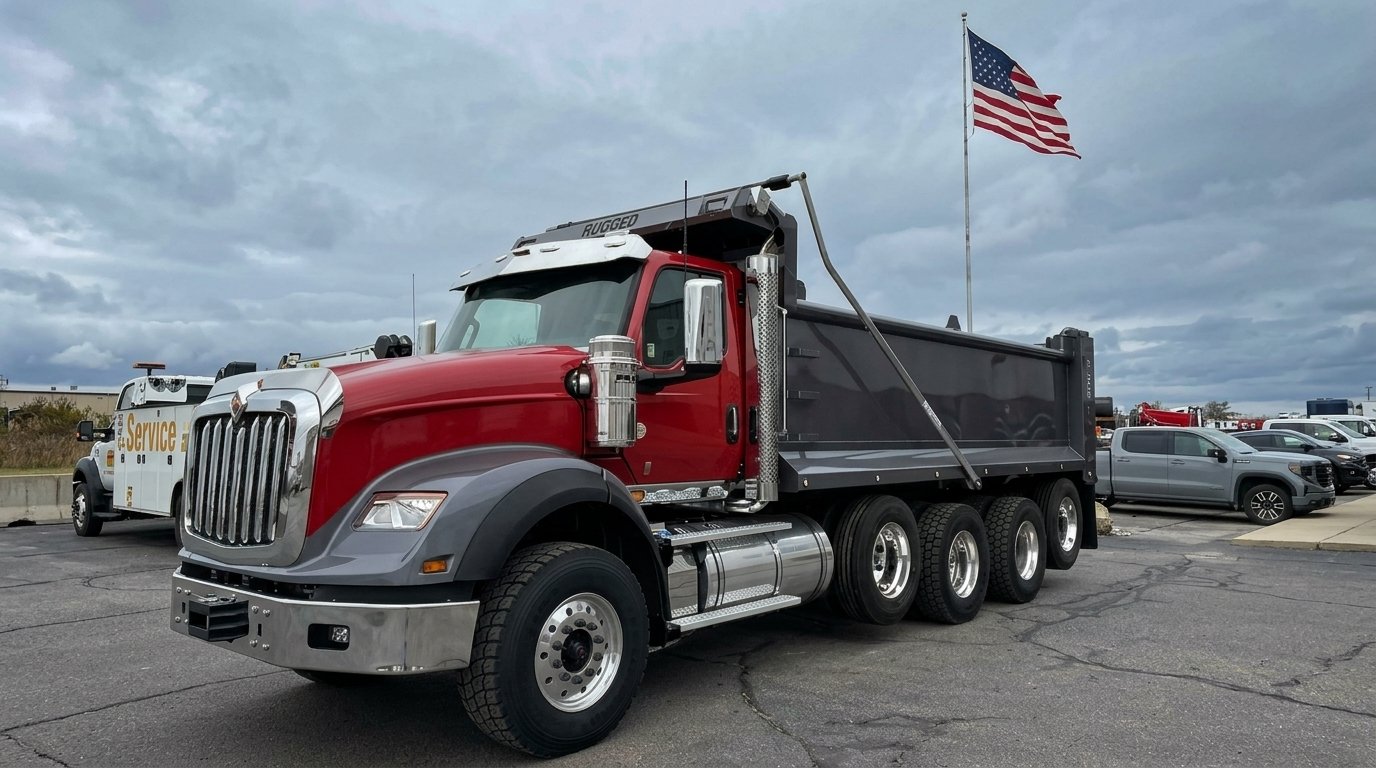
The International HX620 review begins with a clear distinction: this is not an aerodynamic highway tractor designed primarily to minimize drag on interstate runs. It is a Class 8 severe-duty vocational truck, engineered for demanding applications where weight, terrain, and equipment integration determine whether a job gets done. What makes the HX620 distinctive is how much room it leaves for the buyer to shape it. Two very different six-cylinder diesel engines, a wide spread of front and rear axle ratings, 6×4 and 8×6 layouts, factory lift axle options, a frame with several strength levels and cab choices that run from a plain day cab to a 73-inch high sleeper all sit under one model name. That flexibility, combined with a set-back front axle and a heavy-duty chassis, gives the HX620 a clear identity in the heavy-haul and construction world, and it deserves a closer look from anyone who moves serious weight for a living.
Our Take
Based on the published specifications, the HX620 is one of the more thoughtfully configurable heavy-haul platforms in International’s lineup. We have not driven or tested it, so this is an assessment of the engineering on paper, but the paper is persuasive. Its strongest quality is range. A buyer can pair the integrated S13 powertrain with the T14 automated manual transmission for a tightly matched system, or choose the Cummins X15 and its higher published output, which tops out at 605 horsepower and 2,050 pound-feet of torque. The frame is heat-treated alloy steel with a 120,000 PSI yield strength, and the axle and suspension catalog extends well into the ratings that heavy-haul and crane work demand.
The practical advantages follow from that. Low crawler gearing, available lift axles, a long wheelbase range and extensive PTO options make the HX620 a truck that can be specified around the job rather than forcing the job around the truck. The compromises are just as clear. It is not an aerodynamic highway tractor, its published figures vary by configuration, and a buyer has to do real homework to avoid over-specifying or under-specifying the build. Component ratings do not equal payload, and no single number describes what an HX620 can carry or how efficiently it will do it.
The operations that stand to benefit most are heavy-haul carriers moving oversize equipment, construction fleets running dump or platform stake bodies, and crane operators who need a robust chassis with dependable hydraulic and PTO integration. For those buyers, the HX620 reads less like a generic truck and more like a platform to build on.
International HX620 Design and Vocational Purpose
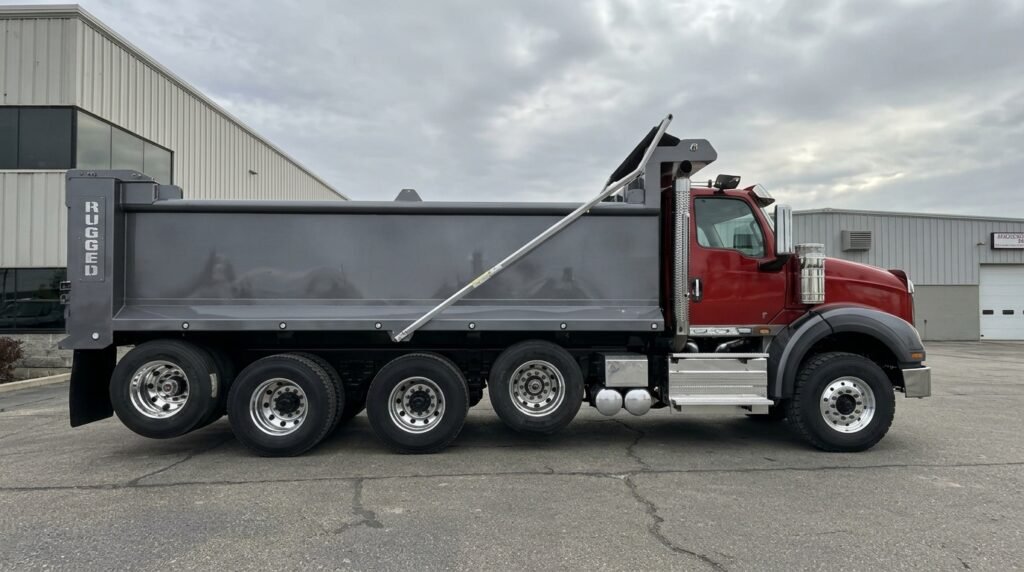
The HX620 is built around a set-back front axle arrangement, which moves the front axle rearward relative to the bumper and changes how weight is distributed and how the truck handles in tight work areas. The model-specific bumper-to-back-of-cab measurement is approximately 119.2 inches, and the BA dimension is approximately 50.2 inches. Combined with the long hood, that gives the truck the traditional vocational stance that heavy-haul operators and dump truck drivers will recognize at a glance. The hood is a three-piece sloped design made from DCPD material, and International positions it as a way to improve forward visibility while keeping strength and durability high. A sloped hood matters more than it might seem on a truck this size. Drivers working around loaders, excavators, crews on foot and cramped job sites benefit from every inch of sightline they can get.
According to the model-specific specification sheet, the HX620 is offered in 6×4 and 8×6 axle configurations. The primary applications for the truck are heavy-haul tractor work, construction dump truck service, platform stake trucks and crane applications. It is worth keeping this distinction in mind, because the wider HX Series supports a broader range of specialized vocational configurations depending on model and order specification. Not every option in the series belongs on every HX620, and a buyer should confirm what is available for this particular model rather than assuming that series-wide features carry over. The HX620 is the heavier, more specialized end of the family, and its design reflects that focus.
The wheelbase range is another sign of the truck’s flexibility. Published options run from 169 to 374 inches, which covers everything from a compact dump configuration to a long platform or heavy-haul build where body length, axle spacing and weight distribution all need careful planning. If you want to see how International approaches the other end of its lineup, our look at the International CV515 review covers the company’s medium-duty approach, which has a very different mission. For the official overview of the series and its configurations, the International HX Series product page is the primary source.
International HX620 Engine Options and Performance
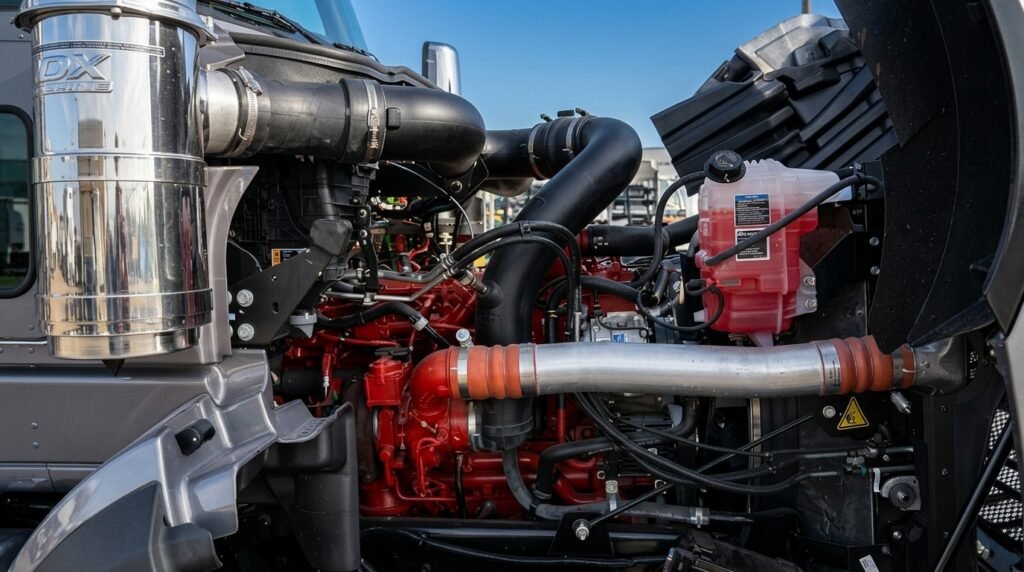
The HX620 offers two engines, and they approach the same job from distinctly different directions. Both are inline six-cylinder, four-cycle diesels with four valves per cylinder, but their displacement, aspiration, fuel systems and design philosophies are not the same.
The International S13 Integrated Powertrain
The International S13 displaces 12.74 liters, or roughly 777 cubic inches, and is rated from 400 to 515 horsepower with torque from 1,450 to 1,850 pound-feet. Its bore and stroke measure 5.12 by 6.30 inches, and it runs a high 23:1 compression ratio. It uses dual overhead camshafts and a fixed-geometry turbocharger, paired with a 1,800-bar common-rail fuel system. The engine holds 47.5 quarts of oil, weighs approximately 2,284 pounds dry, and carries a B10 design life of approximately 1.2 million miles.
What sets the S13 apart is how it fits into a larger system. It is part of the International S13 Integrated Powertrain, which combines the engine, the T14 transmission and a dual-stage aftertreatment system. The published configuration eliminates the need for a cooled EGR system and a diesel oxidation catalyst, relying on dual-stage aftertreatment and DEF dosing instead. In practical terms, that is a simpler emissions architecture with fewer major subsystems to manage. International’s S13 Integrated Powertrain page is the reference for the engine’s characteristics and model-year updates.
The Cummins X15
The Cummins X15 is the larger engine, displacing 14.9 liters, or about 912 cubic inches. In the HX Series it is offered from 430 to 605 horsepower, with torque from 1,650 to 2,050 pound-feet. Bore and stroke are 5.3 by 6.65 inches, with an 18.9:1 compression ratio. It uses a variable-geometry turbocharger, a Cummins XPI high-pressure fuel system and a single overhead camshaft. Oil capacity is approximately 56 quarts, dry weight is approximately 2,961 pounds, and the B10 design life is approximately one million miles. General engine information is available on the Cummins X15 product page.
The highest published HX620 application rating reaches 605 horsepower and 2,050 pound-feet, but it would be a mistake to assume every X15 truck carries that rating. The output depends on how the truck is configured and ordered.
Choosing Between the Two
Declaring a universal winner would miss the point. The X15 brings more displacement, a higher torque ceiling and a variable-geometry turbocharger, which can be attractive for operators who regularly run near the top of a heavy-haul rating. The S13 is lighter by roughly 677 pounds on the dry-weight figures, offers a very long B10 design life figure, and arrives as part of a tightly integrated powertrain with a simplified emissions layout. Under a heavy load, what matters most is not peak horsepower alone but how torque is delivered across the rev range, how well the transmission keeps the engine in its working band, and how the truck is geared. A strong low-end pull is what moves a loaded rig off the line and up a grade, so torque and gearing deserve at least as much attention as the headline horsepower number.
International HX620 Transmission and Drivetrain
Transmission choice may be the most application-sensitive decision on an HX620. The right box can make a truck feel effortless in a quarry and awkward on a highway, or the other way around.
The International T14
The International T14 is a 14-speed automated manual developed for the S13 Integrated Powertrain. It includes two crawler gears and one overdrive. The published forward ratios begin at 20.81:1 in first and step down through 16.16, 12.57, 9.76, 7.56, 5.87, 4.55, 3.53, 2.77, 2.15, 1.66 and 1.29 to 1.00:1 in thirteenth, with a 0.78:1 overdrive in fourteenth. That spread is the heart of the design. The deep first and second gears give a loaded vocational truck the leverage to creep, maneuver and climb at very low speeds, while the overdrive ratio retains some highway usefulness for suitable operation.
The T14 uses an electronically controlled clutch actuator and offers Precision Maneuvering Mode, predictive cruise control, Eco-Coast, downhill speed control and other application-specific driving modes. Certain vocational configurations can include up to six reverse gears, with some reverse ratios optional. In the specified S13 configuration, the compression-release engine braking capability can reach approximately 470 horsepower at sea level. That figure belongs to that specific S13 setup and should not be applied to every engine or model year.
Other Transmission Choices
Depending on engine and configuration, the HX620 can also be ordered with a range of Eaton and Allison units. Manual options include the Eaton Fuller 8LL 10-speed, the 9ALL 11-speed, and 13-speed and 18-speed Eaton Fuller transmissions. Automated options include the Eaton Cummins Endurant HD 12-speed and the Endurant XD and XD Pro 18-speed units. Allison automatics from the 4000, 4500 and 4700 families round out the list. Not every transmission is compatible with every engine configuration, so the available combinations need to be confirmed during ordering.
The reason the choice matters is simple. A dump truck that spends its day in low-speed, stop-and-go cycles has very different needs from a heavy-haul tractor that covers long distances between jobs. Crawler gears, overdrive, shift logic and low-speed control all pull in different directions, and the right answer depends on where the truck actually works.
6×4 and 8×6 Configurations
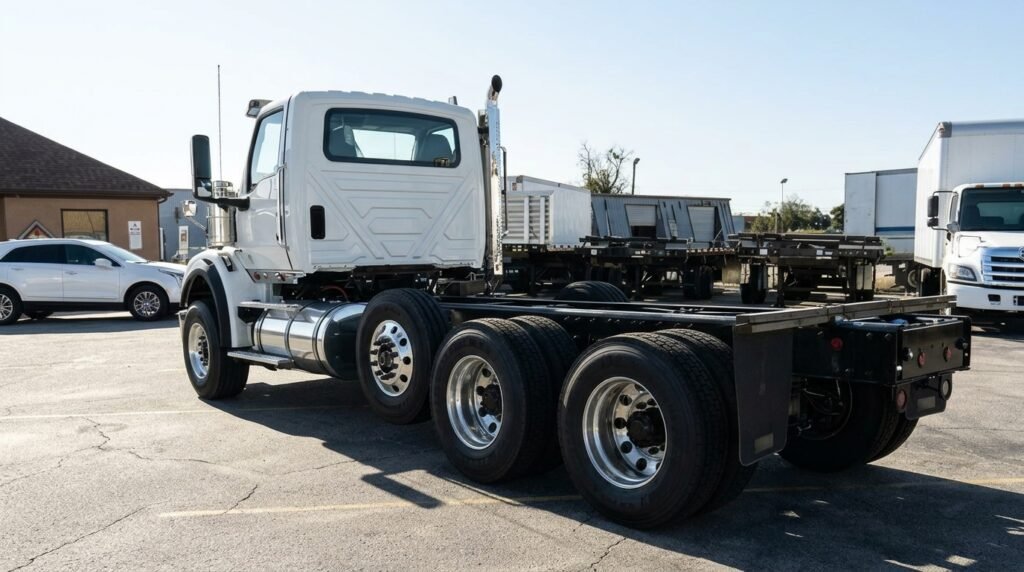
A 6×4 truck has three axles with two driven, which is the familiar arrangement for many dump and heavy-haul builds. The 8×6 adds a fourth axle, with three of the four driven, bringing more weight capacity, more traction and a different weight distribution. The 8×6 suits operations that need extra carrying and driving capability, while the 6×4 is typically lighter and simpler. Which makes more sense depends on body type, legal weight limits and ground conditions.
International HX620 Chassis, Axles, and Weight Ratings
The model-specific HX620 specification sheet lists a GVWR range of 53,200 to 91,800 pounds. The general HX Series website currently lists the HX620 range as 53,200 to 92,800 pounds. These figures should be treated as a difference between published sources, model years or configurations rather than blended into one falsely precise number. The model-specific HX620 specification sheet is the right place to confirm the detail for a specific build.
It is important to be clear about what GVWR means. It is the maximum rated weight of the fully loaded vehicle, including the truck, body, equipment, fuel, driver and cargo. It is not payload. Payload is what remains after the empty weight of the completed truck is subtracted, and that empty weight changes with engine choice, axle configuration, body, crane, PTO equipment, fuel tanks and every accessory added. Two HX620 trucks with the same GVWR can carry noticeably different loads.
Frame Construction
The frame is made of heat-treated alloy steel with a yield strength of 120,000 PSI. Available resistance to bending moment ratings range from approximately 2,037,600 to 4,854,000 inch-pounds, depending on construction. A notable optional single rail measures 12.5 by 3.75 by 0.5 inches and offers approximately 3,536,400 inch-pounds. Huck-Spin fasteners are available for frame and crossmember connections, providing durable clamping strength. For recovery, an optional center tow pin is rated up to 150,000 pounds. That number describes the strength of the recovery component, not the truck’s legal towing capacity or payload.
Front Axles and Suspension
Front axle ratings run from 16,000 to 20,000 pounds for Dana and from 12,000 to 22,800 pounds for Cummins-Meritor. Front suspension choices include multi-leaf systems rated from 14,000 to 23,000 pounds, parabolic taper-leaf systems from 13,200 to 22,000 pounds, and slipper-type systems from 20,000 to 24,000 pounds. The suspension type affects ride quality, load handling and articulation, so it is worth matching to the surface the truck will usually work on.
Rear Axles and Suspension
Tandem rear axle options include Dana single-speed units from 40,000 to 52,000 pounds, Cummins-Meritor units from 40,000 to 58,000 pounds, and a Meritor double-reduction configuration at approximately 58,000 pounds. Tridem options come from Cummins-Meritor at 50,000 to 69,000 pounds. Rear suspension choices include Chalmers, Hendrickson HAULMAAX EX, Hendrickson HAS, Hendrickson PRIMAAX EX, Hendrickson R and RT, and tridem suspension options. Some tridem suspension ratings reach 69,000 pounds, while individual suspension families carry different maximums. These are component ratings, and the legal payload of the finished truck depends on the weakest rating in the system, the empty weight and applicable regulations.
Lift Axles
The HX Series can be ordered with factory-installed lift axles rated from 8,000 to 20,000 pounds, depending on configuration. Some configurations support up to three lift axles in pusher or tag positions. They help distribute weight and accommodate specialized heavy-haul and vocational needs, but they do not automatically raise the legal GVWR. Think of them as a tool for spreading load and meeting axle weight rules, not as a shortcut to a bigger rating.
International HX620 Highway Performance and Heavy-Haul Capability
Heavy-haul work rarely stays on the job site. A truck like this often has to move equipment between yards, quarries and construction projects, sometimes over considerable distances. That is where the combination of torque, gearing, cab choice, fuel capacity and axle configuration comes together. High torque keeps a loaded combination moving on grades, a wide ratio spread helps the driver choose the right gear for the load, and an available sleeper cab makes longer runs more realistic. Fuel tank options of up to 300 gallons in the model-specific sheet further support extended operation, though capacity varies by build.
It would be a mistake to describe the HX620 as an aerodynamic long-haul tractor. Its long hood, vocational chassis and heavy-duty components are designed to prioritize strength, visibility and equipment integration rather than minimizing drag. The International LT, covered in our International LT Series Review: Engines, Specs, and Performance, is oriented specifically toward long-distance highway freight, and it makes a different set of trade-offs. The HX620 is the truck you choose when the work demands capability first and highway efficiency second.
International does not publish a universal maximum road speed, model-wide MPG figure, payload rating or GCWR for the HX620, and we will not invent one. Road speed depends on the transmission, rear axle ratio, tire diameter, engine calibration, vehicle weight and speed limiter. Fuel economy depends on the engine, body type, payload, operating cycle, road conditions and configuration. The honest summary of its road manners is that it is a vocational truck with real highway capability when properly specified, but its character is shaped by its job, not by the pursuit of long-haul efficiency.

International HX620 Cab, Sleeper, and Interior
The HX620 is available in a Day Cab, a 56-inch Low Sleeper, a 56-inch High Sleeper and a 73-inch High Sleeper. The day cab suits local work such as dump and construction duty, where the truck returns to a yard each night. The 56-inch sleepers add overnight capability for drivers on longer heavy-haul trips, and the 73-inch high sleeper offers the most living space for operators who spend multiple nights away. No interior dimensions have been established for this review, and optional sleeper equipment should not be assumed to be standard. Any amenities should be verified for the specific configuration being ordered.
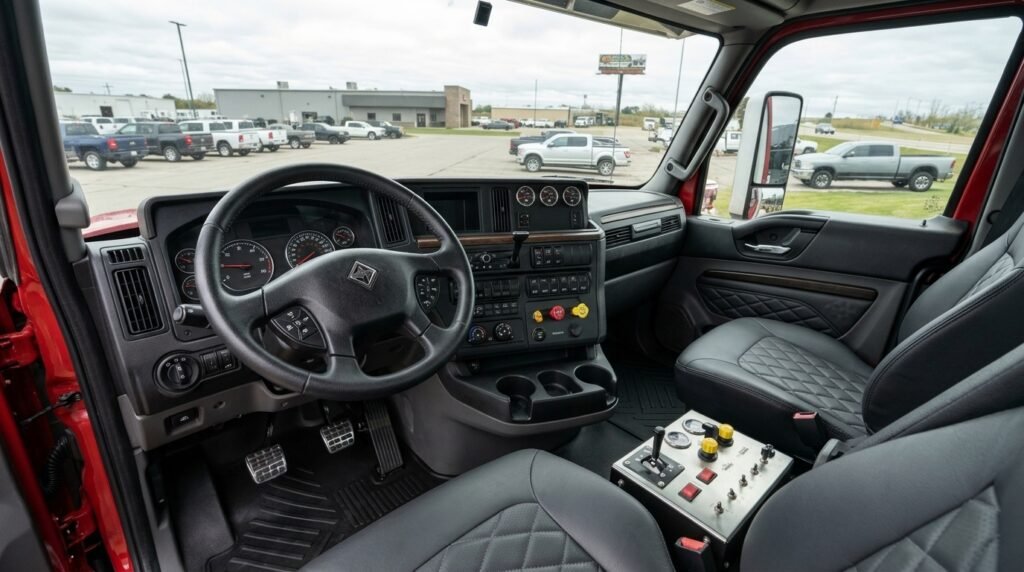
Two interior trims are available. The Diamond trim includes Mineral Grey Teak woodgrain accents and bright door handles, while Diamond Elite adds Satin Mahogany accents and diamond-pattern stitching on the door panel inserts. These are cosmetic differences, but in a truck where drivers spend long hours, a more refined cabin can matter.
Functionally, the cab is designed around visibility, ergonomics and vocational use. Published features include the Premium Gauge Cluster, up to 48 available auxiliary gauges, up to 30 programmable switches, a column-mounted stalk shifter and International Diamond Logic electrical integration. The numbers on gauges and switches are especially telling. Vocational trucks often carry PTO controls, hydraulic systems, body lighting and other add-on equipment, and a cab that can organize all of that cleanly makes the driver’s job easier.
The cab itself is built from high-strength galvanized steel with Chemguard anti-corrosion protection, and an additional spray-on floor coating is designed to resist abrasion, impact and corrosion. For trucks exposed to mud, salt, debris and rough handling, that kind of protection is not a luxury. It is part of what keeps the cab sound over years of hard use.
International HX620 Safety, Braking, and Driver Assistance
Heavy trucks carry heavy consequences when something goes wrong, so safety technology deserves attention. Published options for the HX620 include Traction Control, Electronic Stability Control, Bendix Wingman Advanced and Bendix Wingman Fusion. Traction control helps manage wheel slip when ground conditions are poor, which is a daily reality in construction environments. Electronic Stability Control helps the truck respond to situations where it could lose directional stability, such as a sharp maneuver or slick surface.
Depending on the system selected, driver assistance may include collision alerts, adaptive cruise control, lane departure warnings and related functions. These systems are aids, designed to support an attentive driver by providing warnings and assistance. They are not autonomous driving, and they do not replace good judgment, proper following distances or defensive driving habits. No universal brake type has been established for every HX620 configuration, so buyers should confirm brake specifications for the build they are considering.
International HX620 Fuel System, Exhaust, and PTO
Fuel capacity is one of the spots where published figures differ. The model-specific specification sheet lists tank options from approximately 60 to 300 gallons, while the current general HX Series website lists a narrower range of 60 to 240 gallons. That discrepancy reflects differences in published configurations, so tank size should be treated as variable rather than universal. Mounting options include under-cab, dual under-cab and back-of-cab locations, and the specification sheet describes split fuel and hydraulic tanks, including 100-gallon and 120-gallon configurations with different allocations between fuel and hydraulic fluid. That split design is a sensible answer for trucks that need hydraulic capacity for dump bodies or cranes without sacrificing too much space.
Exhaust options include single and dual vertical stack arrangements and alternative aftertreatment installation configurations. These choices affect the layout of the chassis, available body space and how the truck is packaged for its job.
Power take-off equipment is central to what makes a vocational truck useful. A PTO transfers engine power to hydraulic pumps and other equipment, which is what allows dump bodies to lift, cranes to operate and specialized equipment to run. The HX Series page mentions factory-installed PTO options with ratings up to 1,180 pound-feet, depending on configuration. The S13-equipped HX620 can be ordered with factory-installed transmission-mounted PTO options and rear engine PTO arrangements. Not all PTO types are available on every engine and transmission configuration, so this should be confirmed early in the specification process. Electrical support comes from Delco Remy alternators rated from 165 to 300 amps, as well as Leece-Neville alternatives, with battery setups varying by application.
International HX620 Reliability, Maintenance, and Warranty
For construction fleets and heavy-haul operators, uptime is the product. A truck sitting in a shop is a truck that is not earning, and a delayed delivery can ripple through an entire project schedule. The HX620 approaches this through chassis engineering, tight engine integration and serviceability. Dual external air cleaners are among the published features, and the integrated S13 system is designed so the engine, transmission and aftertreatment work together. Accessible service components help technicians reach routine maintenance items efficiently.
We will not make claims about long-term reliability, repair costs or guaranteed engine life, because the supplied information does not support them. The published B10 design life figures describe engineering targets, not promises for any individual truck.
The published warranty coverage provides a clearer picture. Base vehicle coverage is 12 months with unlimited miles and hours, and the S13 engine is covered for 24 months with unlimited miles and hours. T14 transmission, clutch and transmission-mounted PTO coverage varies by rear axle rating, with 36 months listed for ratings below 52,000 pounds and 24 months at or above that rating. Dual-stage aftertreatment is covered for 24 months, and cab structure and corrosion coverage runs 120 months. Conditions, exclusions and availability depend on the applicable model and contract, and these terms should not be assumed to apply universally to every component or model year. The official HX Series brochure is a useful reference for the broader architecture and available configurations.
Final Verdict: Is the International HX620 Worth Considering?
The International HX620 earns its place on a shortlist for one reason above all others: it is a truck you can build to fit a demanding job. Few trucks in this segment offer such a wide choice of engines, axle ratings, frame strengths, lift axle arrangements and cab configurations, all on a platform designed for severe duty. The S13 offers an integrated powertrain with a simplified emissions architecture, while the Cummins X15 brings higher published output for operators who want maximum pulling power. The chassis, the PTO options and the corrosion protection on the cab all point the same way, toward a truck designed to work hard and keep working.
Buyers should weigh the configuration carefully before signing anything. GVWR is not payload, component ratings are not legal limits, and the empty weight of the finished truck determines what it can really carry. Transmission and axle choices should be matched to the work, whether that means crawler gears for low-speed heavy hauling or a different setup for more road time. Several figures, including GVWR and fuel tank capacity, differ between published sources, so verifying the exact specification for a given build is essential.
The operators who should seriously consider the HX620 are heavy-haul carriers, construction fleets running dump and platform stake bodies, and crane operators who need strong equipment integration. Those who mainly run long highway freight lanes where aerodynamics and fuel efficiency decide profitability are likely better served by a conventional long-haul tractor. The HX620 is not trying to be that truck. It is a specialist, and its value lies in how well it can be shaped to the demands of difficult, heavy work.