Massey Ferguson 1GC.25 Review Specs and Practical Uses
A realistic look at what this sub-compact tractor can do for your property, and where its limits begin.

Anyone who has tried to maintain a gravel driveway, a few acres of rough grass, or a hillside of landscaping beds with a garden mower and a wheelbarrow knows where the limits of that approach are. This Massey Ferguson 1GC.25 review starts from that point, because the sub-compact tractor exists for exactly that gap. It sits between a lawn tractor that struggles with anything heavier than grass and a utility tractor that is more machine than a small property needs. For many American owners, from rural homeowners to hobby farmers to people who simply live on more land than their equipment was built for, a tractor of this size is the sensible middle path.
The Massey Ferguson 1GC.25 belongs to the company’s current 1GC series, and it competes in a segment where the buying decision is rarely about raw power. Maneuverability matters more. A machine built to turn tightly around a barn, slip between trees, and fit through a garden gate has different priorities than one built to pull a multi-bottom plow across open fields. Compact tractors give up some capacity to gain agility, and the useful question is never whether a tractor can do everything, but whether it can do your particular jobs well.
That is the question this article tries to answer. What does the MF 1GC.25 actually offer, based on the published manufacturer information, and where do its limitations begin? Some of the published figures conflict with one another, and some measurements are easy to misread. Where that happens, we will say so plainly instead of smoothing it over.
Our Take: An Honest Assessment of the MF 1GC.25
The MF 1GC.25 is a property-maintenance tractor. That is not a criticism. It is a description of the job it was designed to do, and it is the right lens for judging it. The three-cylinder diesel, the compact frame, the hydrostatic transmission, the front loader, and the range of implements all point toward mowing, moving material, clearing snow, and keeping a few acres in good order. They do not point toward heavy field work.
What makes the package appealing is how these elements work together. A modest diesel engine is enough when the tractor is carrying a mid-mounted mower or filling a bucket with gravel. A hydrostatic drive makes constant direction changes with a loader far less tiring than shifting a mechanical gearbox. A compact footprint lets the machine work in places a larger tractor would simply avoid. The combination suits someone who will spend most of their time switching between mowing, loading, and light grading.
Realistic expectations matter here. The published ratings are modest next to larger tractors, and loader capacity in particular is measured in hundreds of pounds, not thousands. A buyer who understands that will probably be happy with the tractor. A buyer who hopes a sub-compact will behave like a utility tractor will be disappointed no matter which brand is on the hood.
Engine Performance and Diesel Engineering
Power comes from an Iseki diesel, a liquid-cooled three-cylinder engine with a displacement of about 1.1 liters. Detailed technical documentation lists the figure more precisely at roughly 1.12 liters, with a rated speed of approximately 3,000 RPM. Three-cylinder diesels of this size are common in the segment because they balance smoothness, fuel economy, and a compact installation that leaves room for the rest of the machine.
Massey Ferguson advertises the rated engine power as 24.5 horsepower. The official U.S. manufacturer brochure lists 18.5 PTO horsepower, and that second number deserves more attention than the first when you are thinking about implements. Engine horsepower tells you what the engine produces at its source. PTO horsepower reflects what is available at the shaft to run a mower deck or other driven equipment. The gap between the two is normal, because power is lost through the drivetrain before it reaches the PTO.
There is a further wrinkle. The advertised 24.5 horsepower figure and the engine data in the operator’s manual may follow different rating conventions, so comparing them directly can be misleading. We are not going to guess at a net figure that the supplied documentation does not establish, and readers should treat 24.5 horsepower as the manufacturer’s advertised rating and nothing more precise.
In practical terms, this power level suits mowing, general property upkeep, loader work, and a range of compatible implements. It is not a tractor for heavy plowing or demanding commercial field operations, and it should not be shopped as one.
Hydrostatic Transmission and Drivetrain
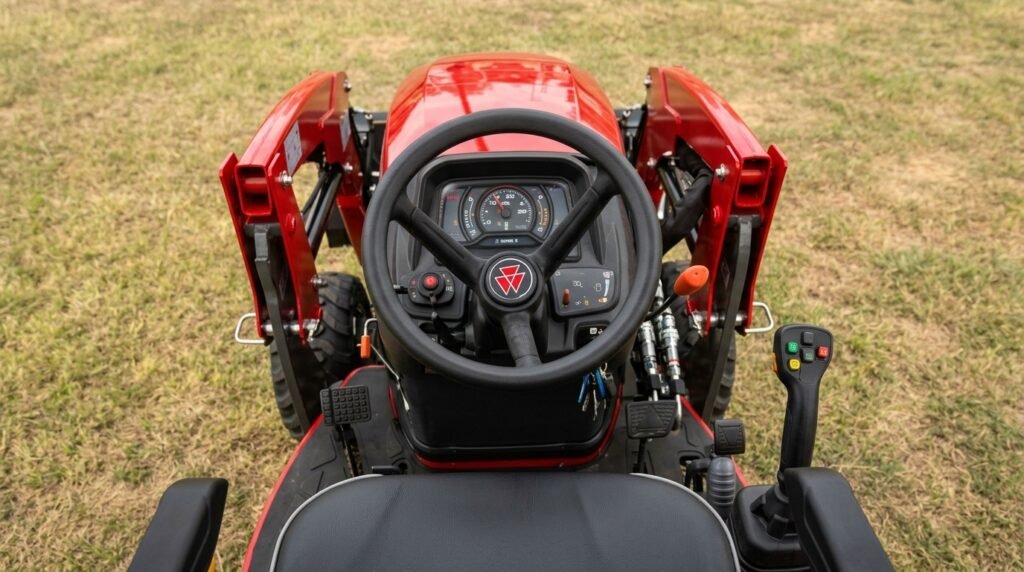
The 1GC.25 uses a two-range hydrostatic transmission. Instead of a clutch and a set of gears, a hydrostatic drive uses fluid pressure to vary speed smoothly, controlled with two side-by-side pedals, one for forward and one for reverse. Cruise control is listed among the documented features of the series, which helps during long mowing passes.
For loader work, the appeal is easy to understand. Anyone who has filled a bucket, backed away, turned, and dumped repeatedly knows how much of the job is changing direction. With a hydrostatic drive, that becomes a matter of moving your foot from one pedal to the other, without clutching or hunting for a gear. Around buildings and landscaping, where space is tight and precise positioning matters, the same smoothness makes the machine easier to place exactly where you want it.
Four-wheel drive, a differential lock, and hydrostatic power steering round out the drivetrain according to the technical and operating information. Four-wheel drive and the differential lock improve traction on soft or uneven ground, and power steering reduces effort when the front loader is loaded.
It would be too simple to call hydrostatic drive better than a mechanical gearbox in every case. Mechanical transmissions are valued for direct power transfer and can be efficient for steady, heavy pulling. Hydrostatic systems trade some of that directness for convenience and control. For a tractor whose work is loader cycles, mowing, and maneuvering, the trade makes sense. A buyer whose main job was sustained heavy draft work might weigh it differently.
Hydraulic System and Rear Three-Point Hitch
The regional technical specification for the MF 1GC.25 lists total hydraulic flow of approximately 6.9 gallons per minute, or about 26.3 liters per minute. That flow serves the loader and other hydraulic functions, and it is sized for a tractor of this scale. We will not break it into figures for individual functions, because the supplied documentation does not provide them.
The rear three-point hitch is Category I, the standard size for tractors in this class. Rear lift capacity is where readers most often get confused, because two published numbers describe different things. The manufacturer’s current U.S. product page lists 661 pounds measured 24 inches behind the lift points. Other technical documentation lists approximately 1,191 pounds at the lift points themselves. Neither number is wrong. They are measured at different positions, and they are not interchangeable.
The reason this matters is leverage. The farther an implement’s center of gravity sits behind the hitch, the harder the lift arms have to work to carry it, and the less weight they can actually raise. A compact implement that hangs close to the tractor may be well within the capacity of the hitch. A heavy, long implement may not be, even if its listed weight looks acceptable next to the larger figure. Anyone planning to buy a rear implement should check its weight and its geometry against the position at which the capacity was measured.
As for hydraulic flow, the useful way to think about it is as a ceiling matched to the tractor’s size. It is enough to run a loader at a reasonable pace and to support compatible implements, but it will not be the limiting factor in the way that engine power and loader geometry are.
Power Take-Off and Implement Compatibility
The documented 1GC series configuration supports an independent rear PTO running at 540 RPM and a mid PTO running at 2,000 RPM. The rear PTO uses a 1.375-inch shaft with six splines, and the mid PTO uses a 1-inch shaft with fifteen splines. If you are matching implements, those shaft details are worth confirming before you buy anything.
The distinction between the two outputs is practical. The rear PTO drives implements mounted behind the tractor and is the connection for rear-mounted equipment working through the three-point hitch. The mid PTO sits under the tractor between the axles and is designed for belly-mounted equipment, most commonly a mower deck. Mid-mounted mowers are popular because the cutting deck sits in the operator’s line of sight, and because the tractor can trim close to obstacles with the deck leading rather than trailing.
Together, the two PTOs make the tractor more flexible than its size might suggest. It can mow with one configuration and work with rear-mounted equipment with another. As a reminder, the 18.5 PTO horsepower figure belongs to the current MF 1GC.25. Older GC1725M documentation lists different PTO numbers, and those figures should not be carried over.
Front Loader and Material Handling
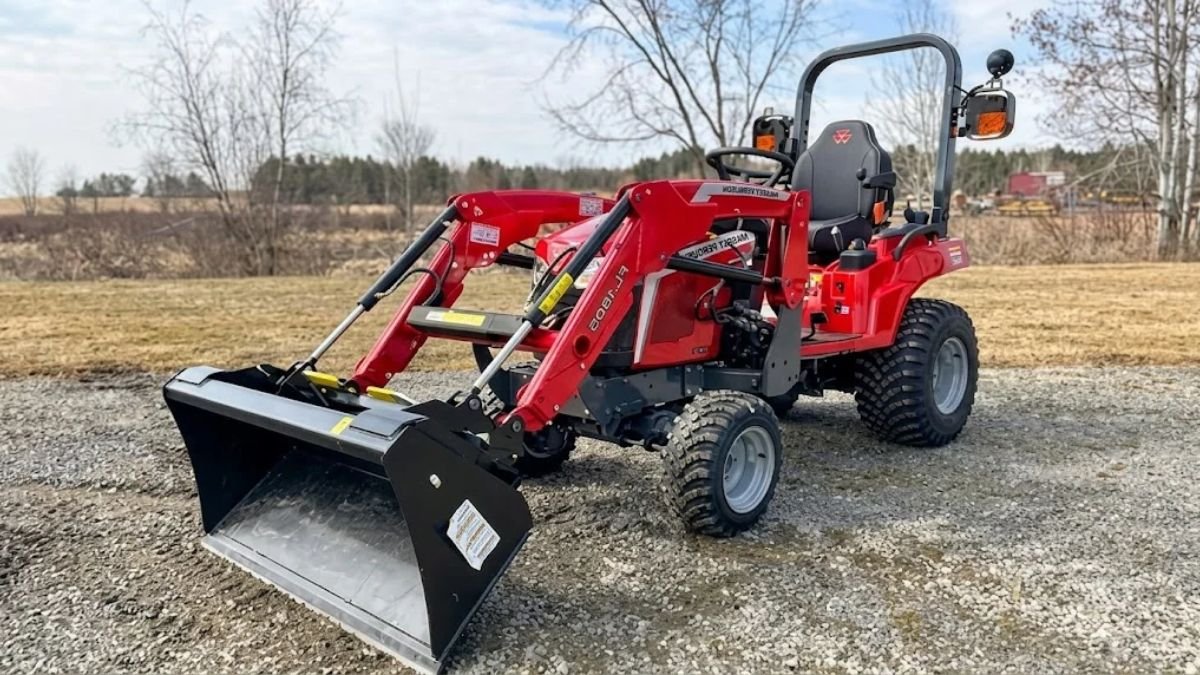
For many owners, the front loader is the reason they buy a tractor at all. The U.S. equipment information identifies the FL1805 loader configuration, which uses a quick-attach system compatible with skid-steer-style attachments. That compatibility matters because it opens up a wide range of buckets and other tools beyond the one that comes with the loader. A 48-inch bucket is documented in the relevant loader configuration, and maximum lift height is approximately 74 inches measured at the pivot pins.
Loader lifting capacity is where careful reading pays off. The documented capacity is approximately 922 pounds at the pivot pins. A different and much lower number applies when the load is measured 19.5 inches forward of the pivot pins, which is closer to where a loaded bucket actually carries its weight. Here the published material conflicts. Massey Ferguson’s current U.S. product page lists 662 pounds at maximum height and 19.5 inches forward of the pivot pin, while the U.S. compact lineup brochure lists 622 pounds for the same stated measurement position. Both are official manufacturer publications.
We are not going to pick one, average them, or invent an explanation. A buyer who needs the exact figure should confirm the loader specification for the configuration they are considering with an authorized dealer. For planning purposes, the practical point is that real bucket loads are far closer to the forward figures than to the pivot-pin figure.
Within those limits, the loader is well suited to moving soil, gravel, mulch, and other landscaping materials in manageable loads. Capacity is only part of the picture. A compact tractor’s stability depends on its weight, its ballast, the ground it is working on, and the manufacturer’s operating limits. A loader can sometimes lift more than the tractor can safely carry, and tipping, not hydraulics, is the real constraint on a slope or soft ground.
Backhoe Configuration and Available Attachments
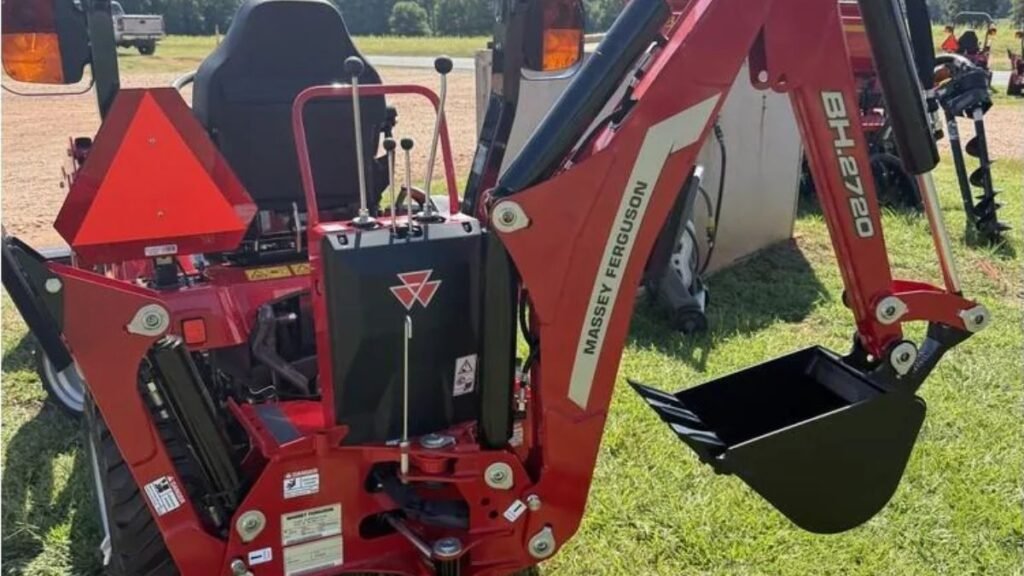
The standard MF 1GC.25 and the loader-backhoe configuration are not the same machine, and the difference matters when you read specifications. The U.S. manufacturer brochure identifies the MF 1GC.25B configuration, which has a folding ROPS and a documented maximum backhoe digging depth of approximately 76 inches.
The backhoe attachment is identified in the technical documentation as the BH2720. Its documented characteristics include about 76 inches of digging depth and 107 inches of maximum reach. Bucket digging force is listed at 2,184 pounds and boom digging force at 1,541 pounds. Loading height is approximately 66 inches, transport height is approximately 71 inches, the swing arc is 150 degrees, and bucket rotation is 177 degrees. These figures describe the specified backhoe equipment. They are not capabilities of an unequipped standard tractor, and they should not be read that way.
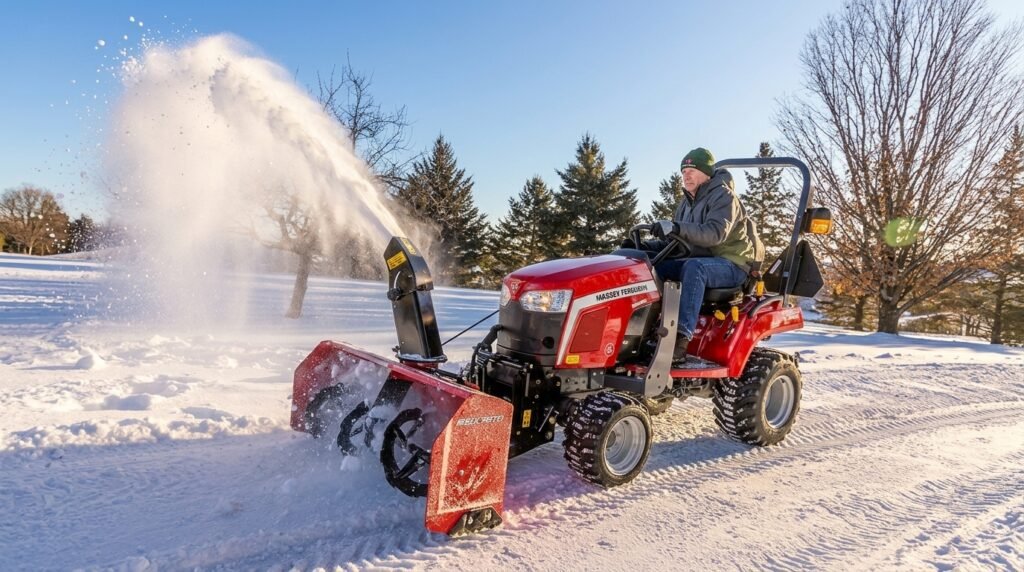
The series also supports other compatible equipment, including mid-mounted mowers, front snow-removal equipment, front blades, rotary brooms, loaders, and rear three-point implements. Documented mower options include 54-inch and 60-inch cutting widths, and the 60-inch configuration has a drive-over installation feature in the applicable specification.
For an owner who deals with snow, gravel, and grass in the same year, this kind of versatility is the real value. One tractor can handle several seasons of work with a change of attachment. But availability varies. What comes with a given tractor depends on the market, the model, and the dealer package, and nothing here should be taken to mean that every attachment is automatically included.
Dimensions, Maneuverability, and Operator Comfort
The published dimensions describe a small machine. Overall length is approximately 97.6 inches on a wheelbase of about 57.1 inches. Overall width is approximately 46.7 inches, and the fixed ROPS stands about 72.8 inches tall. Minimum ground clearance is approximately 6.7 inches. Documented turning measurements vary with the method and configuration, falling in a range of roughly 94.5 to 100.4 inches. Tires are listed as 18 x 8.50-10 at the front and 26 x 12.00-12 at the rear.
These should be read as approximate documented figures, not exact universal measurements, because tire choice and configuration can change them. They also do not include a machine weight, since the precise U.S. base weight was not established in the information we have.
What the footprint means in practice is access. A tractor under four feet wide can work between trees, along garden edges, and around buildings where a wider machine simply cannot go. It can usually fit through narrower gates and turn within modest driveway space. For owners with a lot of tight spots on their property, that agility may matter more than any figure on the power rating.
Massey Ferguson also points to a redesigned operator station, with a wider and taller seat, an ergonomic layout, side-by-side pedals, cruise control, and an improved instrument panel. These are features identified by the manufacturer, and we cannot judge how they feel over a long day. On paper, though, comfort and control are clearly part of the design.
Fuel Capacity, Maintenance, and Ownership
The operator manual and regional technical documentation give the following capacities, and each belongs to its own component. The fuel tank holds approximately 6.6 U.S. gallons. Engine oil with filter takes about 2.7 U.S. quarts, and the cooling system holds about 4.9 U.S. quarts. The transmission and hydraulic system holds approximately 2.9 U.S. gallons, and the front axle takes about 4.1 U.S. quarts. These are separate systems, so the numbers should not be combined or confused.
The operator manual includes dedicated procedures for the engine oil and filter, transmission oil and filter, front axle oil, coolant, engine belt, air filter, fuel filter, brakes, steering, and hydrostatic system. In ownership terms, that means a regular routine of checking engine oil, coolant, fuel system components, air filtration, transmission oil, front axle oil, hydraulic connections, tires, and lubrication points.
We will not invent a service schedule. Different fluids and components have different intervals, and exact numbers should come directly from the applicable operator manual. The manual is available as an AGCO MF 1GC operator’s manual, hosted on a distributor’s website, and it is the right place to look for maintenance procedures. Owners should confirm that the version they use applies to their tractor and market.
Following the correct schedule, with the right fluids and genuine replacement parts, is the most dependable way to protect a diesel and hydrostatic drive over the long term. Compact tractors are not complicated, but they punish neglect, especially in a hydrostatic system where fluid condition matters.
Real-World Use and Owner Feedback
One distinction has to come first. The owner discussions and first-hand reports available to us mostly concern the previous GC1725M and earlier GC1700 models, not long-term ownership of the current 1GC.25. They are useful as context, but they are not evidence about this tractor.
With that caution, previous-generation owners describe using their tractors for gravel driveway maintenance, snow removal, landscaping, mowing, moving soil, trenching, and general property work. That is a realistic picture of how the machine class gets used.
Some owner discussions also raise concerns that a prospective buyer should think about: compact tractor weight and traction, the ergonomics of rear three-point control, the position of hydraulic couplers, and protection for exposed underside components. These are individual reports from earlier or related models, and they do not prove defects in the current MF 1GC.25. We are not drawing reliability conclusions from them, and there are no review scores or failure statistics to cite.
What they do offer is a list of questions to ask when evaluating any tractor in this class. How does it handle traction with a loaded bucket? Are the controls where you want them? Is anything vulnerable on rough ground? Those are worth checking in person, and they are different from anything the manufacturer’s specification sheet can tell you.
Warranty and Price Considerations
We are not publishing a manufacturer’s suggested retail price. Dealer advertisements vary according to loader equipment, backhoe packages, tires, financing, regional availability, and discounts, and a single dealer listing is not a nationwide MSRP.
Warranty terms also depend on the applicable U.S. AGCO warranty document, the sale date, the equipment configuration, and the written terms. The research indicates that qualifying equipment sold and delivered under the applicable U.S. terms after January 1, 2025 may carry basic coverage of 24 months or 2,000 hours, whichever comes first. A separate limited additional coverage period applies to certain specified cast components under particular conditions, and it should not be mistaken for a comprehensive five-year powertrain warranty.
Because we cannot see the written document for a given sale, buyers should request the actual warranty from their authorized dealer before committing.
Comparisons With Other Compact Tractors
The MF 1GC.25 competes in a crowded sub-compact segment, and two of its most obvious rivals are the John Deere 1025R and the Kubota BX23S. We will not state competitor specifications here, because the supplied information does not cover them, and we would rather send readers to the dedicated reviews than risk repeating something inaccurate.
If you are weighing the Massey Ferguson against a Deere, our John Deere 1025R review covers that machine on its own terms. The real comparison tends to come down to how each tractor is configured, what loader and implement package it comes with, and how comfortable its controls are for the work you actually do.
Kubota’s competitor sits in a similar place in the market, and anyone cross-shopping should read our Kubota BX23S review alongside this one. Equipment packages differ enough between dealers that comparing a base tractor to a fully equipped one tells you very little.
None of these machines is definitively the best. Each suits different priorities, and the right choice depends on maneuverability needs, attachment availability, local dealer support, and the exact equipment on the lot. The sensible approach is to compare complete packages at the same level of equipment and decide from there. For details on the Massey Ferguson itself, the Massey Ferguson MF 1GC Series specifications page is the official starting point.
Strengths, Limitations, and Buying Considerations
The tractor’s strengths are clear. A compact footprint allows work in places larger tractors cannot reach. A diesel engine gives dependable power for the class, and hydrostatic operation makes loader work and maneuvering easier. Two PTO outputs add implement flexibility, and a wide range of compatible equipment supports a full year of property maintenance. For its intended role, the combination is thoughtful.
The limitations come from the same compact design. Lifting capacity is small compared with larger tractors, whether at the loader or the rear hitch, and the gap between pivot-pin figures and forward figures should temper any optimism. Weight and traction matter, because a lightweight tractor can struggle with a loaded bucket or a tough surface, and owners of earlier models have raised that concern. The configurations also differ in important ways. The standard tractor, the loader setup, and the backhoe version are not interchangeable, and choosing the wrong attachments for your work is an easy and expensive mistake.
Who benefits most? Owners with a few acres, a gravel drive, a lawn that outgrows a mower, and a need for light to moderate material handling will find the tractor well matched to their work. People who expect to move heavy loads regularly, handle serious field work, or run large implements should consider stepping up to a larger compact or utility machine. Buying more tractor than you think you need is often cheaper than replacing an undersized one.
Final Verdict: Our Massey Ferguson 1GC.25 Review
The central question at the start of this review was what the MF 1GC.25 actually offers and where its limits lie. The answer is that it is an honest sub-compact tractor, built to maneuver, mow, and move modest loads, with a design that favors convenience over raw capacity. Its documented engine, hydrostatic drive, PTO options, and loader compatibility make it a capable machine for property maintenance.
Its value depends entirely on the match between the tractor and the owner’s work. For someone whose days are filled with mowing, gravel, snow, and landscaping on a limited footprint, it is a sensible choice that deserves a serious look. For someone whose work is heavier than that, no amount of attachment flexibility will make up for the missing capacity.
Our verdict is that the MF 1GC.25 earns a place on a property where the job fits the machine. Read the published figures carefully, notice where they conflict, confirm your configuration and warranty with a dealer, and compare it against the alternatives before you buy. If you are researching it further, the official Massey Ferguson compact tractor brochure is a good companion to this article.