Kubota BX23S Review Compact Tractor with Backhoe
A practical look at the Kubota BX23S’s engine, loader and backhoe capabilities, attachments, and performance in property maintenance and landscaping.

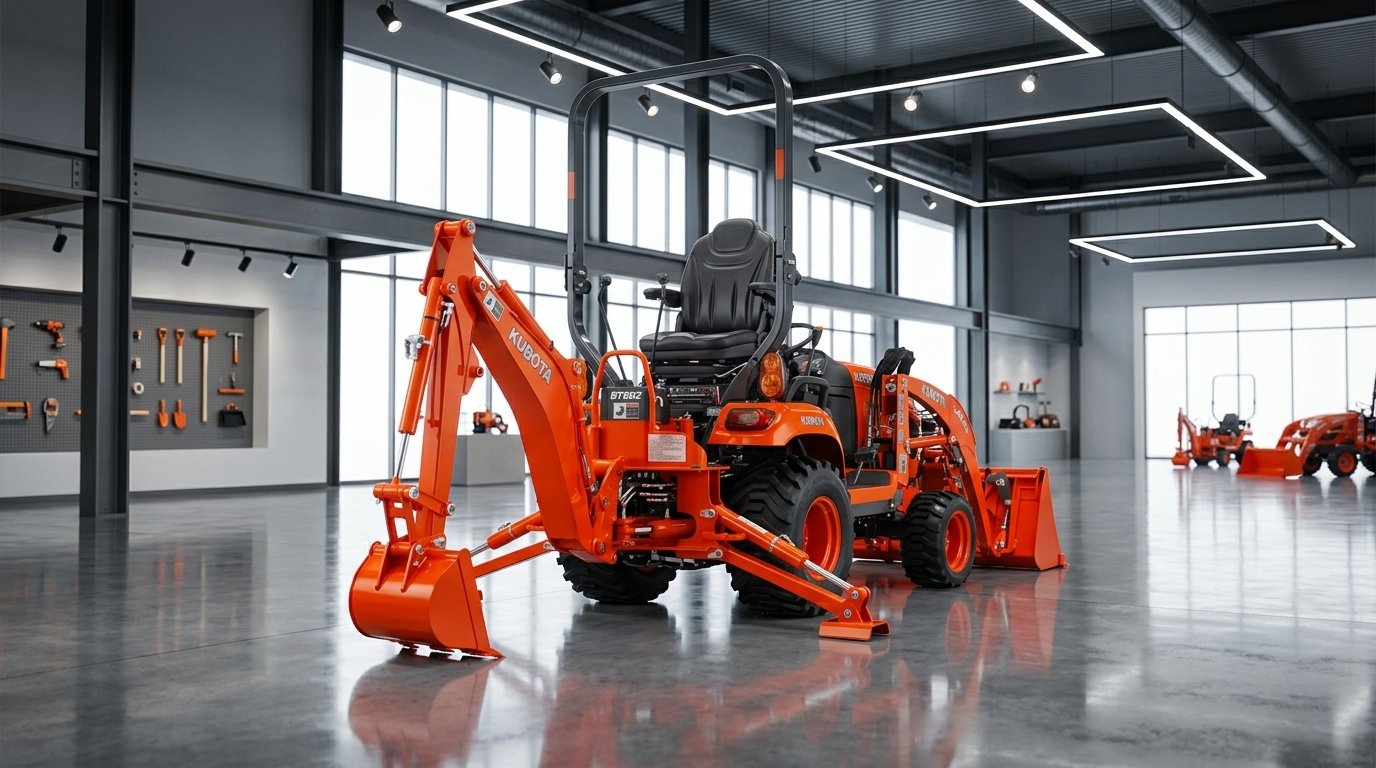
The Kubota BX23S is not a small tractor that happens to accept a loader and a backhoe. It is a purpose-built tractor loader backhoe, sold from the factory with both attachments as part of the machine’s working identity. That distinction shapes how the tractor is used and who should consider it. A homeowner who needs to dig a drainage trench, move the excavated soil, backfill the trench, and then mow the lawn around it is working through a sequence of tasks that require different attachments and different capabilities. The BX23S is designed to handle that sequence without switching machines.
Kubota builds the BX23S around a 21.6 gross horsepower diesel engine, a two-range hydrostatic transmission, four-wheel drive, and the LA340S front loader and BT603 backhoe. The machine’s value is not any single specification. It is the integration of digging, lifting, and carrying functions in a package small enough to work around a house, a barn, or a landscaping project. Whether that integration makes sense for a particular buyer depends on the scale of the work, the conditions on the property, and an honest assessment of what a sub-compact machine can and cannot do.
Our Take
The BX23S earns its place in the market by offering real digging capability in a compact frame. The BT603 backhoe has enough depth and reach to handle residential drainage, utility trenching, and small excavation projects. The loader moves soil, gravel, and mulch at a pace that suits small to medium property work. The hydrostatic transmission and four-wheel drive make the machine manageable in tight spaces and on uneven ground.
The tradeoffs are equally real. The BX23S is not a utility tractor, and it is not a mini excavator. Its 17.7 PTO horsepower limits the size and type of implements it can drive effectively. Its hydraulic flow rate and loader capacity set boundaries on what it can lift and how quickly it can work. Buyers who need to move large volumes of material, dig deeper than about six feet, or run heavy implements across multiple acres should consider a larger machine. The BX23S rewards buyers who understand its limits and match the machine to work that falls within them.
Engine and Power Delivery: Why PTO Horsepower Matters
The BX23S uses Kubota’s D902 engine, a liquid-cooled three-cylinder diesel with a displacement of 54.8 cubic inches, or approximately 898 cc. Kubota’s detailed specifications rate the engine at 21.6 gross horsepower at 3,200 rpm and 17.7 PTO horsepower at the same engine speed, with maximum torque listed at 41.4 lb-ft, or 56.1 Nm.
The difference between those two horsepower numbers is not a technicality. Gross engine horsepower is measured at the flywheel with minimal accessory load. PTO horsepower is measured at the power takeoff shaft after the engine has driven the alternator, cooling fan, and other systems. The PTO figure is what actually turns a rotary cutter, a tiller, or a chipper. A buyer who plans to run PTO-driven equipment should treat 17.7 horsepower as the real power budget, not the more prominent 21.6 rating.
That power level suits the BX23S to tasks a homeowner or small acreage operator would recognize. Running a mid-mount mower deck across a lawn, pulling a small box blade to smooth a gravel driveway, or powering a compatible tiller in a garden plot are within the machine’s intended range. What the engine does not do is deliver the sustained output of a larger utility tractor. Diesel torque characteristics help the tractor maintain momentum under load, but the engine is not sized for continuous heavy draft work. Operators should not expect the BX23S to perform like a 30 or 40 horsepower machine, because it is not one.
Hydrostatic Transmission, Four-Wheel Drive, and Fine Control
The BX23S uses a two-range hydrostatic transmission with low and high ranges. The detailed specifications list forward travel speeds of up to 8.4 mph in high range and up to 4.0 mph in low range, with reverse speeds correspondingly lower. A foot pedal controls forward and reverse, leaving the operator’s hands free for steering and loader or backhoe controls.
The practical value of hydrostatic drive shows up most clearly during loader work. When the operator is approaching a pile of gravel, positioning the bucket, and then backing away to turn and dump, the ability to modulate speed with foot pressure rather than clutching or shifting gears reduces the time spent on each cycle. The same applies to backhoe work, where the operator often needs to inch the tractor forward or back between digs.
Four-wheel drive is standard, with a bevel gear front axle and non-adjustable tread spacing. The rear differential lock is also listed as standard equipment. Four-wheel drive and the differential lock improve traction on loose soil, gravel, and slopes. They do not eliminate traction limits. A sub-compact tractor can still slip in mud, on wet grass, or when the rear of the machine is unloaded. The differential lock should be engaged only when the tractor is moving slowly and conditions warrant it.
The Front Loader: Matching Capacity to Configuration
Kubota’s detailed BX23S specifications list the LA340S quick-coupler loader configuration as standard, which uses a two-lever quick coupler and a 48-inch bucket. Kubota also lists an LA340 configuration with a 48-inch pin-on bucket. The lifting capacities for these two configurations differ, and that distinction matters.
The pin-on or rigid bucket configuration is rated to lift 739 pounds at the bucket pivot pin at maximum height. The LA340S quick-attach configuration is rated at 613 pounds at the same measurement point. Maximum lift height to the bucket pivot pin is approximately 71 inches. A buyer who reads the 739-pound figure and assumes it applies to the standard quick-attach loader may be disappointed to discover that their machine carries the lower rating. Kubota lists different capacities for the two configurations. Buyers should use the figure that applies to the loader and bucket setup on the tractor they are considering.
The more important point for an operator is practical: a bucket of dry gravel, wet topsoil, or dense compost can approach or exceed the loader’s rated capacity depending on how full it is and how the load sits in the bucket. The loader will lift what it is rated to lift, and pushing beyond that rating creates stability and safety problems rather than productivity gains.
Loader work also requires attention to ballast. The BX23S is a light machine, and a full bucket carried forward of the front axle shifts the center of gravity significantly. Kubota’s loader documentation and the operator’s manual address counterweight practices, and buyers should discuss ballast options with their dealer based on the work they intend to do. Rear ballast is not an accessory to consider after the fact. It is part of operating the loader safely.
The BT603 Backhoe: The Feature That Defines the Machine
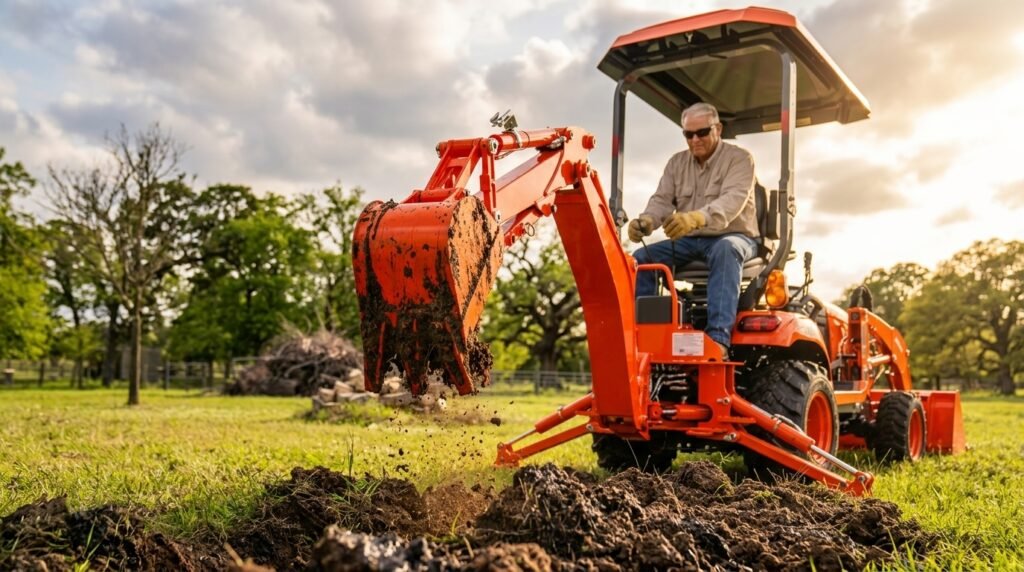
The BT603 backhoe is what separates the BX23S from a sub-compact tractor with a loader. Kubota’s BX80 Series brochure lists a digging depth of approximately 6 feet 1 inch and a reach of approximately 8 feet 7 inches from the backhoe swing pivot. Bucket digging force is listed at 1,936 pounds-force, and dipperstick digging force at 1,171 pounds-force.
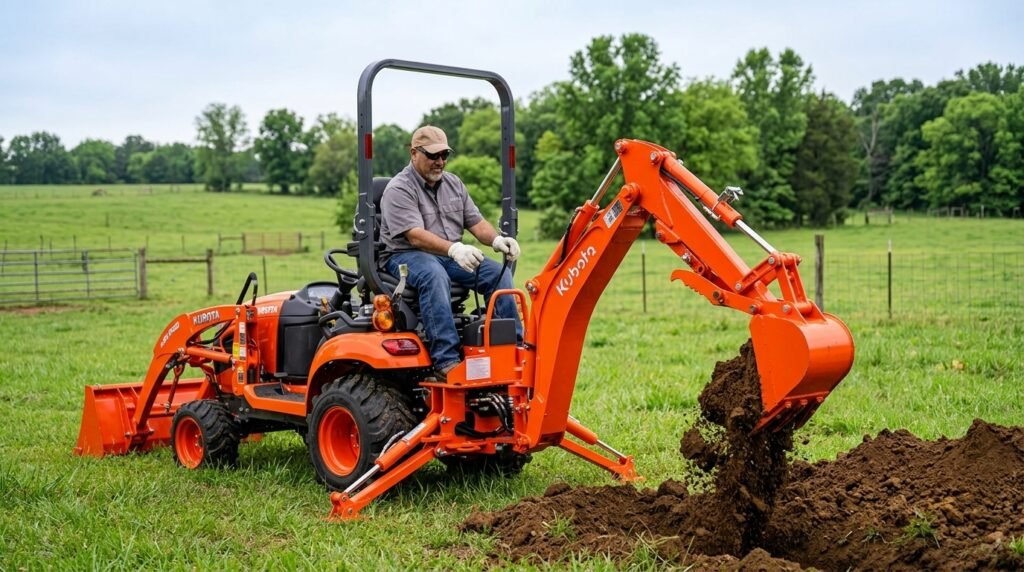
Those figures define a working envelope that covers many practical tasks. A drainage trench for a downspout or a French drain typically needs to be two to four feet deep. A water line or electrical conduit may need to go deeper. The BT603 can handle those jobs within its depth and reach limits. The backhoe can also excavate planting holes, remove small stumps, and handle light demolition work. The reach matters as much as the depth. With the ability to place spoil several feet from the trench edge, the operator can dig without constantly repositioning the tractor or working around a growing pile of dirt. That is a productivity factor, not just a convenience.
The BT603 uses Kubota’s Swift-Connect attachment system. A lever operation detaches the backhoe, and reattachment involves backing the tractor into the backhoe and letting the auto-lock mechanism secure it. For an owner who alternates between digging and ordinary tractor work, that system reduces the time and effort required to switch between configurations. Removing the backhoe restores ground clearance and reduces the machine’s overall length, which matters when using the tractor for mowing or grading in areas where the backhoe would otherwise be in the way.
The backhoe includes boom and swing cylinder cushion valves as standard equipment. These valves smooth the movement of the backhoe arm when it reaches the end of its travel, reducing shock to the operator and the machine. The hydraulic hoses are routed inside the backhoe boom for protection and visibility. The no-spill coupler system matches the front loader’s coupler design, which helps keep hydraulic connections clean during attachment changes.
A mechanical thumb is available as an optional attachment. The thumb allows the backhoe to grasp and move logs, rocks, and other irregular objects, expanding the machine’s usefulness for land clearing and material handling. Buyers who anticipate that type of work should confirm thumb availability and compatibility with their dealer. The reversible operator seat supports the machine’s dual role. When switching from tractor or loader operation to backhoe work, the operator lifts and rotates the seat to face the backhoe controls, eliminating the need for a separate seat or an awkward operating position.
Hydraulics, PTO, and the Limits of Implement Compatibility
The BX23S uses an open-center tandem pump. Kubota’s detailed specifications list the main hydraulic system output at 5.2 gallons per minute and the power steering pump output at 1.0 gallon per minute, for a total of 6.2 gallons per minute. That flow rate supports the loader, backhoe, and three-point hitch, but it also sets limits on hydraulic attachments. A rear remote valve is listed as optional in the detailed specifications. Buyers who plan to use implements that require hydraulic power, such as a top-and-tilt kit or certain types of grapples, should confirm whether the tractor is configured with the necessary remote valves. The front loader valve is standard, but it is dedicated to loader operation.
The rear PTO operates at 540 rpm and the mid PTO operates at 2,500 rpm, both listed as standard equipment. The mid PTO drives mid-mount mower decks. The rear PTO drives a range of implements including rotary cutters, tillers, and chipper/shredders. Implement compatibility depends on more than whether an implement fits the hitch or matches the PTO speed. The implement’s power requirement, weight, driveline specifications, and the tractor’s available PTO horsepower all factor into whether the combination will work safely and effectively. A rotary cutter that is too large or too heavy for the BX23S can overload the tractor and create unsafe operating conditions. Buyers should verify the published requirements of any implement they intend to use rather than assuming compatibility from width or category alone.
The three-point hitch configuration deserves careful attention. Kubota’s official product page lists the three-point hitch type as optional for the BX23S. The detailed specifications include Category I three-point hitch measurements and lift capacities, but the presence of those specifications does not mean the hitch is standard on every configuration. The official product page also shows overall length both with and without the three-point hitch, which reinforces that the hitch is a configuration choice rather than a universal feature.
The detailed specifications list a lift capacity of 1,213 pounds at the lift points and 680 pounds at 24 inches behind the lift points. The product page emphasizes the 680-pound figure measured 24 inches behind the lift points. These figures describe different measurement conditions, and buyers should understand which one applies to the implements they plan to use. Buyers who need to use rear implements should confirm that the tractor they are quoting includes the three-point hitch and that the hitch category and lift capacity match their implements.
Dimensions, Maneuverability, and Storage Considerations
The BX23S has an overall width of approximately 45.1 inches, a wheelbase of approximately 55.1 inches, and a height to the top of the ROPS of approximately 86.2 inches. Turning radius without brakes is listed at 7.5 feet. Those dimensions make the machine narrow enough to pass through many residential gates and maneuverable enough to work around trees, fences, and outbuildings.
Ground clearance for the BX23S is listed in Kubota’s detailed specifications as 5.83 inches. That figure is the manufacturer’s published specification for this document. Ground clearance matters on uneven terrain, particularly when the tractor is working in fields with rocks, ruts, or debris. A sub-compact tractor with limited ground clearance can high-center on obstacles that a larger machine would clear without difficulty. Buyers who will operate on rough ground should keep that limitation in mind.
Overall length varies by configuration. The brochure lists a length of 99.0 inches with the three-point hitch and front guard, and 95.5 inches without the front guard. The detailed specifications show different length figures depending on whether the three-point hitch is included. Buyers should verify the measurement that applies to the configuration they are considering rather than assuming a single figure covers all variants.
The ROPS height is a practical consideration for storage. At approximately 86.2 inches, the BX23S will not fit through a standard residential garage door without folding the ROPS. Kubota notes that the BX2380 has a lower ROPS height that allows it to fit under a standard garage door, but the BX23S does not share that characteristic. Buyers who plan to store the tractor indoors should measure their clearance and consider whether the ROPS can be folded or whether a different storage arrangement is needed.
What the Kubota BX23S Does Well
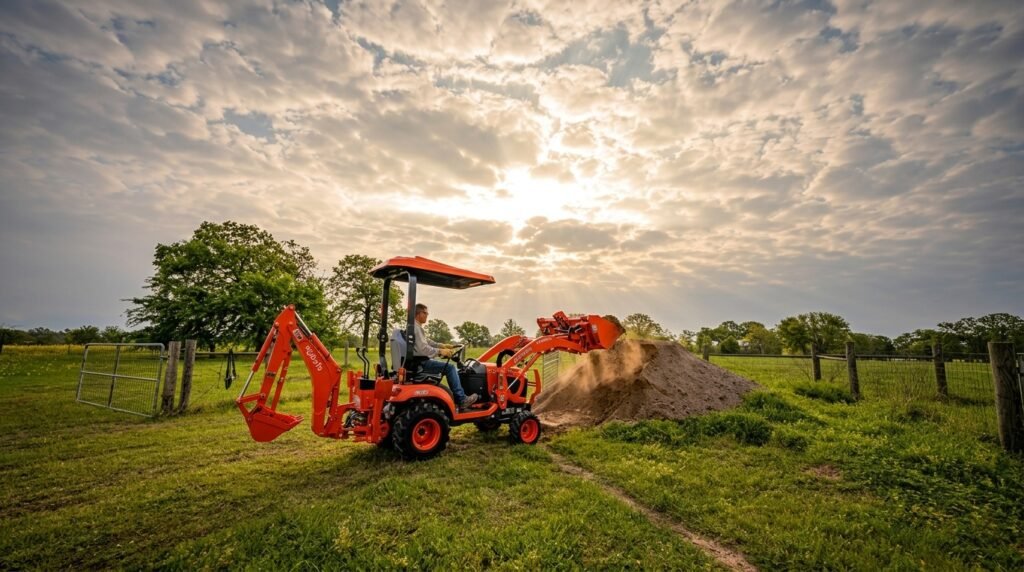
The BX23S suits a range of property maintenance and light construction tasks. The backhoe can dig trenches for drainage, irrigation, and utility lines within its depth and reach limits. It can excavate planting holes, remove small stumps, and handle light demolition work. The loader can move soil, gravel, mulch, and similar loose materials, and it can be used for grading and back-dragging to level ground.
On a hobby farm or small acreage, the BX23S can handle routine tasks such as maintaining driveways, clearing brush, moving feed or bedding, and managing compost. The mid PTO allows the use of a mid-mount mower deck for finish mowing, and the rear PTO can power compatible implements for tilling, cutting, or chipping. The tractor’s compact size makes it easier to work in confined areas than a larger utility tractor, and its four-wheel drive and differential lock provide traction in conditions where a two-wheel-drive machine might struggle.
A concrete example helps illustrate how the machine’s functions work together. Consider a homeowner who needs to install a French drain along the foundation of a house. The backhoe digs the trench. The loader moves the excavated soil to a staging area or into a wheelbarrow. When the drain pipe and gravel are in place, the loader brings soil back to fill the trench. The operator then removes the backhoe using the Swift-Connect system, attaches a box blade or a mower, and returns to routine property maintenance. That sequence is the BX23S’s core competency. It is a focused machine for exactly that kind of work.
Limitations and When a Larger Machine Is Warranted
The BX23S is not a replacement for a larger agricultural tractor. Its 21.6 gross horsepower engine and 17.7 PTO horsepower output are sized for sub-compact work. Heavy draft operations such as plowing, discing, or pulling a large rotary cutter through dense brush are outside the machine’s intended use. The hydraulic flow rate and loader lift capacity also limit the size and type of attachments that can be used effectively.
Buyers who need to move large volumes of material, dig deeper than approximately six feet, or operate heavy implements across many acres should consider a larger utility tractor or a dedicated excavator. A compact utility tractor with 30 to 50 horsepower and higher hydraulic flow would be more appropriate for those tasks. Similarly, a mini excavator would outperform the BX23S for repetitive deep digging or high-volume excavation work.
The BX23S also requires the operator to understand its capacity limits. Overloading the loader, attempting to dig in rocky or compacted soil beyond the backhoe’s capability, or using an implement that exceeds the PTO horsepower rating can lead to equipment damage or unsafe conditions. The operator’s manual and dealer guidance should be consulted for specific operating limits.
Price, Configuration, and What to Confirm with a Dealer
Kubota lists a manufacturer’s suggested retail price for the BX23S starting at $28,061 on its official U.S. product page. That figure is an MSRP, not a transaction price. Dealer pricing, taxes, fees, optional equipment, and regional market conditions can affect the final cost. Buyers should treat the MSRP as a starting point for discussion rather than a guaranteed out-the-door price.
The BX23S is sold as a tractor loader backhoe, but the specific configuration can vary. The three-point hitch is listed as optional on the official product page. Optional equipment such as the mechanical thumb, rear remote valves, and mid-mount mower deck can add to the cost and capability of the machine. Buyers should confirm exactly what is included in the quoted price and what accessories or attachments are optional.
Warranty coverage is another area where the details matter. Kubota’s 2026 U.S. warranty guide distinguishes between home and residential use and commercial use; its limited warranty page also provides the current coverage information. For BX Utility Combos including the BX23S used in non-commercial home and residential applications, the guide lists basic standard limited coverage of 24 months or 1,500 hours, whichever occurs first, and limited powertrain coverage of 72 months or 2,000 hours, whichever occurs first. For commercial use, the guide lists basic standard limited coverage of 24 months or 1,500 hours, whichever occurs first, but does not list a separate limited powertrain warranty period for BX Utility Combos. The warranty guide notes that coverage does not include implements and that separate terms may apply to attachments purchased with the tractor.
Before purchasing, buyers should discuss several practical questions with their dealer. These include the warranty terms and duration for the intended use category, the availability of local service and parts, the maintenance schedule and requirements, and the compatibility of the tractor with the implements they plan to use.
It is also worth considering whether the BX23S is the right machine for the intended workload. A buyer who needs to mow several acres of finish lawn may find that a dedicated mower or a different tractor configuration is more efficient. A buyer who needs to dig many deep trenches may find that a mini excavator or a larger backhoe-equipped tractor is more productive. The BX23S is a capable machine within its class, but it is not the right tool for every job.
For readers comparing sub-compact options across brands, the same questions about loader capacity, backhoe reach, hydraulic flow, and warranty terms apply. John Deere sub-compact tractor review.
Conclusion: Who Should Buy the Kubota BX23S
The Kubota BX23S is a focused solution for property owners and small acreage operators who need a single machine that can dig, lift, and carry. Its backhoe provides genuine digging capability in a package that can still navigate residential properties and confined work areas. Its loader handles routine material movement, and its PTO and hydraulic systems support a range of compatible implements for mowing, tilling, and other light tasks.
The machine is best suited to buyers who understand its limits. It is not a large agricultural tractor, and it should not be expected to perform like one. It is also not a replacement for a dedicated excavator or a full-size loader. Buyers who need to dig deeper than about six feet, move large volumes of material, or run heavy implements across many acres should look at a larger machine.
For the buyer who needs to maintain a few acres, dig drainage trenches, move gravel and mulch, clear light brush, and handle the variety of tasks that come with rural or semi-rural property ownership, the BX23S offers a well-integrated package. The combination of a diesel engine, hydrostatic transmission, four-wheel drive, front loader, and backhoe in a sub-compact frame is a specific capability that few machines in this class can match. Buyers should confirm the exact configuration, attachments, and warranty terms with their dealer before making a decision, and they should be honest with themselves about the size and scope of the work they intend to do.