Diesel Transfer Pumps for Semi Trucks and Tractors
A closer look at tank-mounted 12V pumps and portable fuel transfer kits for commercial trucks, agricultural machinery, and demanding equipment refueling applications.

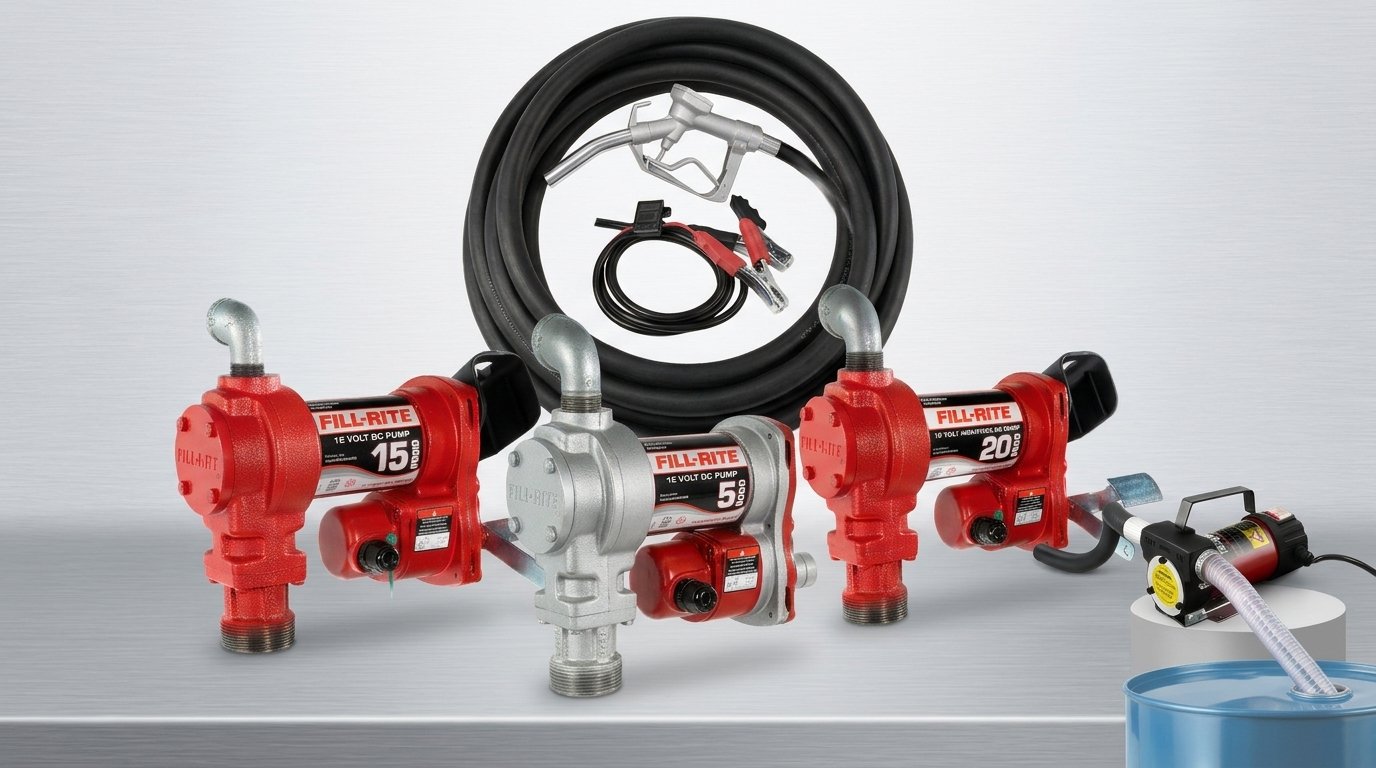
A closer look at tank-mounted 12V pumps and portable fuel transfer kits for commercial trucks, agricultural machinery, and demanding equipment refueling applications.
Diesel transfer pumps solve a problem that anyone running heavy equipment eventually meets: the machine is working in one place and the fuel is somewhere else. A tractor in the middle of a planting window cannot drive to a truck stop every time the gauge drops. An excavator on a grading job is not going to leave the site for a refill. A fleet owner with an on-site storage tank still has to get that fuel into a dozen trucks without spilling it, wasting hours, or paying retail prices for every gallon. In each case the pump is the link between stored fuel and working equipment, and it deserves more attention than it usually gets.
The conditions that make transfer pumps necessary also make a poor choice expensive. Remote fields, barn lots, job sites, and gravel yards offer little tolerance for equipment that overheats, loses prime, or delivers fuel too slowly to be practical. A pump that sits in a toolbox most of the year and then fails on the first cold morning of harvest costs far more than its purchase price. Farmers, contractors, and owner-operators who handle their own fuel know this, which is why the details matter.
This article looks at five 12V diesel transfer pumps available on Amazon.com, a combination of tank-mounted pumps and portable transfer kits. They range from heavy cast iron Fill-Rite units designed for mounting on mobile transfer tanks in trucks and trailers to complete portable kits that can be stored behind a seat. These are editorial observations based on the listing information for each product, not hands-on test results. Specifications and package contents can change, so check the current listing before you buy.
Our Take on Diesel Transfer Pumps for Heavy Equipment
The advertised flow rate is the first number most buyers look at, and it is the least useful number on its own. Gallons per minute describes what a pump can do under ideal conditions with the right hose, the right fittings, adequate voltage, and a short, clean suction path. A real installation rarely matches those conditions. Long hoses, a restrictive nozzle, a tired battery, or undersized wiring will pull a pump well below its maximum. A buyer who chooses the biggest number without thinking about the rest of the system often ends up with a pump that performs no better than a smaller one, while demanding more of the electrical system and the receiving equipment.
Higher flow is also not automatically the right answer. A tractor with a modest fuel tank, or a machine with a filler neck that backs up easily, is better served by a pump that fills at a controlled pace. Fast delivery makes more sense when you are filling large tanks on semi trucks, refueling several machines in a row, or working against a tight schedule. For occasional topping off of a compact tractor, a gentler pump may be easier to manage and better matched to the job.
The distinction between a pump-only unit and a complete transfer kit matters just as much. A pump-only model gives you the motor, the pumping mechanism, and a few basic installation parts. The hose, nozzle, filtration, and any plumbing to the tank are up to you. That is an advantage when you already have quality components or want to build a permanent installation on a truck bed or trailer tank. It is a headache when you expect to unbox the pump and start fueling. A kit that includes a hose and nozzle costs more per unit but removes the guesswork of matching thread sizes, hose ratings, and dispensing hardware. Neither approach is wrong. The mistake is buying one while assuming it works like the other.
Electrical compatibility deserves careful attention. A 12V pump draws real current, and the wiring, fusing, and battery connection have to support that load. Many heavy trucks run 12V systems, but some equipment uses different arrangements, and the condition of the battery and cables varies enormously. Do not assume that a 12V pump will work with every semi truck or tractor. Confirm the actual electrical system on your equipment, size the wiring and protection appropriately, and follow the manufacturer’s installation instructions.
Fuel compatibility is the other point that cannot be left to assumption. Some of these pumps list a range of fuels while another is intended for diesel only and carries an explicit warning against gasoline. Seals, internal materials, and safety considerations all depend on using the right fuel. Check the listing and the manufacturer instructions for the exact fluid you plan to move.
Motor protection and duty cycle belong in the same conversation. Thermal overload protection helps guard a motor against overheating, but it is not permission to run a pump continuously. A portable pump used for a few fill-ups a week lives a very different life from one running through a fleet’s morning refueling. Match the pump to how often and how long you will actually use it.
Fuel quality is a separate subject from fuel transfer. Moving diesel cleanly is one task, while keeping it stable, free of contaminants, and performing well in the engine is another. If you are thinking about the condition of the fuel itself, our guide to Diesel Engine Additives for Heavy Duty Trucks covers that side of the equation. A good transfer pump does not fix bad fuel, and a good additive does not help if the fuel is contaminated on the way into the tank. A filter in the transfer path is a reasonable safeguard for that reason.
Finally, verify the physical details before ordering: tank fittings, outlet sizes, hose specifications, and the mounting arrangement. A pump with a three-quarter-inch port needs matching hardware, and a one-inch pump needs its own. Small mismatches turn into delays and improvised adapters, which are exactly what you want to avoid around fuel.
Fill-Rite FR1204H: A Cast Iron Pump-Only Foundation

- DEPENDABLE & DURABLE PUMP: Made with durable cast iron construction to withstand rough operating environments, every 120…
- EASY INSTALLATION: The fuel pump has a removable junction box that rotates 180-degrees for ease of electrical wiring and…
- PROTECTION AGAINST OVERHEATING: Engineered to exceed the industry’s most stringent safety standards, the pump is constru…
The Fill-Rite FR1204H is a 12V DC fuel transfer pump built around cast iron construction and rotary vane technology. Its maximum flow rate is listed at 15 gallons per minute, or roughly 57 liters per minute. It is designed for mobile installations where the pump is mounted on a truck or trailer tank and powered from the vehicle’s battery.
What sets it apart is the engineering approach. The rotary vane design is a proven way to move fuel, and the pump includes thermal overload protection to help guard the motor. The electrical junction box is removable and rotates 180 degrees, which can make wiring easier in tight mounting locations. The Amazon listing mentions suction from tank depths up to 8 feet and discharge heights up to 37 feet, which gives a sense of the installation flexibility, though real performance depends on the full setup.
This is a pump-only model, and it should not be treated as a complete hose-and-nozzle kit. The package includes a three-quarter-inch street elbow, a ground wire, two wire nuts, and PTFE tape. The hose and nozzle have to be supplied separately. For an operator who is building a fueling station on a flatbed tank or adapting an existing setup, that is perfectly reasonable. For someone who wants to plug in and fuel up, it means additional purchases and planning.
The Amazon listing identifies compatible fuels as diesel, gasoline, kerosene, ethanol blends up to E15, methanol blends up to M15, and biodiesel up to B20. That breadth makes it versatile for operations that handle more than one fuel type, though anyone using it should still confirm the specific fluid and follow the manufacturer’s guidance.
The practical case for the FR1204H is a farm or fleet operation that already owns suitable hoses and nozzles, or wants to choose its own. Its limitations are the extra components required and the need for competent installation. It also draws 12V power, so the battery and wiring on your equipment need to be up to the task.
Fill-Rite FR1210H: The Same Core Pump With the Hardware Included

- DEPENDABLE & DURABLE PUMP: Made with durable cast iron construction to withstand rough operating environments, every 120…
- EASY INSTALLATION: The fuel pump has a removable junction box that rotates 180-degrees for ease of electrical wiring and…
- PROTECTION AGAINST OVERHEATING: Engineered to exceed the industry’s most stringent safety standards, the pump is constru…
The Fill-Rite FR1210H uses the same basic formula as the FR1204H. It is a 12V DC pump with cast iron construction, rotary vane technology, thermal overload protection, and a rotating 180-degree junction box. Its maximum flow rate is also 15 gallons per minute. The Amazon listing for the 1200 series specifies up to 8 feet of suction and up to 37 feet of discharge height, and the pump is designed for mobile installations on trucks and trailers.
The meaningful distinction is the package. The FR1210H includes a discharge hose and a manual nozzle, which the FR1204H does not. That matters most for an owner who does not already have compatible dispensing equipment. Matching a hose and nozzle to a pump is not complicated, but it requires knowing thread sizes, hose ratings, and fuel compatibility, and it often means several orders and some trial and error. A more complete package reduces that friction and gets the system working sooner.
It is worth being careful here. This listing is a specific ASIN, and similar Fill-Rite model numbers can appear in other variants and packages. Verify that you are looking at the exact listing you intend to buy and read the included components closely. The brief for this article identifies a discharge hose and manual nozzle as the defining inclusion, and I would not assume anything beyond that, such as hose length or additional accessories, without confirming it on the listing.
The FR1210H suits the operator who wants a durable, truck-mountable pump and prefers a more complete starting point. It costs more than the pump-only version, which is the trade-off for convenience. If you already own quality hoses and nozzles, you may be paying for items you do not need. If you do not, the added cost can be easier to justify than assembling the parts yourself.
Fill-Rite FR4204H: More Flow, More Responsibility

- DEPENDABLE & DURABLE PUMP: Made with durable cast iron construction to withstand rough operating environments, every 420…
- EASY INSTALLATION: The fuel pump has a removable junction box that rotates 180-degrees for ease of electrical wiring and…
- PROTECTION AGAINST OVERHEATING: Engineered to exceed the industry’s most stringent safety standards, the pump is constru…
The Fill-Rite FR4204H is the high-capacity option in this group. It is a 12V DC pump with a maximum flow rate of 20 gallons per minute, or about 76 liters per minute, which is notably higher than the 15 GPM Fill-Rite units. It shares the cast iron construction, rotary vane technology, and thermal overload protection of the others, and it has a rotating electrical junction box. The outlet connection is one inch, larger than the three-quarter-inch fittings on the other models. The Amazon listing mentions suction from tank depths up to 8 feet and discharge heights up to 37 feet.
This is a pump-only model. The package includes a one-inch street elbow, a five-foot 12-gauge ground wire, two wire nuts, and PTFE tape. As with the FR1204H, compatible hoses and dispensing nozzles must be selected separately. Its listed compatible fuels include diesel, gasoline, kerosene, ethanol blends up to E15, methanol blends up to M15, and biodiesel up to B20.
The higher flow rate can make a real difference when filling large tanks, such as those on semi trucks, or when refueling several machines in succession. It can cut minutes from each fill, and those minutes add up across a busy day. But more capacity is only useful if the rest of the system can handle it. The tank, hoses, fittings, nozzle, electrical supply, and receiving equipment all need to be appropriate for the higher flow. A restrictive nozzle or undersized hose will waste the extra capacity. A weak electrical supply may not keep the pump performing as advertised. A smaller receiving tank may not be suited to rapid filling.
For that reason, the FR4204H is best viewed as a tool for operations that truly need the speed and are prepared to build the installation around it. For occasional use or modest tanks, the extra flow may add complexity without benefit.
AmazonCommercial Diesel Fuel Transfer Pump Kit: A Portable Package

- Heavy-duty fuel transfer pump kit for use with diesel fuel only (do NOT use with gasoline); small compact size for easy …
- Self-priming DC 12-volt motor provides a flow rate of 10GPM (40LPM); low-tension brush motor with intermittent cycling; …
- Safe mechanical seal structure and heavy-duty cast-iron pump chamber; thermal protected; built-in bypass valve time of 3…
The AmazonCommercial Diesel Fuel Transfer Pump Kit takes a different approach. Rather than a permanently mounted pump, it is a portable 12V DC self-priming diesel transfer pump with a maximum flow rate of 10 gallons per minute, or 40 liters per minute. It is built with a handle and a protective steel frame, so it can be carried to the machine rather than bolted to a truck.
The kit is the main attraction. It includes red and black alligator clamp connections, a 13-foot hose that handles delivery and suction, a filter, and an aluminum manual nozzle. The outlet connection is listed as three-quarter inch, and Amazon lists it as universal fit. The product description identifies uses involving work trucks, agricultural equipment, construction sites, boats, and fuel stations. That universal fit claim should be treated with caution, since compatibility ultimately depends on your equipment, tank, and electrical connection. This is a separate product from other AmazonCommercial listings, and the specific ASIN should be confirmed before ordering.
There is one restriction that every buyer should respect. This pump is for diesel fuel only, and the Amazon listing explicitly warns against using it with gasoline. If your operation handles both fuels, that distinction needs to be part of how you store and label the equipment. Mixing up pumps around fuel is a mistake worth designing against.
The practical appeal is simplicity. A portable kit can live in a toolbox or behind a seat and be pulled out when needed. It suits operators who want to move diesel from a drum or auxiliary tank without a permanent installation. Its lower flow rate means fills take longer, and the clamp connections rely on a healthy battery and secure contact. Anyone building a kit of everyday tools might also consider how it fits alongside the equipment covered in Truck Maintenance Tools for Long Haul Drivers, since a fuel transfer setup is another item that rewards organization and regular inspection.
Reywoo 12V Diesel Transfer Pump: An Affordable Portable Option

- Versatile Application: This diesel transfer pump comes with a nozzle, an 82.7″ inlet hose, a 159.4″ outlet hose, and a 3…
- High Efficiency Motor: This Fuel Transfer Pump offers strong suction power with a 12V motor that pumps up to 11.9 GPM, h…
- Safety and Reliability: This Fuel Pump is equipped with an inner bypass valve to prevent motor burnout from clogs, and a…
The Reywoo 12V Diesel Transfer Pump is a more budget-oriented option compared with the Fill-Rite models, and it is also the one with the smallest review history. It is a 12V DC electric fuel transfer pump with a maximum flow rate of 11.9 gallons per minute and a 175-watt motor. The listing gives a maximum suction length of 16.4 feet and a maximum lift of 32 feet.
The package is fairly complete. It includes an 82.7-inch inlet hose, a 159.4-inch outlet hose, an adjustable aluminum nozzle, and a three-quarter-inch NPT fitting. The listing also mentions an internal bypass valve, a metal strainer, a copper motor, a cast steel body, and a mounting base. Amazon lists compatibility with trucks and identifies diesel, kerosene, and transformer oil as compatible fluids.
The lower price compared with the Fill-Rite models is the reason many buyers will look at it first, and for light or occasional use it may be a sensible choice. But it should be presented honestly. Compared with the more established Fill-Rite models, it has far fewer customer reviews, which means less collective evidence about how it holds up over time. A low price does not automatically make a product a better long-term commercial investment, and for an operation that depends on fueling every day, durability and support matter as much as upfront cost.
A pump like this fits an owner who needs a practical, affordable setup for infrequent transfers and is comfortable with the trade-offs. Anyone relying on it for demanding or continuous work should look closely at the listing details and weigh the shorter track record. Even a good portable pump has its limits, and it is no substitute for the preparation described in Roadside Emergency Gear Worth Keeping in a Long Haul Truck. A transfer pump can help move fuel, but it will not solve every situation that arises when a truck is stranded.
Conclusion
The right diesel transfer pump depends on the equipment you run, how often you move fuel, and how you plan to install and maintain the system. A farm with a few tractors and an occasional need to top off from a storage tank has very different requirements from a fleet that fuels trucks every morning. A contractor who moves between sites needs something portable, while an operator with a dedicated fuel tank on a trailer needs something that mounts securely and holds up to regular use.
Those realities should drive the decision, with flow rate following from them rather than leading. Choosing between a pump-only unit and a complete kit then comes down to how much of the installation you are prepared to handle yourself, and the verification work described earlier is what turns a good purchase into a working system.
My own opinion is simple. For a permanent truck or trailer installation that will see regular work, the established cast iron Fill-Rite pumps are the more convincing choice, with the FR1210H making the most sense for buyers who need the hose and nozzle included, and the FR4204H reserved for operations that genuinely need its higher flow. For occasional portable use with diesel only, the AmazonCommercial kit offers a tidy package, and the Reywoo is worth considering for light-duty needs if you accept its shorter review record. Buy for the work you actually do, and the pump will quietly do its job for years.
