John Deere 1025R Review Performance Specs and Practical Uses
A detailed look at the John Deere 1025R’s engine performance, lifting capacity, loader options, and practical capabilities for small farms and property maintenance.

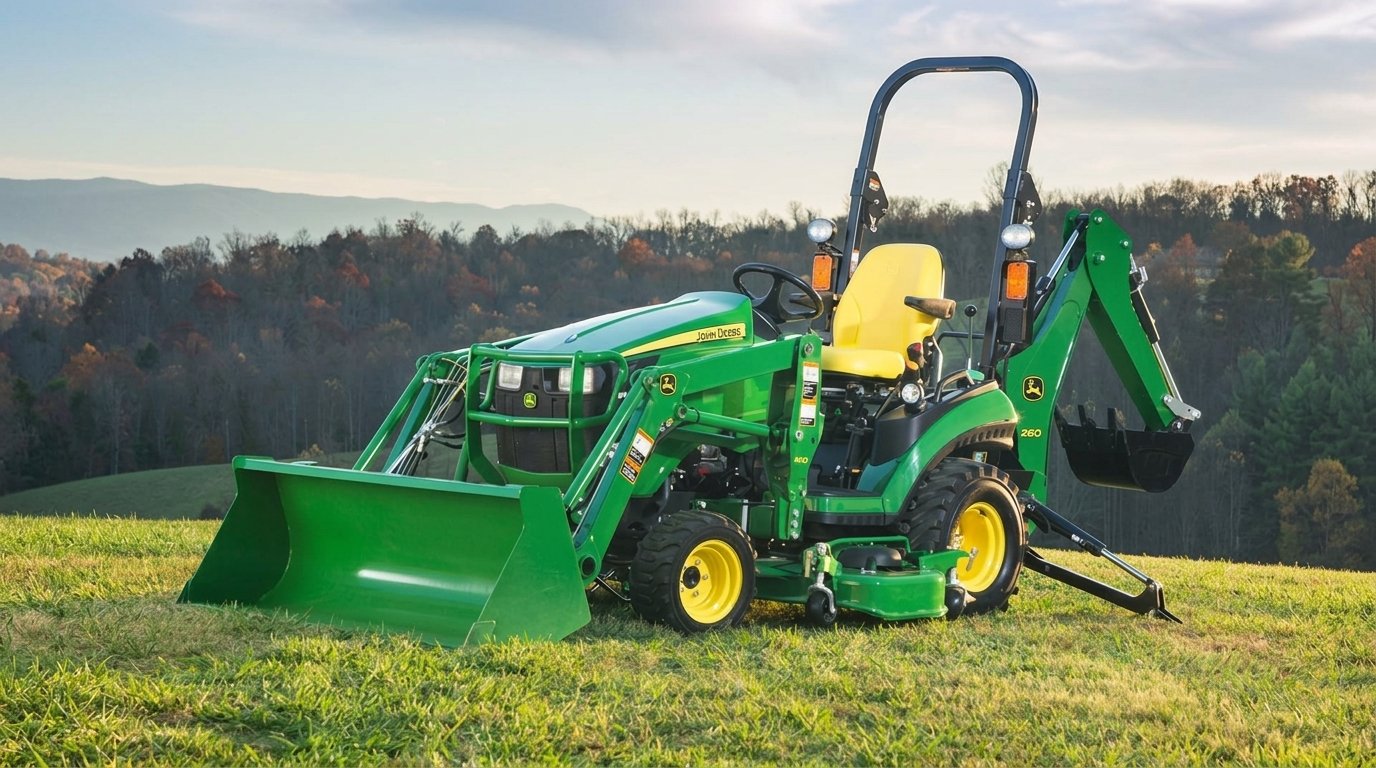
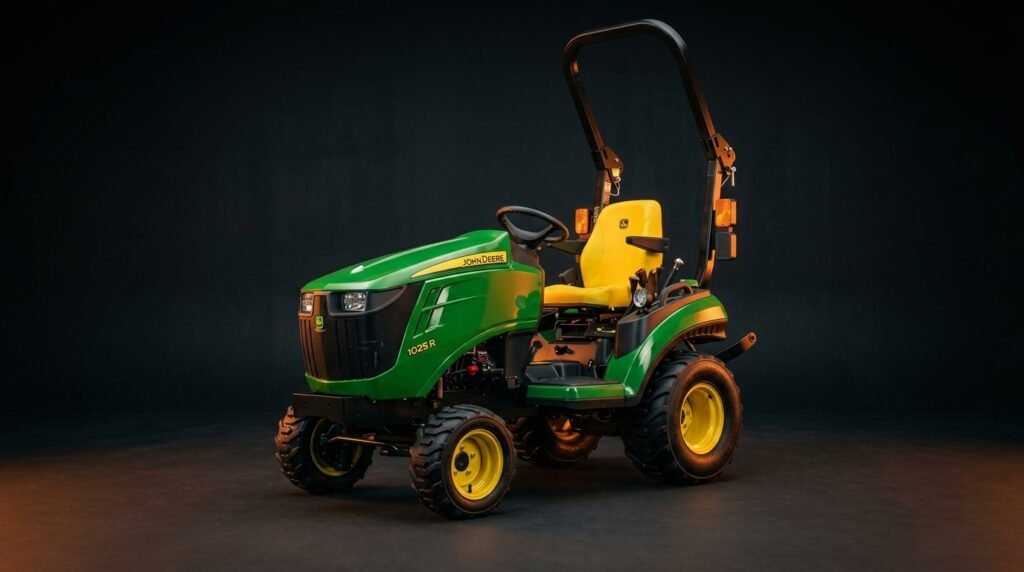
The John Deere 1025R is a subcompact diesel tractor for owners who need more capability than a lawn tractor can offer but do not need the size of a full compact utility tractor. Its appeal combines a three cylinder diesel engine, four wheel drive, a two range hydrostatic transmission, a three point hitch, and compatibility with mowing, loader, and snow removal equipment. On residential acreage, small horse properties, managed grounds, and small farms, that combination can reduce the need for separate machines.
Part of John Deere’s 1 Series, the 1025R is the more feature focused alternative to the 1023E. It remains a small tractor, however, and that matters when assessing its place in the market. It can mow, move loose material, clear snow, maintain a gravel driveway, and operate compatible rear implements, but it is not built for sustained heavy tillage or large draft loads.
Horsepower alone does not explain what the machine can do. Engine output, PTO power, hydraulic flow, hitch capacity, loader configuration, weight, and implement compatibility all matter. This review examines the published specifications and explains their practical meaning. Dimensions and attachment ratings can vary by tire choice, model year, and installed equipment, so buyers should confirm the exact configuration before purchase.
Our Take
The John Deere 1025R makes the most sense for an owner who values maneuverability and versatility more than heavy draft capability. Its hydrostatic transmission is convenient for frequent direction changes, four wheel drive helps maintain traction, and quick attachment systems let owners switch between mowing, loader work, and seasonal tasks. For maintaining property, shifting manageable amounts of mulch or gravel, clearing ordinary snowfall, and grading a driveway, it offers a useful mix of capabilities in a compact package.
Its strengths are tied to a specific workload. The engine is rated at 24 gross horsepower, with 18 horsepower available at the PTO. The Limited Category 1 three point hitch is rated to lift 758 pounds measured 24 inches behind the lift link ends. Those figures support a range of subcompact implements, but do not make the tractor equivalent to a heavier compact utility model. Load position, traction, and an implement’s actual power requirements can matter as much as its listed weight.
The 1025R is less compelling where regular work involves deep tillage, heavy brush cutting, large ground engaging implements, or substantial trailer loads. Its modest weight and hydraulic output can limit productivity compared with a larger machine. Buyers should also account for attachments, since the loader, mower deck, quick hitch, and other equipment may be optional and can raise the total cost significantly.
Engine and Power Output
The 1025R uses a Yanmar 3TNV80F-NCJT diesel engine with three cylinders and a displacement of 1.267 liters, or about 77 cubic inches. Rated engine speed is 3,200 rpm. John Deere lists 24 gross horsepower under SAE J1995 and torque of 39.2 pound feet at rated speed. The engine is naturally aspirated, liquid cooled, and certified to Final Tier 4 emissions requirements. Its dual element air cleaner includes a mechanical restriction indicator.John Deere 1 Series brochure
Gross engine horsepower is not the power delivered to an implement. The 24 horsepower figure describes the engine’s rated output under the stated measurement standard. Power is consumed by the drivetrain and other systems before it reaches the PTO, so the rated PTO output is the more relevant figure when choosing PTO driven equipment. John Deere lists 18 PTO horsepower. That number should be compared with the implement manufacturer’s minimum requirements, alongside implement weight, size, mounting arrangement, and intended working conditions.
The practical rule is to match implements to the tractor’s usable output, not just its gross horsepower. The engine rating also does not establish a safe towing limit.
Transmission and Drivetrain
The 1025R has a two range hydrostatic transmission with Twin Touch foot pedals for forward and reverse. The system is paired with four wheel drive, power steering, a rear differential lock, wet disc brakes, and standard cruise control. Low range supports slow, controlled work, while high range is more suitable for moving between work areas or mowing when conditions permit.
Hydrostatic drive is useful for front loader work. Filling a bucket, backing away from a pile, turning, and approaching a dump point require frequent changes in speed and direction. Pedal control allows the operator to adjust travel without shifting through fixed gears. The same benefit appears when mowing around trees, posts, and landscape beds. Power steering also helps during close maneuvering, although a loaded bucket changes the forces on the front axle and calls for low speed, careful operation.
Four wheel drive can improve traction on loose, wet, or uneven surfaces. The differential lock helps when a rear wheel begins to lose traction by linking the rear wheels so both can contribute to movement. Neither feature eliminates slipping or makes steep side slopes safe. Tire choice, inflation, ballast, surface conditions, and operating technique remain important. Turf tires may be gentler on lawns, while industrial tires may be suited to mixed surfaces, but selection can affect grip and overall dimensions.
This drivetrain is well suited to frequent speed changes and utility work, not a substitute for a heavier tractor in demanding draft work. Low range lets the operator travel slowly with greater reduction through the drivetrain, but it cannot replace the mass and traction needed for pulling heavy implements through compacted ground.
Power Take Off
The 1025R has independent mid and rear PTO capability. The rear PTO operates at 540 rpm, while the mid PTO operates at 2,100 rpm. John Deere lists 18 PTO horsepower, with wet disc clutch and brake arrangements. The mid PTO powers compatible mid mount mower equipment. The rear PTO can power appropriately sized tillers, cutters, snow blowers, and other supported implements.
PTO speed and horsepower are only part of implement selection. Equipment must also match the tractor’s mounting system, driveline requirements, dimensions, and power capacity. A mower that is too wide may struggle in tall grass; a tiller can demand considerably more power in hard ground; and a snow blower’s load changes with snow depth and moisture. Follow the implement maker’s compatibility information and minimum power requirements instead of assuming that everything with a compatible hitch will work properly.
The independent PTO arrangement offers flexibility when the tractor slows or pauses during work, provided operation follows the manual. Having mid and rear PTOs broadens the range of potential tasks, but each attachment must be approved for the configuration and combined power demand must stay within the tractor’s capability.
Hydraulic System
John Deere lists total hydraulic pump output at approximately 6.3 U.S. gallons per minute and maximum operating pressure at 2,000 psi. The system is open center. Published specifications also show steering and implement flow figures, but these should be checked against the exact model documentation rather than added together as if they were necessarily delivered simultaneously. The total pump output is not a promise that all flow is available to the loader or an auxiliary attachment at once.
Hydraulics operate the front loader and support compatible functions on other implements. Flow affects cylinder speed, while pressure and mechanical geometry affect force. For ordinary property work, the system is matched to the loader and attachments the tractor is designed to use. Repeated loading cycles may feel slower than on a larger tractor with more hydraulic flow. Attachments that require sustained high flow may be unsuitable, even if a physical connection can be made.
John Deere documentation lists about 3.25 U.S. gallons for the combined transmission and hydraulic system on the base tractor without implements. That is the system’s fluid capacity, not a separate hydraulic reservoir to be counted as an additional tank. Owners should follow the operator’s manual for checking fluid, replacing filters, and servicing their particular model and attachments. The open center design suits the tractor’s intended jobs, but it is not meant to power every high flow function used on larger equipment.
Three Point Hitch and Lift Capacity
The rear hitch is a Limited Category 1 three point hitch. John Deere lists lift capacity at 758 pounds measured 24 inches behind the lift link ends. The measurement point matters because a load farther behind the hitch creates greater leverage. A rating measured at the link ends is not directly comparable to a rating measured behind them. Buyers should compare capacities only when the measurement method is the same.
Weight, length, center of gravity, working depth, and operating resistance all affect an implement’s suitability. Something below the published lift rating may still be unsuitable if it creates excessive leverage, is too large, or demands more power than the tractor can provide. Check both tractor and implement manuals.
The Limited Category 1 designation is another reason to confirm compatibility. Some standard Category 1 implements may need adjustments or may not be appropriate for this tractor. A compatible quick hitch can simplify connections, but it does not increase lift capacity or make an incompatible implement safe. Position control helps the operator return the hitch to a selected height for repeatable positioning and grading. It should not be confused with increased lifting power or automatic draft control.
Front Loader and Attachment Options
The John Deere 120R loader is a common match for the 1025R and uses the Quik-Park system for tool free attachment and removal. John Deere’s compatibility information lists 517 pounds of lift capacity for the non self leveling 120R on the 1025R and 680 pounds for the 120R mechanical self leveling version on this tractor. The compatibility chart lists different figures for the 2025R, so those higher figures should not be attributed to the 1025R. Loader ratings also depend on the measurement point. A rating measured at the pivot is not directly comparable with one measured farther forward, where the load creates greater leverage.
The listed lift height is 72 inches for the 1025R with the 120R. Height alone does not determine whether the loader can reach a particular trailer or wall. Bucket shape, dump angle, material density, load position, and capacity at the relevant point all matter. A bucket of dry mulch is a different load from an equally full bucket of wet soil or gravel. Operators should never assume that a bucket can safely be filled with any material simply because it fits.
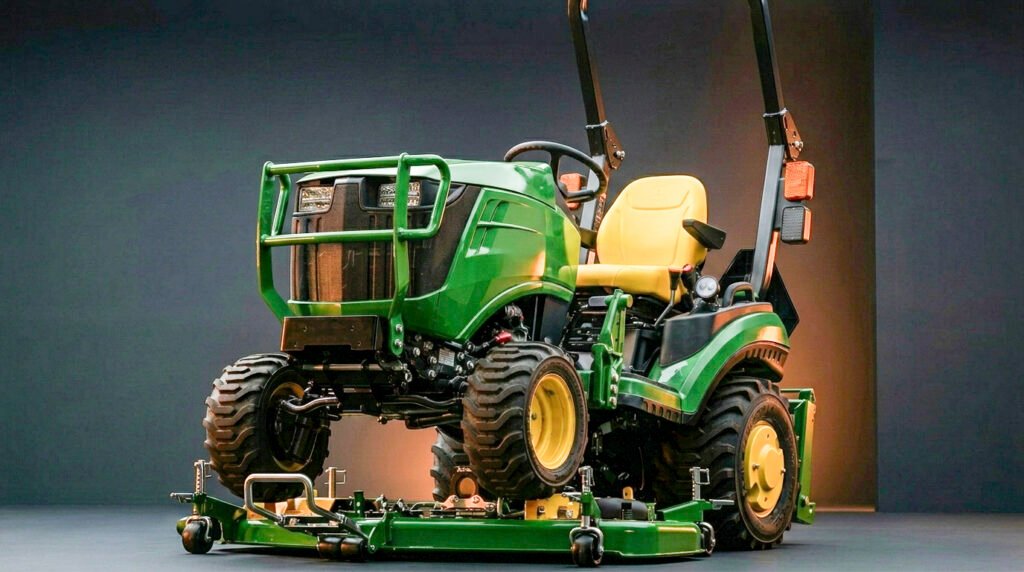
The loader is intended for manageable material handling such as moving mulch, compost, gravel, and snow within the tractor’s limits. Quik-Park simplifies removal when the loader is not needed. AutoConnect supports quick changes with compatible mid mower decks, while iMatch can simplify connection of compatible rear implements. Availability depends on the package, so distinguish the base machine from optional accessories.
Attachment flexibility is one of the 1025R’s main strengths, but compatibility is not universal. Before buying a mower, blade, tiller, snow blower, or another tool, confirm the exact model, required attachment system, weight, and power demand.
Towing and Pulling Capability
A single maximum towing capacity should not be assigned to the 1025R unless it is explicitly supported by the applicable manufacturer documentation. The published specifications reviewed for this article do not establish a universal trailer weight that is safe across every load, hitch, surface, and slope. The operator’s manual for the particular tractor and the requirements of the trailer or implement should guide any decision. Gross engine horsepower, loader lift capacity, and three point hitch lift capacity are not substitutes for a towing rating.
Lifting, pulling, and towing are different operations. Hitch capacity and load leverage affect lifting. Pulling depends on traction, drawbar force, soil, and implement resistance. Towing adds trailer brakes, tongue load, downhill control, and the tractor’s ability to maintain steering and traction.
The tractor’s relatively low weight limits traction compared with a heavier machine. Four wheel drive does not eliminate the risk of a trailer pushing it on wet grass or downhill grades. Those who regularly move heavy trailers should consider a larger tractor or a suitable towing vehicle, and confirm model specific instructions before towing.
Dimensions, Weight, and Fuel Capacity
Published specifications for the open station 1025R with R4 tires list a wheelbase of 57.1 inches, an overall length of about 108.3 inches, and maximum width of approximately 47.3 inches. Height depends on the measurement point and the position of the rollover protective structure; a figure around 91 inches is associated with the ROPS raised on the relevant configuration. These measurements should not be confused with the overall dimensions of a tractor fitted with a loader, backhoe, mower deck, or other attachment. Tire choice and installed equipment can change the dimensions that matter for storage and access.
The compact footprint helps around buildings and landscaped areas, but a width near 47 inches will not fit through every garden gate. Measure access points before buying. Power steering and the short wheelbase help in close maneuvering, although the tractor is not as agile as a zero turn mower around numerous obstacles.
John Deere lists fuel tank capacity at 6.3 U.S. gallons, or approximately 23.9 liters. Fuel consumption depends on engine speed, implement, material, terrain, and work intensity. Tank capacity helps with refueling plans, but does not guarantee a set number of working hours per tank. Owners should monitor fuel during extended work and follow the manufacturer’s recommendations for diesel fuel and cold weather operation.
The published base weight for the open station tractor is approximately 1,556 pounds. A loader, mower, backhoe, ballast, and other equipment add weight and change weight distribution. Ballast should follow manufacturer guidance because it affects axle loads and stability.
Operator Comfort, Safety, and Maintenance
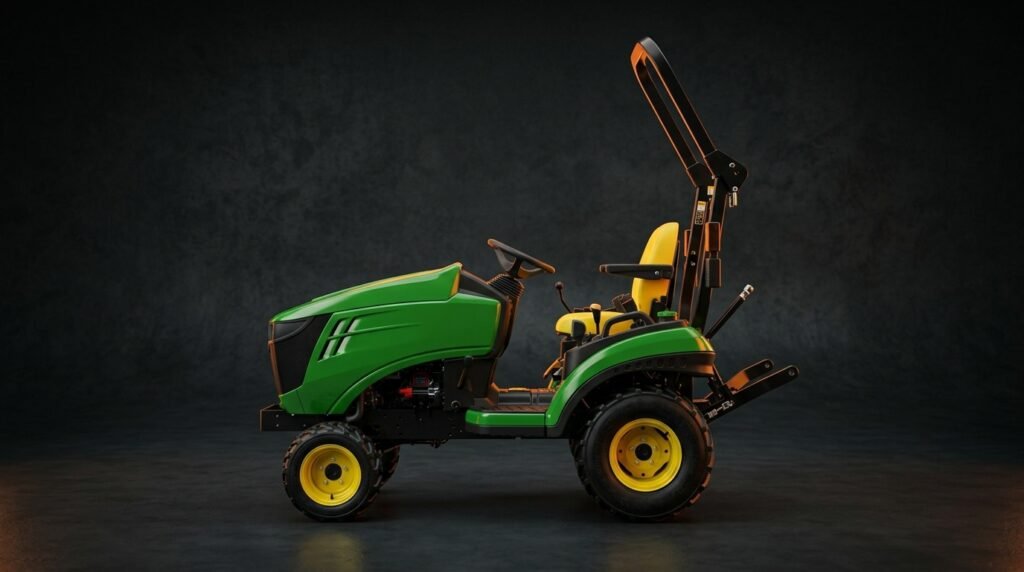
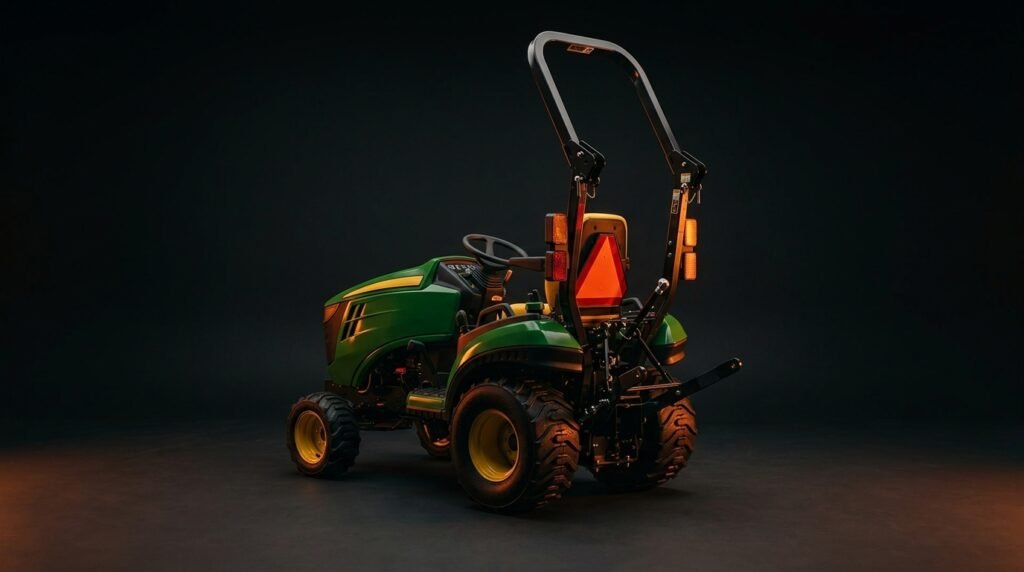
The 1025R has an open operator station with a deluxe seat, suspension, armrests, and a semi flat platform with a rubber floor mat. The layout is intended to support frequent direction changes and implement use. The folding rollover protective structure and seat belt are important safety features, and they should be used according to the operator’s manual. Folding the structure changes the available rollover protection, so it should only be handled as directed by the manufacturer.
A supported seat, accessible controls, and power steering can reduce fatigue during long work sessions. They do not make unsafe conditions acceptable. Keep loader loads low while traveling, avoid sharp turns with a raised bucket, and follow the manual’s guidance for slopes, ROPS, seat belt use, and bystander clearance.
Routine service is part of tractor ownership. Engine oil, filters, the air cleaner, coolant, transmission and hydraulic fluid, and other service points need inspection and maintenance at the intervals specified by John Deere. The dual element air cleaner and restriction indicator are useful when working in dusty conditions. Service intervals depend on the manual and duty cycle. The tractor should not be described as maintenance free, and used buyers should review service records and inspect for leaks, worn pins, tire damage, and evidence of neglected maintenance.
Before work, confirm correct attachment installation, guards, PTO status, and load limits. Quick connect systems save time but do not replace checks of locking points, driveline connections, and hydraulic couplers.
Practical Suitability for Property Work
For finish mowing, the 1025R can replace a separate mower when a property also needs loader and hitch work. Results depend on grass height, terrain, deck width, blade condition, and ground speed. Tall or wet grass may require a slower pace.
For loader work, the 1025R is best considered a machine for moderate jobs rather than high volume material handling. It can move manageable quantities of soil, mulch, compost, snow, or gravel, but material density matters. Gravel and wet soil become heavy quickly. Overfilling the bucket can reduce steering control, stress components, and create a stability risk. Several sensible loads are usually better than trying to finish in as few trips as possible.
A compatible front blade or snow blower can extend its usefulness beyond mowing season, although four wheel drive does not remove the hazards of snow and ice. A correctly sized box blade, rear blade, or tiller can suit light driveway and garden work. Deep tillage, hard packed soil, and large rotary cutters may call for more weight, hitch capacity, and PTO power.
The 1025R is most useful where tasks change regularly and the operator values easy handling. Buyers should identify their common jobs, heaviest implement, and typical loads, then check the applicable ratings before choosing.
Conclusion
The John Deere 1025R is a capable subcompact tractor for owners who need one machine to mow, move moderate amounts of material, clear snow, maintain a driveway, and operate compatible light implements. Its diesel engine, hydrostatic transmission, four wheel drive, independent mid and rear PTO, and attachment options give it flexibility beyond that of a garden tractor.
The 18 PTO horsepower, Limited Category 1 hitch, modest hydraulic output, and relatively light chassis restrict implement size and sustained workload. Loader capacity depends on the exact configuration and measurement point, while towing suitability cannot be inferred from engine power or lifting ratings. Buyers should confirm attachment specifications and consult the operator’s manual for the intended work.
For routine property maintenance and light utility work, the 1025R offers a useful blend of maneuverability and attachment flexibility. Frequent heavy tillage, substantial draft work, large trailers, or high volume material handling may justify a larger compact utility tractor. The best choice is the machine that fits the workload rather than the one with the most appealing brochure. Used within its limits and paired with suitable implements, the 1025R can be a practical tool for small properties and light duty farm tasks.