Reefer Trailers Design Dimensions and Cooling Systems
A technical look at insulated bodies, refrigeration units, airflow, floors, and the weight rules that shape every load.

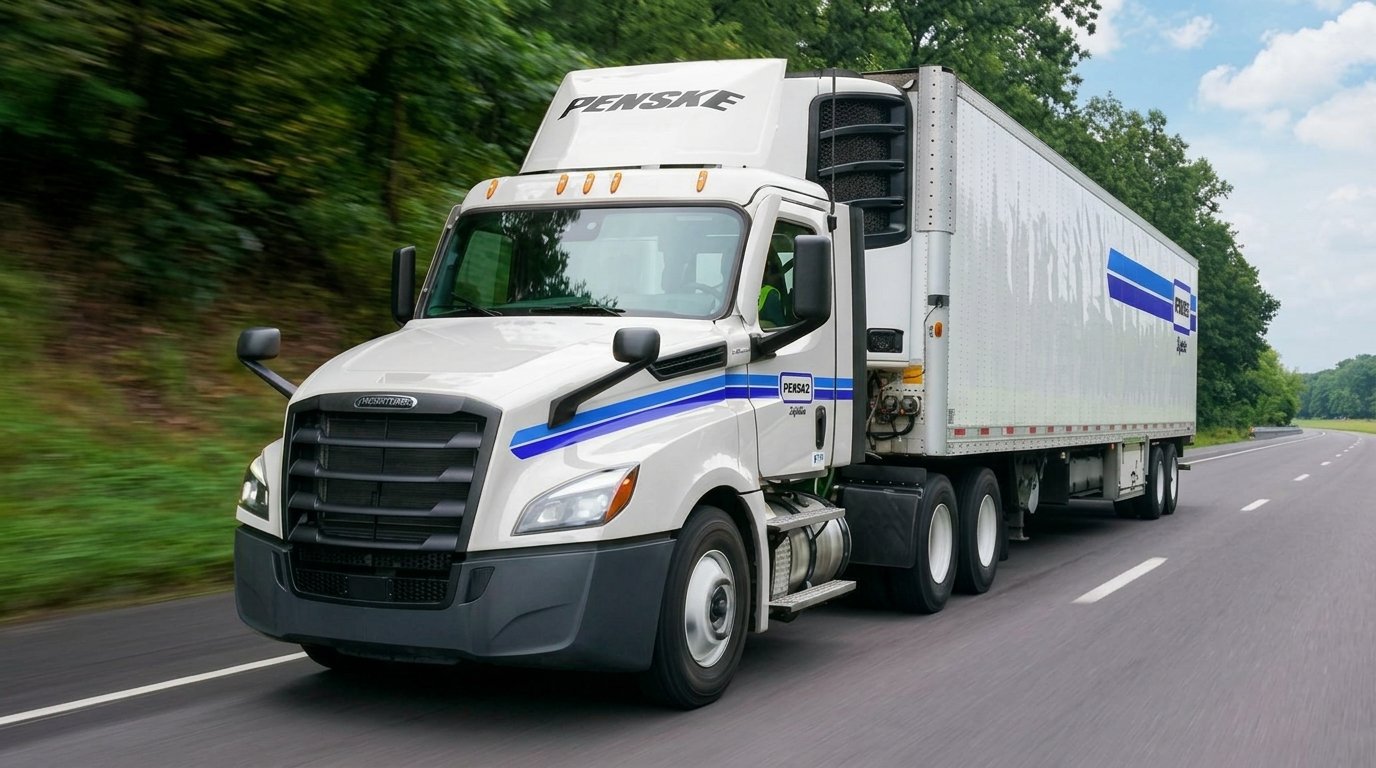
Reefer Trailers carry a large share of what American households eat and take for granted, and the equipment does its best work when nobody notices it. A load of produce, dairy, frozen protein, or pharmaceuticals leaves one climate and arrives in another, and between the two sits an insulated box with a refrigeration unit on its nose. That box has to hold a narrow cargo environment while outdoor temperatures swing, the road works against the load, and dock doors open and close through the day. Long-haul lanes, regional distribution networks, and grocery and foodservice supply chains all depend on it. The challenge is not making cold air. It is keeping the cargo space stable while everything around it keeps changing, and that is a question for the whole trailer, not one component.
Our Take
The most common mistake in evaluating a reefer trailer is treating the refrigeration unit as the product. It is the most visible and expensive component, so it gets the attention, but it only adds and removes heat. How long it has to run, how evenly it can cool, and how much fuel it burns all depend on what the unit does not control: insulation thickness and condition, door seal integrity, airflow paths, and a floor that survives daily forklift traffic.
A buyer who compares only price and unit model is comparing the easiest parts of the answer. Two trailers with identical refrigeration equipment can behave very differently after a few years if one keeps moisture out of its foam and the other slowly absorbs water, or if one floor stays flat while the other develops low spots that choke airflow. Maintenance access matters too, because a trailer that is hard to inspect tends to go uninspected.
It is just as important to say what even an excellent system cannot fix. A technically advanced unit will not rescue warm product, a torn door seal, or pallets stacked against the evaporator inlet. The equipment maintains a condition. It does not manufacture one out of poor practice.
Finally, reefers are not right for every operation. They add purchase cost, tare weight, fuel burn, and maintenance complexity that only make sense when the freight needs temperature control. A fleet hauling shelf-stable goods is better served by a dry van.
A Reefer Is More Than a Dry Van With a Cooling Unit
A refrigerated semitrailer starts with the same basic job as a dry van, enclosing freight behind rear doors, but nearly everything else diverges. The walls, roof, floor, front wall, and doors are insulated, usually with polyurethane foam, and the interior is lined so it can be cleaned and so moisture stays out of the insulation. A dedicated refrigeration unit mounts at the front and conditions the air circulated through the cargo space. The tractor still supplies the air and electrical connections the trailer needs to travel, but the unit generally brings its own power. Whether that is a diesel engine, a diesel-driven generator, or an electric standby connection varies by manufacturer and model.
Setpoints vary too. Fresh produce, dairy, frozen foods, and pharmaceuticals call for different conditions, and some units can heat as well as cool to protect cargo from freezing. The shipper defines the requirement, and the trailer is specified to hold it. For readers comparing equipment more broadly, Haulizo’s Truck Trailers section covers the other configurations.
Reefer Trailer Dimensions and Published Specifications
Long-haul refrigerated trailers generally come in 48-foot and 53-foot lengths, about 8.5 feet wide and about 13.5 feet tall, which mirrors dry vans on the outside. The inside tells a different story. Insulation, liners, wall posts, and flooring all take up space, so interior length, width, and height are smaller than the exterior figures and cargo volume shrinks with them. A reefer rarely matches a comparable dry van on cube.
Hyundai Translead’s published ThermoTech configuration shows the pattern. The 53-foot version measures 53 feet outside and 52 feet 2 inches inside, and 102.36 inches wide outside against 97.4 inches inside, lining to lining. Exterior height is 13 feet 6 inches against an interior height of 105.5 inches, with 3,722 cubic feet of interior volume. Hyundai lists a GVWR of 68,000 pounds, a standard weight of 11,950 pounds excluding the refrigeration unit, and a standard floor rating of 20,000 pounds.
Utility’s 3000R reference specification lists a 53-foot overall length, 102⅜ inches overall width, 97½ inches inside width at the wearband, 104⅛ inches inside height, and 13 feet 6 inches overall height. It also lists a 65,000-pound GVWR and a 55,000-pound payload figure. Both are manufacturer-specific configurations, not universal reefer specifications, and neither payload figure guarantees what a given truck can legally haul.
Insulated Body Construction and Thermal Protection
Heat reaches the cargo through every surface, so a reefer body is built as a thermal envelope. Sidewalls, roof, front wall, floor, and rear doors all carry insulation, and the structure holding the box together becomes a weak point because metal conducts heat far better than foam. Builders respond with thermal breaks, tight perimeter seals, and skins and liners that protect the foam. Thickness varies by surface. Hyundai lists two inches of injected urethane in the sides, floor, and roof, three in the rear doors, and four in the front wall. Utility’s published figures show two inches in the sidewalls, three in the floor, roof, and rear doors, and four at the front wall.
Polyurethane foam is the usual material, and how it gets into the body matters. Utility describes a foam mandrel process that foams the finished shell as one continuous envelope. Wabash builds its Acutherm vans with EcoNex, a molded structural composite with a foam core inside a polymer fiber-reinforced shell. Great Dane’s Everest uses layered walls with puncture-resistant liners and offers a composite ThermoGuard liner as an option. These are different engineering answers to the same problem, and none is universally superior.
Moisture is the shared concern. Water that reaches foam adds weight and reduces insulating value, so moisture barriers and interior liners are part of the thermal system, not trim. Seams, penetrations, and damaged liners are the usual entry points, and the damage often shows up slowly as longer unit run times rather than one dramatic failure.
The Transport Refrigeration Unit
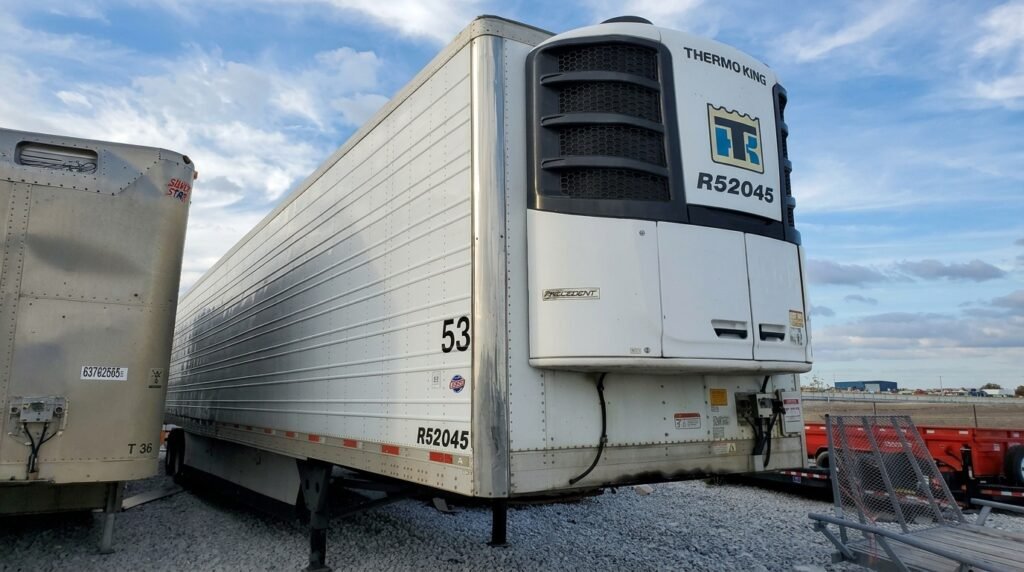
The transport refrigeration unit, or TRU, sits on the front wall and does the active work of temperature control. It monitors conditions, circulates air through the cargo space, and adjusts its output as the thermal load changes with ambient temperature, door openings, and cargo condition. The front wall is built around it. Hyundai lists a heavy-duty mounting frame and bracing for a nose-mounted unit, and Utility lists additional steel support posts for the unit.
Power architecture is where units differ most, and the types should not be treated as interchangeable. A conventional diesel unit uses its own engine to drive the refrigeration system. Diesel-electric designs use the engine to drive a generator that powers electric components. Electric standby lets a unit run on external power while parked. Thermo King describes its Precedent family as built on a Diesel Direct Electric architecture, with single-temperature and multi-temperature models in its C and S series. Carrier Transicold’s Vector 8500 is a single-temperature diesel unit that pairs an engine with a direct-driven generator for an all-electric refrigeration system, with built-in electric standby for stationary operation.
Unit makers and trailer makers are usually different companies. Trailer manufacturers build the insulated body and running gear and prepare it for a unit, while Thermo King and Carrier build the unit itself. That split is why unit service networks and trailer warranties are separate questions at purchase.
How the Refrigeration Cycle Works
Inside the unit, a vapor-compression cycle moves heat out of the trailer. The compressor raises the pressure and temperature of the refrigerant vapor. That hot vapor flows to the condenser, where outside air removes heat and the refrigerant condenses into a liquid. The liquid passes through an expansion device, which sharply reduces its pressure and temperature. The cold refrigerant then moves through the evaporator, where it absorbs heat from trailer air flowing across the coil, evaporates, and returns to the compressor to begin again. The loop repeats for as long as the controller calls for cooling.
Airflow is a separate system layered on top of that loop. Evaporator fans pull return air across the coil and push cooled supply air back out, while condenser airflow carries rejected heat away. Temperature sensors report supply and return conditions to an electronic controller, which adjusts the unit toward the setpoint. Frost builds on the evaporator coil during cooling, so the controller periodically runs a defrost function to clear it. The refrigeration cycle makes the air cold. The distribution system decides whether that cold air reaches the cargo.
Air Distribution and Temperature Uniformity
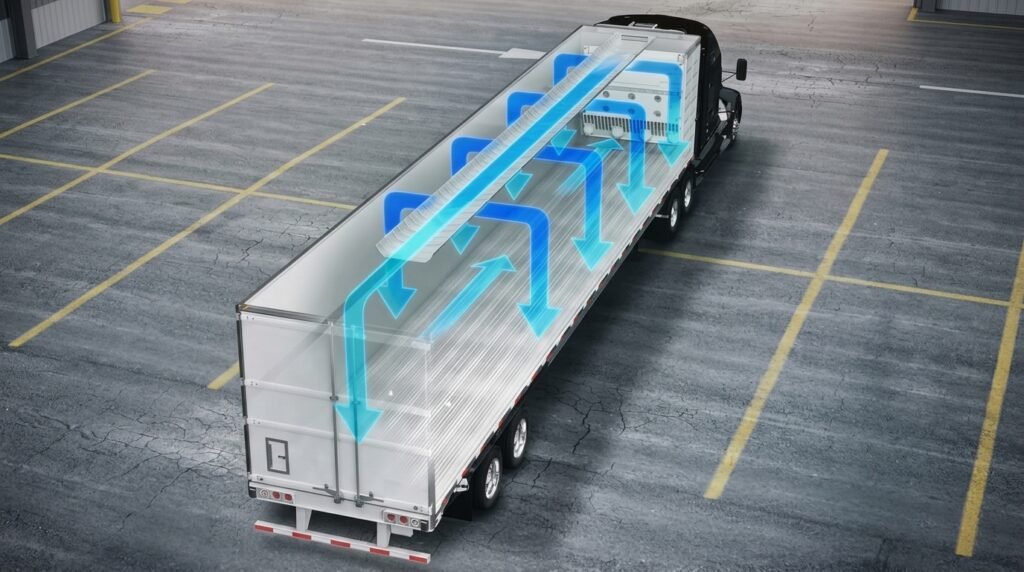
Cold air at the front wall says nothing about the temperature at the rear doors. Uniformity depends on supply air reaching the full length of the cargo space and returning to the unit without short-circuiting. In a common arrangement, the unit discharges air into a ceiling channel or air chute, the air moves through and around the load, and it returns toward the front along the floor. Airflow configurations vary between trailer manufacturers and refrigeration systems, so the design belongs to the specific pairing.
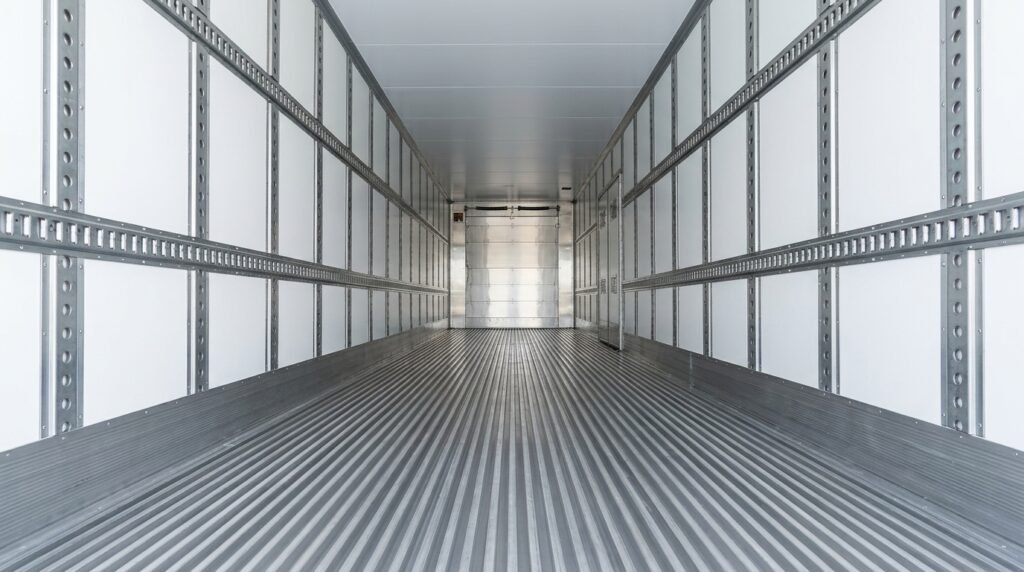
The floor is part of this system. T-floor and aluminum duct floor designs include channels that give return air a path beneath the cargo, and those channels only work while unobstructed. Loading practices undo them quickly. Pallets pushed against the nose block the evaporator inlet, loads stacked to the roof choke the ceiling channel, and wrap or pallet bases can cover floor channels. Tightly packed cartons force air around the load instead of through it, leaving warm pockets in the center. Pallet spacing, packaging, and load height are airflow decisions as much as space decisions.
Flooring and Load-Bearing Structure
A reefer floor has two jobs that pull against each other. It must carry concentrated forklift and pallet jack loads, and it must let air move beneath the cargo. Aluminum duct flooring handles both with extruded sections whose profile creates air channels while resisting load. Grocer-style arrangements differ in how they support cargo and route air, which is why flooring is usually specified to suit the operation.
Utility’s 3000R specification shows how detailed this gets. It lists a 1½-inch extruded aluminum high-wear floor rated at 20,000 pounds, an integral 10-inch aluminum wearband, crossmembers on 12-inch centers, a reinforced bearing grid at the rear where forklifts enter, aluminum troughs, and drains at the front and rear. Floor rating, GVWR, and payload answer different questions. A floor rating typically describes concentrated loading from lift equipment, GVWR is the trailer’s total rated weight, and payload is what the freight may weigh.
Floors wear. Forklift traffic, pallet jacks, standing water, road salt, and deferred maintenance cause corrosion at joints, damaged wearbands, and deflection that hurts both strength and airflow. Clogged drains leave moisture where it does the most harm.
Doors, Seals, and Rear Access
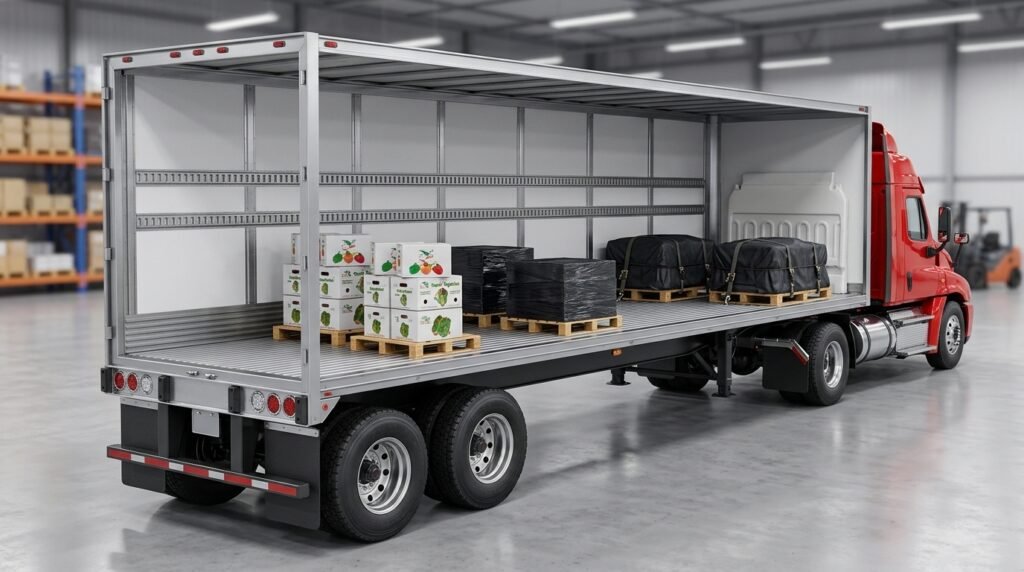
Rear swing doors remain the standard on most over-the-road reefers because they give full-width dock access and carry insulation of their own. Each door hangs on hinges and closes with lock rods that pull it against a perimeter compression seal. Hyundai specifies aluminum-framed swing doors with dual-durometer seals, four hinges and one anti-rack lock rod per door, set in a stainless steel rear frame. Great Dane describes a triple seal gasket and a low-profile blade lock that applies pressure along the door’s full height. Utility’s Barrier Door uses a bonded foam design.
The seal matters because a gap lets in warm, humid air, which adds load to the unit and can leave moisture frozen on the evaporator and cargo. A damaged seal at a bottom corner can cost more over a season than a minor mechanical fault. Dock impact is the usual cause, so rear-frame strength, stainless steel components, and rubber dock bumpers earn their place. Doors should stay closed in transit, and open time at the dock should be kept short.
Side doors and roll-up rear doors are application-specific options. Hyundai offers both, and Great Dane offers side-door placement options. They add access for multi-stop work, but they also add perimeter to seal and hardware to maintain.
Single-Temperature and Multi-Temperature Configurations
A single-temperature trailer holds one setpoint throughout. A multi-temperature trailer divides the cargo space with insulated partitions or movable bulkheads so compartments can run at different conditions, using a unit and airflow arrangement designed for the job. Thermo King describes insulated bulkheads that separate a trailer into zones with their own setpoints.
Great Dane states that the Everest Multi Temp can be configured with up to three temperature-controlled compartments plus an additional ambient section. Hyundai lists optional load partitions on the ThermoTech, and Utility offers a 3000R Multi-Temp with its own partition system. Compartment counts and refrigeration capabilities differ by design, so one manufacturer’s three-zone layout says nothing about another’s.
The benefit is straightforward. One trailer can serve a store with frozen, fresh, and dry goods in a single delivery, which cuts trips and consolidates stops. The cost is complexity. Loading plans must account for zone placement and delivery order, airflow must be preserved in each compartment, partitions and their seals need inspection, and a fault can affect several products at once. Multi-temp equipment rewards operations with genuinely mixed loads and penalizes those without them.
Pre-Cooling, Setpoints, and Loading Practices
Two kinds of pre-cooling get confused. Trailer pre-cooling means running the unit on the empty trailer so the interior is at temperature before loading begins. Product pre-cooling means the cargo is already at its required temperature when it goes on. The first is a fleet practice. The second is a shipper responsibility, and it is the one that most often goes wrong.
A refrigeration unit is designed primarily to maintain a cargo environment, not to pull heat out of warm product. Load warm freight and the unit can run hard for hours without bringing the load to temperature. Setpoints should follow the shipper’s product requirements and applicable food-safety rules, not a universal reefer number.
Drivers and dispatchers watch supply-air and return-air readings, which show what the unit is delivering and what the cargo is giving back. Temperature recorders, sensors, and telematics build a record that can settle disputes, and a shipper’s cargo profile can set the plan. Loading finishes the job. Keep freight off the nose, preserve ceiling clearance, avoid blocking floor channels, respect any load-limit markings, and leave room for air to circulate through and around the load.
Weight, Payload, and Federal Limits
Tare weight is the empty trailer. GVWR is the manufacturer’s rated maximum for the loaded trailer, and GAWR is the rating for each axle group. Payload is the freight, and gross combination weight is tractor, trailer, fuel, and freight together. Axle weight distribution describes how that total lands on the steer, drive, and trailer axles.
Reefers weigh more than dry vans, and published figures show only part of why. Hyundai’s 11,950-pound standard weight excludes the refrigeration unit. Carrier lists a Vector 8500 at approximately 1,810 pounds, with its remote 50-gallon fuel tank and brackets at 65 pounds and a battery at 50 pounds. Insulation package, flooring, axle configuration, and options such as side doors push the final figure higher.
Federal law frames what may legally travel. On the Interstate System, a single axle is generally limited to 20,000 pounds, a tandem axle group to 34,000 pounds, and gross vehicle weight to 80,000 pounds. The Federal Bridge Formula adds another check. It limits the weight on any group of consecutive axles based on the number of axles and the distance between the outer ones, so a load that passes the axle and gross limits can still be illegal if the axles are too close together. The FHWA’s own worked example shows an 80,000-pound five-axle truck failing on its rear four axles for exactly that reason.
Grandfathered state exceptions, state regulations, permits, and route restrictions can change what is legal on a given route. GVWR and advertised payload do not decide how much freight can be carried. Utility’s 55,000-pound payload reference illustrates the point, because once tractor, trailer, unit, and fuel are counted, the 80,000-pound limit typically leaves less room for freight than that figure suggests.
Axles, Suspension, Brakes, and Running Gear
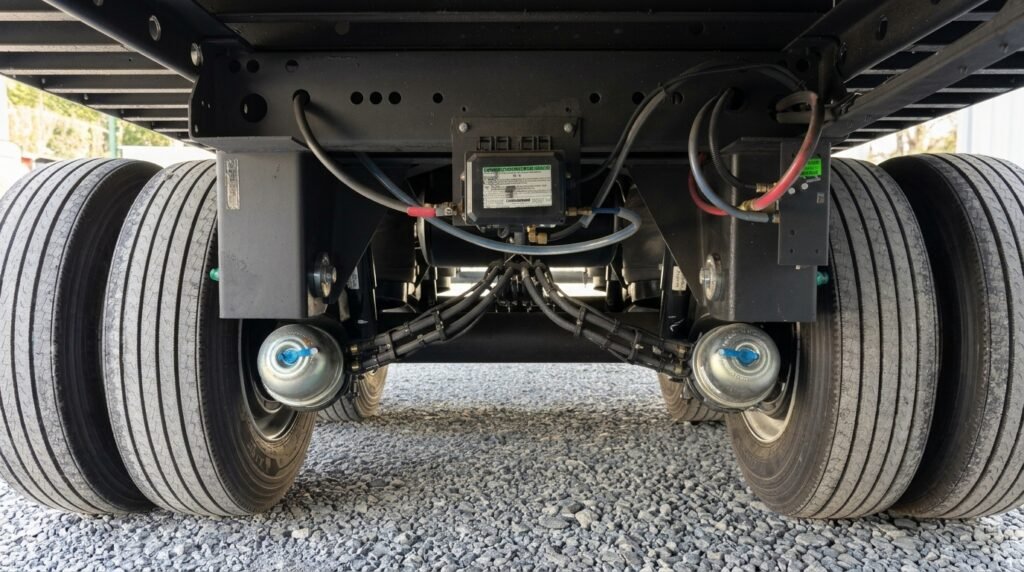
Under the box, the running gear carries the load and controls the trailer. A tandem axle assembly supports the rear weight, often on a sliding subframe so axle position can shift weight between trailer and tractor axles and help meet bridge formula limits. Air springs support the load, shock absorbers damp motion, and wheels, hubs, bearings, and tires turn it. Brake chambers drive slack adjusters that apply drum brakes, or air disc brakes where specified, while ABS monitors wheel speed to prevent lockup.
Utility’s 3000R specification gives a concrete example: a Hendrickson ULTRAA-K air ride slider with 49-inch axle spacing and 96 inches of slider travel, Bendix TABS-8 ABS with roll stability, 16½-by-7-inch drum brakes, and 295/75R22.5 tires. Hyundai lists air disc brakes and factory tire inflation systems as options. Options are not standard equipment and should be confirmed against the specific trailer’s build sheet.
Air-ride suspension is widely used for temperature-sensitive and damage-sensitive freight because it softens shocks that shift pallets, though suspension choice also depends on weight, duty cycle, and operation. Because a sliding tandem moves weight onto or off the tractor’s drive axles, trailer axle position and cargo placement have to be considered together with the tractor.
Electrical Systems, Controls, and Telematics
The tractor connects to the trailer through air lines and an electrical receptacle that powers lighting and ABS. Utility’s 3000R lists a seven-way receptacle, for example. The refrigeration unit carries its own controller, sensors, and power source, so trailer electrics and unit electrics are largely separate systems that need separate attention.
Telematics divides along the same line. Refrigeration-unit telematics report unit status, setpoints, temperatures, and alarms. Thermo King offers TracKing, and Carrier offers Lynx Fleet, and Thermo King says every Precedent unit includes an initial complimentary period of TracKing from the factory. Trailer telematics track the trailer itself. On Great Dane’s refrigerated trailers, FleetPulseGO Track asset tracking is standard, while upgrades add features such as ABS fault codes, tire inflation system monitoring, and cameras. Great Dane also lists an integration that brings Thermo King TracKing data into FleetPulse. Not every reefer includes the same tracking, monitoring, or temperature-reporting equipment, so the build sheet is the only reliable guide.
Food Safety Rules for Refrigerated Transportation
For food, equipment performance is also a legal matter. The FDA’s Sanitary Transportation of Human and Animal Food rule, part of FSMA, sets requirements for shippers, loaders, carriers by motor or rail vehicle, and receivers. It covers vehicles and equipment, which must be suitable, adequately cleanable, and capable of maintaining the temperatures needed for safe transport. It also covers transportation operations such as temperature control and protection from contamination, training for carrier personnel when the carrier and shipper agree the carrier is responsible for sanitary conditions, and records of written procedures, agreements, and training, retained for no more than 12 months. The rule includes exemptions and waivers, so applicability depends on the parties and the food involved.
The rule does not set one shipping temperature for all foods. Required temperatures depend on the product and the shipment. It is also worth separating law from practice. The rule’s requirements are the floor, while features like antimicrobial liners, temperature recording, and telematics are industry practices that can help demonstrate control without being legal requirements themselves.
Maintenance and Inspection
A reefer needs two inspection routines, one for the body and one for the unit. On the body, inspect walls and roof panels for punctures, bulges, and delamination, along with door seals, hinges, lock rods, floors, wearbands, drains, air channels, and crossmembers. Underneath, check the chassis, landing gear, axles, tires, suspension, brakes, ABS, wiring, lighting, and structural connections.
On the refrigeration unit, check condenser and evaporator cleanliness, fans, belts where applicable, engine oil, coolant, fuel supply, batteries, electrical connections, refrigerant-system condition, temperature sensors, controllers, and defrost drainage. Neglect shows up as uneven temperatures, unit downtime, damaged cargo, and higher operating costs.
Service intervals are not universal. They should follow the refrigeration unit manufacturer’s manual, the trailer manufacturer’s recommendations, unit operating hours, and the fleet’s own maintenance policy.
Leading Reefer Trailer Manufacturers
Four manufacturers are worth knowing, each with a distinct engineering approach.
Great Dane Everest
Great Dane builds the Everest with a layered wall system, antimicrobial-infused puncture-resistant liners, and the optional ThermoGuard composite liner, which it describes as foil-lined and nearly impermeable to moisture. The floor is wood-free, an aluminum duct floor on composite sills. The single-temperature model lists a base weight of 12,000 pounds, and the Multi Temp adds up to three temperature-controlled compartments plus an ambient section. FleetPulse ties trailer and unit data together.
Utility Trailer 3000R
Utility’s defining feature is its foam mandrel process with foam-in-place insulation, using a low-global-warming-potential blowing agent. The 3000R pairs it with a 20,000-pound aluminum duct floor and a Hendrickson air-ride slider. For corrosion protection, it lists pre-painted aluminum side panels with a protective coating, a front subframe fully immersed in rust-preventative coating, and a stainless steel rear case.
Hyundai Translead ThermoTech
The ThermoTech uses flat 0.04-inch pre-painted aluminum side sheets, extruded aluminum Z posts on 12-inch centers forward and 24-inch centers rearward, and a one-piece corrugated aluminum roof designed to expand and contract without foam delamination. Hyundai lists hot-dipped galvanizing as standard, an optional Ultimate Corrosion Package, and optional load partitions for multi-temperature work, along with the published dimensions covered earlier.
Wabash Acutherm
Wabash states that its Acutherm vans are built with EcoNex, a structural composite that serves as both body and insulation. The foam core is encapsulated in a polymer fiber-reinforced shell, producing smoother walls with fewer seams. Wabash argues this reduces water entry and slows thermal degradation while saving weight. Those are manufacturer claims, and fleets should weigh them against repair network and operating experience.
Reefer Trailers vs. Dry Van Trailers
A dry van protects freight from weather and theft. A reefer controls the environment around it. That single difference drives every other contrast. Reefers carry foam insulation, interior liners, a dedicated refrigeration unit, drainage, and airflow-capable flooring, while dry vans use thinner walls and simpler floors. The result is higher tare weight, lower cube, higher purchase cost, and ongoing fuel and unit maintenance costs that a dry van never incurs.
Loading changes too. Dry freight can be packed wall to wall, but reefer cargo must leave air paths and arrive at the right temperature. For a fuller look at the simpler side of the comparison, see our detailed explanation of Dry Van Trailers. The practical rule is that reefers belong on freight that needs temperature control and dry vans belong on everything else.
Advantages and Limitations
The strength of a reefer is protection. It keeps perishable and sensitive freight within a required range across long distances, which makes it central to food distribution, pharmaceutical logistics, and the wider cold chain. It also offers versatility, since a single trailer can serve fresh, frozen, or heated applications depending on setpoints and configuration.
The limitations are real. Reefers are complex machines with a unit, controls, and a fuel or power system to maintain. They cost more to buy and operate, weigh more empty, and cut into payload. They also demand operational discipline in pre-cooling, loading, door handling, and monitoring. They are not a good fit for freight that does not need them, and carrying that cost without benefit is a common way to lose margin.
What Buyers Should Consider
Start with how the trailer will be used. Compare interior dimensions and floor rating against pallet and forklift requirements. Compare tare weight and payload against the routes and axle weights that matter to your lanes. Ask how the insulation and liner system resists moisture over time, how thermal performance is verified, and how door seals are built and replaced. If mixed loads are routine, evaluate multi-temp configurations on their specific compartment layout and unit capability.
Then look at the mechanical package: axle configuration, suspension, brake type, and ABS. Check refrigeration unit compatibility with the trailer and the fleet’s service network, along with parts support, warranty terms, and the telematics included versus optional.
For used equipment, inspect the refrigeration unit and review its maintenance history and operating hours. Examine walls and roof for bulges or punctures that suggest wet foam, and check floors for corrosion, damage, and deflection. Inspect doors and seals, the roof, running gear, brakes, and electrical systems. Look for evidence of previous moisture intrusion or structural damage, because those problems cost the most to fix and are the easiest to miss.
A Cold-Chain System, Not an Insulated Box
A reefer trailer is an integrated cold-chain system. The insulation, the unit, the airflow, the floor, the doors, and the running gear each carry part of the job, and the loading and maintenance practices around them decide whether the design delivers. Reliable performance comes from engineering that works together and from picking equipment matched to the freight. Refrigerated trailers remain essential to American freight because they make long-distance perishable logistics possible at all.