Volvo VHD Review Specs Engines and Worksite Uses
How the VHD 300 and VHD 400 differ, what the D11, D13, and I-Shift choices mean on a worksite, and which configuration questions to settle before you order

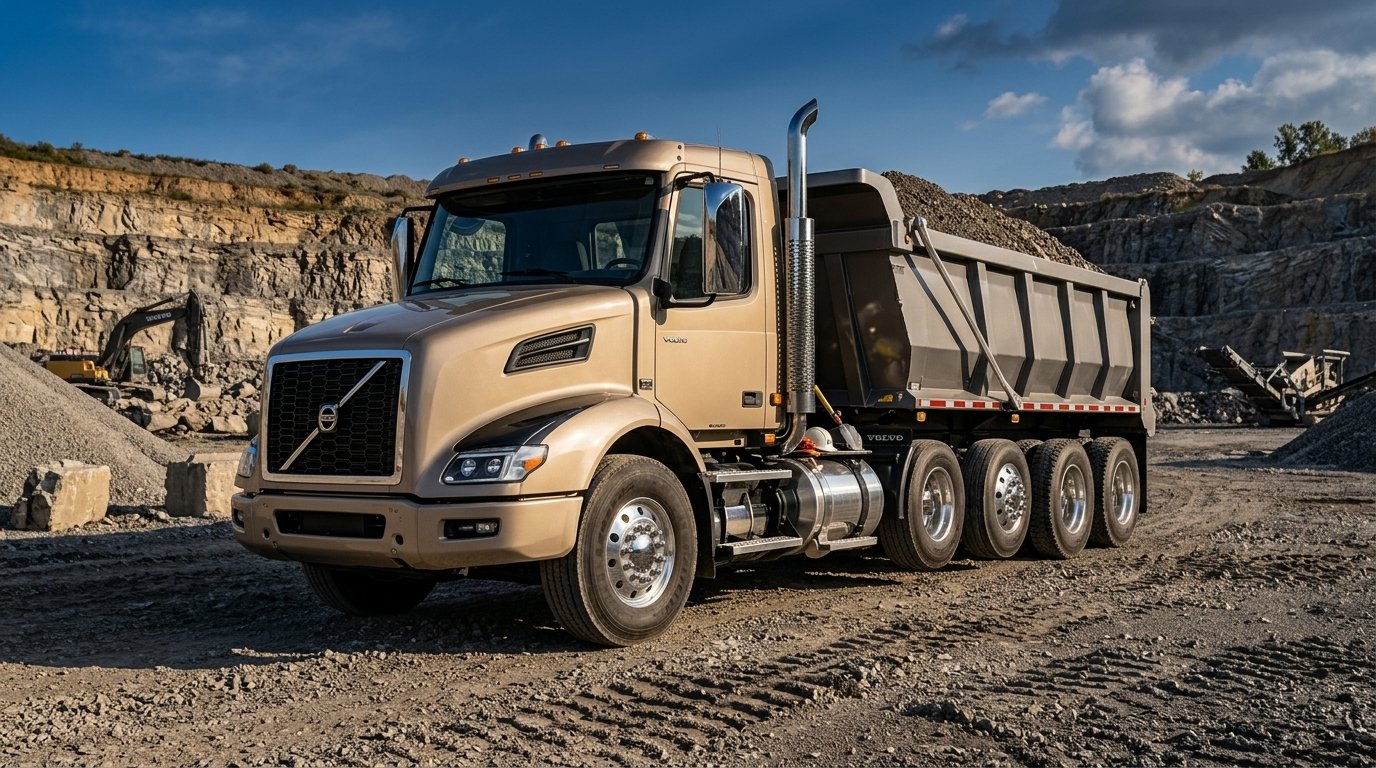
This Volvo VHD review begins from a premise that sounds obvious but is often ignored when vocational trucks are shopped: the model name tells you very little about what you are actually buying. A VHD can leave the factory as a day cab dump truck built to turn inside a cramped job site, as a sleeper intended for regional timber or construction work, or as a long wheelbase chassis that carries a heavy body inside bridge formula limits. Those trucks share a badge and a family resemblance, yet they can differ in engine, transmission, axle arrangement, suspension, frame length, and the hydraulic equipment bolted behind the cab.
That flexibility is the point of the truck, and it is also the reason a review of it has to be careful. Volvo Trucks North America positions the VHD as a Class 8 vocational platform for construction, dump and mixer bodies, roll off containers, cranes, timber hauling, snow removal, and mining and quarry work. These are environments where the truck is judged less by how it runs down an interstate than by how it starts on a muddy grade, how it maneuvers beside an excavator, how reliably it drives a pump, and how many days it stays out of the shop. Horsepower matters in that world, but it is rarely the deciding number.
What makes the VHD worth a closer look is the way Volvo has assembled the pieces around that reality. There is a choice between the Volvo D11 and D13 engines, an I-Shift automated manual transmission with a severe duty version and optional Crawler Gears, two cab families, two chassis layouts, a wide range of power take off provisions, and a connectivity package aimed at keeping trucks productive. Each of those decisions interacts with the others, which is why a buyer who focuses on a single headline figure can end up with a truck that is mismatched to the work.
The central question of this article is therefore not whether the VHD is a good truck in the abstract. It is how a buyer should evaluate a configurable vocational platform so that the truck on the order sheet matches the job it will actually do. Everything below is based on Volvo’s published information and on the engineering logic behind it, not on any hands on testing, and it is meant to help you ask better questions of a dealer.
Our Take
The strongest case for the VHD is its range of sensible configurations. A contractor who needs a tight turning radius on crowded sites can specify a very different truck from the fleet that hauls aggregate on roads with strict wheelbase rules, and both can start from the same family. The powertrain choices are well matched to vocational reality, particularly the severe duty I-Shift and the Crawler Gears that give the truck unusually fine control at very low speeds. Add the extensive PTO provisions, the focus on visibility and low speed steering effort, and Volvo’s connected diagnostics, and the VHD reads as a platform designed around how work trucks are really used.
The limitations are equally real. Because the VHD is so configurable, no single payload, weight rating, price, or fuel consumption figure describes it, and buyers who expect one will not find it. The D11 may not suit every heavy duty cycle, the D13 adds weight that matters in some payload sensitive jobs, and the sleeper on the VHD 400 is a compact work sleeper rather than a long haul living space. Driver assistance features and some comfort equipment vary by specification, so they should be confirmed rather than assumed.
In practical terms, the truck is best suited to operators who know their duty cycle in detail: construction contractors, dump and mixer fleets, roll off operators, snow removal contractors, and regional vocational haulers who can describe their body, axle loads, and terrain before they sit down with a dealer. For buyers who cannot yet describe those things, the VHD is a reminder that the specification work comes before the purchase decision.
What the Volvo VHD Is Built to Do
Vocational trucks are chosen by task, and that principle shapes everything about the VHD. A highway tractor can be specified largely around fuel efficiency and driver comfort because the work is predictable. A dump truck, mixer, or timber hauler faces variable ground, repeated starts under load, frequent low speed maneuvering, and body equipment that draws power from the drivetrain. Choosing by horsepower alone ignores most of what determines whether the truck will performReaders can explore the manufacturer’s official Volvo VHD for additional details about the truck’s configurations, available features, and vocational applications..
The questions that matter are more specific. How tight is the site the truck must turn around in? What does the body weigh, and where does it sit over the axles? Will a hydraulic pump run from a PTO, and at which location? How steep and soft is the terrain? What do bridge formula and local road rules require of the wheelbase and axle spacing? Volvo built the VHD around the idea that those answers should drive the chassis, engine, and transmission, rather than the other way around.
This is also why comparing work focused trucks makes sense before committing. Readers weighing the VHD against other vocational options may find it useful to look at how the Freightliner 114SD Plus approaches chassis configuration and construction work, because the differences in how manufacturers structure their vocational lines often reveal which truck fits a given job more naturally. The point of that comparison is not to find a universal winner but to see which design logic lines up with your own operation.
Volvo VHD 300 vs. Volvo VHD 400
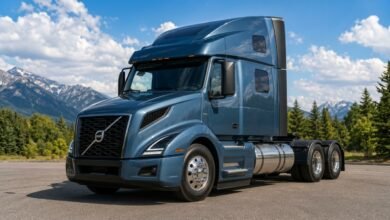
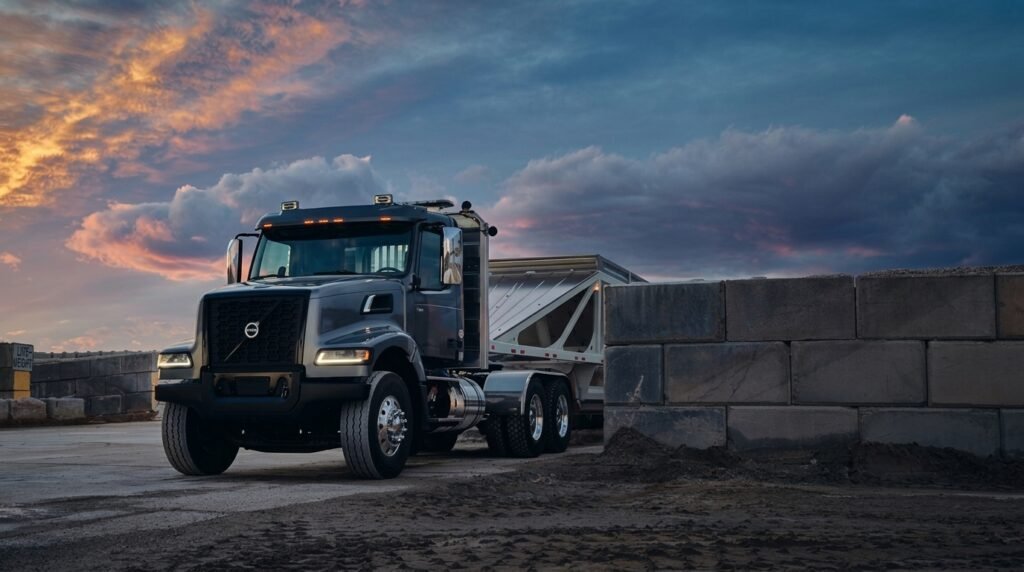
The two model families are distinguished mainly by the cab. The Volvo VHD 300 is offered as a day cab, which suits operations where the driver returns home or to the yard each day. The Volvo VHD 400 adds a 42 inch flat roof sleeper for applications where a driver may need to rest between work periods or deliveries.
Each family is available in Axle Back and Axle Forward layouts, and these are chassis arrangements rather than a ranking. Axle Back places the cab further forward relative to the axles, which supports a tight turning radius. Volvo presents the VHD 300 Axle Back as the choice for jobs demanding an extremely tight turn, including some dump truck applications, and the VHD 400 Axle Back as a sleeper that keeps that maneuverability. Axle Forward moves the axles forward relative to the cab, which allows the wheelbases some jobs need. Volvo describes the VHD 300 Axle Forward as suited to wheelbases that satisfy bridge formula requirements, and it can be specified as a straight truck or a tractor. The VHD 400 Axle Forward is the vocational sleeper for regional transport, including some construction and timber hauling work.
Neither layout is universally better. The right choice depends on the body to be installed, the wheelbase required, the axle loads, how tightly the truck must turn, the operating conditions, and the regulations that apply where it works. A contractor who prizes maneuverability on cramped sites and a hauler who needs a longer wheelbase for weight distribution can both be right, because they are solving different problems.
Volvo D11 and D13 Engine Options
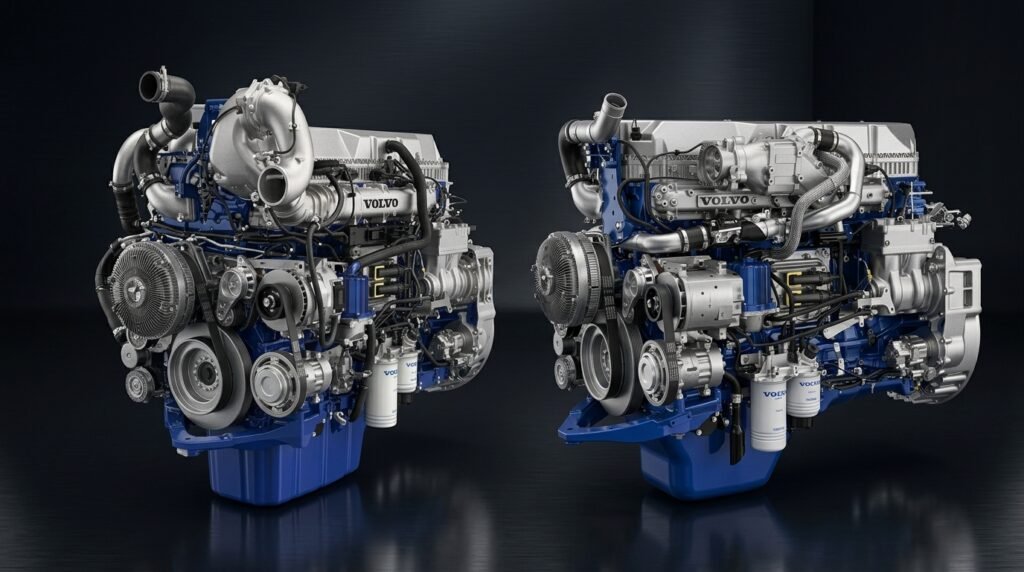
The VHD is offered with the Volvo D11 and D13 diesel engines, and the differences between them are worth understanding precisely. Volvo describes the D11 as the standard engine for the VHD. Its ratings run from 325 to 425 horsepower with up to 1,550 lb ft of torque, and Volvo says it weighs roughly 345 pounds less than the D13. The D13 is intended for applications that need more horsepower and torque, with several ratings available and a top output of 500 horsepower and 1,850 lb ft. Across the VHD range, that makes for roughly 325 to 500 horsepower and torque ratings reaching from the mid 1,400s to 1,850 lb ft, depending on the selected specification. Volvo also notes that straight torque and multi torque offerings are available with the D13.For a closer look at the available engine ratings and powertrain options, consult Volvo’s official VHD powertrain specifications.
That weight difference deserves attention. On a truck that is weight sensitive, such as a dump truck hauling dense material or a body heavy configuration working near its limits, carrying 345 fewer pounds in the engine is not trivial. For many vocational duty cycles, a D11 with an appropriate rating can deliver the output the work calls for, and the lighter engine leaves more room in the weight budget.
The D13 earns its place when the work calls for more pulling power: heavy loads, steep grades, off road starts, or high gross combined weights. Its higher torque ratings help when a loaded truck must get moving on a grade or work through soft ground. The mistake would be to treat the larger engine as automatically the better choice. Extra output that the duty cycle never uses adds weight and cost without adding value, so engine selection should follow the real demands of starting, climbing, and operating weight. Volvo does not publish a fuel consumption comparison between engines that would let a buyer settle the question on efficiency alone, so a dealer conversation about the specific duty cycle is the sound way to decide.
I-Shift and Crawler Gears
The Volvo VHD comes standard with the 12 speed I-Shift for Severe Duty automated manual transmission, designed for demanding construction and heavy haul applications that involve frequent shifting and rugged operating conditions. For jobs that require more precise low speed control, buyers can specify optional Crawler Gears, which add one or two additional ratios to create 13 or 14 speed configurations. This distinction matters because the standard transmission and the crawler gear options serve different needs. The base transmission is designed for demanding vocational work, while the additional low gears are particularly useful for steep starts, heavily loaded maneuvering, paving, and other applications where the truck must move slowly and predictably.
The optional Crawler Gears are the feature most specific to vocational work. They add one or two very low gears depending on the configuration, giving the truck what Volvo calls a low gear and an ultra low gear for controlled operation at very low speeds. Volvo advertises forward and reverse travel at speeds as low as about 0.6 mph. That kind of control is valuable in paving and curbing, where a truck must creep steadily alongside other equipment, and in steep starts or heavily loaded maneuvering where a normal first gear would be too fast or too harsh on the driveline.Volvo provides further technical information about the I-Shift for Severe Duty transmission, including its design for demanding construction and heavy haul applications.
Volvo advertises forward and reverse travel at speeds as low as about 0.6 mph with the applicable Crawler Gear configuration. This level of control is valuable in paving and curbing operations, where a truck must move steadily alongside other equipment, as well as during steep starts and heavily loaded maneuvering. In these situations, the ability to maintain a very low, controlled speed can matter more than simply having greater engine power, particularly when precise movement helps the driver work safely and consistently.
It is worth stressing why this matters more than raw output in some jobs. A truck with very precise low speed control can do work that a more powerful truck without it handles poorly, because the limiting factor is how smoothly the truck can move, not how hard it can pull.
Chassis, Axles, Suspension, and PTO
The VHD is built around a customizable chassis intended to take specialized bodies and equipment. Volvo advertises up to nine power take off options across the line. Depending on the configuration, PTO connections can be available at the front of the engine, the rear of the engine, or at the transmission, and some configurations can be ordered with factory installed piston or gear pumps.
These options matter because so many vocational bodies are hydraulic. Dump bodies, roll off hoists, cranes, and many other attachments rely on a pump driven from the truck, and the PTO location, pump type, and required flow all have to agree with the body. Buyers who plan hydraulic equipment should confirm PTO compatibility and pump requirements before the truck is ordered, because correcting a mismatch after delivery is far more expensive than specifying it correctly at the start.
Axle arrangements depend on the build. Some Axle Back configurations can be ordered as a 6×4 tandem, an 8×4 tandem, or an 8×6 tri drive, subject to the applicable specification, and none of these should be read as standard on every VHD. Volvo also offers the T Ride rear suspension for suitable applications. Its relevance is in uneven ground, where articulation helps keep the axles working and supports traction on rough sites, though no suspension guarantees superior traction in every condition.
The lesson of all this is that frame length, axles, suspension, PTO, and body equipment must be specified together. They are not independent options on a menu. A heavier body changes the axle and suspension requirements, a pump changes the PTO choice, and a wheelbase changes how the whole truck handles and what rules it must satisfy.
A Specific Example: The VHD 300 Dump Truck at CONEXPO 2026
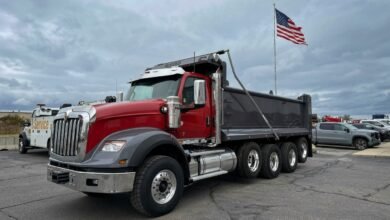
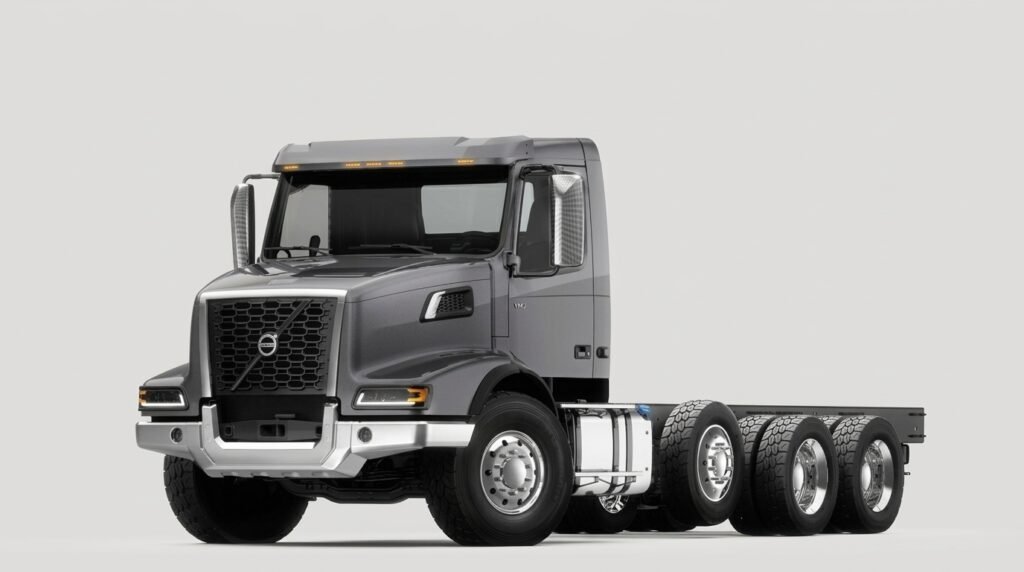
In its official announcement for CONEXPO-CON/AGG 2026, Volvo described a specific VHD 300 dump truck displayed at the show, illustrating how the platform can be configured for demanding vocational work. The truck featured a 10×4 Axle Back configuration, a 261 inch wheelbase, and a full liner frame measuring 11.81 by 4.13 by 0.44 inches. Its powertrain included a 500 horsepower engine producing 1,850 lb ft of torque, paired with a 14 speed I-Shift transmission equipped with Crawler Gears. These specifications describe the particular show truck, not every Volvo VHD 300 configuration.
Volvo listed a 22,800 pound Volvo front axle with a 22,800 pound multileaf front suspension, along with a Meritor RT58-185P rear axle arrangement rated at 58,000 pounds, a 3.73 ratio, and T Ride rear suspension.
It is important to read this as a single demonstration build, not a description of what a VHD 300 comes with. What it shows is the breadth of the platform: a heavy, long wheelbase dump truck with the top engine rating, the Crawler Gear transmission, and a high capacity rear suspension, all within the same family that also includes lighter, shorter configurations. A buyer should take it as evidence that the chassis can be shaped to demanding work, not as a template for an ordinary order.
Exterior Design, Visibility, and Maneuverability
On a work truck, the exterior is mostly about function. Volvo gives the VHD a one piece windshield with a stated area of 2,050 square inches and large mirrors, both aimed at helping a driver see the ground and the people around the truck. On a busy site, forward and side visibility is a safety matter as much as a convenience.
Maneuverability is addressed through the Axle Back layouts and through a wheel cut that Volvo lists at up to about 50 degrees in applicable configurations. A greater wheel cut lets the front wheels turn more sharply, which helps a truck get into and out of confined work areas, back to a dump point, or turn within a narrow lane. Combined with a layout that places the axles to support a tight turn, it can make a real difference where space is limited.
The lighting is LED throughout, with LED headlamps, daytime running lights, and marker and parking lamps, and an optional heating feature for de-icing in cold weather. Volvo also highlights steps designed to shed dirt and snow, which is a sensible detail for drivers climbing in and out in poor conditions, though it should be considered a design aid rather than a promise. Volvo lists a front bumper tow pin rated at 80,000 pounds in the applicable setup. That rating belongs to the component and should not be read as the towing capacity of the whole truck.
One further point is that two VHD trucks can look nearly identical from the front yet differ meaningfully underneath, in wheelbase, axle arrangement, frame length, and body equipment. The appearance of the cab says little about the capability of the chassis, which is why the specification sheet matters more than a walkaround.
Cab Comfort and the VHD 400 Sleeper
Volvo describes three interior trim levels for the VHD, called Premier, Express, and Fleet, along with seven seat options. That range lets a buyer match the cab to how the truck is used, for example choosing a more durable, easy to clean specification for a truck that sees mud and dust daily. Dashboard organization, steering wheel controls, and driver displays matter in the same practical way, because a driver who can find controls and read information easily is less distracted during a long day.
Comfort and fatigue are legitimate concerns on vocational work. Long shifts, rough surfaces, and repeated entering and exiting take a toll, and cab insulation, supportive seating, and reduced steering effort all help. It would be a stretch to attach a measurable productivity gain to any of this, since Volvo’s material does not support specific figures, but the logic is straightforward: a driver who is less tired tends to be more attentive.
The difference between the day cab and the 42 inch flat roof sleeper is best understood by use. The VHD 300 day cab suits daily operations. The VHD 400 sleeper is for vocational and regional work where a driver may need to rest between jobs or deliveries, such as a timber or construction operation with overnight stays. It is not comparable to a large sleeper built for extended long haul living, and buyers who expect that will be disappointed.
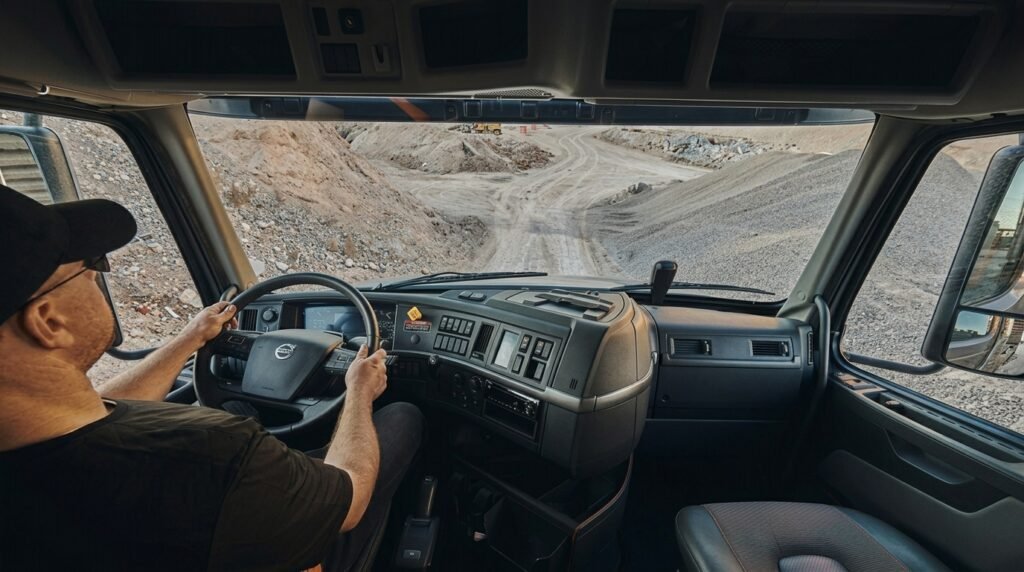
Safety and Driver Assistance
Volvo lists a range of safety technology for the VHD, and the intended function of each is worth stating accurately. Volvo Enhanced Stability Technology is meant to support vehicle stability in applicable conditions. Volvo Dynamic Steering reduces steering effort, especially at low speeds, which Volvo says lessens strain on the arms, shoulders, and neck over a full day. Volvo Active Driver Assist uses radar and camera sensing to monitor obstacles ahead, warn the driver, and support collision mitigation. It does not make the truck autonomous and cannot prevent every collision.
On the structural side, Volvo describes a high strength steel cab and a standard driver side airbag, and it offers the optional Rolltek seat system, which combines seat belt pretensioning and automatic seat lowering with additional side impact protection. Because this is optional equipment, buyers who want it should specify it, and they should confirm which driver assistance features are included for the model year and configuration they are ordering.
All of this assists the driver without replacing training, sensible speed, safe following distance, daily inspections, and attention to what is happening on the work site. A truck with excellent technology still depends on a driver who is alert and well trained.
Connectivity, Maintenance, and Uptime
Volvo’s connectivity offering includes Volvo Connect, Remote Diagnostics, Remote Programming, ASIST services, and Volvo Action Service. Volvo Connect gives owners and fleet managers a single place to view vehicle information, reports, and selected fleet management functions. Remote Diagnostics can monitor relevant systems and help identify faults, and Remote Programming supports certain software and parameter updates without a shop visit. Volvo Action Service advertises round the clock support in the United States and Canada, and Volvo cites a dealer network of more than 430 locations.
For a working fleet, the value is in planning. Early notice of a developing fault allows maintenance to be scheduled rather than forced by a breakdown, and remote updates can reduce time spent in the shop. These benefits depend on the truck being appropriately equipped and on the services being available, so buyers should not assume that every service is free, unlimited, or identical across vehicles. Subscription terms, hardware, model year, and availability can vary.
Practical Applications and Configuration Choices
Connecting the specifications to real jobs makes the choices clearer. A dump truck operator working narrow construction sites has good reason to prioritize an Axle Back configuration, since the tight turning radius and generous wheel cut help in confined space. An operator who must satisfy bridge formula or wheelbase requirements has equally good reason to consider Axle Forward, whose longer wheelbase serves that need.
Higher engine output and Crawler Gears make the most sense for heavy loads, steep or soft starts, and work such as paving or curbing where very slow, controlled movement is essential. For many other applications, a lighter D11 with a suitable rating, or a different axle arrangement, will serve better and leave more weight available for payload. Buyers working with hydraulic equipment need to settle PTO location and pump requirements first, because the body’s demands should dictate the driveline provisions. And where a vocational operation includes regional travel and overnight stays, the VHD 400 sleeper is the relevant choice.
For readers whose work is especially punishing, it can also help to read about how other manufacturers approach severe duty trucks. The Kenworth C500 is one example of a truck aimed at demanding, specialized applications, and looking at it alongside the VHD can sharpen your sense of what your own operation requires, even though the two trucks should not be assumed to share capabilities.
The common thread is that no configuration is correct in the abstract. Each must be judged against the work it has to perform.
Limitations and What Buyers Should Consider
The most important caveat is the one that follows from the VHD’s strength. Because the truck is so configurable, its model name does not establish payload, gross vehicle weight rating, gross combined weight rating, exact operating weight, towing capacity, fuel consumption, or final price. Those depend on the selected build and on the dealer specification, and anyone quoting a single figure for the whole line is guessing.
A chassis configured for one job may be unsuitable for another. Engine power, suspension, axle ratings, wheelbase, PTO equipment, body weight, and applicable regulations all need to be evaluated together. Standard and optional equipment also differ, and availability can change by model year, so features such as particular driver assistance systems, the Rolltek seat, or specific PTO and pump options should be confirmed in writing before ordering.
It is also fair to repeat that this review rests on published engineering information, documented uses, and reasoning, not on any hands on testing of the truck. Where current authoritative figures are unavailable, such as price or fuel use, the honest answer is that they depend on the specification, and a dealer quote tied to your exact build is the only reliable source.
Conclusion: Matching the VHD to the Work
Viewed as a whole, the VHD is best understood as a set of decisions rather than a single product. The D11 and D13 give buyers a choice between lighter weight and greater output. The I-Shift, especially the severe duty version and the Crawler Gears, addresses the starting, shifting, and low speed control that vocational work demands. The Axle Back and Axle Forward layouts, the range of axle and suspension arrangements, and the PTO provisions let the chassis be shaped around a body. The cab, safety technology, and connectivity services then support the driver and the uptime of the truck once it is working.
The operators most likely to benefit are those with a clearly defined job: contractors running dump or mixer bodies, roll off and snow removal operators, timber and aggregate haulers, and regional vocational fleets that can describe their duty cycle precisely. The VHD rewards that precision, and it punishes vagueness, because a poorly specified configurable truck can be a poor fit even when every individual component is excellent.
Before ordering, a buyer should be able to answer a short set of questions. What is the body, and how much does it weigh? What turning radius does the site demand, and does that point toward Axle Back or Axle Forward? What wheelbase do bridge formula and local rules require? Does the work need the higher torque of the D13 or the lower weight of the D11, and does it call for Crawler Gears? What PTO location and pump does the hydraulic equipment need? Is a day cab enough, or does the operation justify the 42 inch sleeper? Which safety and driver assistance features are included for the model year, and which must be added?
If those answers are clear, the VHD offers a credible way to build a truck around the work rather than adapting the work to the truck. If they are not, the right first step is to define the duty cycle, and only then to sit down with a dealer and specify the build.