Western Star 4900 One Name Many Configurations
Engine options, configurations, heavy-duty applications, and what to check when buying a used example of this long-hood truck

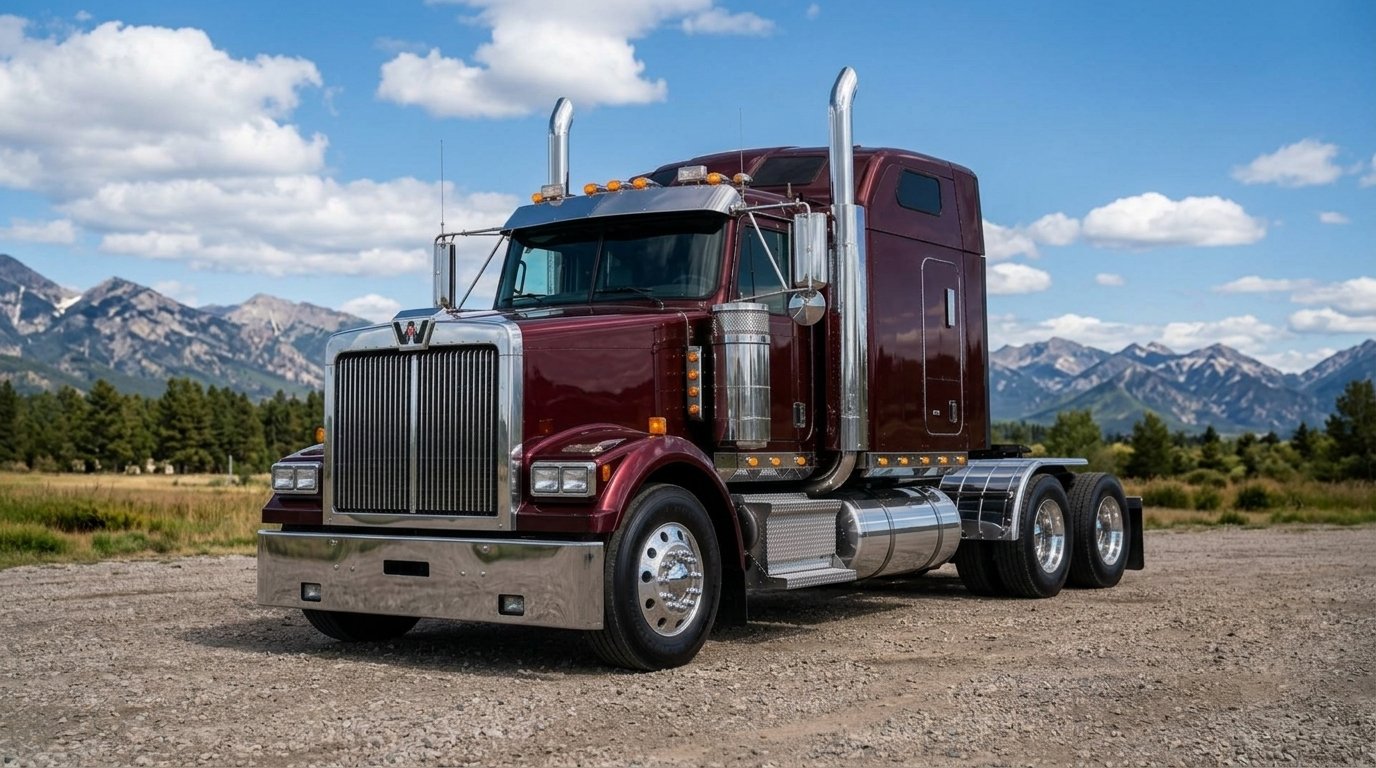
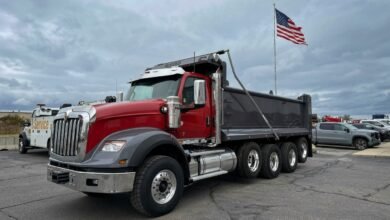
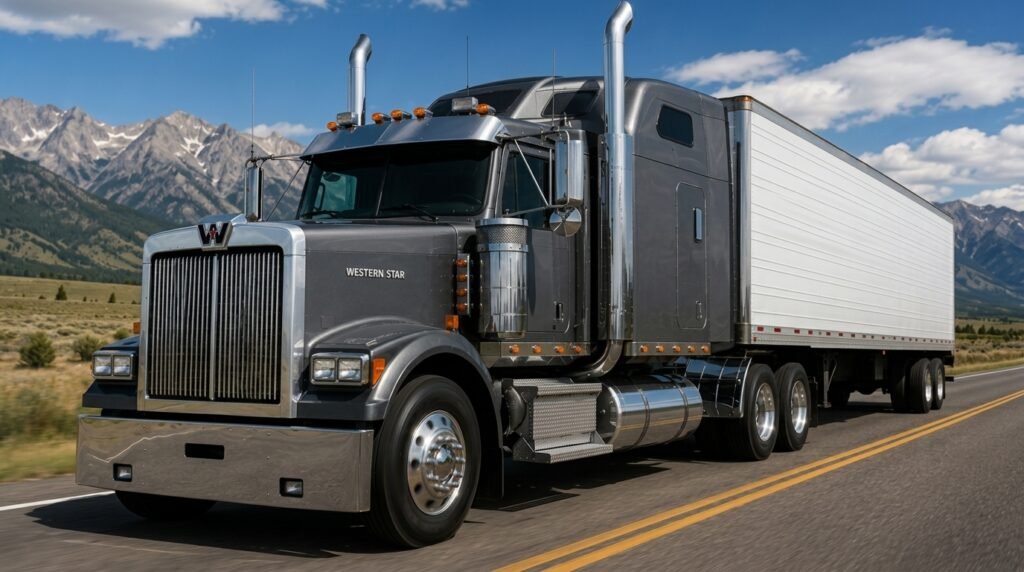
A long hood on a truck is rarely just a styling choice, and on the Western Star 4900 it never was. The engine, cooling package, and front axle sit under a prominent nose that gives the cab its upright, unmistakable profile. That layout has served both the logging road and the interstate, and few other Class 8 platforms have been stretched across such a wide range of work. The Western Star 4900 can be a sleeper-equipped highway tractor, a tight-turning dump truck, a twin-steer heavy-haul unit, or an extreme-duty chassis built for off-road service.
That breadth is the reason this truck is hard to summarize. The name 4900 covers a family of configurations, not a single specification. Hood length, front-axle position, steering arrangement, rear-axle ratings, engine choice, transmission, and cab all change from one build to the next. Two trucks wearing the same badge can have very different strengths, and what suits a timber operation may be wrong for a regional line-haul fleet.
This review works through that family one layer at a time: the submodels, the engine options, the drivetrain, the chassis, the cab, and the work each configuration suits. It also covers what a buyer should verify before committing to a used example. The figures quoted come from historical manufacturer material and are treated as documented options for specific configurations and model years, not as universal specifications.
Our Take
The most interesting thing about the Western Star 4900 is how little of it is fixed. Customers could build around a long-hood highway tractor, or a heavy vocational chassis with a set-forward front axle, twin-steer layout, and a tridem rear. The engine choices ranged from mid-output Detroit units to 600 hp-class Detroit and Cummins engines. That flexibility is a genuine strength for operators who need a chassis shaped around a body or a payload, and it is the reason the truck earned its following in demanding trades.
The same flexibility is the main risk when buying used. A 4900 listed as a “Western Star 4900” tells you very little. A highway-oriented EX with a sleeper and a severe-duty XD with a heavy tridem share a name and a family resemblance, but they were built for different jobs and have lived different lives. The sensible approach is to treat the build sheet, the engine plate, the axle tags, and the service records as the real description of the truck, and the model name as only a starting point.
Western Star 4900: Model Overview and Background
The Western Star 4900 is a heavy-duty Class 8 truck with traditional long-hood styling and a steel cab. It was sold both as a highway tractor and as a vocational chassis, and the brand has long been associated with logging, construction, heavy haul, and other severe-duty work. The general Western Star 4900 brochure (PDF) documents the cab, engine options, sleeper sizes, and the principal configurations. It is a historical document, so its figures describe the trucks it covers and should not be assumed to apply to every production year.
It also helps to keep the company and the model separate. Western Star as a brand predates the 4900 by a considerable margin, and the founding year says nothing about when this particular platform appeared. This review sticks to what the available documentation supports and avoids attaching an introduction date to the model.
The brochure organizes the family into five submodels: the 4900EX, 4900SB, 4900SF, 4900TS, and 4900XD. The 4900EX is the extended-hood version, with a published bumper-to-back-of-cab (BBC) measurement of 132 inches. That longer nose is associated with highway work and with sleeper-equipped tractors, where engine bay space and a distinctive profile matter. The SB, SF, TS, and XD configurations listed in the brochure share a shorter 123-inch BBC.
Among those four, the differences come mainly from axle placement and intended duty. The 4900SB uses a set-back front axle, changing the relationship between the front axle, cab, and chassis. Its effects on maneuverability and weight distribution depend on the wheelbase, body layout, and overall truck configuration. The 4900SF places the front axle farther forward, a layout associated with heavier front-axle loads and certain vocational bodies. The 4900TS is the twin-steer version, with two steering axles at the front, a configuration used where a high front load is needed. The 4900XD is the extreme-duty variant, built for the harshest off-road and heavy-load applications. How each differs in frame, suspension, and axle ratings should be confirmed against the specific truck’s documentation instead of assumed from the label.
Western Star 4900 Engine Options and Performance
Engine choice defined much of what a 4900 could do, and the brochure lists a broad range. The figures below come from the 2016 Western Star 4900 brochure and serve as reference points, not as ratings found on every truck from every year. The 4900XD-specific technical sheet lists different ranges for some engines, including 455–505 hp for the DD15 Turbo Compound and 475–600 hp for the DD16. These differences reinforce the need to match engine ratings to the exact submodel and configuration.
Detroit DD13, DD15, and DD16
The Detroit DD13 is a roughly 12.8-liter engine, the smallest of the DD family. The 2016 brochure lists approximately 350 to 505 hp and 1,350 to 1,850 lb-ft of torque. The brochure specifically notes that the DD13 rating of 505 hp and 1,850 lb-ft was available only for certain applications, so those figures should not be treated as a standard rating for every truck. On a vocational chassis, the lower ratings suit lighter or more local work, while the upper end brings it near the output of larger engines.
The Detroit DD15, at about 14.8 liters, is listed at roughly 400 to 505 hp and 1,550 to 1,750 lb-ft. It is the engine most closely associated with highway tractors in this family, offering a balance between output and the weight and fuel appetite of a larger block. The DD16, at about 15.6 liters, sits at the top of the Detroit lineup with approximately 500 to 600 hp and 1,850 to 2,050 lb-ft. Its torque range makes it relevant to heavy haul and demanding grades where sustained pulling power matters more than outright efficiency.
Cummins ISX15 and X15
The brochure also lists the Cummins ISX15, a roughly 15-liter engine, at approximately 400 to 600 hp and 1,450 to 2,050 lb-ft. Terminology matters here. The ISX15 is the earlier designation. The later X15 name reflects Cummins’ revised engine generation and naming, and its availability should be tied to model year, submodel, and configuration. Treating the two names as interchangeable would be inaccurate, as would assuming an X15 was offered in every 4900 variant.
A maximum around 600 hp also deserves a caution. Published peak ratings depend on the specific engine, calibration, and configuration. If a later specification source lists a slightly different maximum for a particular configuration, the correct response is to check which engine and model year it describes, not to blend the figures. For a used truck, the engine plate and original build records are more reliable than any brochure.
Detroit Series 60 Tier III
The brochure also lists a historical Detroit Series 60 Tier III option, a roughly 14-liter engine, at approximately 425 to 500 hp and 1,475 to 1,550 lb-ft. This option carries application restrictions stated in the brochure, so it should not be read as available across every 4900 configuration or use. A buyer who finds one should confirm what the original documentation permitted for that truck.
Output, Duty Cycle, and What Ratings Mean
Horsepower and torque describe what an engine can deliver, but how much of that matters depends on the work. A highway tractor running steady speeds benefits from a rating that holds highway pace without constantly dropping gears. A dump truck or logging unit operates differently. It may work at low speed under heavy load on steep, uneven ground, where torque at low rpm and good transmission matching count for more than peak power. Across all applications, a heavier load on a given grade needs more engine capability, but a lower rating can still be the right pick for lighter or more local duty.
This is why a used 4900 should be evaluated by the exact engine family, rating, and original application, not simply by whether it has a “big” engine.
Transmission Options and Drivetrain Configurations
The transmission choices span three broad types. Eaton Fuller manual transmissions have a long history in heavy trucks and give the driver direct control of gear selection, which many operators value in demanding terrain. Eaton automated options, such as UltraShift PLUS where listed for a given specification, reduce driver workload by handling shifts automatically while retaining a manual-style mechanical layout. Allison automatics offer smooth, torque-converter-based operation that is often favored in vocational use, particularly where low-speed control matters.
Selection affects the job in practical ways. A highway tractor spending hours at steady speed can benefit from an automated or manual transmission matched to the engine’s rating. A vocational truck that creeps, stops, and starts repeatedly on a job site tends to gain more from an automatic’s low-speed behavior. In heavy hauling, the match between transmission, engine torque, and rear-axle ratio affects how the truck moves a load from rest and how it holds speed on a grade.
Drive arrangements vary widely too. A 4×2 is the common highway tractor layout, while a 6×4 adds a second rear drive axle for heavier loads. Specialized trucks may use 4×4 or 6×6 arrangements, or twin-steer and lift-axle setups, but these vary by submodel and application and should be confirmed from documentation for the particular variant. It would be inaccurate to assume every configuration was offered on every version of the Western Star 4900.
Chassis, Frame Construction, Axles, and Suspension
The chassis is where the 4900’s vocational reputation is earned. Frames can be specified with reinforcement and customized to suit the body that will sit on them. A dump body, a logging crane, a tanker, a tow-and-recovery rig, and a heavy-haul tractor all place different demands on frame strength, mounting space, and torsional behavior. The ability to adapt the frame, axle spacing, and suspension to a body is a central part of what this truck offers.
Axle ratings illustrate why details matter. The 4900XD technical specifications (PDF) list Meritor tandem rear-axle ratings of 46,000 to 70,000 lb and tridem ratings of 69,000 to 77,000 lb. Those are different configurations, so they cannot be read as one universal rear-axle rating. Similarly, an individual front-axle rating is not the same as the combined capacity of a twin-steer arrangement, which spreads load across two steering axles. The XD sheet describes that specific variant and should not be applied to the rest of the family.
It also helps to separate several weight terms that are often confused. An axle rating is the capacity of one component. Gross vehicle weight rating (GVWR) is the engineered limit for the complete truck. Gross combination weight rating (GCWR) applies to a truck and trailer together. Payload is what remains after the truck’s own weight is subtracted from its allowed weight. A strong axle does not make a truck legal or safe at any weight, since frame, suspension, brakes, tires, and regulations all set limits. This review does not cite a single maximum GVWR for the family, because no one figure describes every configuration.
Suspension and brake choices matter just as much. Vocational trucks working off-road generally need suspensions that tolerate articulation and shock, while highway trucks are often tuned for ride quality and stability. Whatever the setup, a used buyer should confirm what was fitted from the factory and whether it has been altered.
Dimensions and Cab Configurations
Dimensions are easy to misread, so it helps to define terms. BBC measures from the front bumper to the back of the cab. It is a layout measurement, not overall vehicle length. Wheelbase is the distance between axle centers and has its own consequences. The brochure lists wheelbase options up to 448 inches, which gives an idea of how far the chassis can be stretched for long bodies or specialized equipment.
Hood length and axle position shape how a truck behaves. A shorter BBC and set-back axle generally help maneuverability in tight spaces, while longer hoods and wheelbases offer more room for equipment and different weight distribution. For trailer compatibility, the relationship between the steer axle, drive axles, and fifth-wheel position affects how weight is shared. For vocational body installation, available chassis space behind the cab determines what can be mounted.
Sleeper lengths in the brochure include 34, 40, 54, 68, and 82 inches, depending on the roof and cab configuration. That 82-inch figure is the length of the sleeper section. It does not describe sleeper height or the overall cab height, and it should not be confused with either. Not every cab option was available on every submodel, so the specific truck must be checked.
Cab Design, Interior, Sleeper Comfort, and Practicality
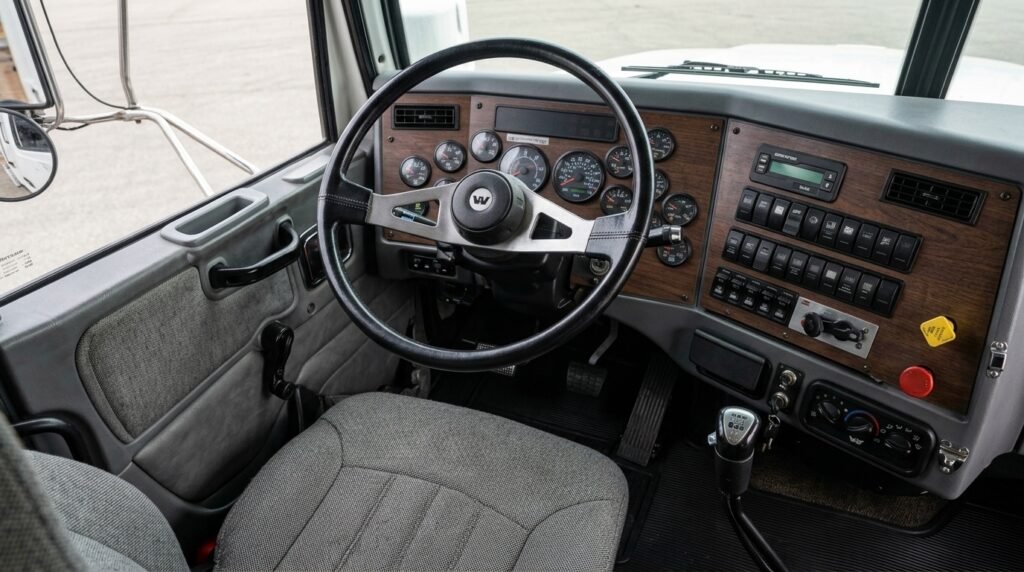
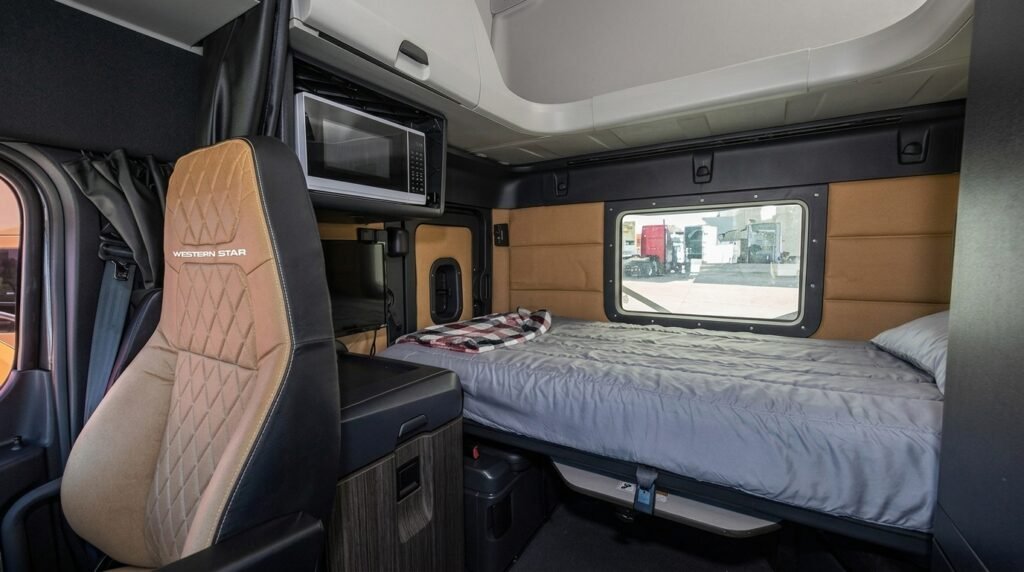
The 4900 uses a steel cab, which suits severe-duty use where durability and repairability matter, and corrosion protection is part of that construction story. Details such as insulation, door seals, dashboard layout, storage, and service access are described in manufacturer material, but they differ by year and build, so it would be wrong to assume every truck shares identical interior materials or equipment. What can be said is that these features have practical purposes. Good sealing and insulation reduce noise and drafts over long hours. Visibility matters on a job site, where the driver needs to see around a long hood and work near other equipment. A sensible dash layout and storage reduce fatigue and clutter.
The day cab versus sleeper decision follows the work. A day cab keeps the truck shorter and lighter, which suits local and vocational operation where the driver goes home each night. A sleeper adds living space for long routes and overnight stays, at the expense of length and weight. The sleeper lengths noted earlier give buyers a range, but there is no single standard cab layout across the family. In a used truck, sleeper condition, from bunk and cabinetry to HVAC components, is also part of the assessment.
Cooling, Fuel Capacity, and Serviceability
Cooling and fuel setups depend on the engine and application. Heavy loads, steep grades, and hot or dusty worksites place particular demands on the cooling system, and the available choices should be checked against the specific truck’s build. Service access around a long hood can make routine checks easier, though how convenient any given component is to reach depends on the configuration and any added equipment.
For fuel, the 4900XD technical sheet lists aluminum fuel tanks in several capacities, with options up to 150 US gallons. That is a documented option for that configuration, not a standard capacity for every 4900. Tank size on any individual truck depends on how it was ordered.
Serviceability in the real world depends on more than design. Operating environment, maintenance history, parts condition, and past body or chassis modifications all affect what ownership demands. A truck that has worked in abrasive, wet, or heavily loaded conditions may need more attention than one with lighter service. This review does not offer fuel-economy figures, maintenance intervals, repair costs, or reliability statistics, because the available documentation does not support universal numbers.
Real-World Applications: Highway, Logging, Construction, and Severe-Duty Work
Highway Tractors
For highway work, the long-hood EX and sleeper-equipped configurations are the natural fit. These builds typically pair a DD15 or similar engine with a transmission suited to steady-speed operation and a sleeper sized for the route. Weight distribution, trailer matching, and cab comfort matter most here, while extreme axle ratings matter less.
Logging, Dump, Tanker, and Recovery Work
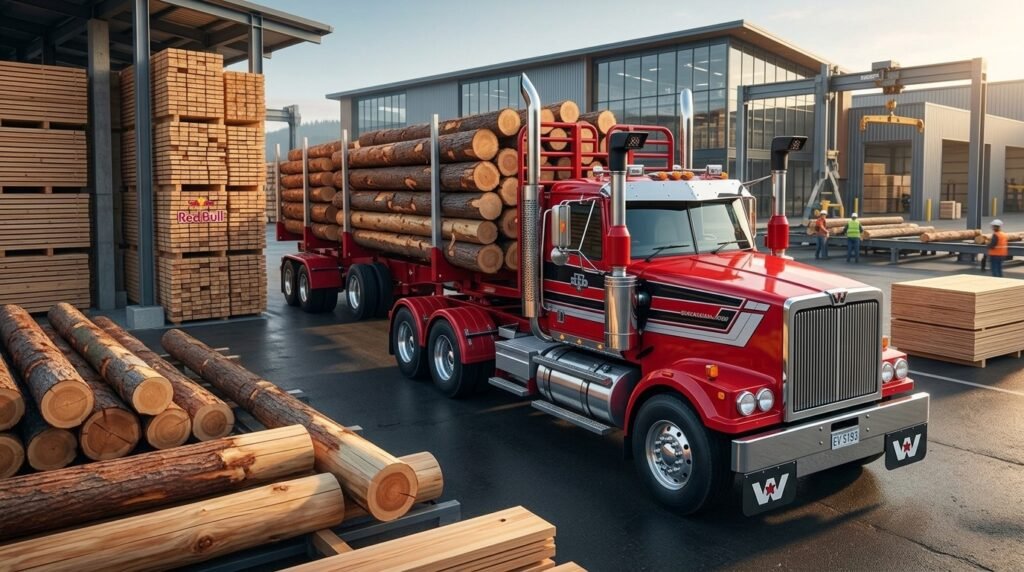
Vocational duty is where the configuration details separate trucks. Logging and heavy dump work call for strong frames, robust suspensions, and rear axles rated for the loads involved, which is where tandem and tridem arrangements come in. Tankers and recovery equipment place different emphasis on axle spacing, frame mounting, and low-speed control. The heavy chassis requirements for these jobs are comparable to those of other vocational platforms, and readers who want to see how a competing design handles worksite demands can compare it with the Volvo VHD review, which covers a rival heavy-duty vocational truck and its intended uses.
Heavy Haul and Mine-Site Support
Heavy-haul and mine-site work tends to push toward the extreme-duty end of the family, where twin-steer layouts, heavier axle ratings, and stronger frames come into play. Even then, one configuration cannot cover every task. A truck built around a specialized body may be poorly suited to general hauling, and the reverse is also true.
Western Star 4900 vs. Western Star 49X
The Western Star 49X was announced in 2020 as a new vocational platform. The manufacturer emphasized durability, safety, weight reduction, and modern powertrain technology. It is a newly developed truck, not a rebadged 4900, and it should not be treated as mechanically identical to its predecessor.
The transition between the two should be described carefully. The Western Star 4900 is now a legacy model rather than a current production offering. Official records document certain 2023 model-year trucks built through September 2023, but that does not establish a single final production date for every 4900 variant. The announcement of the 49X also does not mean every 4900 configuration vanished at once. What a buyer can reasonably do is treat the 4900 as the older generation and the 49X as the newer vocational option, then compare them on the specific needs of the job. For readers curious about how other modern severe-duty platforms compare, the Freightliner 114SD Plus review offers useful context on a contemporary vocational truck.
What to Check Before Buying a Used Western Star 4900
A used 4900 should be judged on its actual build, not its name. Start by verifying the engine model, rating, and service history from the engine plate and records. Look for signs of neglected maintenance, and check how the transmission shifts and engages across its range. Inspect axles and suspension for wear, and examine the frame carefully for cracks, corrosion, or repairs, since frame condition is central to a heavy chassis. Evidence of overloading, such as stress around mounts and unusual wear, deserves attention in a truck that has done vocational work.
Cooling-system condition, electrical function, and sleeper condition matter as well, along with any modifications made for specialized work, from added bodies to altered frames. Confirm the factory configuration, axle ratings, and weight ratings against documentation, and ask for service records, not a generic description. No single engine can be called universally reliable or unreliable, so conclusions should come from the condition of the particular truck.
Severe-duty and heavy-haul requirements also frame how a buyer should read a listing. The Kenworth C500 review covers another truck built for similar demands, and it is a useful reference for the kind of axle, frame, and powertrain questions worth asking about any heavy-haul candidate.
Final Verdict
The Western Star 4900 occupies a distinctive place among heavy-duty trucks because it can be built to suit very different work. Its strengths are chassis flexibility, a range of engine and transmission choices, and a long-hood, steel-cab design suited to demanding use. Its limitations are the other side of that flexibility: there is no single specification to rely on, and a mismatched configuration can be a poor fit for the job.
What separates a suitable used example from a poorly matched one is verification. A 4900 whose engine, axles, frame, and body match the intended work, and whose records support its condition, can serve an operator well. One bought on the badge alone may not.
Operators in logging, construction, heavy haul, and similar trades may find a properly configured 4900 worth considering, as may highway users who want its long-hood layout. Buyers who want newer design and modern powertrain technology, or who need current factory support, may find the 49X deserves a look as well.