2026 Mack MD7 Review Engine Specs, and Work Capability
A closer look at the Class 7 truck's Cummins powertrain, chassis engineering, payload considerations, and commercial applications.


The 2026 Mack MD7 sits at the top of Mack’s medium-duty range as a Class 7 chassis with a published gross vehicle weight rating of up to 33,000 pounds. It is powered by a Cummins B6.7 diesel and built to accept whatever body a fleet needs. Mack describes the MD Series as heavy-duty toughness in a medium-duty truck, and the MD7 is where that idea is pushed furthest. Its frame rails are rated at 120,000 psi yield strength, a figure Mack reserves for the MD7 while the lighter MD6 uses 110,000 psi rails. The truck leaves the factory as a cab and chassis, not a finished delivery vehicle, and what it becomes depends on the body bolted behind the cab.
That raises the question that defines this review. A business needs more capability than a lighter Class 6 truck can offer but has no reason to buy a heavy Class 8 tractor with its added cost and complexity. For that buyer, what does the MD7 actually provide, and where do its limits begin? The answer depends on engine calibration, transmission choice, axle ratings, wheelbase, and above all the weight of the completed truck. Regional distributors, refrigerated carriers, vocational fleets, and commercial body builders each read those variables differently. The sections below take them in turn.
Our Take
The MD7’s appeal comes from how its major components fit together. It combines a Class 7 GVWR, a Cummins B6.7 diesel offered across a 220 to 300 horsepower range, three six-speed Allison automatic transmissions, a high-strength steel frame, and a chassis with prewired connections for body installation. That mix suits regional distribution, dry freight, refrigerated delivery, and a range of vocational work. Mack’s own product page lists refrigerated goods delivery among the applications the MD Series is designed for, and the company showed an MD7 dump truck at Work Truck Week 2026 to underline its vocational side.
The buyer’s homework is what separates a good MD7 from a poorly specified one. A 33,000-pound GVWR is a ceiling for the entire loaded vehicle, not a cargo figure. Once the body, refrigeration unit, liftgate, fuel, driver, and equipment are added, the remaining payload can be far smaller than the number suggests, and it will differ from one truck to the next. Axle ratings must be checked separately. Trailer towing is not a standard attribute of the platform at all, because it depends on the final certified configuration. Judged on its published specifications, the MD7 is a capable and flexible platform. How well it performs for a given business will be settled by the completed truck’s certified ratings and actual weight, not by the headline numbers.
Exterior Design Cab Construction, and Gen 2 Improvements
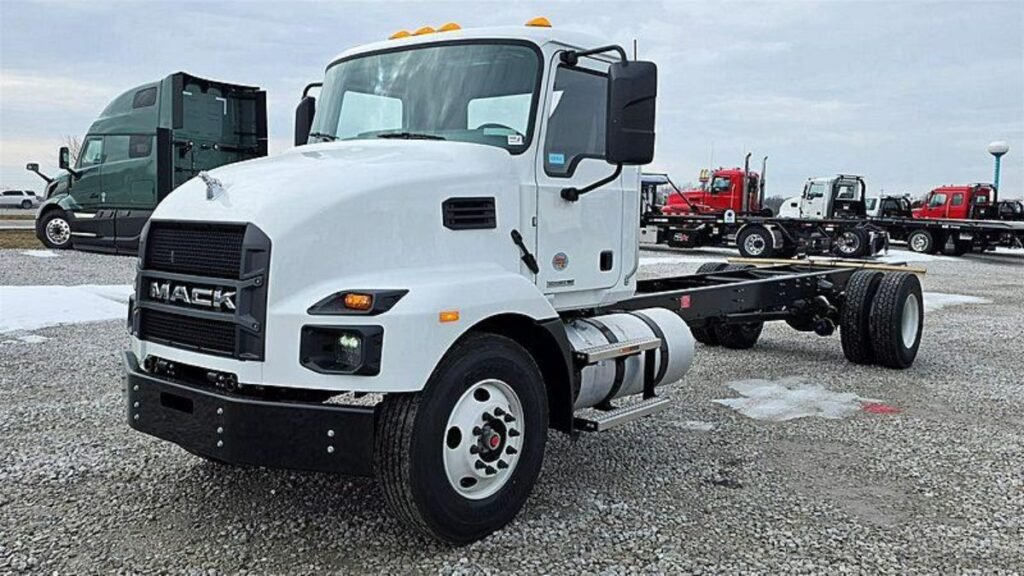
The MD7 uses a conventional layout with a forward-mounted hood, not a cab-over-engine arrangement. In a medium-duty truck that has practical consequences. A hood gives technicians access to the engine from the front, which can simplify routine checks. It places the driver’s seat behind the engine, which many drivers moving from pickups and lighter trucks find familiar. And it leaves a clean, uninterrupted frame behind the cab for body installation. Mack’s product page also notes a flat back-of-cab rail design intended to provide clean electrical connections, and the chassis includes prewired body-builder connections that reduce the wiring work a body manufacturer must do.
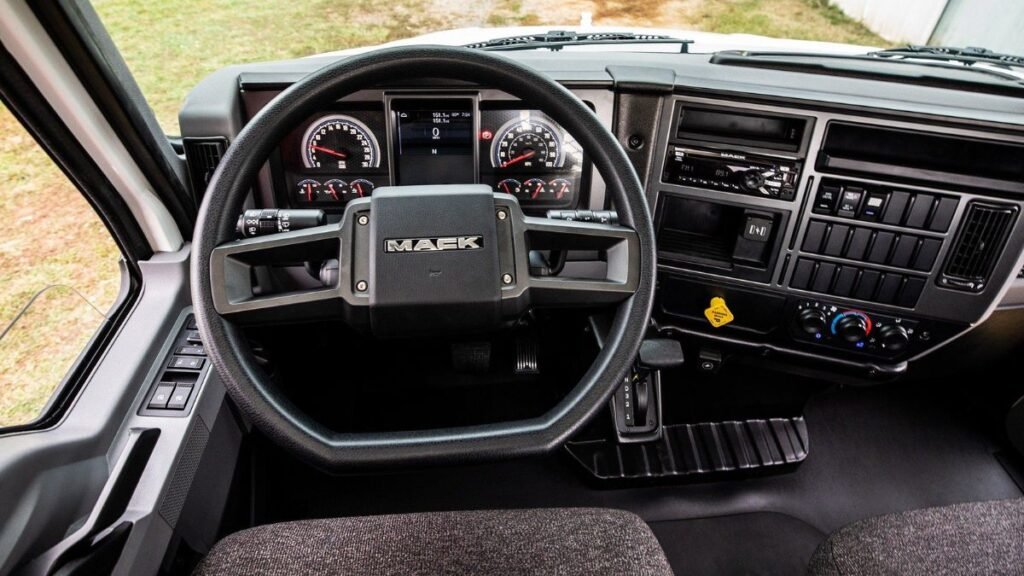
Mack refreshed the MD Series in August 2024, and the Mack MD Series refresh announcement describes the changes in the cab. The updated cab is four inches longer than the one it replaces. According to Mack, the extra length improves driver legroom and allows the seat to recline further. The driver’s seat offers adjustable lumbar support, and the refreshed series includes adjustable seat belts for both the driver and the passenger. The interior adds satin aluminum trim, an overhead console with additional storage, and upgraded LED cabin lighting. The steering column is tilt and telescopic, and the steering wheel carries controls for cruise control, the telephone, and audio.
Cab construction matters as much as the trim. Mack’s MD product page states that the cab is made from galvanized American steel to resist corrosion. It also lists a standard dual-airbag cab suspension, which isolates the cab from some of the vibration traveling through the frame. A medium-duty delivery truck can spend a full shift in stop-and-go traffic, climbing in and out at every stop. In that service, seat position, entry and exit, and how much road vibration reaches the driver are operating considerations, not luxuries. Mack lists full-width grated steel steps and a flat-bottom steering wheel that leaves more room for entry and exit.
Visibility depends partly on how the truck is ordered. Mack lists a passenger peep window, which gives the driver a view down the passenger side for lane changes, backing, and right turns. Chrome convex mirrors appear among the listed options. Mirror and lighting packages are not necessarily identical on every build, so fleets should confirm them when specifying a truck.
Chassis Construction Frame Rails, Axles, and Suspension
The MD7 is a body-ready chassis and not a factory-built box truck. That distinction shapes every other decision. The truck arrives with a cab, engine, transmission, axles, suspension, and frame. A body manufacturer then adds a dry van, refrigerated box, flatbed, dump body, tank, or other equipment. The frame’s job is to carry that body, spread its weight and the cargo’s weight along the chassis, and tolerate the twisting and flexing of daily work. Mack specifies steel frame rails with a 120,000 psi yield strength for the MD7. That figure belongs to the MD7 and should not be assumed for other Mack models. Meritor supplies both the front and drive axles. In the Gen 2 4×2 chassis information used by body builders, bumper-to-back-of-cab is listed as 107 inches.
Rear Suspension Choices
Two rear suspensions are offered. The standard Mack multi-leaf suspension uses stacked steel springs and is intended for heavy load-carrying work. It is a straightforward design whose strength is suited to bodies and cargo that stay heavy all day. The optional Mack AL AirRide replaces the leaf springs with air springs in a dual-airbag design that Mack says softens bumps. Air suspension can improve ride quality, and it can also help with cargo that is sensitive to vibration. It is an option, so a fleet should confirm which system a specific truck carries.
This rear chassis suspension is separate from the cab’s dual-airbag suspension. One isolates the cab and driver from vibration, and the other controls how the frame and axle ride under load. A truck can have the standard cab suspension and a leaf-spring rear, or the same cab with air springs at the rear. Treating them as one feature confuses what each does.
Why Axle Ratings Need Checking
Axle ratings are configuration specific. Some documented MD7 upfits show a 12,000-pound front axle and a 21,000-pound rear axle, but those figures describe particular builds and not every MD7. The certified ratings appear on the vehicle’s certification label, and they govern how much weight each axle can legally carry. A body builder or fleet that assumes standard axle ratings can end up with a truck that reaches its GVWR on paper while overloading one axle in practice. The section on payload below returns to this point.
Cummins B6.7 Diesel Engine and Available Power Ratings
The MD7’s diesel is the Cummins B6.7, a 6.7-liter inline six-cylinder turbocharged engine. It uses charge-air cooling and an integrated exhaust aftertreatment system, as described on Cummins’ B6.7 page. An inline six is naturally balanced, which is one reason the layout has been popular in commercial trucks. The turbocharger lets a 6.7-liter engine deliver the torque a loaded medium-duty truck needs. Charge-air cooling keeps the compressed intake air denser.
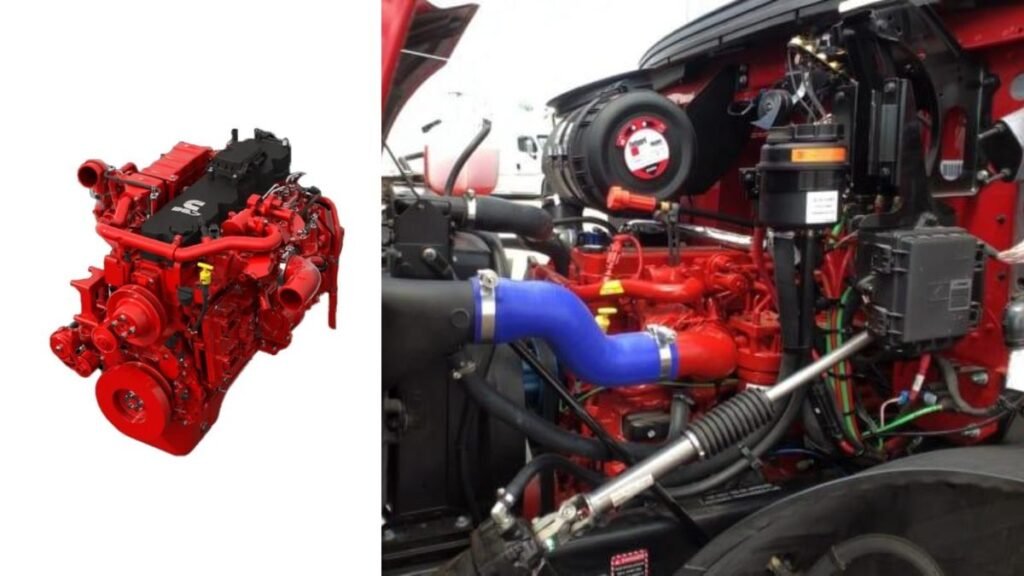
Mack publishes the MD Series diesel range as 220 to 300 horsepower and 560 to 660 lb-ft of torque on its overview. Its engine listing divides the B6.7 into two groups. The Efficiency Series covers 220 to 260 horsepower with torque from 520 to 660 lb-ft, depending on calibration. The Performance Series covers 280 to 300 horsepower with 660 lb-ft. The 520 lb-ft figure appears in the engine listing, while the overview range starts at 560, so buyers should rely on the rating attached to a specific build.
Cummins publishes many B6.7 calibrations for various manufacturers. They include 220 horsepower ratings with different torque calibrations, 240 horsepower with about 560 lb-ft, 250 and 260 horsepower ratings with up to 660 lb-ft, and 280 and 300 horsepower ratings with up to 660 lb-ft. The Cummins engine family has also offered ratings above 300 horsepower in some applications, but Mack’s published MD Series range tops out at 300, and that is the number that applies to this truck. Which calibrations are available on a given 2026 MD7 depends on how Mack configures the vehicle.
The practical difference between the two groups follows from their purpose. Efficiency-oriented ratings suit urban delivery and regular distribution, where predictable power and moderate demands are the norm. Higher-output ratings make more sense for heavier bodies, sustained workloads, and demanding vocational use. Low and mid-range torque is the important quantity in much of this work. A loaded truck pulling away from a stop or climbing a grade leans on torque at modest engine speeds more than on peak horsepower. Because every rating in the Performance Series peaks at 660 lb-ft, the larger difference between ratings is in horsepower, and a buyer’s weight and duty cycle should decide between them.
Allison Automatic Transmission Options
Mack lists three six-speed Allison automatics for the MD Series, described on its Allison transmission page. They are the Allison 2500 HS Highway Series, the 2500 RDS Rugged Duty Series, and the 3000 RDS Rugged Duty Series. The 2500 HS is aimed at highway-oriented delivery and regional transport, where smooth automatic shifting during regular commercial service is the goal. The 2500 RDS is built for more demanding medium-duty work with frequent stops and starts. The 3000 RDS is the choice for tougher vocational applications, and Mack lists PTO and retarder options with it. The 3000 RDS is one available configuration, not standard on every MD7.
An automatic transmission matters in this class of truck because the driver’s workload is part of the operating cost. Delivery drivers make dozens of stops, and an automatic removes clutch work from each one. Fleets can also train new drivers faster on an automatic than on a manual, since there is no clutch technique to teach. The transmission affects how power reaches the wheels, how smoothly the truck pulls away with a load, and how easily the driveline works with auxiliary equipment.
A Power Take-Off, or PTO, is a drive point on the transmission that lets the engine run a hydraulic pump or other auxiliary equipment. Bodies such as dump bodies, cranes, and some specialized equipment need it. Mack lists a PTO preparation kit, which is a harness and switch kit, as an option. PTO preparation is not the same as an installed hydraulic system. It means the truck is ready to accept one. The pump, hoses, controls, and powered body equipment still have to be added.
GVWR Actual Payload Axle Ratings and Chassis Dimensions
The MD7’s maximum published GVWR is 33,000 pounds. GVWR is the maximum permitted weight of the completed vehicle when loaded. It is not a measure of cargo. Usable payload is what remains after the vehicle’s actual ready-to-operate weight is subtracted from the applicable GVWR. That ready-to-operate weight includes the original chassis and cab, the installed body, any refrigeration system and hydraulic liftgate, fuel, the driver and passengers, tools and accessories, and any other installed equipment.
That is why two MD7 trucks with the same GVWR can carry very different loads. A refrigerated truck can carry less cargo than a dry van of similar size because insulation, refrigeration machinery, and related equipment add weight. No single payload figure applies across the MD7 range, and none should be invented. Chassis curb weights are also not a safe substitute, since they change with engine, transmission, axles, suspension, fuel capacity, and options.
Axle loading is a separate limit from GVWR. A truck can sit below its GVWR and still exceed an individual axle rating if the cargo is poorly distributed. Loading a body heavily toward the rear can overload the drive axle even when the total weight is acceptable. Checking axle ratings against the vehicle’s certification label, and planning the load distribution, is part of specifying the truck correctly.
Wheelbase and Commercial Body Lengths
Mack’s 2025 body-builder instructions for the Gen 2 chassis give planning examples that pair typical dry van lengths with wheelbases. A 12-foot body corresponds to a 151-inch wheelbase, a 14-foot body to 175 inches, a 16-foot body to 187 inches, an 18-foot body to 205 inches, a 20-foot body to 217 inches, a 22-foot body to 235 inches, a 24-foot body to 255 inches, a 26-foot body to 274 inches, and a 28-foot body to 287 inches. These are planning examples and not rigid rules.
Mack’s documentation explains that wheelbase should be chosen based on weight distribution. It also notes that the typical body-length planning assumes a level load that maximizes GVWR, and that it does not include the weight of the driver, passengers, fuel, liftgates, refrigeration equipment, or other ancillary equipment. Wheelbase affects maneuverability, body length, rear overhang, and axle loading, so the choice is a trade-off. A shorter wheelbase turns more tightly in urban streets. A longer one supports a longer body and a different weight distribution. Wheelbase is also not the same as overall vehicle length or cargo-box length, so a 217-inch wheelbase does not describe a 217-inch truck.
Dry Van Box Truck Applications
A dry van body is the most common way to use a medium-duty chassis. It encloses freight, protects it from weather and outside exposure, and suits general cargo. The MD7 fits that work in regional freight distribution, warehouse-to-warehouse transportation, retail distribution, furniture and appliance delivery, commercial goods transportation, and interstate or regional delivery.
Body length and wheelbase decide where the truck fits. A shorter body on a shorter wheelbase works in dense urban areas and at tight loading docks. A longer body supports larger delivery loads and fewer trips. The engine, transmission, and GVWR then matter in a concrete way. A heavier GVWR gives the body builder more room to add body length, a liftgate, or other equipment without immediately exhausting the weight limit. The engine and automatic transmission have to move that mass through traffic and on grades all day.
How much freight a particular dry van body can carry cannot be stated in general, because it depends on the body, the options, and the axle ratings. Fleet buyers should request the certified weight of the finished truck before relying on any estimate.
Refrigerated Box Truck Applications
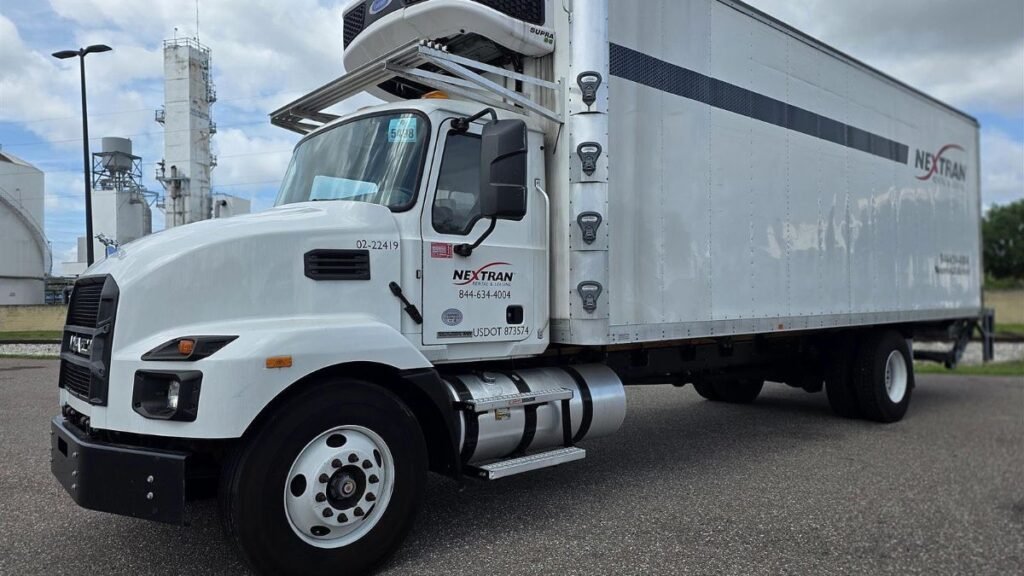
Mack lists refrigerated goods delivery among the applications for the MD Series. A refrigerated truck is built from two parts. The insulated body holds the cargo and slows heat transfer, and the refrigeration unit actively cools it. They are separate pieces of equipment, and a body can be insulated without any refrigeration at all. Neither comes from the factory on the MD7. A refrigerated truck exists only after a body builder installs both on the chassis.
Typical uses include grocery distribution, dairy and frozen food transportation, foodservice delivery, regional refrigerated transportation, and pharmaceutical or other temperature-controlled distribution where the appropriate certified refrigeration equipment is installed. What the truck can hold and how cold it stays is a function of that equipment and not of the chassis.
Weight is the main constraint. Insulation, the refrigeration unit, a liftgate, and other equipment all add to curb weight, and each pound they add reduces the remaining payload. A refrigerated body on an MD7 can therefore use up a meaningful share of the available capacity, and the buyer should plan around the completed vehicle’s weight. Performance claims about temperature ranges depend on the specific refrigeration equipment and are not a property of the MD7 itself.
Flatbed Stake Body Dump Tank and Other Vocational Configurations
The open chassis is what gives the MD7 its range. Flatbed and stake-body configurations suit lumber, construction materials, equipment, pipes, and other cargo that does not need an enclosed body. Dump bodies serve material delivery, municipal work, landscaping, and construction-related duties, and they typically rely on the PTO and hydraulic provisions discussed earlier. Mack showed an MD7 dump truck at Work Truck Week 2026, which points to the chassis’s vocational role. That display truck represents one configuration and not the standard MD7.
Tank bodies and equipment haulers are also possible, provided the final vehicle design, weight distribution, and applicable certifications support that use. Not every body type is automatically approved for every configuration. A tank carries a liquid load that shifts and concentrates weight differently from a flat cargo, and each body brings its own regulatory and engineering requirements. The chassis is the starting point, and the body builder and the buyer have to confirm that the completed truck meets them.
Trailer Compatibility and Towing Capability
The MD7 is a rigid 4×2 medium-duty truck, not a Class 8 semi-tractor. It has no fifth wheel for pulling a semi-trailer in the conventional way. Some completed MD7 configurations can still be fitted to tow a trailer, and the equipment that makes that possible is not standard on every truck.
A documented upfit example shows what that equipment can include. It has a pintle or ball hitch arrangement with a 2-5/16-inch ball connection and reinforced hitch mounting. It adds trailer air-brake connections and the air supply and protection components that support them, along with a seven-pin electrical connection and additional trailer brake controls where required. These are configuration-specific items. They show that towing is possible on a properly equipped truck and do not describe what every MD7 includes.
Trailers that might be considered on a properly configured chassis include equipment trailers and commercial flatbed trailers. No universal maximum towing capacity or gross combination weight rating can be stated for the MD7, and publishing one would be misleading. The permissible trailer weight depends on the completed truck’s certified configuration, the gross combination rating where one is assigned, the axle ratings, the transmission, the hitch rating, the brakes, and applicable regulations. Installing a hitch does not by itself establish a safe or legal trailer rating. The certified ratings for the specific truck have to support it.
Safety Systems Visibility and Driver Comfort
The refreshed MD Series carries a set of safety and driver-assistance features that Mack describes in its refresh announcement. These include an anti-lock braking system, automatic traction control, radio mute when reverse gear is engaged, a park-brake alarm, adjustable driver and passenger seat belts, and improved LED cabin lighting.
Each does a specific job. Anti-lock braking prevents the wheels from locking under heavy braking, which helps the driver keep steering control. Automatic traction control reduces excessive wheelspin when available traction is limited, such as on a wet or loose surface with a loaded truck. Muting the radio in reverse makes it easier for the driver to hear what is happening around the truck while backing. The park-brake alarm gives the driver an extra notification that the brake state needs attention.
Visibility matters because medium-duty trucks work among loading docks, tight streets, parked vehicles, and pedestrians. The passenger peep window, mirror choices, and cabin lighting contribute to that, and what a given truck carries depends on how it was ordered. The steering-wheel controls keep common functions within reach.
Two clarifications apply. The dual-airbag cab suspension is a ride and vibration system and is not a passenger crash-protection airbag. Beyond these standard safety features, Mack introduced its Mack Protect collision mitigation system for the MD Series in March 2026, bringing additional driver-assistance technology to the MD7. The available system combines radar sensors, cameras, and detection technology to provide features such as forward collision warning, adaptive cruise control, automatic emergency braking, lane departure warning, speed limit sign recognition with overspeed alerts, and right-side lane change and blind spot support with pedestrian and bicyclist detection. These technologies add another layer of protection for trucks operating in congested urban areas and on regional delivery routes. However, buyers should verify the availability and installation of Mack Protect on the specific 2026 MD7 they are considering rather than assuming that every truck includes the complete system. Mack’s official Mack Protect announcement.
Fuel Capacity Emissions Maintenance and Fleet Support
Mack’s Gen 2 body-builder documentation lists 50-gallon and 90-gallon fuel tank configurations. Capacity influences route planning, since a larger tank allows longer stretches between fuel stops and can reduce the time a truck spends refueling. It also adds weight, which comes out of payload.
The Cummins engine is paired with an integrated exhaust aftertreatment system. Diesel emissions systems of this kind generally use diesel particulate filtration to capture soot and selective catalytic reduction to reduce nitrogen oxides. Service intervals and emissions performance depend on the configuration and should be taken from the manufacturer’s documentation.
Mack supports its trucks through its certified dealer network and services such as Geotab-based performance tracking and Mack OneCall roadside assistance. For a fleet, that support structure can matter as much as the truck’s hardware, since uptime is part of the economics.
Mack does not publish a single fuel-economy figure or driving range for the MD7, and none should be assumed. Real-world consumption depends on engine calibration, vehicle weight, body type, load, speed, traffic, route conditions, and driving behavior. A box truck on a flat regional route and a loaded dump truck in a quarry will use fuel very differently.
How the MD7 Compares With Other Medium-Duty Trucks
The MD7 sits in a segment with several credible alternatives. Comparing them is most useful when it is framed around business requirements and not specification totals.
Mack MD7 vs. 2026 Ford F-650
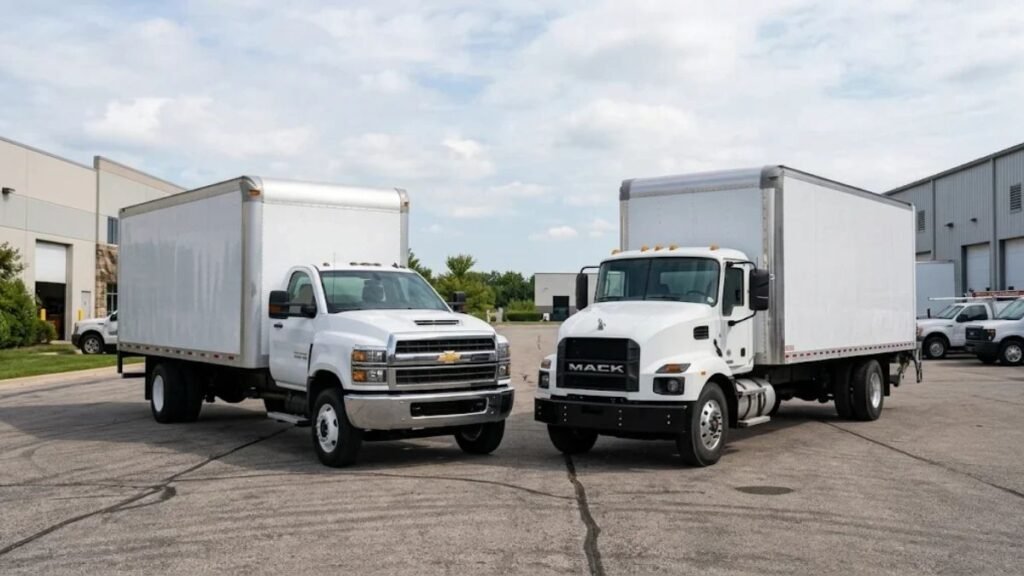
Ford’s published 2026 information for the 2026 Ford F-650 lists a maximum GVWR of 29,000 pounds, compared with the MD7’s 33,000. Ford offers more engine choice, including a 7.3-liter gasoline V8 rated at 335 horsepower and 468 lb-ft, and a 6.7-liter Power Stroke diesel V8 available at 270, 300, or 330 horsepower with 800, 825, or 850 lb-ft depending on calibration. Ford also publishes GCWR as high as 50,000 pounds for diesel F-650 and F-750 configurations, but that figure should not be read as the F-650’s own rating, because the F-750 shares it.
The MD7 offers a single diesel family from Cummins and a higher maximum GVWR. Ford offers a gasoline option and higher peak torque in certain diesel calibrations. A higher GVWR does not automatically mean a higher payload, since payload depends on the weight of the finished truck. A fleet comparing the two should compare completed, equipped vehicles and not the headline ratings.
Mack MD7 vs. Freightliner M2 106 Plus
The Freightliner M2 106 Plus is a family and not a single truck. According to Freightliner’s specifications, it spans Class 6 through Class 8 configurations, 200 to 360 horsepower, torque from 520 to 1,150 lb-ft, and a family maximum GVWR of 66,000 pounds. It offers Cummins B6.7 and L9 engines depending on domicile and configuration, Allison automatic and Eaton Fuller manual transmissions, and several axle and suspension combinations.
Those are family-wide ranges and do not describe any one truck, so the 66,000-pound figure should not be set directly against the MD7’s 33,000. The comparison that matters is one of scope. Freightliner’s M2 106 Plus covers a very broad span of configurations, which can suit a buyer who needs one platform across several weight classes. The MD7 is specifically a Class 7 platform with a 33,000-pound maximum GVWR, which suits a buyer who knows the work sits in that band.
Mack MD7 vs. Chevrolet Silverado 6500 HD
According to Chevrolet’s chassis cab information, the Chevrolet Silverado 6500 HD offers a maximum GVWR of 23,500 pounds and a maximum GCWR of 37,500 pounds for the chassis cab family. It uses the 6.6-liter Duramax turbo-diesel V8, rated at 350 horsepower and 750 lb-ft, with an Allison automatic. It offers factory rear air suspension and 2WD and 4WD configurations, and it is designed for commercial body upfits.
The Silverado has more peak horsepower and torque than the MD7’s published ratings. The MD7 has a much higher GVWR and a heavier Class 7 chassis. A more powerful engine is not automatically better. For a truck that will carry a heavy body and cargo, weight capacity and axle ratings can matter more than output, and a lighter truck with strong power may reach its weight limit first. A business with lighter loads and a need for 4WD may prefer the Chevrolet, and one that needs to carry a heavy refrigerated or vocational body may prefer the Mack.
Mack MD7 vs. International CV515
International’s CV Series information lists a 4×2 GVWR range of 15,000 to 23,500 pounds and a 4×4 range of 17,500 to 23,000 pounds for the series, and these are series ranges and not guarantees for every International CV515. The CV515 cab configuration is listed with a 115-inch bumper-to-back-of-cab and a 34-inch back-of-cab-to-axle dimension. It uses an International 6.6-liter V8 rated up to 350 horsepower and 700 lb-ft, and offers Dana Spicer axle options.
The CV515 targets a lighter commercial segment. The MD7 offers a higher 33,000-pound GVWR and a heavier Class 7 platform. For work that fits within the CV Series’ weight range, the lighter truck may be sufficient. For work that needs the MD7’s higher ceiling, the CV515’s range is simply not designed to reach it.
Conclusion
The MD7 earns its place through a combination of attributes and not any one of them. It is a Class 7 chassis with a 33,000-pound maximum GVWR, a Cummins B6.7 offered from 220 to 300 horsepower, three Allison six-speed automatic choices, 120,000 psi frame rails, Gen 2 cab improvements that address driver comfort, and an open chassis ready for a wide range of bodies. Those traits make it a serious platform for businesses that have outgrown a Class 6 truck but do not need the cost and size of a tractor.
The businesses most likely to benefit are regional distributors, refrigerated and foodservice carriers, and vocational and municipal fleets that need a flexible, heavy-duty rigid truck. Body builders also gain from the prewired chassis and range of wheelbases. What decides the outcome is the configuration. The best MD7 is the one specified around the completed body, its operating weight, the certified axle ratings, and the real work the truck must do. Buyers who treat GVWR as a ceiling, check axle loads, and confirm towing equipment against certified ratings will get what the platform is designed to give. In the American medium-duty market, the MD7 is a heavier, more adaptable answer to a question many fleets ask, and it rewards the buyers who specify it carefully.