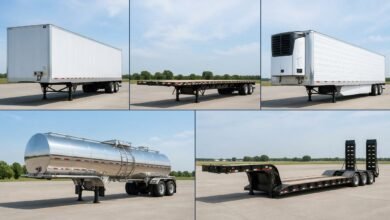
Step Deck vs. Lowboy Trailers Differences Dimensions and Best Uses
How deck height, concentrated load ratings, and loading method decide which heavy-haul trailer fits the job.

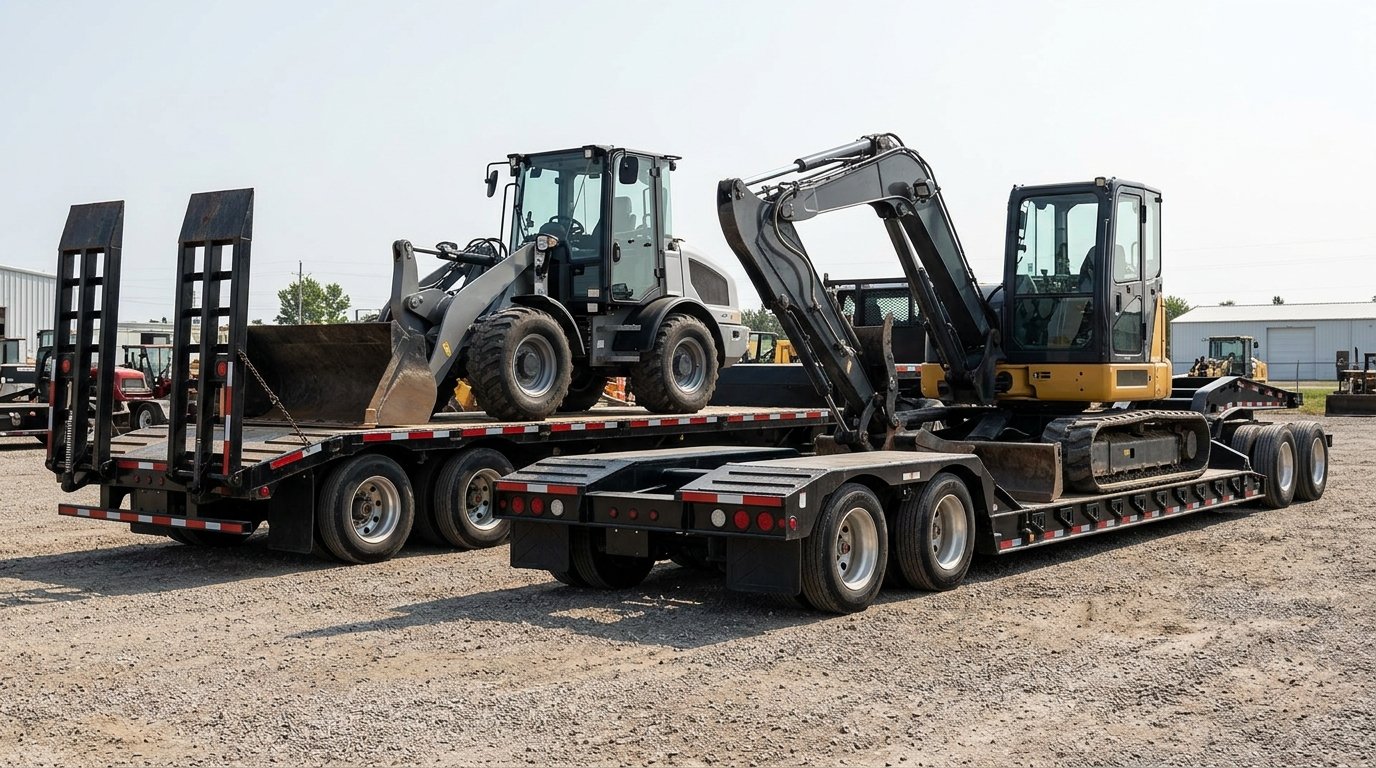
A comparison of Step Deck vs. Lowboy Trailers often starts with a machine that seems straightforward to move. A dealer needs to transport a mid-size excavator to a job site two states away. Its weight may fall comfortably within the rating of a suitable heavy-haul trailer, making weight seem like the easiest part of the job. The real challenges are the height of the cab, the width of the tracks, and the clearance beneath the machine once it is positioned on the trailer deck. Add a low overpass along the route, and the decision is no longer simply about how much weight a trailer can carry. It becomes a question of the machine’s total loaded height and whether it can be loaded and unloaded without scraping its undercarriage, encountering clearance problems, or creating an unsafe loading angle.
That is where the two designs begin to diverge. Both are open-deck trailers built to carry freight that cannot easily travel on a conventional flatbed, but each approaches the problem differently. A Step Deck provides additional vertical clearance through its lowered main deck, making it suitable for taller cargo that still fits within its structural ratings. A Lowboy takes that approach further with a much deeper center well, allowing certain types of heavy equipment to ride closer to the road. Its structure can also be configured to handle substantial concentrated loads. Choosing between them based solely on the largest capacity figure on a specification sheet can lead to the wrong decision. The better approach starts with the equipment itself: its overall height, actual weight, weight distribution, ground clearance, loading requirements, and the roads it must travel.

Our Take
In the Step Deck vs. Lowboy Trailers comparison, neither design is universally better. The assumption that a Lowboy is always the more capable choice while a Step Deck is merely a compromise does not hold up when the engineering is considered. A Step Deck is often the more practical option for tall or awkward freight when the equipment’s dimensions and concentrated loading requirements fall within the trailer’s structural ratings and applicable road limits. Its lowered main deck provides additional vertical clearance compared with a conventional flatbed, without requiring the deeper center well or detachable gooseneck system found on many specialized Lowboys. That does not mean a Step Deck is exempt from permits. Oversize or overweight permits may still be required whenever the actual load exceeds applicable state or route restrictions. The Trail King TK80ACS, for example, carries a published distributed capacity rating of 80,000 pounds and a concentrated load rating of 60,000 pounds over 10 feet. Those figures demonstrate that a Step Deck is far from a light-duty trailer and can handle a substantial range of construction, industrial, and agricultural freight.
The Lowboy earns its place when the problem moves beyond what a conventional drop deck can accommodate. If a machine is tall enough that a Step Deck’s loaded deck height puts it over the route’s clearance, the low center well may provide the additional vertical room needed. The same applies to equipment with substantial concentrated weight, tracked machinery that cannot safely negotiate a steep loading ramp, or self-propelled machines that benefit from front loading through a detachable gooseneck. A Lowboy should not be judged better simply because it sits closer to the ground. A lower deck often comes with a heavier, more complex structure, additional axles, hydraulic systems on detachable designs, and more involved loading procedures. Depending on the equipment and route, these features can also bring greater planning requirements and operating costs. Choosing a Lowboy for equipment that a properly rated Step Deck can handle adds complexity without necessarily improving the transportation job.
The Step Deck is the right default for tall cargo and moderate-to-heavy loads that fit within its structural ratings and applicable transportation limits. The Lowboy is the more specialized choice when height clearance, ground access, or concentrated weight leaves little room to compromise. The difference is not simply how close the deck sits to the pavement, but how the trailer’s structure and loading arrangement match the equipment being transported. The mistake is not choosing one over the other. It is choosing without measuring the freight first. Understanding that distinction is the starting point for comparing their construction, dimensions, and best uses.
What Is a Step Deck Trailer?
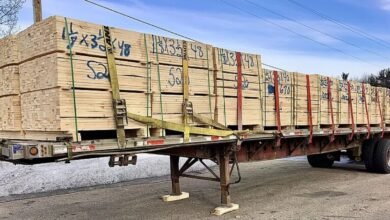
A Step Deck is an open-deck trailer with two deck levels. The front section, sitting over and just behind the gooseneck, is a raised upper deck. Behind it the deck drops to a lower main deck that runs most of the trailer’s length. That drop is the whole point of the design. Because the main deck rides lower than a conventional flatbed, a load of the same height ends up lower overall, and cargo that would exceed height limits on a flatbed may fit on a Step Deck.
The relationship is simple geometry. Total loaded height equals the deck height plus the height of the cargo, including anything that protrudes, such as exhaust stacks, mirrors, cab roofs, or folded booms. Every inch taken out of deck height is an inch given back to the cargo. Trail King makes this point in its own product materials, noting that a Step Deck’s two levels allow taller freight to be carried within height limits where a flatbed’s single deck height suits shorter cargo.
That makes the Step Deck a close relative of the flatbed, with a purpose of its own. For readers who want the baseline first, Haulizo covers flatbed trailer design, dimensions, and capacity in a separate article. The Step Deck keeps the flatbed’s open, accessible deck and adds a lowered section for height. Its advantages are versatility, simpler loading than a Lowboy, and the ability to haul both tall machinery and ordinary freight. Its limitations follow from the same design. The main deck is lower than a flatbed’s but not as low as a Lowboy’s well, and the raised upper deck wastes some usable length for low or heavy cargo. For very tall machinery, or equipment that must be driven on from the front, the Step Deck runs out of room before the Lowboy does.

Step Deck Trailer Dimensions and Weight Capacity
No single set of measurements describes every Step Deck, so it helps to look at one manufacturer’s published configurations. Trail King’s steel-aluminum Step Deck, the TK80ACS, is offered in three variants, the TK80ACS-34, TK80ACS-38, and TK80ACS-40. Trail King lists an overall length of 47 feet 10 inches, an overall width of 102 inches, and an upper deck length of 10 feet. The loaded deck height is 34, 38, or 40 inches depending on the configuration, and the trailer uses a tandem axle arrangement. These numbers describe this model line, not Step Deck trailers in general.
Two measurements are easy to confuse. Loaded deck height is how far the top of the deck sits above the road when the trailer carries a load. Loaded ground clearance is the space beneath the lowest part of the trailer. Trail King publishes loaded ground clearance values that differ by configuration, with examples of 9, 13, and 15 inches. A trailer can have a modest deck height and still offer generous clearance beneath the frame, which matters when crossing a rail crossing, a steep driveway, or a ramped approach.
The capacity ratings need the same care. Trail King lists 80,000 pounds as the distributed capacity and 60,000 pounds as the concentrated load rating in 10 feet. A distributed rating assumes the load is spread along the deck. A concentrated rating applies when a heavy machine puts most of its weight on a short stretch of structure, which is exactly what tracked equipment does. The concentrated figure is lower because the same frame is asked to carry more weight in a smaller area. Neither number is a legal payload allowance. The weight a driver may lawfully carry depends on the trailer’s own weight, the tractor, axle spacing, and the rules of every state on the route.
Construction material changes the practical picture. Trail King describes the TK80ACS as a reinforced steel frame with an aluminum deck, and the company says the aluminum deck reduces weight and resists corrosion, which it says can increase payload capacity. That is a manufacturer claim, and it is reasonable engineering logic, since less trailer weight leaves more of the legal gross weight available for cargo. Steel construction is generally heavier but is often chosen for rugged use, while steel-aluminum combinations try to keep the structure strong where it carries the heaviest stresses and save weight in the deck. Axle configuration works the same way: more axles can spread weight, but they also add trailer weight and cost.
What Is a Lowboy Trailer?
A Lowboy is designed around a single idea: put the cargo as close to the ground as the structure allows. The common configuration is the double drop, which has three functional deck areas. The front deck sits over the gooseneck and the tractor connection. Behind it a low center well drops down between the axles, and the rear deck rises again over the wheels at the back.
The center well is the most important part of the design. It is where heavy equipment actually rides, and its depth determines how much vertical clearance a tall machine will have. A lower loading surface reduces overall equipment height, which helps with bridges and overhead limits. It also lowers the center of gravity, which many heavy-equipment operators consider a stability advantage, though the stability of a given load still depends on securement and how the load is positioned. The other areas serve the structure. The front deck and rear deck give the trailer the space needed to connect to the tractor, to carry the wheels and axles, and to support the load.
Not every Lowboy uses a detachable gooseneck. Some have a fixed gooseneck, and the double-drop layout does not by itself say how the machine gets onto the deck. That distinction matters later, because loading method is one of the most important practical differences between trailers that look similar from the side.
Lowboy Trailer Dimensions and Weight Capacity
Lowboy dimensions vary widely by manufacturer and model, so any attempt to define a single standard would be misleading. The Talbert 60CC/55SA-LD spread-axle Lowboy illustrates one end of the range. Talbert publishes a loaded deck height of 18 inches, a loaded road clearance of 6 inches, a deck length of 26 feet, and a deck width of 8 feet 6 inches, which is 102 inches. Its capacity is listed as 110,000 pounds in a 10-foot, two-point rigid load base on four close-coupled axles.
The detail in that rating matters as much as the number. A capacity stated for a specified load base tells you how concentrated the weight is allowed to be. Move the same load to a shorter base and the rating no longer applies. Trail King’s hydraulic detachable gooseneck line shows how different manufacturers describe similar ideas. The TK70HDG is listed at 70,000 pounds in 12 feet on a 24-foot deck with two axles. The TK102HDG is rated for 102,000 pounds in 12 feet on a 25-foot-9-inch deck with three axles, and the TK110HDG at 110,000 pounds in 12 feet on the same deck length, also with three axles.
Those figures cannot be compared casually. Talbert’s 110,000-pound rating is tied to a 10-foot, two-point rigid base and four axles. Trail King’s 110,000-pound rating is tied to a 12-foot basis and three axles. They are different engineering conditions, and each is specific to its model and configuration. The number of axles alone does not establish how much equipment a trailer can legally transport. Axle count affects structural capacity and weight distribution, but legal weight depends on axle spacing, axle group limits, and permits, and a rating printed on a data plate is not permission to load to that figure on public roads.
Fixed Gooseneck vs. Detachable Gooseneck Lowboys
This is where Lowboys diverge most in daily use. A fixed gooseneck trailer stays connected to the tractor, and equipment typically gets on and off at the rear using ramps, a loading dock, or another method. A detachable gooseneck trailer lets the front of the trailer separate from the tractor, which opens a very different loading path.
Detachable designs are commonly called RGN trailers, short for removable gooseneck. The term describes the gooseneck arrangement, not every Lowboy. A hydraulic detachable gooseneck uses hydraulic components to assist with separating and reconnecting the gooseneck from the main deck. The operator can lower the front of the deck toward the ground, drive the tractor away, and load a machine over the front. When the machine is in position, the gooseneck is reconnected and locked. Exact steps and features vary by manufacturer and model.
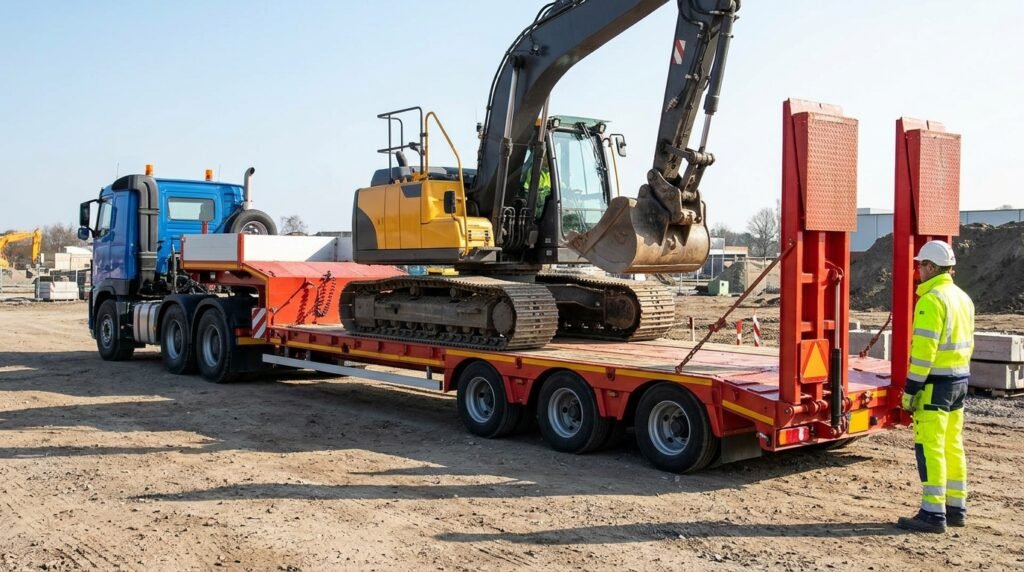
Front loading is useful for tracked and self-propelled machinery. An excavator or bulldozer can drive straight onto the deck without climbing a steep rear approach, and the low surface reduces the angle the machine has to negotiate. Trail King’s TKHDG product page describes 31-inch double-hinged front loading ramps with a reinforced support ledge on that model, which helps tracked equipment move from the ground onto the deck in a controlled way. That arrangement belongs to that configuration and is not a feature of every Lowboy. Talbert lists its own gooseneck features, including a non-ground-bearing gooseneck design with a hydraulic support cylinder, optional front ramps, removable outriggers, a bucket well, and a boom well on the 60CC/55SA-LD. These show how much engineering variation exists within the category, and no single Lowboy has them all.
Step Deck vs. Lowboy Trailers: The Important Engineering Differences
The core difference between these trailers is the geometry of the deck. A Step Deck has one drop, from the upper deck to a main deck that stays at a single height for most of its length. A Lowboy usually has a double drop, with a deep center well and a rear deck that rises again. That well lets a Lowboy offer a much lower loaded deck height, as the Talbert’s 18 inches shows against the 34 to 40 inches Trail King lists for its Step Deck line. Those two figures come from different manufacturers’ specific models, but they illustrate why the vertical clearance advantage of a Lowboy can be substantial.
Cargo clearance is only part of the story. Equipment accessibility follows the loading method, with Step Decks commonly loaded by crane, forklift, side loading, or rear ramps, and detachable-gooseneck Lowboys loaded from the front. Concentrated loading is another dividing line. A Step Deck’s published concentrated rating, such as Trail King’s 60,000 pounds in 10 feet, reflects a structure designed for heavy but not extreme point loads. Specific multi-axle Lowboys are engineered for much higher concentrated loads, and some are rated for more than 100,000 pounds on a defined load base. That does not mean every Lowboy outweighs every Step Deck. A two-axle Lowboy rated at 70,000 pounds in 12 feet carries less than a well-configured Step Deck’s 80,000-pound distributed rating, though the two ratings use different bases.
Weight distribution and axle arrangement add further complexity. Lowboys often use more axles to spread heavy loads, and spread-axle designs change how weight is shared across the road surface. More axles can help meet legal weight limits, but they add trailer weight, tire and brake maintenance, and turning and tracking considerations. Operational complexity also rises with detachable goosenecks, hydraulic systems, and multi-step loading. Route requirements may differ too, because heavier and wider loads can bring permits, and a lower deck can reduce overall height but not overall weight. These trailers solve different transportation problems, and the engineering reflects that.
Loading and Unloading: Ramps, Goosenecks, and Ground Clearance
Step Deck loading depends on the equipment and the site. Cargo can be lifted on by an overhead crane or forklift, driven on from the side where the setup allows, or loaded over the rear. Some configurations offer rear ramps, and some offer hydraulic folding ramps as an option. These are manufacturer-specific equipment choices, not standard features across all Step Decks, so a buyer should confirm what a given trailer includes before assuming it can self-load wheeled or tracked equipment.
Lowboy loading with a detachable gooseneck works differently. With the gooseneck disconnected and the front of the deck lowered, the machine drives up from the front onto the well. This reduces the climb angle, which is the central advantage for tracked equipment. Ramp angle, ground clearance, and the machine’s approach and departure geometry still matter, because a long machine can high-center where a ramp meets the deck, and a short-wheelbase machine can scrape its underside.
Several practical issues apply to both trailer types. Loaded ground clearance determines whether the trailer clears a crowned road, a rail crossing, or a steep entrance. Tracked equipment needs support in the right places, and the weight should sit over structurally rated areas rather than on a convenient but unrated stretch of deck. Securement points, chain angles, and the final position of the load on the deck all affect safety. Loading is an engineering step, and operators who treat it as a formality are the ones who find out about ground clearance the hard way.
Best Uses for Step Deck and Lowboy Trailers by Equipment Type
No machine category belongs automatically to one trailer. The right choice depends on actual weight, dimensions, attachments, ground clearance, loading capability, weight distribution, and route restrictions, and the following examples show how that reasoning works.
Agricultural tractors vary enormously. A compact or mid-size tractor is often a good candidate for a Step Deck, because the machine is tall but not extremely heavy and the lowered main deck gives its cab and canopy room. A very large articulated or high-horsepower tractor may call for a Lowboy if its weight, width, or height pushes past what a Step Deck’s ratings and clearances can handle. Excavators and bulldozers are tracked machines where weight is concentrated and ground clearance is limited, so a detachable-gooseneck Lowboy with front loading often makes sense, especially at larger sizes. A smaller excavator may still ride safely on a Step Deck if its weight and height fit.
Skid steers and compact track loaders are generally light enough that a Step Deck handles them comfortably, and they can often be driven on over a rear ramp where the configuration allows. Forklifts and many industrial machines are commonly loaded by crane or by another forklift, which suits the Step Deck’s accessible open deck, though a very tall mast or counterweight may change the math. Industrial generators and compressors are heavy and compact with defined lifting points, and they may suit either trailer, with the decision driven by weight, height, and loading method rather than machine type. Cranes and large construction machinery are where the Lowboy’s strengths show most, since weight, size, and clearance all tend to push toward a low deck and a high concentrated rating. Even here, the final answer comes from measuring the specific machine against the specific trailer and route, not from a category rule.
U.S. Legal Height, Weight Limits, and Oversize Permits
Federal rules set a framework, and the states fill in the rest. The Federal Highway Administration’s size and weight information is clear that there is no universal federal commercial vehicle height limit. States set their own, which means a load that clears one state’s limit may not satisfy the next, and bridges, overpasses, and route-specific restrictions can lower the practical limit below the legal one. Nobody should treat 13 feet 6 inches or any other single figure as a national height rule.
Width has a federal standard. On the National Network, the commercial vehicle width limit is 102 inches, with an exception that applies in Hawaii. Cargo wider than the standard may require an appropriate permit. For weight, FHWA’s Interstate standards are 20,000 pounds on a single axle, 34,000 pounds on a tandem axle, and 80,000 pounds gross vehicle weight, subject to the Bridge Formula and to applicable exceptions. The Federal Bridge Formula ties permissible weight to the number of axles and the distance between them, which is why a rig with widely spaced axles can legally carry more than one with closely spaced axles, and why adding axles does not automatically make a heavy load legal.
When a load exceeds the standard limits, states administer the permits. According to FHWA’s overview of oversize and overweight permitting, the federal government does not issue these permits in place of the states. Permits generally apply to nondivisible loads, meaning loads that cannot reasonably be broken into smaller pieces without damaging their value or intended use, which describes a typical piece of heavy equipment. One state’s permit does not authorize travel in every state. Requirements such as pilot cars and route surveys depend on the load, the state, the permit, and the route. A trailer rated for 80,000 pounds does not carry an automatic right to an 80,000-pound road load, and a manufacturer capacity figure is an engineering rating, not a license.
Heavy Equipment Securement and Transportation Safety
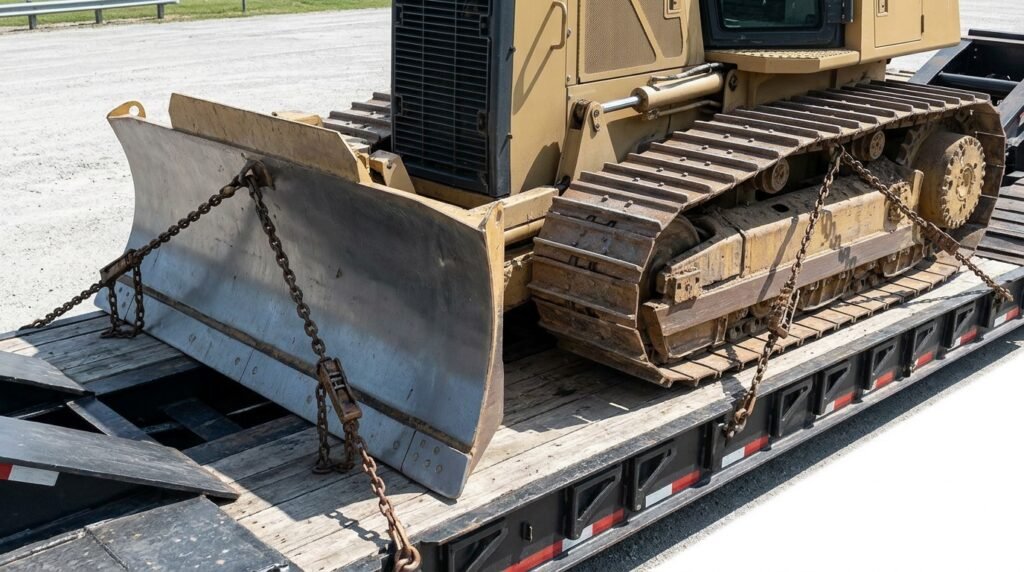
Securing heavy equipment is a regulated task, and the Federal Motor Carrier Safety Administration’s cargo securement rules set the baseline. Tracked and wheeled equipment can shift, tip, or roll if it is not restrained, and the consequences on a highway are severe. Chains, binders, and tie-down points all have working load limits, and the securement system is only as strong as its weakest component. Attachment points on both the trailer and the machine should be rated and in sound condition.
The specific provision for heavy equipment is 49 CFR 393.130. It applies to wheeled or tracked heavy vehicles, equipment, and machinery that individually weigh 10,000 pounds or more, and it generally requires at least four tiedowns for qualifying loads. It also requires that accessory equipment, such as a bucket or a hydraulic attachment, be lowered and secured, and that articulated equipment be restrained against movement at its articulation points. In practice that means an operator must think about the whole machine, including the boom, the blade, the bucket, and any joint that can swing or fold.
Four chains do not by themselves make a load legal. The tiedowns must also meet the general working load limit and performance criteria in the cargo securement rules, and the securement must actually prevent the machine from shifting forward, backward, or sideways. A properly secured load is the result of the right equipment, correct positioning on the deck, appropriate chain angles, and a final check before the truck moves.
Operating Costs, Maintenance, and Long-Term Ownership
Operating costs differ between these trailers for structural reasons rather than because of any simple rule. A Step Deck is mechanically simpler. A Lowboy, especially a multi-axle or detachable design, adds weight and parts, and that can affect tare weight, which is the empty weight of the trailer. A heavier trailer leaves less of the legal gross weight for cargo, and a heavier rig can influence fuel consumption, though real figures depend on the tractor, the route, and the load. Loading time also matters. Detaching and reattaching a gooseneck and managing ramps takes longer than driving a machine onto a deck or lifting it with a crane, and time is a cost for any operator. Purchase complexity follows the same logic, since a detachable, multi-axle trailer involves more components to specify, and any real figure depends on the exact configuration.
Maintenance concerns differ too. A hydraulic detachable gooseneck adds cylinders, hydraulic lines, locking mechanisms, and ramps to the inspection list, and a leak, a worn pin, or a sticking lock can sideline a trailer. Multi-axle Lowboys add more brakes, bearings, tires, and suspension components. For a Step Deck, the checklist centers on deck condition, frame integrity, suspension, brakes, and axles, along with any ramps or loading equipment that the trailer includes. Steel decks need attention to corrosion, and aluminum decks need attention to wear and damage.
It is worth separating general operating cost from the cost of a specific trailer. The numbers depend on the manufacturer, the configuration, the options, and how the trailer is used, so a fleet manager should evaluate the exact model and duty cycle rather than assume a category average.
How to Choose: Step Deck vs. Lowboy Trailers
A professional transporter should start with the cargo and work outward. Measure the actual height of the equipment, including every protruding component, and add it to the trailer’s loaded deck height to find the total height. Check width and length against the deck and against legal limits. Determine the machine’s weight and, just as important, how that weight is distributed, because a concentrated load against a concentrated rating is a different question from total weight against a total rating.
Then look at how the machine will get on and off the trailer. A tracked machine with limited ground clearance may need front loading, while a wheeled machine or a palletized load may load easily from the side or by crane. Consider axle distribution and the resulting legal weight under the Bridge Formula, then check permit requirements for the states on the route. Finally, weigh total operating expense, including tare weight, loading time, and maintenance.
A Step Deck makes more sense when the cargo is tall but within the trailer’s weight ratings, when versatility across many kinds of freight matters, and when simpler loading and lower complexity are priorities. A Lowboy makes more sense when height clearance is tight, when the machine is heavy and concentrated, or when front loading is the safest way to get it on the deck. When the freight fits comfortably on a Step Deck, the added expense of a Lowboy is difficult to justify.
Conclusion
The question at the start was how to move a tall, heavy machine without trouble on the route. Neither trailer answers that on its own, because the answer lives in the freight. A Step Deck gives tall cargo vertical room and handles a wide range of loads with straightforward equipment. A Lowboy gives the lowest loading surface and the structure for concentrated heavy machinery, and in detachable form it adds a loading method that suits tracked equipment.
The right decision comes from matching trailer design to the actual machine and route, not from a headline capacity figure or a preference for the lowest possible deck. A published rating describes an engineering condition, and the road imposes its own conditions through height, weight, axle spacing, and permits. The operators who get this right measure first, check the limits, and pick the trailer the job requires, and they treat the Step Deck and the Lowboy as two different tools rather than a good option and a better one.