Chevrolet Silverado 6500 HD Review
An in-depth look at the Silverado 6500 HD’s Duramax engine, chassis design, commercial upfits, weight ratings, and ownership costs.

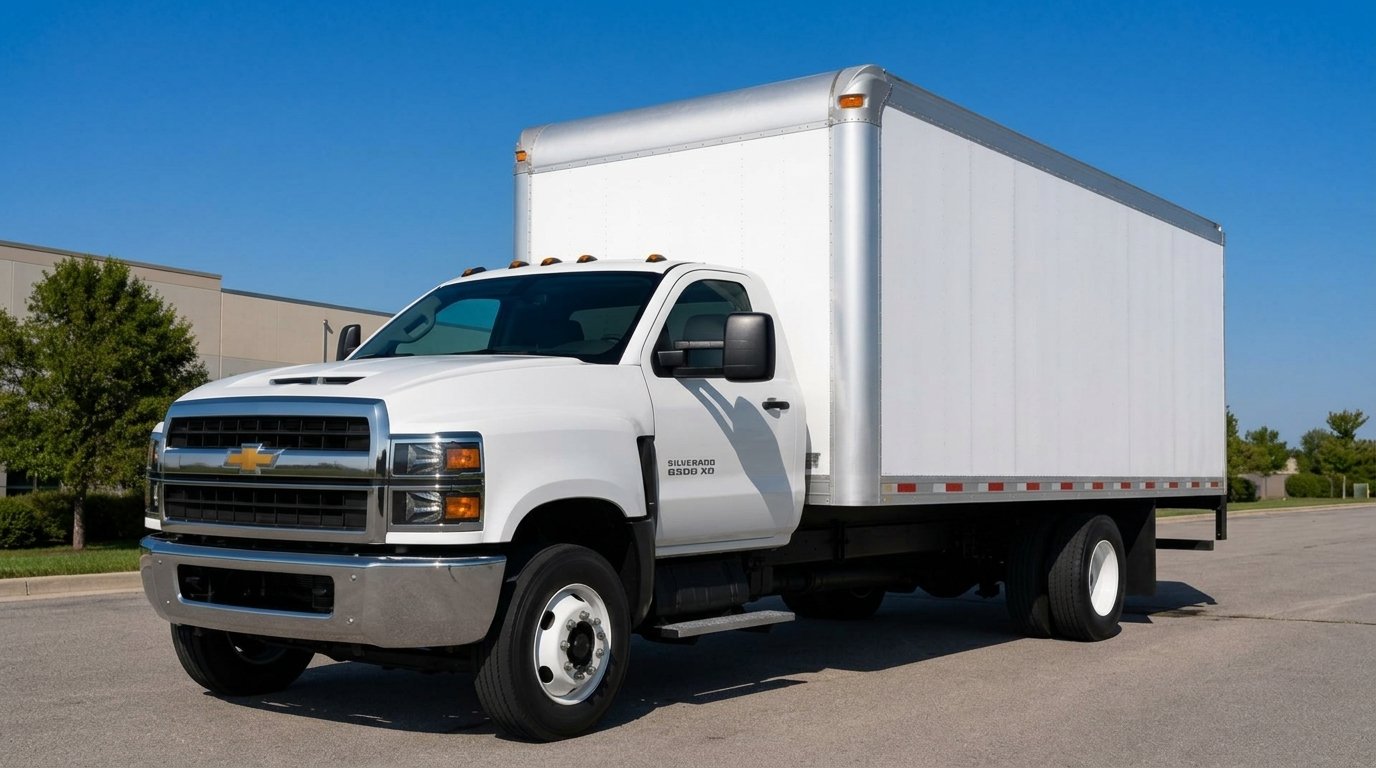
The 2026 Chevrolet Silverado 6500 HD sits at the top of Chevrolet’s medium duty chassis cab family, above the 4500 HD and 5500 HD, in the part of the American market where a pickup is too light and a Class 8 tractor is far more truck than the job requires. It is a conventional cab chassis, meaning the engine sits under a long hood ahead of the cab, and it leaves the factory without a cargo body. The business that buys it decides what goes behind the cab, whether that is a dump body, a flatbed, a utility body, or a stake body. Chevrolet pairs that open frame with a Duramax 6.6L diesel V8 and an Allison automatic transmission, and the result is a truck whose real character is only settled after the body builder finishes the job.
That arrangement changes how a buyer should read the Chevrolet Silverado 6500 HD. A pickup is judged largely on what Chevrolet delivers, while a chassis cab is judged on what it can become. The official Chevrolet Silverado Chassis Cab page lists the 6500 HD with a gross vehicle weight rating from 21,000 to 23,500 pounds, depending on configuration, and a starting MSRP of $65,850 on the page reviewed. Published prices can change, so confirm the figure with a dealer before budgeting. This article walks through the engine, the frame, the cabs, the upfit provisions, the weight ratings, and the cost questions, separating what Chevrolet has published from what a buyer must determine for a specific truck.
What the Chevrolet Silverado 6500 HD Is Built For
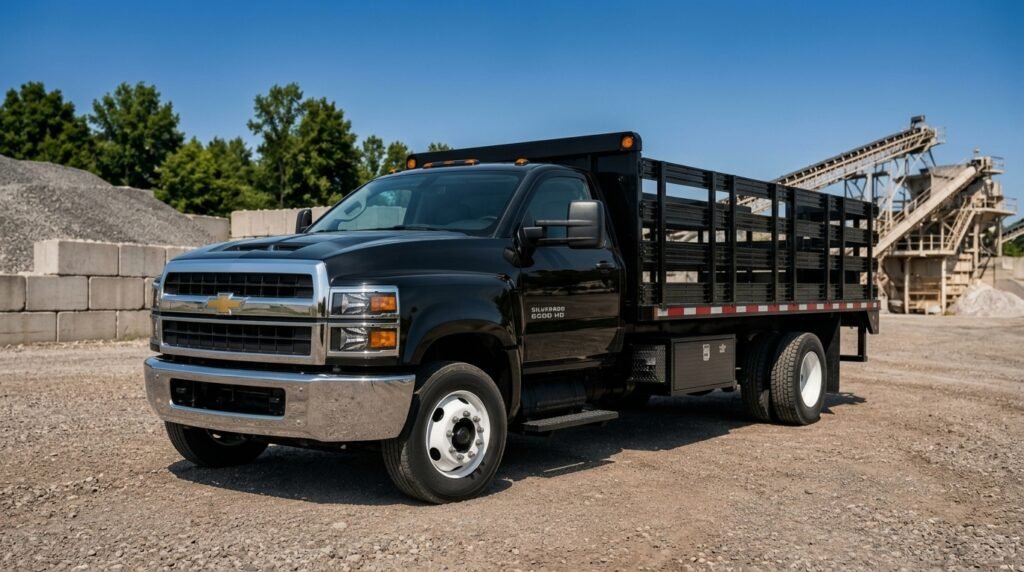
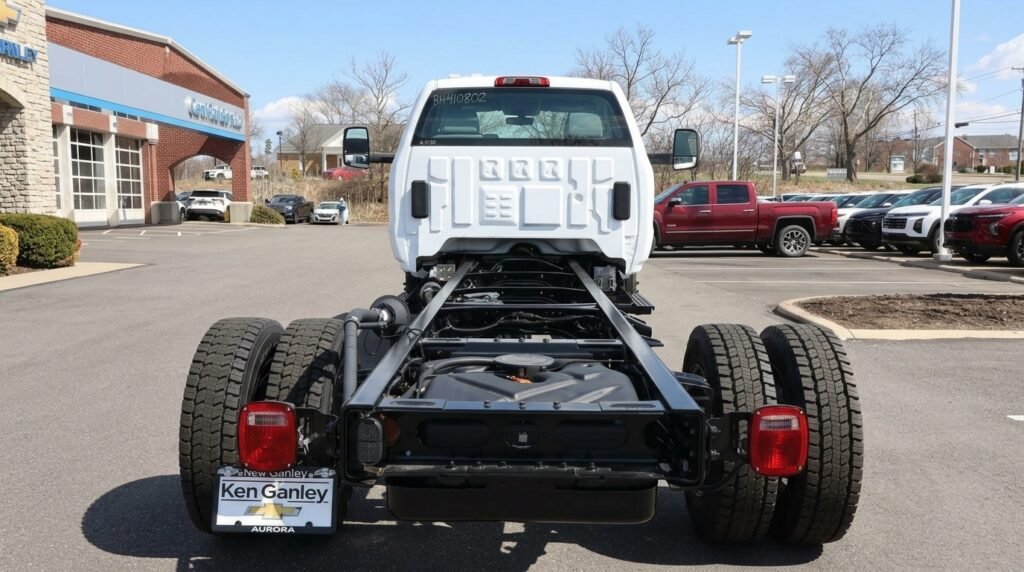
A chassis cab is an incomplete vehicle. It includes the frame, powertrain, axles, suspension, steering, brakes, and cab, but no cargo area. The manufacturer builds a platform with ratings, and a body builder or upfitter completes it with equipment suited to a trade. This is why Chevrolet’s own materials describe the Silverado Chassis Cab as designed for custom upfitting, and why the completed truck can differ enormously from one customer to the next even when the factory chassis is the same.
Chevrolet promotes the platform for utility bodies, dump bodies, and stake bodies, and the same chassis can reasonably be considered for flatbeds, service bodies, and other specialized equipment. That list describes intended use, not a guarantee that every body fits every configuration. A body that works well on one wheelbase and axle rating may not suit another, and the approved equipment for a given truck depends on its dimensions, frame requirements, and weight limits.
The selected body shapes almost everything about the finished vehicle. It changes empty weight, which changes how much the truck can legally carry. It changes overall length and height, which affects access to loading docks, garages, and job sites. It changes weight distribution, which determines how the load is shared between the front and rear axles. It also changes cost, because a hoist, a hydraulic system, a crane, or a built in compartment layout can add substantially to the invoice. A buyer who evaluates only the chassis is evaluating roughly half of the truck.
Based on its published GVWR range, the Silverado 6500 HD is generally treated as a Class 6 medium duty truck. That places it well below Class 8 vocational and highway tractors such as the Volvo VNX, Kenworth C500, or Western Star 4900, which are built for heavier combination weights and different duty cycles. The 6500 HD fills the space between heavy pickups with dual rear wheels and those larger trucks, serving contractors, landscapers, utilities, municipal fleets, and equipment operators who need more rated capacity than a one ton pickup can offer but not the size or cost of a heavy truck.
Duramax Engine and Allison Transmission
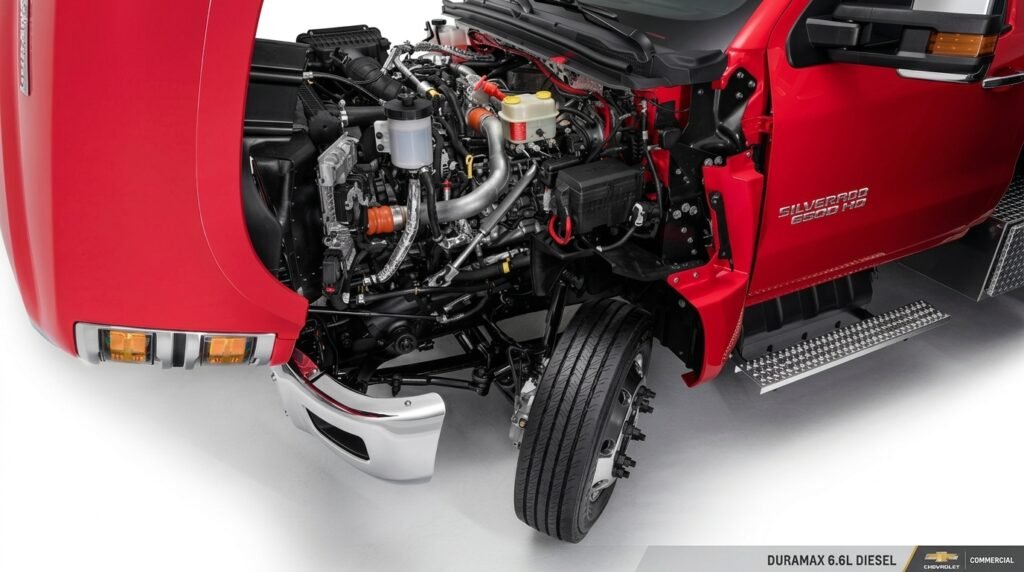
The Silverado 6500 HD engine is the Duramax 6.6L Turbo Diesel V8, which Chevrolet lists at 350 horsepower and 750 lb ft of torque for the Silverado Chassis Cab family. Configuration documentation identifies those ratings at roughly 2,500 rpm for horsepower and 1,400 rpm for torque. Some older material on earlier medium duty Silverados shows different torque figures, but the current published number for this family is 750 lb ft, and that is the figure that applies to the 2026 truck.
Horsepower and torque describe different things. Horsepower is the rate at which the engine does work, while torque is rotational force. For a loaded work truck, torque matters most when getting a heavy body moving from a stop or holding progress against a grade, and the fact that peak torque arrives at a relatively low engine speed suits stop and start vocational work. Still, the driver does not feel the engine alone. Transmission ratios, axle gearing, vehicle mass, and road conditions determine how those numbers translate into real performance. Chevrolet has published no standardized acceleration or hill climbing test for this truck, so any claim about a specific time or speed would be speculation.
The Allison automatic transmission is the other half of the powertrain. The 2026 towing supplement documents several Allison families across the 4500 HD, 5500 HD, and 6500 HD, including the 1700, 1750, 2700, and 2750 variants, with the right unit depending on model and configuration. Different transmissions exist because the unit must match the vehicle’s operating weight, intended load, axle ratio, drivetrain, and approved combined weight. A transmission suited to a lighter truck is not a free swap into a heavier one, and the approved ratings in the manufacturer’s documentation reflect those pairings.
Drivetrain adds another decision. The 6500 HD is offered in two wheel drive and four wheel drive, and four wheel drive helps with traction on loose or muddy ground, which can matter on construction sites, utility rights of way, and unpaved access roads. It does not automatically raise payload or towing capacity. In the official towing data, approved combination ratings vary with the transmission, axle ratio, rear axle rating, and drivetrain, and some four wheel drive configurations carry lower combined ratings than their two wheel drive counterparts.
The exhaust brake is standard across the family, according to Chevrolet. It slows the truck by using engine and exhaust system resistance, which reduces the work demanded from the service brakes during suitable conditions, such as long descents. It supplements the service brakes and does not replace them, and it does not independently guarantee a safe stop with a heavy load. Proper gear selection and adherence to the operating instructions still matter on a grade. Buyers should also consult the owner’s manual for the correct fuel specification, since any biodiesel blend compatibility should be confirmed against the documentation for the specific model year rather than assumed.
Chassis Design, Axles, and Suspension
Chevrolet describes the chassis as built around a single piece frame rail with a clean top of rail design. For a body builder, a straight, uncluttered frame top makes it easier to mount a subframe or body without working around obstructions, and it supports a more predictable installation. For the fleet owner, that can mean fewer surprises during the build, though the completed truck still depends on the exact body, mounting arrangement, and approved limits. Chevrolet has not published frame steel grades or thicknesses in the material reviewed, so strength claims beyond the manufacturer’s description would be unsupported.
Wheelbase is one of the most consequential choices. Chevrolet lists Regular Cab wheelbases from 165 to 243 inches and Crew Cab wheelbases from 175 to 235 inches. A longer wheelbase leaves room for a longer body and can spread cargo weight over more of the frame, while a shorter one improves maneuverability in tight work areas. The related dimension is cab to axle length, which determines how much room exists behind the cab for the body. Frame length and the position of the rear axle together influence the type of equipment that fits, the overall length of the completed truck, and how weight is shared between axles.
Axle ratings are practical limits, not decorative numbers. The 2026 towing supplement lists rear axle ratings from 10,000 to 15,500 pounds across the 4500 HD, 5500 HD, and 6500 HD family, and the higher combined weight configurations of the 6500 HD are associated with suitable rear axles. That does not mean every 6500 HD carries the highest rear rating, nor does it establish a single front axle rating for every version. A truck must stay within its front axle rating, its rear axle rating, and its GVWR at the same time, even when the engine feels capable of moving more. Equipment mounted behind the cab, such as a hoist, a toolbox run, or a crane, can shift load toward the rear axle, so planning the body is partly an exercise in weight distribution.
Chevrolet lists factory rear air suspension as available on the Silverado Chassis Cab family. Air suspension can be useful where the body, load, or ride requirements justify it, but its availability does not imply a higher payload or universal superiority over a conventional suspension. The right choice depends on the body, the cargo, and the surfaces the truck works on. Chevrolet also describes tuned shocks and cab mounts as measures to improve ride comfort. Those are manufacturer design claims, and no independent measurement of ride quality has been supplied here.
Steering geometry affects daily usability. Chevrolet advertises up to a 50 degree wheel cut in the applicable configuration, which can reduce the space needed to turn around on a tight job site. Wheelbase and overall length still govern how a truck behaves in confined areas, and the manufacturer has not given a turning circle in the material reviewed, so none is stated here. A shorter wheelbase with a generous wheel cut tends to suit congested sites, while a long body on a long wheelbase demands more room regardless of steering angle.
Regular Cab, Crew Cab, and Interior Design
The two cab choices serve different businesses. A Regular Cab is a good fit when the priority is rated capacity and body space and the crew is small, since it keeps the cab compact and can leave more of the wheelbase available behind it. A Crew Cab seats more occupants and suits operations that move several workers and their tools between sites, such as utility crews, landscapers, and contractors who would otherwise need a second vehicle. The wheelbase ranges differ by cab, from 165 to 243 inches for the Regular Cab and from 175 to 235 inches for the Crew Cab, so the cab decision also narrows the body options.
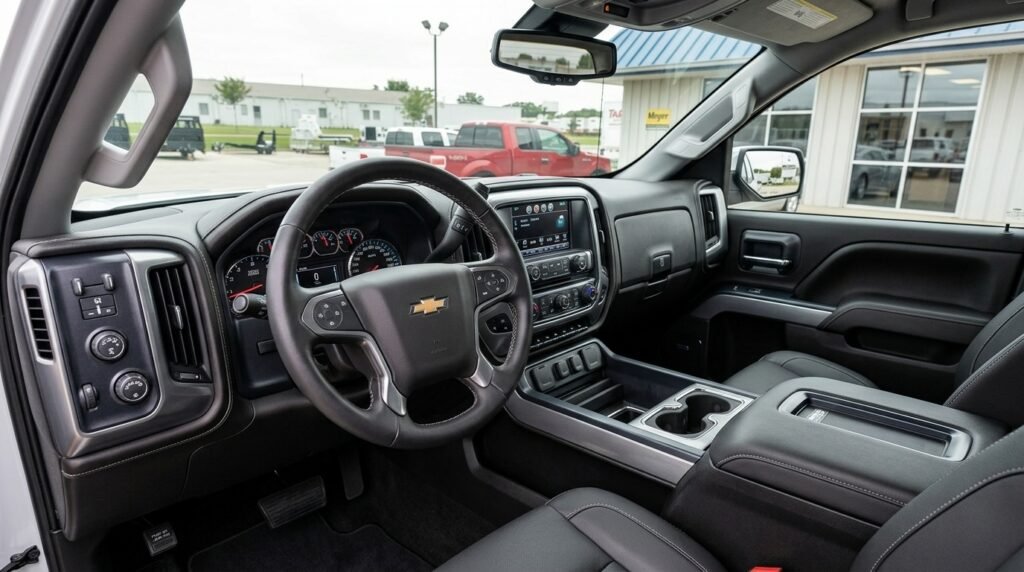
Chevrolet describes the interior as designed for comfort and practicality, with tuned shocks and cab mounts, a downward sloping hood for forward visibility, and triple sealed doors that help minimize outside noise. Visibility deserves emphasis in a vehicle that works around parked vehicles, equipment, pedestrians, and urban delivery areas. A hood that slopes away from the driver’s eye line can make it easier to judge the front of the truck when positioning it near a work zone. Door sealing and cab mounting matter on a long day, since sustained noise and vibration contribute to driver fatigue over hours of work.
This is not a long haul tractor, and it has no sleeper compartment. The cab is built around the working day and the number of occupants, not overnight living. Buyers should also be careful about interior assumptions. The Silverado pickup line offers a wide range of infotainment, seating, and driver assistance features, and those do not automatically carry over to the medium duty chassis cab. Touchscreens, smartphone connectivity, and power adjustable seating should be treated as configuration dependent and confirmed against the current build sheet, and no screen size, seat material, or digital dashboard specification is stated here for that reason.
The forward tilting hood connects the cab discussion to ownership. Chevrolet says it allows convenient servicing, and the same hood geometry that supports forward visibility also provides access to the engine and related components. For a fleet, that means technicians can reach key service points without removing major body panels, though Chevrolet has not published a time savings figure and none is claimed here.
Commercial Upfits and PTO Equipment
For many buyers, this section decides the purchase. Chevrolet offers up to ten auxiliary switches, depending on equipment, which give the upfitter dedicated circuits to power lights, beacons, pumps, and other body equipment without improvised wiring. Those switches matter because modern work bodies often draw considerable electrical power, and a clean factory provision reduces the risk of unreliable splices and overloaded circuits.
The power take off, or PTO, is a provision that transfers engine power through the transmission to run auxiliary equipment. On a completed truck, that can drive a hydraulic pump for a dump hoist, a crane, a liftgate, or other equipment installed by a body builder. Chevrolet lists dual side PTO access as available, allowing upfitters to take auxiliary power from either side of the transmission. That flexibility can simplify packaging, since the location of the pump and hydraulic lines affects how the body fits on the frame and how easily the equipment can be serviced.
Upfit planning should begin before purchase, not afterward. The business needs to define the body type, hydraulic requirements, electrical loads, wheelbase, cab to axle dimension, axle loads, overall height, and frame compatibility before it chooses a configuration. A mistake here can be costly, such as ordering a wheelbase that cannot accept the desired body or an axle rating that leaves too little payload once the equipment is installed. Working with the body builder early gives the buyer an accurate picture of final weight and cost.
GM publishes upfitter documents through the GM Upfitter Integration page for 2026 medium duty. In reviewing that page, the conventional cab body builder manuals carried publication dates of 2022 and 2023, and the vehicle configuration diagrams were dated 2024 and 2025. That does not make them wrong, but it means a builder should confirm that a measurement or provision applies to the 2026 model year before relying on it, and should request current data when in doubt.
Chevrolet also states plainly that equipment from an independent supplier is not necessarily covered by the GM new vehicle warranty, and that GM is not responsible for the safety or quality of independent supplier alterations. That is a significant practical point. A buyer who adds a body from an outside builder should confirm in writing who stands behind the body, the installation, and any related electrical or hydraulic work.
Brakes, Stability, and Safety
Chevrolet lists StabiliTrak electronic stability control for the Silverado Chassis Cab family, along with an available locking rear axle. Stability control can help a driver maintain control when the vehicle begins to depart from its intended path, and a locking rear axle can improve traction in certain low speed situations where one wheel would otherwise spin. Neither is a substitute for judgment. A locking differential does not guarantee traction under all conditions, and stability control cannot compensate for excessive speed, unsuitable tires, overloading, or poor weight distribution.
The exhaust brake, discussed earlier, belongs in a separate category from the service brakes. It assists with deceleration but does not replace the primary braking system. Older technical documents on earlier members of this family describe hydraulic heavy duty brakes with ABS and a driveline parking brake, but those details have not been confirmed here for the 2026 truck, so they are not presented as verified standard equipment. Nor does the evidence support calling this a full air brake truck. Buyers who care about the specific braking hardware should ask the dealer for the documentation covering their configuration.
The documented safety equipment for this chassis cab is narrower than what a buyer might assume from the pickup line. The current Chevrolet page identifies StabiliTrak and the available locking rear axle, but it does not establish that advanced driver assistance features found on Silverado pickups, such as adaptive cruise control, automatic emergency braking, or trailer side blind zone alerts, are offered on the 6500 HD. Those features should not be assumed, and any buyer who wants them should look for confirmation in the build documentation.
Several safety factors depend on the completed truck, not the chassis. Visibility, properly rated brakes, appropriate axle loading, suitable tires, correct towing equipment, and compliance with the towing supplement all contribute. A well matched truck, body, and load is safer than a more capable chassis that has been loaded beyond its ratings, and that responsibility rests with the owner and the upfitter once the vehicle leaves the factory.
Weight Ratings and Towing Capability
Four terms matter here. GVWR, or gross vehicle weight rating, is the maximum rated weight of the truck itself, including its body, occupants, fuel, and cargo. GCWR, or gross combined weight rating, is the maximum rated weight of the truck and any trailer together. GAWR, or gross axle weight rating, is the rated load for an individual axle. Every one of these limits applies at once, along with any hitch rating and legal weight limit.
GVWR should never be confused with payload. Payload is what is left after the truck’s actual weight is subtracted from its rating, and it cannot be calculated from the maximum GVWR alone. On a chassis cab, the answer depends on the weight of the completed vehicle, including the body and any equipment. The only reliable way to know the available payload is to weigh the finished truck in its operating condition and compare the result with its ratings.
The more detailed 2026 Silverado 4500 HD, 5500 HD, and 6500 HD Trailer Towing Supplement provides model and configuration-specific ratings. It is available through Chevrolet’s official Manuals and Guides portal. The supplement lists a maximum GCWR of 37,000 pounds for certain Silverado 6500 HD two-wheel-drive configurations equipped with the Allison 2750 transmission and a 4.88 axle ratio. The rating changes with the axle ratio, transmission, and drivetrain, so buyers should consult the supplement and confirm the specifications for their exact truck.
The supplement also states that a maximum trailer weight cannot be supplied for these chassis cab configurations, because the total weight of the completed vehicle is unknown when the chassis leaves the factory. That is not an omission. It reflects the fact that an upfitter adds a body and equipment afterward, and the weight of that addition determines how much of the combined rating remains for a trailer. For that reason there is no single maximum trailer weight for the Chevrolet Silverado 6500 HD, and any article or listing that offers one should be treated with caution. Engine torque and chassis capacity do not by themselves guarantee a legal towing rating.
Maintenance, Connectivity, and Fleet Support
Chevrolet says every Silverado Chassis Cab is designed for easy and efficient maintenance, and several confirmed details support that claim in practical terms. The forward tilting hood opens access to the engine compartment. The battery box sits below the driver’s side of the cab, with an available auxiliary jump start stud on applicable configurations, which can help a crew revive a truck at a job site without disturbing the body. The DEF fill is positioned to make refills straightforward and to help prevent accidental mix ups between diesel exhaust fluid and fuel, a mistake that can cause expensive damage.
For a fleet, access matters because labor hours and downtime carry real cost. A truck that technicians can reach quickly is easier to keep on schedule. Chevrolet has not published data quantifying maintenance savings, reliability, or repair cost, and this article does not invent any. It has also not been verified here whether specific oil change or transmission service intervals apply, so those should come from the owner’s manual.
Chevrolet lists available OnStar Vehicle Insights, which it describes as providing vehicle information that can help with route planning, identifying service needs, and reviewing driver behavior data. For operators who manage multiple vehicles, that kind of data can support scheduling and maintenance decisions, though availability depends on configuration and subscription, so confirm the details with a dealer.
Chevrolet also promotes its Business Elite dealer network, which it says offers dedicated dealer representatives, work ready loaner vehicles, and extended service hours. Actual availability depends on the individual dealer, and not every Chevrolet dealer provides the same services, so a buyer should confirm what a specific store can offer for medium duty trucks before relying on those benefits.
Price, Warranty, and Total Cost of Ownership
On the official Chevrolet page reviewed, the 2026 Silverado 6500 HD starts at $65,850 MSRP, which is higher than the listed starting prices for the 4500 HD and 5500 HD. That figure is for the basic chassis configuration and reflects the page at the time of research, so it can change. It is not the price of a working truck. A finished dump truck, utility service vehicle, or flatbed will cost more after the body, auxiliary equipment, installation, and other charges are added, and no completed vehicle price, discount, financing rate, or lease payment is stated here because none has been verified.
Fuel economy is an area where honesty matters more than a number. No verified standardized figure for this commercial configuration was identified, and actual consumption depends on installed body, vehicle weight, payload, stop and start frequency, idling, road speed, terrain, axle ratio, drivetrain, fuel, maintenance, and driving conditions. Two identically equipped chassis can return very different results in different duty cycles, which is why fleet buyers often rely on their own operating data.
Total cost of ownership is the more useful frame. It includes purchase price, upfit cost, fuel use, routine maintenance, downtime, dealer access, parts availability, insurance, and resale value. Some of those are knowable in advance and others are not, and a careful buyer keeps published manufacturer figures separate from estimates. No annual maintenance cost, resale value, or lifetime mileage is offered here, since none has been verified.
Warranty terms deserve direct confirmation. Chevrolet’s official 2026 Silverado Chassis Cab page specifically warns that equipment installed by independent suppliers is not covered by the GM New Vehicle Limited Warranty and that GM is not responsible for the safety or quality of those alterations. Buyers should obtain the warranty booklet and written coverage details for the exact vehicle from a Chevrolet commercial dealer. Because an independently installed body may carry separate warranty terms, confirm in writing who covers the chassis, body, installation, and any related electrical or hydraulic components before completing the purchase.
Chevrolet Silverado 6500 HD vs. Other Medium Duty Trucks
The medium duty segment includes conventional cab chassis and low cab forward designs, and the differences go beyond brand. A conventional truck like the Silverado 6500 HD places the engine under a hood, which affects cab access, visibility, and service. A low cab forward truck places the cab over the engine, which typically shortens the overall vehicle and can improve maneuverability in dense urban settings. Neither layout is inherently better, and the right one depends on the work.
Readers who are comparing platforms may also want to read the Haulizo International CV515 review. A buyer considering one medium duty truck for a work application will often look at another, because both are sold as platforms for commercial bodies and both serve businesses that need more capacity than a heavy pickup. Their configurations, ratings, and specifications are not necessarily identical, so the comparison should be made on the specific build, the intended body, the axle and weight ratings, and the dealer support available locally.
Chevrolet’s published material does not provide head to head results against other manufacturers, and this article does not invent any. The more honest comparison is a checklist in the buyer’s own head: the weight the truck must carry, the body it must carry it in, the space it must work in, and the service network that will keep it running. A truck that fits those answers is a better choice than one that wins on paper.
Final Thoughts on the Chevrolet Silverado 6500 HD
The Chevrolet Silverado 6500 HD is best understood as a platform for building a work truck. Its conventional cab layout, Duramax 6.6L diesel, Allison automatic transmission, standard exhaust brake, and upfit friendly frame give a body builder a flexible starting point, and its published GVWR range of 21,000 to 23,500 pounds places it in the Class 6 segment between heavy pickups and larger vocational trucks. The 350 horsepower and 750 lb ft figures describe the engine, but the experience of the finished truck depends on the body, the axle arrangement, and the load.
The decisions that matter most come before the order. Choosing the wheelbase, cab, axle ratings, suspension, and PTO provisions around the intended body prevents expensive mismatches, and weighing the finished truck is the only reliable way to know its true payload. The towing picture needs the same care. The 37,500 pound headline is a family level maximum, the detailed supplement lists lower, configuration specific ratings for the 6500 HD, and no universal maximum trailer weight can be offered. Pricing begins at $65,850 on the official page reviewed, and the final cost depends on the body and equipment added.
The limits of the available evidence are worth stating. There is no verified fuel economy figure, no published maintenance cost, and no independent road test supporting claims about acceleration or ride quality, so buyers should treat Chevrolet’s design claims as manufacturer statements and gather their own data. For a business that needs a customizable medium duty chassis and has done the planning, the Chevrolet Silverado 6500 HD is a credible option. The best way to decide is to specify the completed truck with a dealer and a body builder, confirm the ratings and warranty in writing, and compare that build against the alternatives.