Freightliner M2 106 Plus Review Engines, Specs, and Work Capability
A configurable medium-duty chassis that rewards buyers who spec it around the job, not around a single headline number

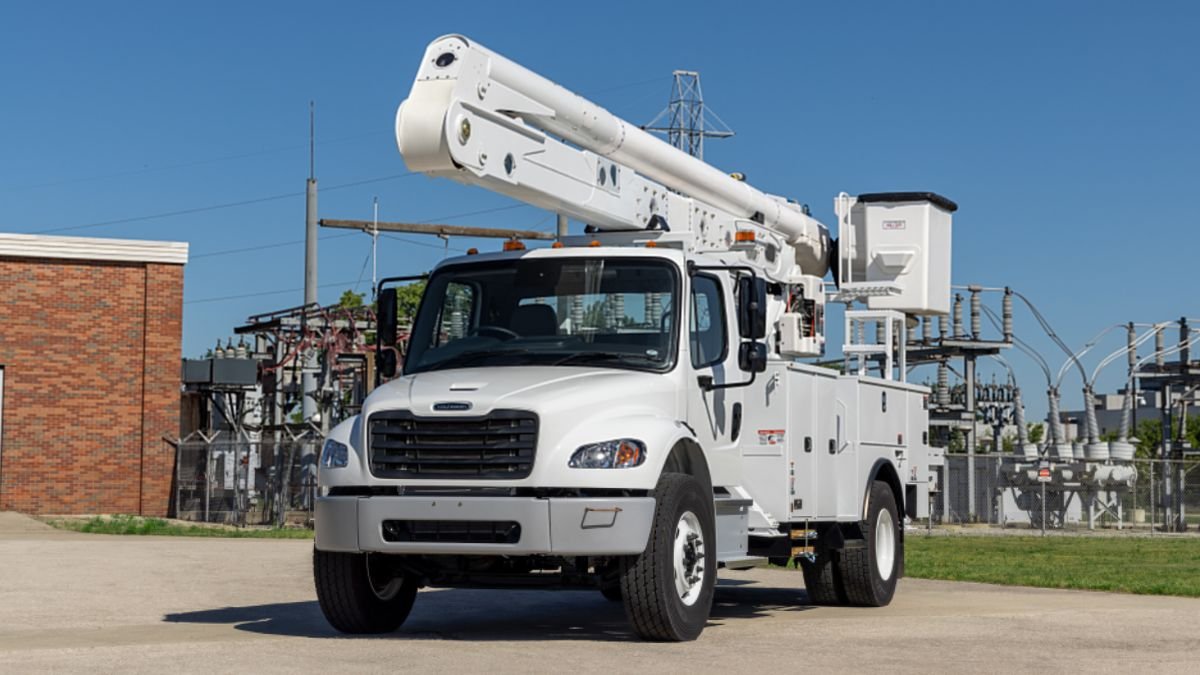
Spend a morning near any commercial loading dock in America and you will notice a pattern. The vans are too small, the Class 8 tractors are too big for the alley, and the truck backing in between them is usually a medium-duty conventional with a body on the back. The Freightliner M2 106 Plus is built for exactly that spot. This Freightliner M2 106 Plus review looks at how far the platform stretches, from a lightly loaded delivery route to a vocational chassis carrying equipment that would overwhelm a pickup, and what a buyer needs to check before the build sheet is signed.
Businesses move up to a medium-duty truck for reasons that a heavy-duty pickup cannot answer. A pickup with a service body works until the payload, the air brakes, the frame strength, or the duty cycle say otherwise. A Class 8 tractor solves the capacity problem but brings size, cost, and licensing complexity that a local delivery or municipal operation may not need. The M2 106 Plus sits in the gap as a cab-and-chassis platform that Daimler Truck North America sells to body builders and fleets who finish the job themselves. The central question is how much real flexibility, carrying ability, and driver comfort that platform delivers once the brochure language is stripped away.
Our Take
The engineering philosophy behind the M2 106 Plus is easy to read once you look at what Freightliner chose to emphasize. This is not a truck designed around one dramatic capability. It is designed around choices. Freightliner’s published materials describe a platform that can be a straight truck or a tractor, in three cab lengths, with several engine families, a long list of transmissions, multiple axle suppliers, and a suspension menu that runs from simple leaf springs to air ride and heavy-duty vocational systems. The strength of the truck is that this menu is real, and the weakness is that the menu has to be used correctly.
That second point deserves more attention than most spec sheets give it. A published maximum GVWR of 66,000 pounds describes the ceiling of the platform, not the capability of a particular truck. A truck configured for urban pickup and delivery, with a lighter-duty rear axle, a spring or air suspension tuned for ride quality, and a modest engine, may have a rated capacity far below that ceiling. A truck built for construction, with heavier axles, a stronger suspension, a longer frame reinforcement package, and a more powerful engine, is a different machine even though the badge is identical. The label on the door jamb, not the brochure, tells you what you actually bought.
Visibility and maneuverability are where the M2 106 Plus earns its reputation as a practical truck. The sloped hood, the large windshield, and the set-back front axle all serve a driver who spends the day in tight places. The cab is also aimed at the daily environment of the person behind the wheel rather than at novelty. Chassis flexibility is the other real asset, since the electrical system and frame provisions are meant to make life easier for the companies that install bodies. Reasonable limitations remain. Some options are tied to specific engines, some features are optional, and published specifications differ between model years and between Freightliner’s own documents. We have not driven or owned this truck, so this review is built on manufacturer documentation and the way the platform is specified, and we flag where we are interpreting rather than quoting.
Where the Freightliner M2 106 Plus Fits in the Market
Freightliner positions the M2 106 Plus across Class 6 through Class 8, depending on the certified ratings of the finished truck. That range is unusually wide. At one end are lighter medium-duty builds suited to local distribution. At the other are heavy vocational and tractor applications where the truck starts to overlap with work normally given to larger platforms. Where a specific truck lands depends on its axle ratings, suspension, and the GVWR assigned at completion.
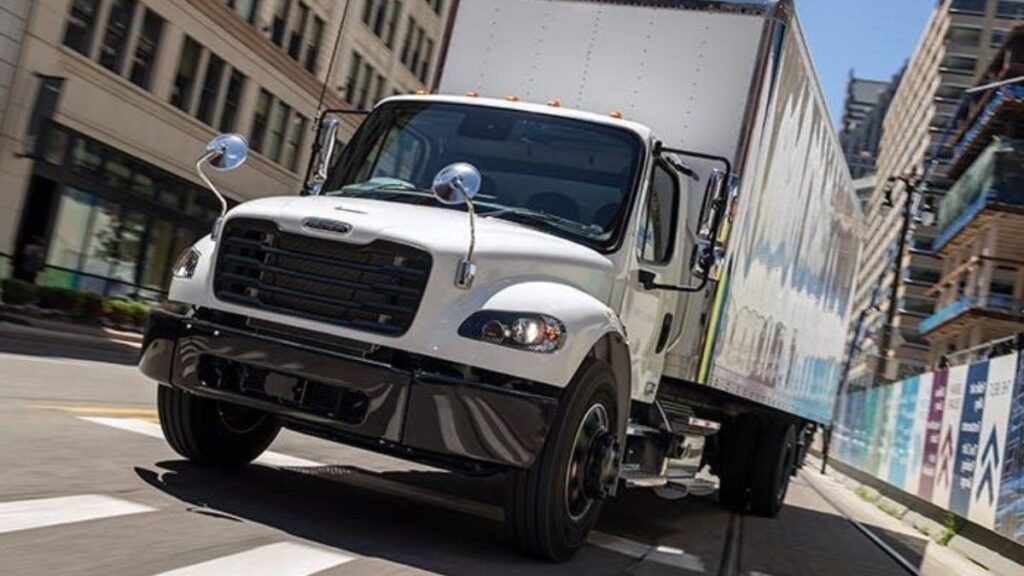
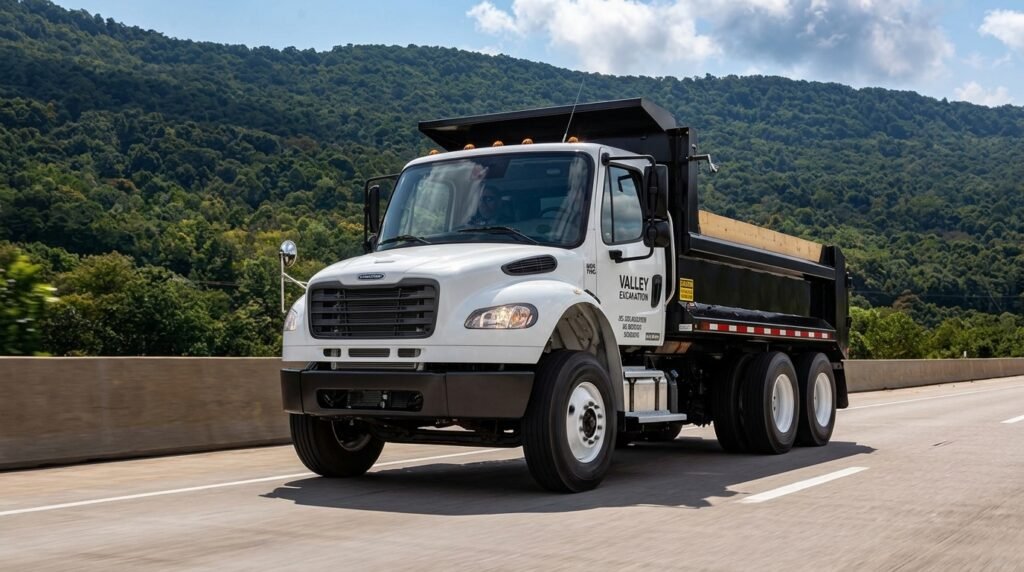
The platform is available as a straight truck, which carries its body on the frame, or as a tractor that pulls a trailer. The straight truck is the more common image: a cab-and-chassis delivered to a body builder, who mounts a box, a flatbed, a dump body, a utility body, or other equipment. The tractor option makes the M2 106 Plus useful for short-haul and local delivery work where a full highway tractor is more truck than the job requires.
Anyone comparing it with other American medium-duty chassis will find that the competition takes a different path. Ford’s approach, which we examined in our 2026 Ford F-650 review, leans on a familiar pickup-derived cab and Ford’s dealer network. The M2 106 Plus is a more traditional commercial truck design with a broader range of weights, axles, and bodies. Neither approach is automatically better, and the right answer depends on how heavy the job really is.
Frame, Chassis, and Structure
The M2 106 Plus uses a conventional chassis with a ladder-style frame. Freightliner’s official M2 106 Plus specifications highlight clear frame rails behind the cab and an optional full inner-frame reinforcement. That matters because the frame is the part of a truck that carries everything a body builder adds. Clear rails make it easier to mount bodies, tanks, and equipment without working around obstructions, and the reinforcement option lets a buyer match frame strength to heavier bodies and more punishing duty.
The cab is built from aluminum with a steel reinforcement structure. Freightliner describes it as steel-reinforced aluminum, and the M2 106 literature also points to e-coated, corrosion-resistant steel in the structure. Aluminum keeps weight down, which helps payload, and it does not rust the way steel does. The reinforcement and coating address durability and protection. For a work truck that may spend years in road salt, rain, and job-site mud, a cab that resists corrosion is a quiet but important feature.
Chassis choices also set limits on what the truck can carry and how it behaves. In our Chevrolet Silverado 6500 HD review, we looked at how a chassis-cab design draws its capability from the combination of frame, axles, and body rather than from one number, and that logic applies even more strongly here. The M2 106 Plus gives a buyer more room to build, and more room to build the wrong truck.
Engines and Powertrain Options
Engine selection is one of the most important decisions when configuring the Freightliner M2 106 Plus. Its official specifications identify four diesel engine families: Detroit DD5, Detroit DD8, Cummins B6.7, and Cummins L9. The platform’s headline ratings range from 200 to 360 horsepower and 520 to 1,150 lb-ft of torque, although individual engine ratings and availability vary by configuration and application.
Cummins B6.7 and L9
The Cummins B6.7 is a 6.7-liter inline-six diesel with brochure ratings of 200 to 325 horsepower and 600 to 750 lb-ft of torque. It suits delivery fleets, utility operators, and moderate vocational work where a balance of output and operating costs matters. The larger 8.9-liter Cummins L9 offers 260 to 360 horsepower and 860 to 1,150 lb-ft, making it a stronger choice for heavier straight trucks and demanding tractor applications that require sustained pulling power.
Cummins X10: A Planned 2027 Addition
The 10-liter Cummins X10 represents a significant future addition to the M2 106 Plus lineup. Its published medium-duty ratings reach 380 horsepower and 1,250 lb-ft of torque, although these maximum engine-family figures are not guaranteed for every truck configuration. Allison has announced a pairing with its 3414 Regional Haul Series automatic transmission for medium-duty tractor applications, originally targeting production in January 2027. Cummins’ updated Model Year 2027 launch plan calls for limited production beginning in January, with full production expected in the third quarter of 2027. The L9 is expected to remain available during the transition, so buyers should confirm the X10’s final rating and order availability before specifying it.
Detroit DD5 and DD8
The Detroit DD5 is a 5.1-liter four-cylinder diesel producing 200 to 240 horsepower and 560 to 660 lb-ft of torque. It is suited to shorter routes and pickup-and-delivery operations. The larger 7.7-liter DD8 is an inline-six with published ratings reaching 375 horsepower and 1,050 lb-ft, making it better suited to demanding vocational applications. Its highest ratings are associated with specific specialized configurations. Both engines support Detroit Connect Virtual Technician remote diagnostics, helping fleets monitor engine conditions and manage service needs.
Cummins B6.7 Octane
For buyers who prefer gasoline, the Cummins B6.7 Octane adds another powertrain option. In its March 2026 announcement, Daimler Truck North America listed output of up to 300 horsepower and 660 lb-ft of torque on regular 87-octane gasoline. Its three-way catalyst system eliminates the need for diesel exhaust fluid, simplifying some aspects of emissions-system maintenance. Ordering was announced for March 2026, with production originally planned for the third quarter of that year; buyers should confirm current availability rather than rely on the original schedule. Cummins also advertises oil service intervals of up to 15,000 miles, subject to operating conditions and the applicable maintenance schedule.
Diesel remains attractive for operators who need higher torque ratings and regularly work under heavy loads, while gasoline can simplify certain maintenance requirements. The better choice depends on annual mileage, fuel prices, payload, duty cycle, and service needs. Neither fuel type guarantees lower ownership costs in every application.
Transmission and Drivetrain
The Freightliner M2 106 Plus offers several transmission choices to match different commercial applications. According to its official specifications, the lineup includes Allison 1000, 2000, and 3000 Series automatics, Eaton Fuller six-speed automatic transmissions, and nine-, ten-, and eleven-speed manuals. Newer powertrain announcements add further options, although availability depends on the engine and production schedule.
In March 2026, Allison announced two additional automatic combinations. The first pairs a nine-speed Allison transmission with the Cummins B6.7 Octane gasoline engine. Production was originally scheduled for July 2026, so buyers should confirm its current availability with a Freightliner dealer. The second pairs the Allison 3414 Regional Haul Series with the Cummins X10 diesel for medium-duty tractor applications, with production announced for January 2027. Cummins’ updated Model Year 2027 production plan anticipates limited X10 production in January and a gradual ramp toward full production in the third quarter of 2027.
Another option is ZF’s PowerLine eight-speed automatic, paired with the Cummins B6.7 Octane. ZF announced its availability for order in North America beginning March 13, 2026. Its gear ratios are designed to improve launch response and reduce engine speed during cruising, while ZF claims fuel savings of up to 10 percent in selected applications. The transmission also supports a live engine-driven Power Take-Off (PTO), allowing operators to run auxiliary equipment while stationary or in neutral. This is useful for dump bodies, cranes, and hydraulic service equipment, although buyers must confirm the required PTO arrangement and compatibility with their chosen body and powertrain.
Transmission selection affects more than shifting comfort. Automatic units are generally convenient for stop-and-go delivery, refuse collection, and utility work, while manual transmissions can suit demanding applications where drivers prefer greater control over gear selection. The right choice depends on vehicle weight, engine output, operating conditions, and the equipment installed behind the cab.
Drivetrain is a separate decision. Freightliner’s M2 106 Plus literature lists 4×2, 4×4, and 6×4 configurations. Four-wheel drive can provide additional traction on difficult surfaces, while a 6×4 layout uses two driven rear axles for applications requiring greater traction and load capability. Not every engine and transmission combination is available with every drivetrain, so buyers considering a Freightliner M2 106 4×4 should confirm the exact configuration and certified ratings before ordering.
GVWR, Payload, Carrying Capacity, and Towing
Freightliner publishes a maximum GVWR of 66,000 pounds for the platform, with front axles available up to 20,000 pounds and rear axles up to 46,000 pounds. These are maximum platform capabilities. They do not all apply to the same truck at the same time, and a truck with a 20,000-pound front axle and a 46,000-pound rear axle is a very different build from a Class 6 delivery truck.
GVWR is the maximum a loaded truck is rated to weigh, including the chassis, body, fuel, driver, equipment, and cargo. Payload is what remains after everything permanent is subtracted. A box truck with a heavy insulated body, a liftgate, a full tank, and a driver may leave far less usable payload than its GVWR suggests, and a dump truck with a heavy steel body leaves less than a flatbed on the same chassis. This is why we never trust a single payload number for the Freightliner M2 106 payload capacity. It depends on empty weight, and empty weight depends on the build.
Front and rear gross axle weight ratings set separate limits. A truck can be under its GVWR and still overload one axle if the body or load is poorly distributed. Gross combination weight rating, the limit for the truck and any trailer together, is a further constraint. Towing is not simply whatever GVWR remains. Towing capacity depends on the truck’s GCWR, the powertrain, the brakes, the hitch, and the trailer’s own weight and braking, and a truck operating at its maximum GVWR does not automatically have room left to tow at the maximum. For anyone asking about Freightliner M2 106 towing capacity, the honest answer is that it belongs to the specific truck’s certified ratings, not to the model name.
Axles, Suspension, and Load Management
Freightliner lists Detroit and Meritor axles for the platform, and some dealer materials also reference Dana. As with engines, availability depends on the configuration. Rear arrangements include single-axle and tandem setups. A single rear axle is lighter and less expensive and suits most delivery and utility work. A tandem adds capacity and traction, along with weight, cost, and tire wear, and is the usual choice when ratings climb toward the upper end of the platform.
The suspension menu is long: taper leaf, flat leaf, multi-leaf, AirLiner air suspension, TufTrac, and HAULMAAX or PRIMAAX for the heaviest work, with PRIMAAX and FIREMAAX associated with specific vocational or emergency uses. Spring suspensions are simple, durable, and well suited to rough job sites and heavy fixed loads, but they ride stiffly when the truck is empty. Air suspension rides smoothly, protects fragile cargo, and can keep the truck level as load changes, which is why it is common on box trucks and food distribution. It is also more complex and may cost more to maintain.
The right choice follows the work. A delivery truck that runs partly empty most of the day benefits from the ride quality of air. A dump truck or crane truck that carries heavy, concentrated loads often wants the toughness of a heavy-duty spring or vocational suspension. A wrong match shows up as premature wear, an uncomfortable ride, or a truck that sits poorly under load.
Wheels, Tires, and Road Contact
Tires and wheels are easy to overlook until they fail. Commercial tires carry load ratings and ply or load-range ratings that must be equal to or higher than the axle load they support. Wheel type, tire size, and inflation pressure all have to be right together, and tire pressure strongly influences heat, wear, fuel use, and safety.
A delivery truck on paved routes generally wants a road-oriented tire and a spec that emphasizes tread life and ride. A construction or vocational truck faces cuts, scrubbing, and uneven ground, and tends to need a more rugged tread and construction. We are not going to name one standard size or wheel material for the M2 106 Plus, because none exists across all configurations. Buyers should read the tire and wheel specification on the build sheet and check it against the axle ratings.
Dimensions, Wheelbase, and Cab Configurations
The M2 106 Plus offers three cab configurations. The Day Cab measures 106 inches BBC, the Extended Cab 132 inches, and the Crew Cab 154 inches. BBC stands for bumper to back of cab, the distance from the front bumper to the rear of the cab, and it tells you how much of the chassis length is used up by the cab itself. The extended cab adds 26 inches over the day cab for storage or a rear seat area, and the crew cab adds 48 inches for a full rear seat.
Wheelbase, cab-to-axle distance, overall length, and rear frame clearance all depend on the specification and the body. A longer cab leaves less room behind it, and a longer wheelbase gives a body builder more length to work with at the cost of turning radius. A crew cab on a long wheelbase will not turn like a short day cab. For that reason we do not offer a universal length or wheelbase for the Freightliner M2 106 dimensions. The truck that arrives at your door is the truck that has been measured.
Steering, Braking, and Driving Control
Freightliner publishes a maximum wheel cut of 55 degrees, which the earlier M2 106 brochure notes can depend on wheel equipment. Paired with a set-back front axle and a swept-back front fender and bumper, that gives the truck one of the tighter turning radii in the class by Freightliner’s own description. The benefit is concrete. In narrow residential streets, in loading areas with parked vehicles, and on cramped job sites, a tighter turn means fewer multi-point maneuvers and fewer scraped corners.
Braking depends on the specific configuration. The brake system a truck uses is part of its build, chosen to match its weight rating, axles, and application, and we would not assume the same equipment on every truck. Freightliner offers the Bendix IntelliPark electronic parking brake system, which it describes as designed to help prevent rollaways, and a factory backup camera with reverse proximity sensors for rear visibility. Stopping performance under load depends on the brake specification, tires, load distribution, and the driver’s following distance. Buyers should read the brake and stability equipment on the build sheet instead of relying on a general description.
Exterior Design and Visibility
The hood slopes downward, the dash is low, and the windshield is about 2,500 square inches, which Freightliner describes as large and clear. These are functional choices. A sloped hood lets the driver see closer to the front of the truck, and a large windshield reduces blind spots when watching for pedestrians, curbs, and low obstacles. Combined with the swept-back bumper, those features support the same urban and job-site work the steering geometry is built for.
Entry matters too. Wide doors, a low step-in height, and multiple grab handles reduce the strain of climbing in and out dozens of times per shift, which is a real consideration for delivery drivers. Optional door-mounted down-view mirrors and a lower passenger window are also offered to improve vision around the truck.
Interior, Dashboard, and Driver Comfort
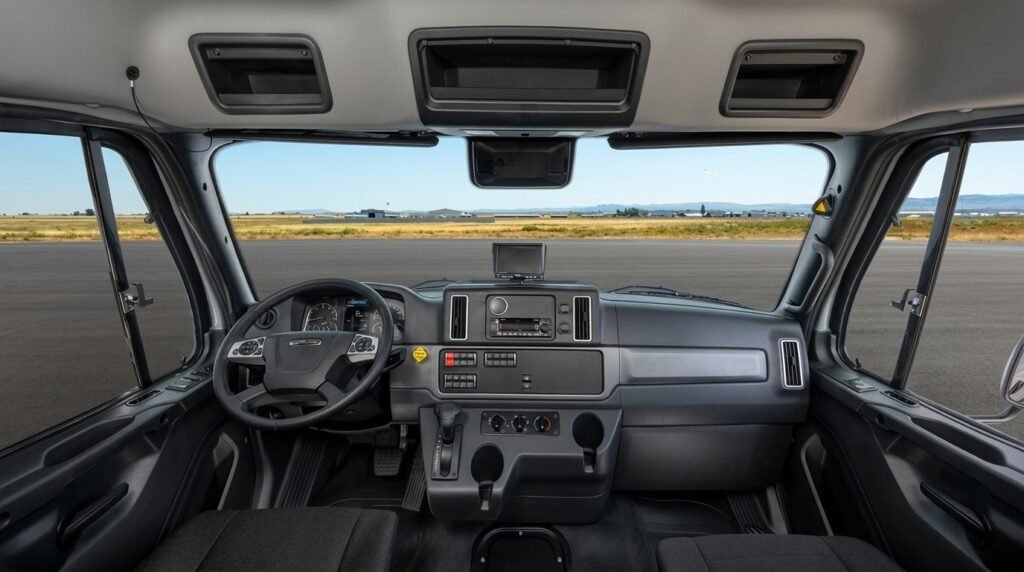
The Plus update brought a redesigned interior with three trim levels: Professional as the standard, Elite, and Rugged. Freightliner describes new, more durable thermoplastic polyolefin materials, improved cab insulation, ergonomic seats with more adjustability, LED cab lighting, new HVAC vents, and standard electric windows. The new instrument cluster includes the Driver Command Center, which presents operating information, alerts, and settings, and a multifunction steering wheel carries controls for cruise, audio, and phone.
The question is whether this improves the working environment, and for the most part we believe it does. Driver fatigue, noise, and awkward controls are operating issues, not luxury complaints. A quieter cab, a seat that adjusts properly, and controls within reach can reduce fatigue over a ten-hour day. Trim levels are also a business decision, since the Rugged trim is aimed at harder-wearing environments and the Elite at buyers who want more refinement.
Safety Systems and Driver Assistance
Detroit Assurance is the umbrella for the active safety package, and Freightliner’s official M2 106 Plus information identifies Active Brake Assist 5 within it for both Detroit and Cummins engine configurations. Active Brake Assist is designed to warn the driver and brake when the system detects a collision risk ahead. Adaptive Cruise Control, which manages following distance, is specifically identified as available with Detroit engines. Other elements of the package include Side Guard Assist, which alerts the driver to objects and pedestrians in the passenger-side blind spot, Tailgate Warning, intended to alert the driver when a following vehicle is too close, and an optional Lane Departure Warning, which alerts the driver if the truck drifts out of its lane without signaling.
A factory-installed backup camera with reverse proximity sensors helps with rear visibility, Bendix IntelliPark addresses rollaways, and Bendix tire pressure monitoring is part of the broader equipment story. Exactly which of these systems a given truck carries depends on the selected configuration, including the engine and the options ordered, so the safe approach is to confirm each system, and whether it is standard or optional, on the build sheet before ordering.
Electrical System and Upfitting Technology
The QuickFit electrical system is one of the more meaningful upgrades for the companies that turn a chassis into a finished truck. It is a multiplexed system, meaning that instead of running a separate wire for every function, it uses a network of control units to manage electrical signals. Freightliner says its control units can be stored in the cab or on the firewall under the hood for easier access and protection, and that its connectors are rated IP67 or higher for resistance to water and dust.
The CHEC Tool, Daimler’s programming interface, lets body builders configure switches, body functions, and safety interlocks without custom wiring. The result is a more straightforward path for municipal, construction, utility, and service operators, whose trucks often need power takeoffs, lighting, beacons, or hydraulic controls tied into the chassis. Faster, cleaner upfits can shorten delivery time and reduce the chance of electrical faults.
Fuel System, Fuel Economy, and Operating Costs
Fuel choices center on diesel, with the Octane gasoline engine announced as an addition. Fuel economy depends on payload, body type, wheelbase, engine, axle ratio, transmission, speed, terrain, idle time, and duty cycle, and for that reason we do not publish a universal MPG or fuel tank capacity for the Freightliner M2 106 fuel economy. Manufacturers sometimes cite best-case mileage figures under ideal conditions, and a fleet’s real results can look very different.
Diesel engines require emissions systems, DEF, and in some cases regeneration cycles, and the maintenance that comes with them depends on the engine family. A gasoline engine without DEF avoids some of that, as Daimler and Cummins describe it. Real operating cost includes fuel, scheduled maintenance, unscheduled repairs, and downtime, and the last of those can matter most to a business that cannot afford a truck sitting idle. Total cost of ownership is the sum, and it is why a truck with a cheaper purchase price is not always the cheaper truck to run.
Maintenance, Diagnostics, and Fleet Support
The hood tilts for engine access, a feature Freightliner has long highlighted for the M2 106, and good service access shortens routine work. For diagnostics, Detroit Connect Virtual Technician comes standard on trucks with Detroit engines and provides remote diagnostics and guidance on service decisions. Freightliner also points to its ServiceLink tools for repair and maintenance.
Maintenance requirements vary by engine family, annual mileage, and duty cycle. A truck that idles through stop-and-go delivery routes, one that runs steady regional miles, and one that spends the day at a construction site are all working differently. We will not publish arbitrary oil-change intervals, and each engine manufacturer’s published schedule should govern. Preventive maintenance is the part that matters most. The best build sheet in the world means little if the truck is not serviced on time.
Commercial Bodies and Real-World Applications
The M2 106 Plus can be built into dry-freight and box trucks, refrigerated delivery trucks, flatbeds, dump trucks, utility service trucks, towing and recovery vehicles, food and beverage distribution trucks, municipal and refuse trucks, and construction equipment carriers. Freightliner lists pickup and delivery, food service, construction, municipal, utility, towing, and refuse among the main applications.
The body changes everything. A refrigerated body adds insulation and a refrigeration unit, which add weight and reduce payload. A dump body adds a hoist and a heavy steel box. A rollback tow body places weight very differently from a box truck, concentrating load over the rear axle and changing how the truck handles. Each body shifts the empty weight, the axle loads, the dimensions, and the suitability of the whole truck.
Other chassis are built with different philosophies, and our review of the International CV515 shows how a different manufacturer approaches vocational flexibility. The M2 106 Plus sits at the broader end of that spectrum, with a wider range of ratings and a bigger menu of options. The lesson is to build the truck around the actual job, not around one impressive specification on a brochure.
Pricing, Ownership Considerations, and Value
We are not going to quote a factory starting price, because Freightliner does not publish a single one that would be meaningful. A base chassis price is only the beginning. Engine selection, cab configuration, wheelbase, axle ratings, transmission, suspension, safety packages, and every dealer-installed option move the figure. Then the body, liftgate, hydraulic equipment, refrigeration, and any added technology are installed, and the finished truck can cost far more than the chassis alone.
Anyone searching for the Freightliner M2 106 price should also distinguish between an advertised dealer price for one specific completed truck and any manufacturer base pricing. The first describes a particular build with particular equipment, and the second, where it exists, describes a stripped starting point. Comparing them directly leads to bad decisions. Ownership value includes financing, resale, warranty, fuel, maintenance, and downtime, and a good dealer should be able to walk through those with you.
Freightliner M2 106 Plus Review: Final Verdict
So what makes the M2 106 Plus a useful commercial platform? In our judgment, it is the breadth of the build, not any single feature. Few medium-duty trucks can plausibly be a route truck on Monday and, in a different configuration, a heavy vocational chassis on Tuesday. The tight turning, the visibility, the upfit-friendly electrical system, and the wide choice of engines and axles all point toward a truck meant to be shaped around the work.
That flexibility serves some buyers better than others. Fleets and contractors with specialized needs, municipal operations, utility companies, and food distributors who need a particular body and a particular capacity will find the most to like. Owners with a simple, uniform job may do just as well with a more standardized truck and avoid paying for options they will never use.
Before ordering, buyers should confirm the exact engine and whether it is available for their model year and location, along with the axle and suspension ratings, the certified GVWR, the empty weight with the body installed, the resulting payload, and the standard and optional safety features. Newer powertrains such as the Octane gasoline engine and its announced Allison pairing deserve an explicit orderability check. They should also ask how maintenance and diagnostics will be handled over the life of the truck. The balance among carrying ability, maneuverability, driver comfort, upfitting flexibility, and operating cost is the real measure of value here. Specified carefully, the M2 106 Plus is a strong and adaptable work truck. Specified carelessly, it is an expensive way to discover the difference between a platform maximum and a truck’s real limits.