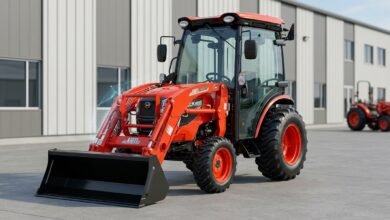
Mahindra 1635 Compact Tractor Specs Loader Performance and Farm Uses
A closer look at the 36.2 horsepower diesel, HST and Shuttle transmissions, 1635L loader, PTO output, and backhoe options.


Mahindra 1635 Compact Tractor shoppers are rarely new to the work. They usually own a subcompact that has quietly run out of room. A pallet of gravel sits at the end of the driveway, the pasture needs cutting before the grass goes to seed, and the small machine in the barn spends half its day straining against jobs it was never sized for. A loader that lifts a few hundred pounds and a mower deck that stalls in thick growth are tolerable on a suburban lot. On ten or twenty acres with orchard rows to mow, fences to mend, feed to move, and snow to clear, they become a daily frustration. The workload grows gradually, and eventually the tractor, not the operator, becomes the limiting factor.
Engine power alone does not solve that. A tractor’s real capability depends on how much output reaches the PTO, how the hydraulics feed the loader, how the hitch carries rear implements, and whether the machine weighs enough to stay planted under load. The Mahindra 1635 is built around that fuller picture. It pairs a 36.2 horsepower diesel with a choice of hydrostatic or geared transmissions, an optional enclosed cab, a front loader, and a Category I hitch, placing it firmly in the compact utility class. That combination makes it worth a detailed look before a purchase.
Our Take: Mahindra 1635 Compact Tractor
This is an editorial evaluation built on Mahindra’s published specifications, its technical literature, and independent reference databases. Haulizo has not operated or tested the tractor, so nothing here describes how it feels in the field. What the published figures support is a clear sense of the machine’s role.
The proposition is a balanced one. A 36.2 horsepower three cylinder diesel delivers 26 PTO horsepower on the HST versions and 27.6 on the Shuttle, a range suited to moderate rotary cutters, finish mowers, and tillers. The 1635L loader is rated at 1,830 pounds with a 92 inch lift height, and the Category I hitch covers the implements most compact owners need. None of those figures is extreme, but together they describe a tractor that can handle loader work, mowing, and implement work without forcing a jump to a much larger and costlier class.
The three configurations then decide how it fits a particular owner. The open station HST suits someone doing frequent loader cycles who does not need weather protection. The HST Cab adds an enclosed station for snow, dust, and long days, at the price of extra weight and cost. The Shuttle offers geared control and the higher PTO rating, and Mahindra lists it with a different backhoe than the HST Cab.
The limits deserve equal attention. Hydraulic flow is modest, base weight is roughly three thousand pounds, and attachment compatibility varies by configuration. A tractor is also only as useful as the dealer behind it, so parts and service access matter as much as any rating. The 1635 fits the owner of a small ranch, orchard, or rural property who wants one capable machine for mixed work. It is a poor choice for anyone expecting full size tractor capacity from a compact frame.
Where the Mahindra 1635 Compact Tractor Fits in the Market
The 1635 belongs to Mahindra’s 1600 Series and is a compact utility tractor, not a subcompact garden tractor. A subcompact such as the New Holland Workmaster 25S is built for lawns, gardens, and light loader duty on small acreage. A compact utility tractor carries a heavier frame, a bigger engine, a stronger loader, and a hitch able to handle real implements, and it brings more weight, a longer wheelbase, and a higher purchase cost.
Owners who step up from a machine such as the John Deere 1025R usually do so because the work has changed. They are moving round bales, maintaining long fence lines, grading a farm lane, or running a rotary cutter through rough ground. Readers who want the wider picture can browse Haulizo’s tractor reviews and buying guides, and the KIOTI CK3520 compact tractor review covers another compact utility model that shoppers often compare with the Mahindra.
Mahindra 1635 Compact Tractor Engine and Power Delivery
The engine is the Mahindra CE35, a four stroke, naturally aspirated, direct injection, water cooled diesel with three cylinders. Displacement is 125 cubic inches, or 2,048 cc, from a 3.5 inch bore and a 4.3 inch stroke. Mahindra’s technical brochure lists a compression ratio of 18.7 to 1. Rated output is 36.2 horsepower, or 27 kilowatts, at 2,500 RPM, and the fuel tank holds 7.7 US gallons.
Displacement is the combined volume the pistons sweep, and in a naturally aspirated engine, which draws in air without a turbocharger, it largely sets how much fuel and air each cycle can burn. That is why an engine of about two liters sits in this power class. Rated engine speed is the point at which the horsepower rating applies. The 2,500 RPM figure matters in practice because the rear PTO reaches its standard 540 RPM at 2,376 engine RPM, slightly below rated speed. An operator running PTO implements at full speed is therefore working near, but not beyond, the engine’s rated range.
The 36.2 horsepower rating is engine output, not the power available to an implement. Power must pass through the transmission and driveline before it reaches the PTO shaft. Mahindra lists 26 PTO horsepower on the HST versions, roughly 72 percent of the engine rating, and 27.6 on the Shuttle, roughly 76 percent. Anyone choosing a mower or tiller should compare its requirement against the PTO figure, not the engine figure.
Mahindra equips the engine with mCRD, a common rail diesel injection system, and does not use a diesel particulate filter. According to Mahindra’s mCRD technology page, the system uses higher injection pressure and multiple injection events, meets Tier IV emissions standards without a DPF, and avoids regeneration cycles. Those are manufacturer claims. The design is not free of aftertreatment, because Mahindra identifies a diesel oxidation catalyst, and claims about fuel efficiency and longevity should be treated as marketing until independent data supports them. Buyers who care about low speed pulling response should spend time with a demonstration unit rather than rely on horsepower alone.
Transmission Choices: HST Versus Shuttle
The transmission decision shapes daily use more than almost any other option.
The HST versions use a three range hydrostatic transmission with infinitely variable speed within each range. The operator selects a range, then uses pedals to control direction and speed without shifting gears. Mahindra lists a maximum travel speed of 13.3 miles per hour. The three ranges let the operator match a broad speed band to the task, slow for loader work and implement work, faster for transport. The pedal control makes the HST especially convenient for loader cycles, where the operator reverses from a pile, swings the bucket, and moves forward again dozens of times an hour. It also suits tight spaces around barns and fence corners, where small, smooth speed changes matter, and it allows ground speed to be adjusted without interrupting the work.
The Shuttle uses a constant mesh gear transmission with eight forward and eight reverse speeds and a synchronized shuttle for changing direction. Mahindra lists a dry single clutch and a maximum speed of 12.2 miles per hour. Selecting a fixed gear gives repeatable ground speed, which is valuable for mowing or tilling where consistent speed produces consistent results, and the arrangement will feel familiar to anyone who has run conventional farm equipment. Changing direction with the shuttle lever is quick, though it demands more operator involvement than a hydrostatic pedal during repetitive loader work.
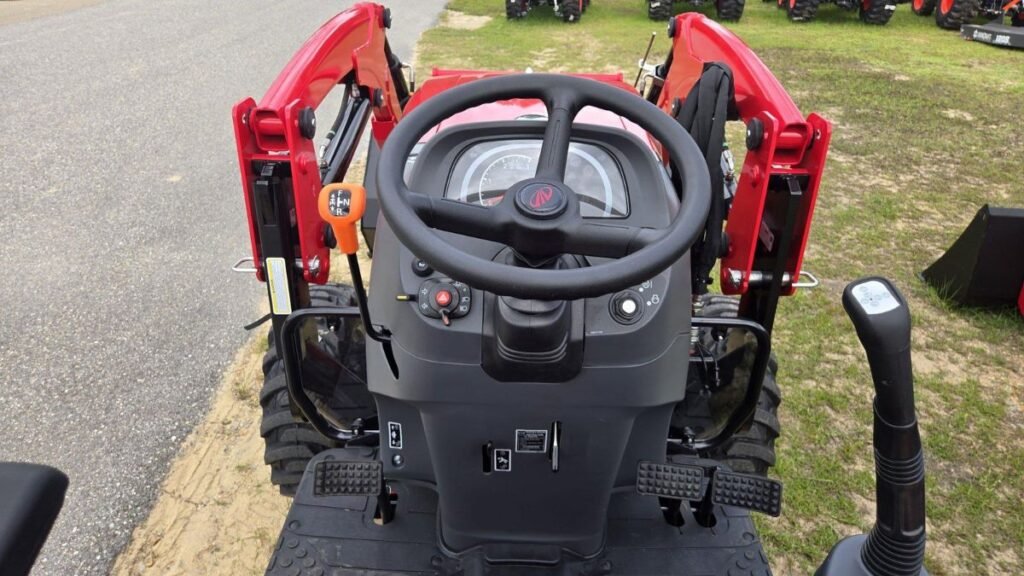
The Shuttle also carries the higher published PTO figure. Mahindra publishes the numbers without attributing the gap to a specific cause. Hydrostatic drives generally involve additional hydraulic losses compared with geared drives, which may contribute, but that is general engineering context and not a Mahindra statement.
Neither layout is universally better. A buyer whose work is mostly loader tasks and short repositioning will probably lean toward the HST. A buyer who spends long hours on PTO powered implements, or who prefers mechanical control, has a reasonable case for the Shuttle. The factory cab is offered only with the HST, so anyone who wants an enclosed station effectively chooses the transmission as well.
Mahindra 1635 Compact Tractor PTO and Hydraulic Performance
The rear PTO turns at 540 RPM at 2,376 engine RPM on all three configurations, and an optional mid PTO turns at 2,000 RPM at 2,526 engine RPM for mid mounted mower decks and similar equipment. Mahindra lists the HST versions with a live PTO with an overrunning clutch and the Shuttle with an independent PTO. An independent PTO is engaged separately from ground travel, so an implement can keep running while the tractor is stopped or a gear is changed. A live PTO also keeps turning while travel is interrupted, and an overrunning clutch lets a heavy implement coast freely when the tractor slows, which reduces driveline shock. These are general descriptions of how such systems work, and buyers should confirm the engagement behavior of the exact tractor with a dealer.
PTO horsepower sets the ceiling for powered implements. Rotary cutters, finish mowers, and tillers carry manufacturer recommendations for minimum PTO horsepower, and the 26 to 27.6 available here defines what is sensible. An oversized cutter may connect and turn but will bog down in thick brush. Matching implement width and design to the tractor protects both machines and gives better results than buying the largest attachment that fits.
The hydraulic system is open center. Mahindra publishes a main implement pump output of 7.5 gallons per minute and a separate steering pump output of 3.3 gallons per minute, for a combined flow of 10.8 gallons per minute, or about 40.7 liters per minute. The combined figure is not a loader rating and should not be read as flow dedicated to the loader or to hydraulic attachments. Because these are pump outputs rather than loader specific figures, they describe the hydraulic configuration, not how quickly a given loader or attachment will cycle. A dealer demonstration is the practical way to judge that. Mahindra lists a rear auxiliary hydraulic remote as optional, so owners who plan to run hydraulic implements at the back of the tractor need to confirm that equipment before buying.
Mahindra 1635 Compact Tractor Loader Performance
The matching loader is the 1635L. Mahindra’s detailed specifications list a maximum lift height of 92 inches, a lift capacity of 1,830 pounds, and a digging depth of 3 inches. The 2025 technical brochure describes the 1,830 pound figure as lift capacity to full height measured at the pivot pin, and lists a breakout force of 2,777 pounds with a standard 64 inch bucket.
Each term measures something different. Lift capacity is the weight the loader can raise. Because it is measured at the pivot pin rather than at the bucket edge, where a real load sits, a bucket of material carried farther forward will be effectively heavier than the same weight at the pin, and the usable capacity falls. Breakout force is the curling and prying strength at the bucket edge when digging into a pile. Lift height decides whether the loader can reach a trailer bed or a hay stack. Digging depth, or below grade reach, is how far under ground level the bucket can go, and at 3 inches it marks this as a loader for scraping and grading, not for digging holes.
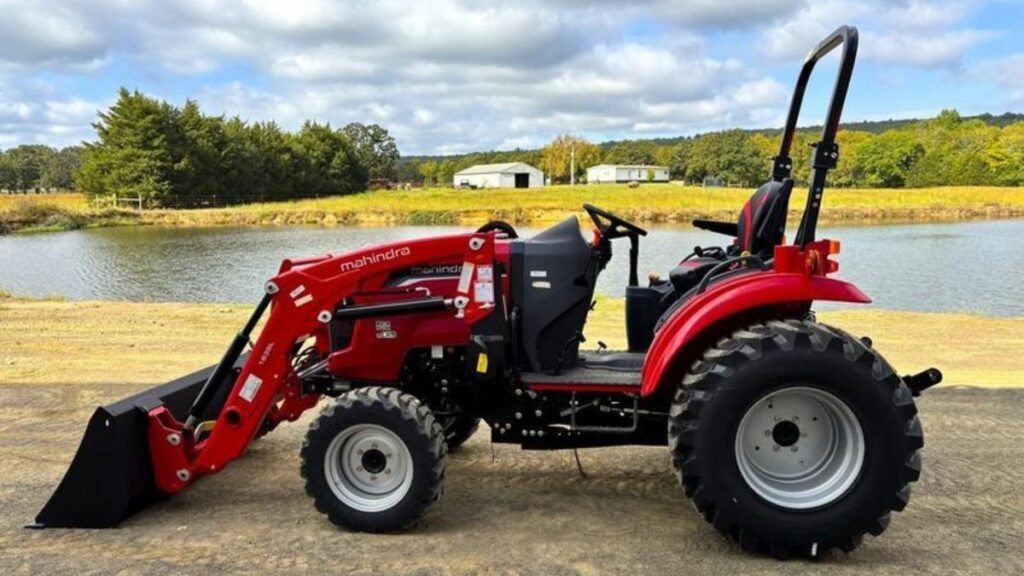
Mahindra’s general series feature text mentions a loader figure of up to 1,650 pounds. That appears in the broader overview copy, separate from the detailed 1635L specifications, and the two should not be treated as identical measurements. This article relies on the detailed specification and the brochure.
On a working property the loader handles soil, gravel, mulch, compost, and feed with a bucket, and bales or palletized material with forks or a spear. Mahindra’s 2025 brochure describes stacking four foot round bales two rows high with the 1635 and 1640. That is a manufacturer stated capability, not a guarantee. Bale weight varies widely with moisture and density, and the result depends on the loader setup, attachment, and ground conditions.
Stability decides how much of the rating is usable. A tractor weighing about three thousand pounds carries a loaded bucket well ahead of the front axle, which shifts weight forward and lightens the rear wheels. Rear ballast, whether wheel weights or a rear implement, restores balance and traction. Tire selection and slope matter too, since a load that is safe on level ground can be dangerous across a hillside. Heavy loads should stay low while moving. Buyers who regularly handle heavy bales, wet material, or tall stacking may find a larger loader on a heavier tractor a better fit.
Rear Hitch, Implements, and Attachment Compatibility
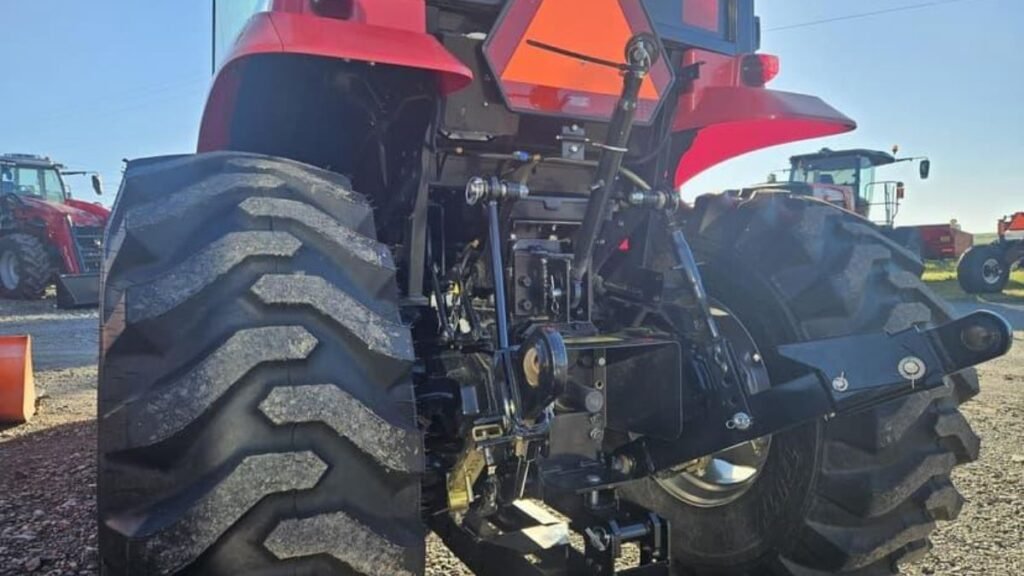
The 1635 has a Category I three point hitch with telescoping stabilizers and flex links. Category I describes the pin sizes and connection geometry used by most compact tractor implements. Telescoping stabilizers limit side sway so an implement tracks straight, and flex links ease hookup. Category I is not a promise that every implement is suitable. Weight, width, center of gravity, and power requirement all matter.
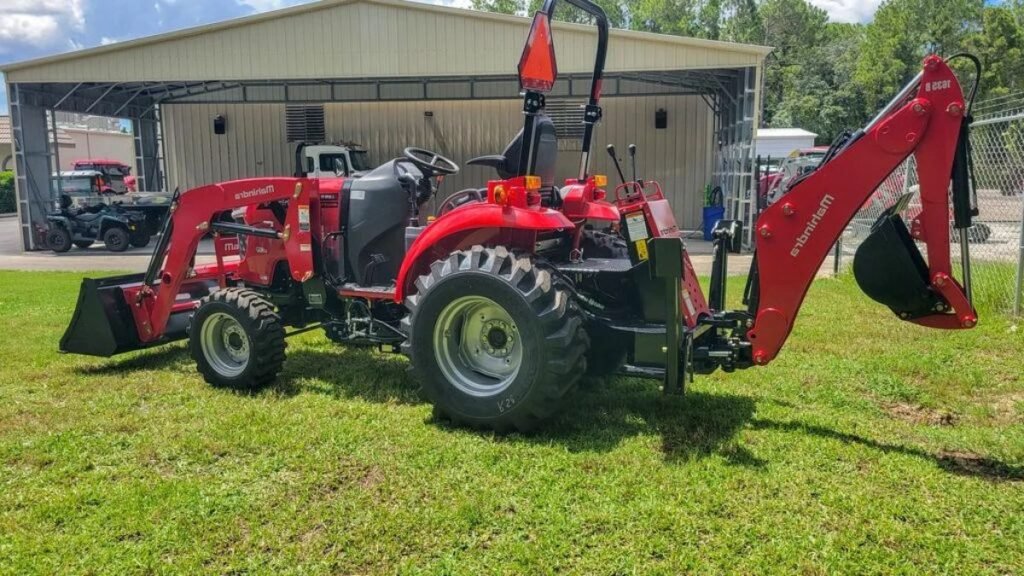
Mahindra publishes two rear lifting figures. The 2,646 pound figure is measured at the ball ends of the three point hitch, and the 1,720 pound figure is measured 24 inches behind the lift points. They are not contradictory. They describe the same hitch under different load positions. The farther a load hangs from the lift arms, the less weight the system can raise, so a rating taken at the ball ends will always exceed one taken two feet back. Most implements hang well behind the hitch, which makes the 1,720 pound figure the more informative number when checking whether a heavy box blade, tiller, or post driver is within reach.
Compatible equipment includes Category I rear implements and 540 RPM PTO attachments such as rotary cutters and tillers, while the optional mid PTO widens the field to mid mounted mower decks. A historical listing on TractorData shows a 72 inch mid mount deck, but that is not proof of current availability.
Backhoe Configurations by Model
Backhoe availability differs by configuration, and the current manufacturer documentation takes priority over older references such as the Mahindra 1635 attachment information on TractorData, whose backhoe details do not match the 2025 brochure.
Mahindra’s September 2025 technical brochure lists no backhoe configuration for the 1635 HST. For the 1635 HST Cab it lists the 1635B, with a standard 12 inch bucket, a maximum digging depth of 89 inches, a two foot flat bottom digging depth of 86 inches, a bucket digging force of 2,822 pounds, a dipper digging force of 1,660 pounds, and a shipping weight of 770 pounds.
For the 1635 Shuttle the brochure lists a different unit, the 1660B. It has a standard 16 inch bucket, a maximum digging depth of 98 inches, a two foot flat bottom digging depth of 95 inches, a bucket digging force of 3,192 pounds, a dipper digging force of 2,162 pounds, and a shipping weight of 1,100 pounds.
These are different attachments, not interchangeable backhoes, and neither is standard equipment or universally compatible across the 1635 range. The 1660B reaches roughly eight feet and brings higher digging forces and about 330 more pounds of shipping weight, so it suits deeper work but also asks more of the tractor’s rear end. The 1635B suits occasional trenching for water lines, small drainage runs, and footings. Sustained excavation, deep drainage, or rock and hard clay will test either machine, and a dedicated excavator is the better tool. Owners who prefer a lighter frame for loader and backhoe work might compare Haulizo’s Kubota BX23S coverage. Before buying any attachment, verify the part number and compatibility with a Mahindra dealer, including model year, transmission, mounting arrangement, and hydraulic connections.
Mahindra 1635 Compact Tractor Cab, Dimensions, and Comfort
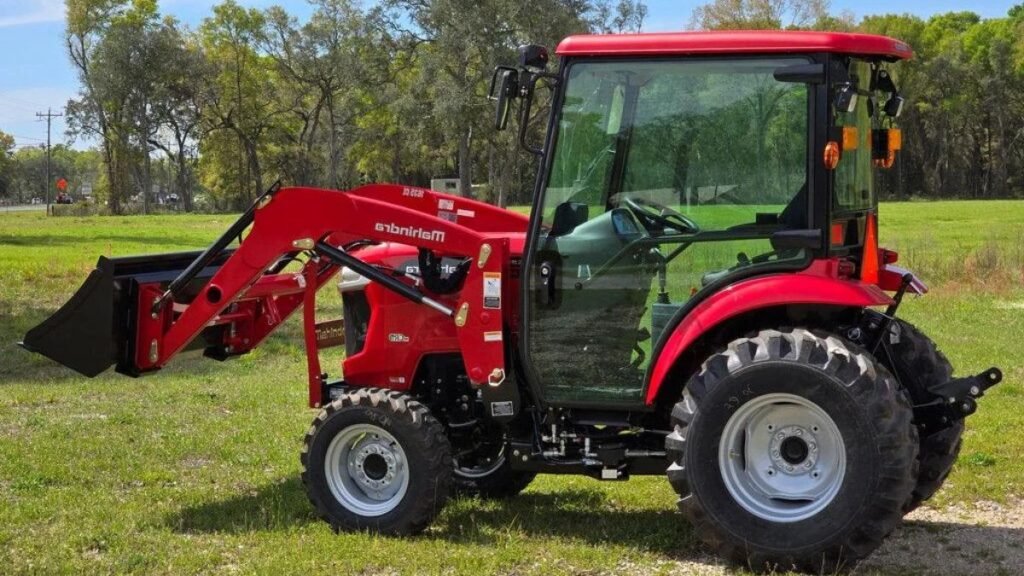
The enclosed 1635 HST Cab is the only factory cab configuration. Mahindra describes a climate controlled cab within the 1600 Series, and the practical value is plain. Dust, rain, wind, summer heat, and winter cold all become easier to manage with an enclosure, which matters most during long mowing days and seasonal snow removal. The cab does not change engine or PTO output, which match the open station HST. It changes the working environment and adds weight: Mahindra lists the HST Cab at 3,527 pounds against 3,086 for the open HST and 3,075 for the Shuttle.
Across all versions Mahindra describes its mComfort seat as having a contoured cushion, adjustable positioning, foldable armrests, and air suspension, and power steering is standard. These are manufacturer descriptions, not test results, and comfort will vary by operator.
The dimensions show how the tractor behaves in tight spaces. Mahindra lists an overall length of 123.8 inches, a wheelbase of 73 inches, an overall width of 64 inches, minimum ground clearance of 12.2 inches, and a turning radius of 8.5 feet with brakes. The wheelbase helps stability under a loader, while the width and turning radius decide whether the tractor fits between orchard rows, inside barns, and along narrow farm lanes. Mahindra’s table lists an overall height of 90.2 inches for the open station versions and 88 inches for the HST Cab, which matters for low doors and storage buildings. These weights are base figures, not operating weights. Fuel, an operator, a loader, ballast, and attachments all add to the total.
Tire Choices
Tire choice changes the tractor as much as the cab. Agricultural tires, 7 x 16 front and 11.2 x 24 rear, use deep lugs for traction in soil and mud, at the cost of more turf disturbance. Industrial tires, 27 x 8.5 on 15 inch rims at the front and 15 x 19.5 at the rear, suit mixed surfaces and material handling between gravel, pavement, and dirt. Turf tires, 25 x 8.5 on 14 inch rims at the front and 13.6 x 16 at the rear, are meant to protect lawns and finished ground. No single package suits every job.
Electrical System
Mahindra lists a 12 volt battery rated at 925 cold cranking amps and a 90 amp alternator. Cold cranking amps measure how much current the battery can deliver at low temperature for starting, which matters for a diesel with a high compression ratio on a frosty morning. A strong rating helps but does not guarantee starting in every condition. CCA is not the same as amp hour capacity, which describes how long a battery can supply a lower current. The alternator replenishes the battery and supports the tractor’s electrical loads while the engine runs.
Farm Applications and Real Working Limits
Mahindra describes the 1600 Series as suited to estates, parks, orchards, and ranches, and the 1635 covers a broad range of work: mowing, brush cutting, tilling and planting, seeding and spreading, landscaping, snow removal, grading, fence work, and trenching with compatible equipment.
Small ranches and hobby farms are its most natural home. A loader for feed and bedding, a rotary cutter for pasture, and a box blade for the farm lane can all be served by one tractor. Orchard owners benefit from the modest width and 8.5 foot turning radius when mowing between rows, though a sprayer or large mower with high power demands may exceed the PTO output. Property managers and rural estate owners will value the loader for gravel and mulch and the cab for winter work. Driveway grading with a box blade is a task the hitch and weight suit, provided the blade is matched to the 1,720 pound rating at 24 inches.
Limits appear in heavier work. Wide cutters in dense brush will bog the engine and call for a narrower implement or slower pace. Deep tillage and subsoiling test weight, traction, and PTO output together. Heavy snow handled with a wide blower can exceed the modest hydraulic flow and traction on slick ground without suitable tires. Repeated handling of large round bales stresses the loader and the tractor’s stability. At that point a larger tractor is the more appropriate machine.
Ownership, Maintenance, and Warranty
Routine care for a compact diesel includes engine oil and filter changes, hydraulic fluid and filter service, coolant inspection, air filter maintenance, fuel system care, tire pressure, loader pivot lubrication, hose inspection, and hitch checks. Intervals and fluid capacities differ by model year and configuration, so the operator manual for the exact tractor is the authoritative source. Mahindra’s owner resources and operator manuals provide manuals, parts information, and service resources.
Dealer proximity shapes ownership more than many buyers expect. Parts availability, service response, and loaner policies decide how long a tractor sits idle during a busy season, and rural distances can be significant. The total outlay also grows with every addition. A loader, cab, backhoe, mower, and other attachments each change the price, so an itemized quote should identify the configuration, loader and bucket, attachments, delivery, taxes, fees, and the applicable warranty. Mahindra advertises a starting price for the 1600 Series as a whole, but that figure does not describe a 1635.
Mahindra USA describes Mahindra’s limited powertrain warranty as lasting seven years for qualifying 1600 Series tractors, with a limit of 3,000 hours of work. It is a limited powertrain warranty, not coverage of every component and attachment for seven years, and normal wear items and various forms of damage may fall outside it. Read the official terms before the coverage influences a purchase. For a historical cross check of older figures, the Mahindra 1635 technical specifications on TractorData are useful, while Mahindra’s official 1600 Series specifications remain the controlling source for current ratings.
Final Assessment
The 1635 makes sense for the owner whose work has outgrown a subcompact but does not justify a full size farm tractor. Its published figures describe a machine that can feed livestock, grade a lane, cut pasture, and clear snow, provided each implement is matched to 26 to 27.6 PTO horsepower, a 1,720 pound hitch rating at 24 inches, and a base weight near three thousand pounds.
The HST buyer is the owner whose days are full of loader cycles and tight maneuvering. The Shuttle buyer is the one who runs PTO implements for hours and prefers fixed gears, and who may also want the deeper 1660B backhoe. The buyer who needs the cab accepts the HST, the extra weight, and the higher cost for protection from weather.
Anyone planning daily heavy bale handling, deep tillage, or serious excavation should look at a larger tractor, because weight and hydraulic flow become the limits. For everyone else, the right next step is to compare an itemized dealer quote for the exact configuration and test it against the work it will actually do.