Kenworth T680E Electric Truck Specifications Range Battery, and Performance
A closer look at Kenworth's Class 8 battery-electric truck, including its PACCAR ePowertrain, battery configurations, charging capabilities, and commercial applications.


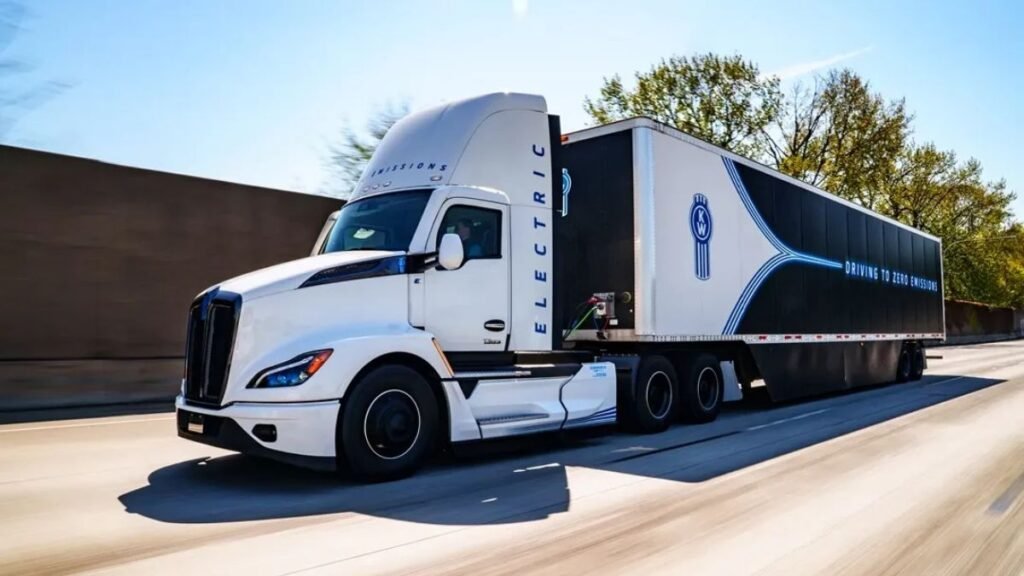
The Kenworth T680E is the battery-electric version of the Kenworth T680, the aerodynamic conventional that anchors the company’s on-highway lineup. It is a Class 8 truck, rated for the heavy end of commercial freight, with Kenworth listing weight ratings of up to 82,000 pounds. What separates it from the diesel T680 is not the silhouette. It is everything underneath: a high-voltage battery system, an electric drive motor, and a charge port where a fuel tank would normally sit.
Kenworth positions the Next Generation T680E for short-haul and regional-haul work, less-than-truckload (LTL) delivery, and drayage. That is a narrower target than the diesel T680, which Kenworth also offers for long-haul duty, and the narrowness is honest. Electric Class 8 trucks trade range and refueling speed for a different cost structure and a quieter driveline.
Two different trucks share the T680E name. The first generation arrived in 2020 with a Meritor-based powertrain. The Next Generation model, unveiled in April 2025, uses a drivetrain developed in-house at PACCAR. Their specifications are not interchangeable, so every figure below is labeled by generation.
Advantages and Limitations of the Kenworth T680E
The Kenworth T680E offers a practical set of strengths for the right operation:
- No tailpipe emissions during operation
- Up to 1,850 lb-ft of peak torque from an in-house PACCAR drivetrain
- 350 kW peak charging, with a roughly two-hour charge to 90 percent per Kenworth
- Three battery sizes to match range and weight to the job
- A quieter driveline and fewer routine wear items than a diesel
- A strong fit for fixed routes with daily depot return
The limitations are just as clear:
- Estimated range tops out near 200 miles, which is shorter than some competitors list
- Battery weight can reduce payload, and Kenworth publishes no curb weights
- Day cab only, with no sleeper
- Dependence on charging infrastructure, which can be costly and slow to install
- Range varies with load, weather, speed, and terrain
- Pricing and several technical details are not published
Kenworth T680E Model History and Development
Kenworth introduced the T680E in 2020 as its first Class 8 battery-electric truck. It was offered as a 4×2 or 6×4 tractor and as a 6×4 straight truck, and its powertrain was a collaboration with Meritor, built around Meritor’s 14Xe tandem electric drive. Kenworth rated that truck at an estimated 150 miles of range from a 396 kWh battery, with DC charging at up to 120 kW and an estimated charge time of 3.3 hours, according to a Kenworth dealer’s product listing.
The redesign came at ACT Expo in Anaheim on April 28, 2025, where Kenworth showed the Next Generation T680E alongside the T880E, which Kenworth calls the industry’s first Class 8 battery-electric truck built specifically for vocational work. That is the kind of extreme-duty territory traditionally held by diesel trucks such as the Kenworth C500. Both new electric models use a PACCAR-developed ePowertrain that Kenworth describes as designed from the ground up. Orders opened at U.S. and Canadian dealers with customer deliveries scheduled to begin later in 2025.
The changes are substantial. The battery can now grow to 500 kWh, peak charging power rises to 350 kW, and a central drive motor with an integrated three-speed transmission replaces the axle-integrated drive of the first generation.
Kenworth T680E Electric Powertrain and Motor Performance
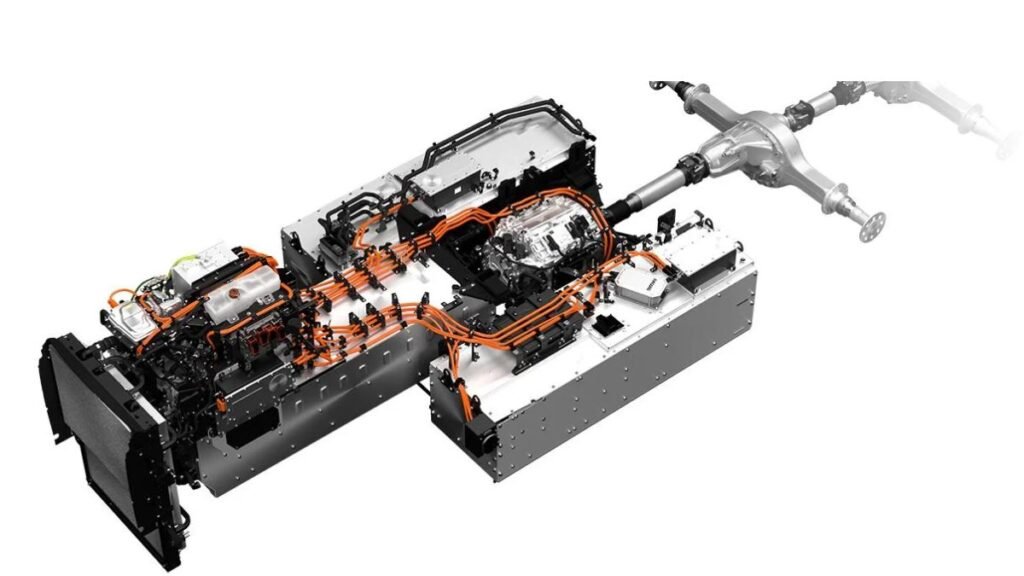
The Next Generation T680E uses a PACCAR ePowertrain with a central drive eMotor and an integrated three-speed transmission. Kenworth offers three power ratings. The base rating delivers 365 hp (270 kW) continuous and 470 hp (350 kW) peak. The middle rating delivers 415 hp (310 kW) continuous and 540 hp (400 kW) peak. The top rating delivers 470 hp (350 kW) continuous and 605 hp (450 kW) peak. All three share a peak torque rating of 1,850 lb-ft.
The continuous number matters more than the peak for commercial work. Peak power is available for short bursts, such as pulling away with a load, while continuous power is what the system can sustain on a long grade without overheating. Kenworth’s brochure also lists an 847 pound motor, a 650 volt system, and AC current of 520 amps peak and 350 amps continuous. The truck pairs this drive unit with traditional rear axles and suspensions in a 6×4 layout.
Not every combination is available. The base rating can be ordered with two to four battery strings, while the middle and top ratings require three or four. In practice, the highest output cannot be paired with the smallest battery.
The first-generation truck worked differently. Its Meritor drive delivered 536 hp continuous, up to 670 hp peak, and 1,623 lb-ft of torque, with a 65 mph top speed. Kenworth said it had enough torque to start a load from a stop on a 25 percent grade and could hold 28 mph on a 6 percent grade. Those are manufacturer claims, and they describe the earlier truck only.
Kenworth T680E Battery System and Configurations
The Next Generation T680E uses lithium iron phosphate (LFP) battery chemistry, and Truck News reported that Kenworth plans to stay with LFP for the foreseeable future. Transport Topics reported that the cells come from China’s CATL, with PACCAR planning to shift to cells from Amplify Cell Technologies, a U.S. battery joint venture in which PACCAR holds a 30 percent interest according to its SEC filings. That same Transport Topics report said Amplify expected to begin cell production in 2027.
Capacity is built in strings. A two-string pack provides 250 kWh with an estimated 100 miles of range, three strings provide 375 kWh and 150 miles, and four strings provide 500 kWh and more than 200 miles. Kenworth says the modular design gives buyers flexibility in wheelbase, weight distribution, and body building, and that the configurations let customers tune range, power, and vehicle weight to the job.
Kenworth’s published materials do not detail the battery management system, thermal management hardware, or where each string sits on the frame, and they do not say whether the listed capacities are nominal or usable. That last point matters when comparing against Freightliner and Volvo, which publish usable figures.
On durability, the brochure lists battery coverage of up to 500,000 miles, tied to 4,000 charge cycles and 70 percent state of health. Buyers should confirm the exact term length and conditions with a dealer. LFP packs are generally valued for cycle life and thermal stability, at the cost of lower energy density than other lithium chemistries, which is one reason battery weight remains a real factor in this truck.
Kenworth T680E Driving Range and Energy Efficiency
Kenworth’s range numbers are estimates, and the brochure says so, noting that actual range depends on geography, climate, operator, and duty cycle. The company lists roughly 100, 150, and 200 miles for the three battery sizes.
Dividing capacity by estimated range gives about 2.5 kWh per mile for every Next Generation configuration, and about 2.6 for the first generation. Those are simple ratios of Kenworth’s own estimates, not measured consumption. Kenworth has not published an efficiency figure, so real consumption should be verified in a trial on the buyer’s own route.
Several things will move the real number. A heavier load takes more energy to accelerate and climb. Higher highway speeds raise aerodynamic drag sharply. Cold weather reduces what a battery can deliver, and cab heating draws power too. Hilly terrain costs energy on the way up, though regenerative braking returns some of it on the way down. Kenworth fits fairings, turning vanes, and side extenders as standard to protect range, and offers DigitalVision camera mirrors that it says improve aerodynamic efficiency.
The range suits regional routes with a return to base, not open-ended highway travel, and the figure should never be read as guaranteed in every condition.
Kenworth T680E Charging System and Charging Time
The Next Generation T680E uses a CCS1 DC fast-charging port and ships with a 350 kW DC charger capability as standard, with an optional 19 kW onboard AC charger. Kenworth says the truck can reach 90 percent in about two hours, and its brochure says less than two hours at 350 kW. It does not publish a 10 to 80 percent time or say which battery size the two-hour claim applies to.
If the claim refers to the 500 kWh pack, charging 450 kWh in two hours implies an average near 225 kW. That is well below the 350 kW peak, which is how charging works in practice: the station’s actual output, the truck’s charge curve, and battery temperature all shape the session.
The optional AC charger is a convenience rather than a primary solution. At its rated 19 kW, filling a 500 kWh pack would take more than a day, ignoring losses. For comparison, the first-generation truck charged at up to 120 kW and needed an estimated 3.3 hours.
Depot planning is the real project. A single 350 kW charger is a large electrical load, and several trucks charging together multiply it, so many fleets will need utility coordination and service upgrades. PACCAR offers chargers through PACCAR Parts and works with Qmerit on installation. A driver’s break can add energy, but at a sustained 350 kW, 30 minutes delivers at most 175 kWh, and real sessions will deliver less.
Chassis, Axles, and Dimensions on the Kenworth T680E
The Next Generation T680E is available as a 6×4 day cab, either as a tractor or a straight truck. Kenworth lists a 56,000 pound GVWR and an 82,000 pound GCWR, a minimum wheelbase of 190 inches, and conventional rear axles and suspensions. The cab uses the T680 aerodynamic short hood, and the brochure points to a driver-friendly charge port location and a separate low-voltage battery box.
The first generation had more configuration variety. It came as a 4×2 or 6×4 tractor and a 6×4 straight truck, with 190 inch and 216 inch wheelbases, the longer one with ePTO. Kenworth listed 295/75R22.5 tires and a short hood without fairings, with weight ratings of 54,000 and 82,000 pounds.
The tractor and the straight truck differ in how they work. A straight truck carries a body and its equipment on the chassis, so body weight and any ePTO load matter. Kenworth offers 25 kW and 150 kW ePTO sockets with factory-installed dash switches. A tractor pulls a trailer, so the trailer and cargo determine the gross weight.
Kenworth’s brochure does not list curb weight, weight distribution, ground clearance, or exterior dimensions for the Next Generation truck, so those details should come from the dealer for the specific build.
Payload and Towing Capability
Kenworth rates the Next Generation T680E at up to 82,000 pounds gross combination weight. That is a ceiling, not a payload figure. Payload is what remains after subtracting the truck, the trailer or body, and the equipment from the applicable weight rating, and Kenworth has not published a curb weight for the Next Generation truck.
The physics are not in doubt. A larger battery adds mass, and every pound of battery displaces a pound of potential cargo on a weight-limited load. Legal gross weight limits also vary by jurisdiction, so the 82,000 pound rating does not mean the truck can legally run at that weight everywhere.
Kenworth designed the truck for short and regional hauling, LTL, and drayage, which suggests trailers and container chassis in routes with defined weights.
Kenworth T680E Cab Design, Interior, and Driver Comfort
Both generations of the T680E are day cabs. Kenworth does not offer a sleeper on this truck, which fits its positioning for routes that end at the depot each night.
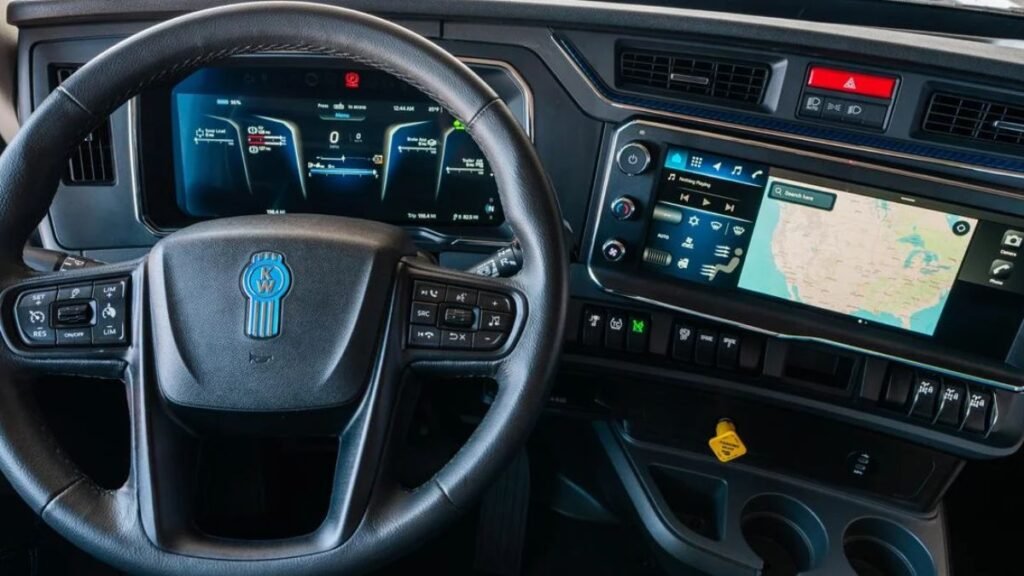
The Next Generation interior was refreshed with updated seats and trim, blue carbon-fiber dash accents, and blue stitching. The dash includes a wireless charger and the Kenworth SmartWheel. The centerpiece is a 15 inch DriverConnect touchscreen on the B-panel. Truck News reported that the left side shows radio and climate controls, while the right side runs applications such as navigation, and Kenworth lists BEV-specific app integration.
The digital interface also displays range, regenerative braking activity, and performance data, which gives a driver the information needed to manage an electric truck’s energy.
Kenworth has not published measured noise or vibration data. The expectation of a quieter cab follows from the absence of a diesel engine, but without test numbers it remains an expectation.
Technology, Connectivity, and Driver Assistance
The 15 inch DriverConnect display is standard on the Next Generation T680E. Driver assistance is optional, and Kenworth bundles it by customer need.
The Bendix Fusion package includes a forward-looking camera and bumper-mounted radar, adaptive cruise control with stop and go, autonomous emergency braking including multi-lane braking, highway departure braking, and lane departure warning. Other options include predictive cruise control, which anticipates changes in grade, side object detection with a passenger-side radar, tire pressure and temperature monitoring, and Lane Keeping Assist with torque-assisted steering. DigitalVision mirrors replace conventional mirrors with cameras and in-cab monitors, with night vision and trailer tracking.
Kenworth’s published T680E materials do not describe fleet telematics, remote battery monitoring, or charge-planning software in detail.
Safety Systems and Braking Performance
Kenworth’s T680E materials emphasize the optional Bendix Fusion safety systems described above, especially autonomous emergency braking and highway departure braking. Kenworth does not publish the base braking hardware or stability control details in the T680E brochure, so buyers should confirm them for their build.
High-voltage safety is a separate subject. Kenworth has not published detail on emergency disconnect procedures or battery thermal protection in the T680E materials. Fleets that service their own trucks should request the manufacturer’s high-voltage safety and first-responder documentation.
Regenerative braking helps slow the truck, but it supplements the friction brakes and does not replace them. A battery near full charge, for example, has limited ability to accept regenerated energy on a long descent, so the service brakes still do real work.
Regenerative Braking and the Kenworth T680E Driving Experience
Regenerative braking uses the electric motor as a generator when the driver lifts off the accelerator or brakes. Instead of turning kinetic energy into heat at the brake drums, the motor converts part of it into electricity and sends it back to the battery. That helps most in stop-and-go delivery work and on downhill stretches, and it matters less at steady highway speeds.
Kenworth says the T680E display shows regenerative braking activity but has not published the number of regeneration levels or the maximum regenerative power. Peterbilt, which uses the same PACCAR ePowertrain in the 579EV, describes adjustable regenerative braking and a transmission that shifts without torque interruption. Kenworth has not made the same claims for the T680E, so they should be treated as a hint, not a specification.
Electric motors deliver torque from a standstill, which is why Kenworth could claim hill-start capability on the first generation. Kenworth has not released acceleration times or instrumented loaded-launch data for the Next Generation truck. What can be said is structural: a three-speed transmission means far fewer shifts than a diesel’s automated manual, and there is no engine to rev up before the truck responds.
Operating Applications and Ideal Commercial Uses
Kenworth names the Next Generation T680E for short-haul and regional-haul operations, LTL, and drayage. Those uses share a pattern: predictable routes, daily returns to a depot, and enough idle time for charging.
Port and logistics-center work is a natural fit because routes are short and repeatable. Regional distribution can work when the daily mileage sits comfortably inside the battery’s real capability. Warehouse-to-warehouse shuttles, industrial-area deliveries, and fixed-route runs also suit the truck.
It is a poor fit for operations that need to cover long distances without scheduled charging stops. With Kenworth’s top estimate at about 200 miles, a driver would stop to charge long before reaching the mileage a diesel sleeper covers in a day. The T680E also has no sleeper cab, which rules it out for team and long-haul operations by design. Fleets weighing diesel options for that kind of work can start with our comparison of the Volvo VNL and International LT, two sleeper tractors built around long-haul duty.
Maintenance Reliability, and Battery Warranty
An electric truck removes several routine tasks. There is no engine oil, no oil filter, and no diesel exhaust aftertreatment to maintain. It does not become maintenance-free. Brakes and tires still wear, suspension and chassis components still need inspection, cooling systems still need service, and the high-voltage system needs periodic checks by trained technicians.
Kenworth says the integrated PACCAR design improves serviceability, but it has not published a service schedule. Parts and service are available through Kenworth’s dealer network in the U.S. and Canada, and buyers should ask how many nearby locations are equipped for high-voltage work.
Warranty terms are published in the brochure. The HD electrical drive system carries standard coverage of 36 months or 300,000 miles, with an extended option of 150 months or 500,000 miles that applies to the eMotor, eAccessories, eControls, and related components. Battery coverage is listed to 500,000 miles, with a 4,000 cycle and 70 percent state-of-health condition. Kenworth has not published repair or battery replacement costs, and that is a gap fleets should close with a written quote.
Kenworth T680E Operating Costs and Total Cost of Ownership
Total cost of ownership for an electric truck depends on a handful of variables, and no single savings figure applies to every fleet. The strongest factor is the price of electricity versus diesel in the fleet’s service area, including demand charges and time-of-use rates, which can change the economics of depot charging significantly.
Charging infrastructure is the second big item. Chargers, electrical service upgrades, installation, and utility work can add substantial cost and lead time before the first truck charges. Maintenance savings are plausible, since the driveline has fewer wear items, but they should be modeled from the fleet’s own records. Insurance and the cost of a future battery replacement are also real inputs, and Kenworth does not publish either.
Incentives have changed. The federal Section 45W commercial clean vehicle credit does not apply to vehicles acquired after September 30, 2025, according to the IRS. State programs still exist, and California’s HVIP offers vouchers that, per the California Air Resources Board, range from $7,500 to $420,000 per truck across eligible vehicle types. Eligibility for a specific T680E configuration must be confirmed with the program administrator.
Kenworth T680E vs. Kenworth T680 Diesel
The two trucks share a hood design and much of the Kenworth cab experience, but they serve different jobs. The diesel T680 is powered by a PACCAR MX-13 or, as Kenworth now also offers, a 15-liter X15N natural gas engine. The T680E replaces that with a battery, an electric motor, and a three-speed transmission.
Refueling is the clearest contrast. A diesel truck refuels in minutes at a public station. The T680E needs roughly two hours for a 90 percent charge at 350 kW, and it needs the right charger available. Range follows the same pattern, with the diesel T680 capable of far more miles per fill than the T680E’s estimated 100 to 200 miles. Other long-haul diesels show the same advantage, as in our Volvo VNL review, which covers a D13 diesel with an I-Shift transmission.
The electric truck’s case rests on energy cost, driveline simplicity, and quieter operation, along with the possibility of lower maintenance spending. The diesel’s case rests on range, flexibility, a sleeper option, and a lighter drivetrain that leaves more of the weight rating for cargo. Neither truck is better in general. The right choice depends on whether the routes are fixed, how far the truck runs each day, and whether charging is available where the truck sits.
Kenworth T680E Pricing, Availability, and Market Position
Kenworth does not publish a price for the T680E. Quotes come through dealers, and cost depends on battery size, power rating, and options. Kenworth says the Next Generation T680E and T880E can be ordered through dealers in the United States and Canada, and directs buyers to kenworth.com for available incentives.
The closest sibling is the Peterbilt 579EV, which uses the same PACCAR ePowertrain, 250, 375, and 500 kWh battery options, and an estimated range of up to 200 miles. Peterbilt lists 80 percent charge in about 90 minutes at 350 kW.
The Freightliner eCascadia offers 291 or 438 kWh of usable capacity and a typical range of 155 to 230 miles depending on configuration, with 80 percent recharge in about 90 minutes and up to 82,000 pounds GCW. The Volvo VNR Electric reaches up to 275 miles with its 565 kWh pack, which Volvo says holds 452 kWh of usable energy, and lists a typical range of 220 miles for that configuration. Volvo also lists 80 percent charge in 90 minutes and up to 82,000 pounds GCW.
On those published numbers, the T680E leads in peak charging power and offers a wide battery choice, but its top estimated range is shorter than the Volvo’s and Freightliner’s maximum.
Final Verdict Is the Kenworth T680E Worth Considering?
The Kenworth T680E makes the most sense for a fleet that knows its routes. If the trucks return to the same depot each night, run a measured number of miles, and have charging in place, the Next Generation model is a credible Class 8 tool, with a strong torque rating, 350 kW charging, and battery sizes that can be matched to the job.
It suits short-haul, drayage, LTL, and many regional operations. It is not a long-haul truck. A top estimate of about 200 miles, no sleeper, and charging that takes hours rather than minutes rule it out for work without scheduled charging stops. In those cases the diesel T680 remains the more practical choice.
Battery size is the central decision. The 250 kWh pack, with an estimated 100 miles, is for very short, repeatable routes. The 375 kWh pack suits mid-range regional work. The 500 kWh pack provides the most margin but adds weight that Kenworth has not quantified, so weight-sensitive operators should settle that point first.
Before investing, a fleet should study its real daily mileage and load weights, the cost and timeline of depot charging, its electricity rates, available incentives, dealer service capability for high-voltage systems, and written pricing and warranty terms. Kenworth’s own range figures are estimates, and the strongest test is a trial on the actual route.