2026 Ford F-650 Review Power Payload and Work Capability
A closer look at the 2026 Ford F-650's engine options, commercial capabilities, weight ratings, and versatility for demanding work.

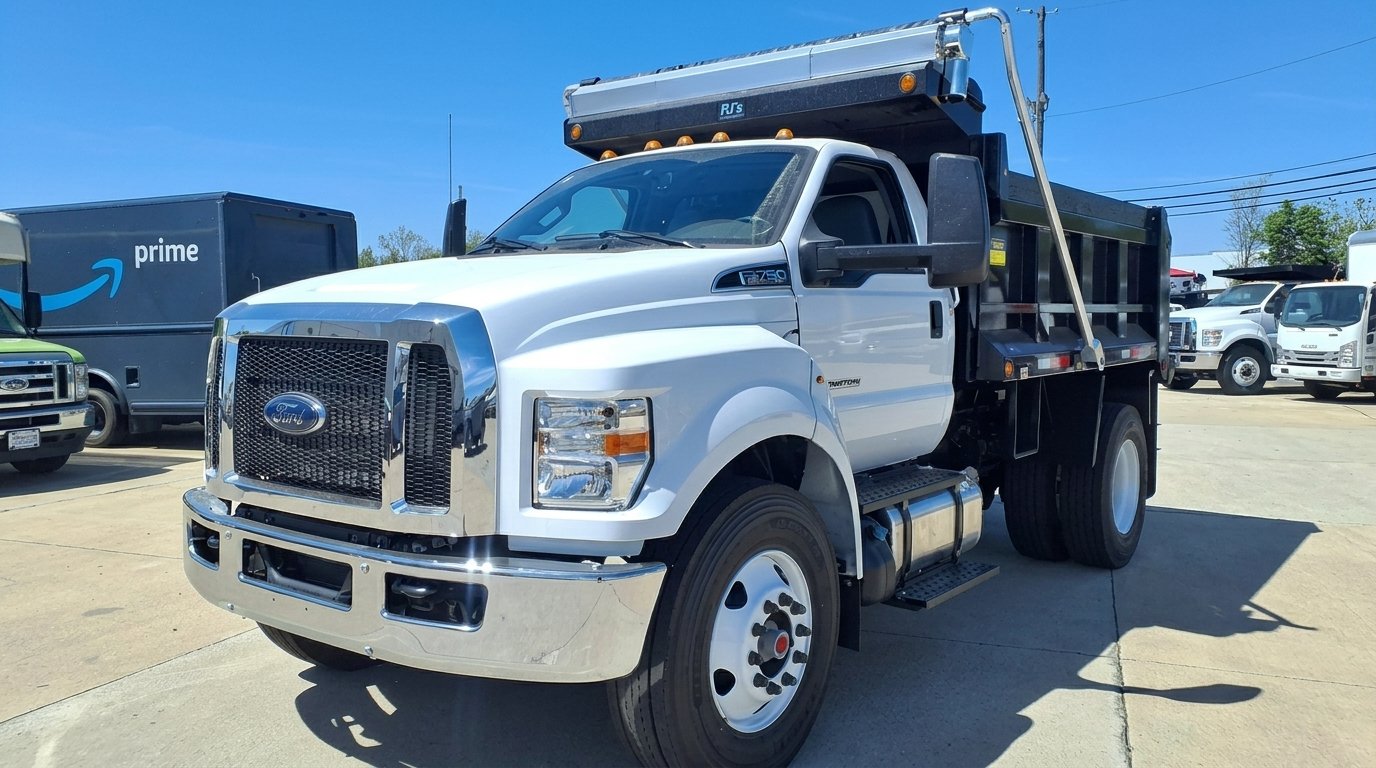
The 2026 Ford F-650 review begins with a simple observation: this is not a pickup truck that happens to be bigger. It is a medium-duty commercial chassis, built to carry a dump body, a service body, a box, or a flatbed through years of daily work, and it sits in the gap between heavy-duty pickups and Class 8 tractors. Business owners who have outgrown a one-ton pickup, but don’t need a full-size highway tractor, tend to end up looking at this truck.
The F-650 is a Class 6–7 truck, depending on the GVWR configuration an operator selects. It is sold primarily as a straight-frame cab-and-chassis, meaning Ford delivers the cab, frame, engine, transmission, axles, and suspension, and a professional upfitter completes the truck with the body the job requires. A plumbing contractor, a beverage distributor, a municipal fleet, and a towing company can all start from the same underlying platform and finish with very different trucks.
That flexibility is the central idea of the F-650, and it also explains why some questions have no single answer. Curb weight, payload, and real-world fuel use all depend on how the truck is built. The sections below explain what Ford publishes, what it deliberately leaves to the final configuration, and how to think through the choices that matter most, starting with gas or diesel.
Our Take
The F-650’s strongest quality is how much choice it offers within one platform. The gasoline 7.3L V8 gives lighter-duty and local operations a simple, predictable power source at a lower entry price. The 6.7L Power Stroke turbo diesel, paired with a 10-speed automatic, is the better fit for operators who regularly work near the limits of the truck’s ratings. Ford also offers three cab styles, a wide range of wheelbases and cab-to-axle lengths, several fuel tank options, and PTO provisions, so a buyer can shape the chassis around the body instead of the reverse.
The ratings are also substantial for the class. A published GVWR range of 22,000 to 29,000 pounds, a diesel GCWR of up to 50,000 pounds, and rear axle ratings reaching 19,000 pounds put the truck well above what any pickup-based platform can legitimately claim.
The limitations are mostly about how much of the truck’s real-world performance can’t be read from a spec sheet. Ford does not publish a standardized EPA fuel-economy rating or a certified range figure for the 2026 F-650, so buyers must estimate operating costs from their own duty cycle. Payload and curb weight can’t be stated in general either, because they change with every body and option. The base interior is also utilitarian by design: it is a workplace, and buyers expecting a luxury cabin will be looking at the wrong truck. Finally, the starting prices cover a bare chassis. The finished truck, with its body and equipment, costs considerably more.
In short, the F-650 rewards buyers who know their workload in detail. It is less forgiving of buyers who choose a configuration without understanding their weight, duty cycle, and body requirements.
A Chassis Built to Be Finished by Someone Else
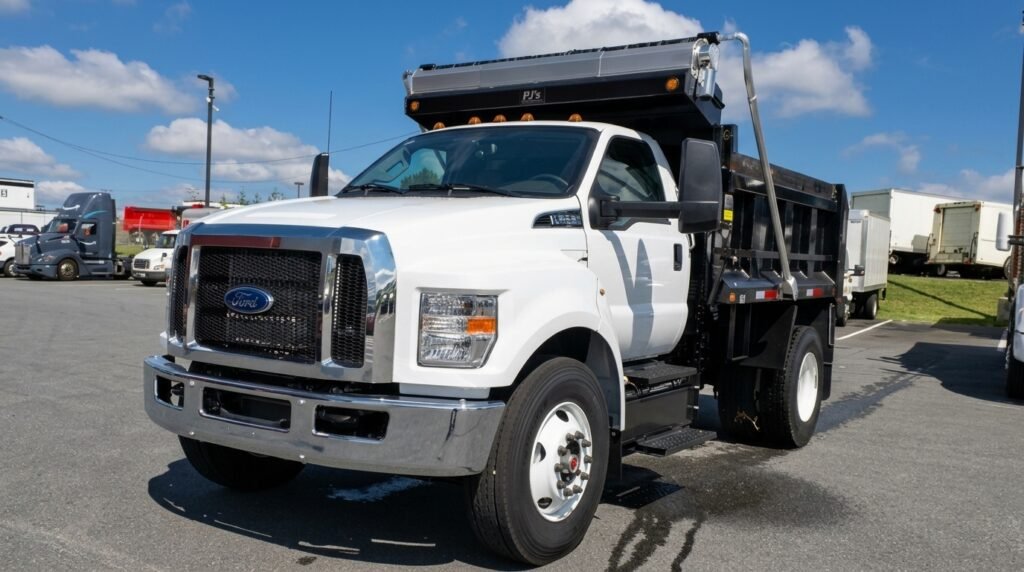
Anyone shopping the medium-duty segment should understand the cab-and-chassis model first. The F-650 is delivered as a driver’s cab on a bare frame, with no cargo box behind it. That arrangement is what lets the same truck become a dump truck in one fleet and a refrigerated delivery truck in another.
Ford offers three cab configurations: Regular Cab, SuperCab, and Crew Cab. The published bumper-to-back-of-cab measurements are approximately 114.4 inches for the Regular Cab, 135.4 inches for the SuperCab, and 149.9 inches for the Crew Cab. These figures describe the cab section only, not the length of the complete truck. Final dimensions depend on the cab, the wheelbase, the frame length, and whatever body the upfitter installs.
Chassis configurations are broad. Ford lists a clean cab-to-axle range from 84 to 207 inches across the available builds, and a documented base configuration pairs a 158-inch wheelbase with an 84-inch cab-to-axle measurement. Cab-to-axle length matters because it determines how much frame is available behind the cab for a body, and a long box truck needs a very different layout than a short dump body.
The standard configuration is a rear-wheel-drive 4×2 commercial chassis. Buyers who need four-wheel drive should confirm with Ford and a dealer rather than assume it is available.
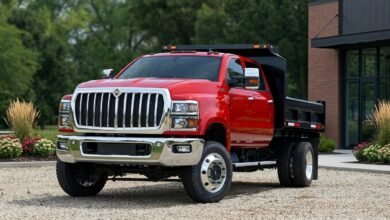
Readers comparing the F-650 with other trucks in this class may also want to look at Haulizo’s Chevrolet Silverado 6500 HD review and our coverage of the International CV515 medium-duty truck. Each approaches the segment differently, and the details of each are worth reading on their own terms.
Pricing: What the Starting Numbers Actually Mean
For the 2026 model year in the United States, the F-650 Gas starts at $69,995 and the F-650 Diesel starts at $79,300. These are starting manufacturer prices for base vehicles.
Those figures don’t buy a work-ready truck. They cover the chassis, not a dump body, box body, flatbed, hydraulic system, towing equipment, or other aftermarket installation. Upfitting is often a significant part of the total cost, and it varies with the body and equipment chosen. Buyers should also expect additional charges and dealer terms that vary by location and order, and should get those figures from a dealer rather than rely on the starting price. The gap between the gas and diesel base prices is real, but the more useful comparison is how each engine fits the work over the life of the truck.
The 7.3L V8 Gasoline Engine
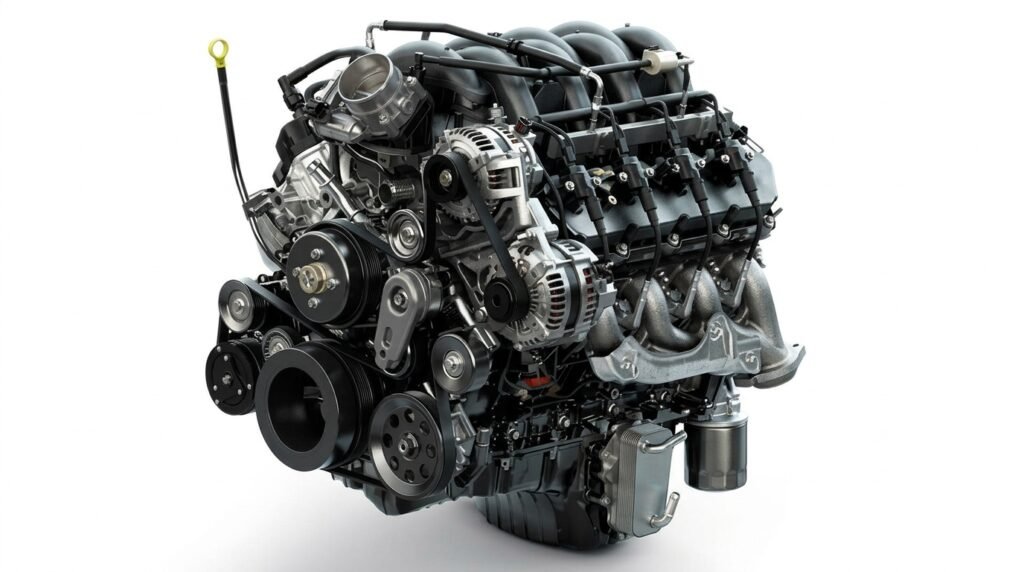
The gasoline option is a 7.3-liter V8, roughly 445 cubic inches. It is naturally aspirated, uses port fuel injection, and has an overhead-valve, pushrod design. Ford rates it at 335 horsepower at 3,750 rpm and 468 lb-ft of torque at 3,750 rpm. The compression ratio is 10.5:1, and the engine requires a minimum of 87-octane gasoline, which keeps fueling simple at almost any station.
Ford’s published horsepower and torque ratings are based on premium fuel under SAE J1349 testing conditions, while the 2026 owner’s manual lists 87-octane gasoline as the minimum required fuel.
These horsepower and torque figures are independent published ratings, and each peaks at its own point in the rev range. They should not be read as a single simultaneous peak. It would also be a mistake to compare this engine’s output directly with the diesel’s and conclude that one is simply stronger. The two engines produce power in very different ways.
The engineering is oriented toward sustained commercial use. The engine uses a forged-steel crankshaft supported by large main bearings, a variable-displacement oil pump, and piston cooling jets. Each of these addresses a stress that commercial engines face: heavy and repeated loading, long running hours, and the heat that builds up when an engine works hard. A pushrod design also keeps the engine compact and mechanically straightforward.
In practice, a naturally aspirated gasoline V8 delivers power in a linear, predictable way. Throttle input produces a proportional response, without the boost buildup of a turbocharged engine. That makes it comfortable for stop-and-go work, short routes, and operators who value simplicity. It also tends to need more rpm to do its work than a turbo diesel, because its torque peak sits much higher in the rev range.
None of this means gasoline is automatically cheaper or more economical to run. Operating economy depends on the weight, the body, the route, and the duty cycle, and Ford publishes no fuel-economy rating that would settle the question. The gas engine suits operators whose trucks run moderate loads, cover local routes, and benefit from the lower purchase price.
The 6.7L Power Stroke Turbo Diesel
The alternative is the 6.7L Power Stroke V8 turbo diesel, which is aimed at operators who prioritize low-rpm torque and heavy work. It is offered in three output levels:
The standard version makes 270 horsepower at 2,400 rpm and 800 lb-ft of torque at 1,500 rpm. An optional version makes 300 horsepower at 2,500 rpm and 825 lb-ft at 1,500 rpm. The optional higher-output version makes 330 horsepower at 2,600 rpm and 850 lb-ft at 1,500 rpm.
The important number here is the engine speed at which torque arrives. Every diesel output level reaches its peak torque at 1,500 rpm, which is far below the gas engine’s 3,750 rpm torque peak. For a loaded truck climbing a grade, pulling away from a stop with a full body, or running hydraulic equipment through a PTO, strong torque at low engine speed means the engine doesn’t have to work at high rpm to do the job.
The engine is a turbocharged V8 with an inverse-flow arrangement, in which the turbocharger sits between the cylinder banks and the exhaust manifolds are positioned accordingly. This compact layout keeps the exhaust path short, which helps the turbocharger respond quickly. It is one of the engineering decisions that makes the engine behave well at low speeds under load.
The diesel also supports engine exhaust braking, which uses the engine to help slow a heavy truck and reduces demand on the service brakes on long descents. Like all modern diesels, it relies on a diesel particulate filter, which periodically burns off collected soot in a process called regeneration. Ford offers operator-commanded regeneration features on available configurations, which can help a fleet manage when regeneration occurs. Operators should understand how regeneration works, because short, light-duty routes can make it more of a consideration than long highway runs do.
Ford reports that the engine went through more than 500,000 simulated customer miles in its testing program, and states a B10 design life of more than 500,000 miles for the 330-horsepower configuration under Ford’s specified test conditions. This is an engineering target, not a guarantee. Actual engine life depends on maintenance, operating conditions, load, and how the truck is driven, and no single engine can be promised to reach a particular mileage.
Transmissions and the Value of Gear Selection
The two engines come with different automatics, and the difference matters. The gasoline engine is paired with Ford’s TorqShift HD 6-speed automatic with double overdrive. The diesel is paired with the TorqShift HD 10-speed automatic, also with double overdrive.
Both transmissions are designed around commercial duty. Tow/Haul mode adjusts shift behavior for heavy loads. SelectShift operation lets the driver choose gears manually when conditions call for it. Progressive Range Select lets the driver limit the highest gear the transmission will use, which helps on grades and when descending with a load.
The practical benefit of the 10-speed is the number of ratios available. With more gears closely spaced, the transmission can keep the diesel in its useful torque range more consistently. Climbing a hill, the truck can reduce the kind of gear hunting that happens when a transmission shifts repeatedly between two ratios. Descending, it can provide more controlled engine braking and shifting. For an operator running a loaded truck in hilly terrain or at weights near the truck’s limits, a 10-speed behind a torque-rich diesel is a strong combination.
The 6-speed in the gasoline truck remains a purpose-built commercial transmission. The diesel’s 10-speed offers closer gear ratios and shorter first and reverse gears, which provide additional flexibility when moving heavy loads or operating on softer surfaces. The choice between them should depend on the truck’s actual workload, terrain, and operating requirements rather than gear count alone.
Power Take-Off Capability
Power Take-Off, or PTO, lets the truck’s engine drive equipment other than the wheels. In the vocational world, this typically means hydraulic pumps that power dump hoists, cranes, aerial lifts, compactors, and similar equipment.
On the F-650, the diesel configuration includes a live-drive PTO provision as standard equipment, while the gasoline configuration can be equipped with an available PTO provision. A provision is not the same as a complete system: the PTO prepares the truck to run equipment, but each attachment still needs the correct pump, controls, and installation by a qualified upfitter. A PTO does not let the truck operate every aftermarket attachment on its own. For buyers planning a dump body, a utility body with a crane, or a bucket truck, though, factory PTO provision is a meaningful advantage, because it makes the integration cleaner.
Weight Ratings: GVWR, GCWR, GAWR, and Payload
Commercial truck weight terms are often confused, and the confusion can be expensive. The F-650 is a good platform for explaining them, because Ford publishes strong ratings that are easy to misread.
GVWR, or gross vehicle weight rating, is the maximum allowable total operating weight of the truck itself. It includes the chassis, the body, the passengers, the equipment, and the cargo. The F-650’s published GVWR range is 22,000 to 29,000 pounds. The wide range reflects the number of configurations Ford offers, and the right figure for any individual truck is the one on its certification label.
GCWR, or gross combined weight rating, is the maximum allowable combined weight of the loaded truck and its trailer. Ford’s maximum GCWR is 37,000 pounds for the gasoline engine and 50,000 pounds for the diesel. This is the figure that most often leads to mistakes. A 50,000-pound GCWR does not mean the truck can tow a 50,000-pound trailer. The combined rating has to cover the truck’s own weight, its body, its cargo, and the trailer. The more the truck itself weighs, the less is left for the trailer, and the real towing capability of a specific truck depends on how it is built and loaded. We won’t put a towing number on a truck whose weight can’t be known in advance.
GAWR, or gross axle weight rating, is the maximum load assigned to an individual axle. The F-650’s standard front axle rating is 8,500 pounds, with an available maximum of 10,000 pounds. The standard rear axle rating is 17,500 pounds, with an available maximum of 19,000 pounds. Axle ratings matter because a truck can be under its GVWR and still overload an axle if the body or cargo is poorly distributed. A dump body or a heavy rear-mounted piece of equipment can push the rear axle toward its limit well before the truck reaches its total rating.
Payload is the weight the truck can carry after accounting for its actual completed weight. The calculation is simple: payload equals GVWR minus the actual vehicle weight. The difficulty is that the F-650 is sold as a customizable chassis, so there is no universal curb weight or payload figure. Cab style, engine, wheelbase, installed body, fuel, equipment, and modifications all change the empty weight of the finished truck. A heavy steel dump body leaves less payload than a lightweight flatbed on the same chassis, even though the GVWR is identical. It would be wrong to say the F-650 carries 29,000 pounds. That is the maximum rating for the whole truck, not the amount it can haul.
The right way to determine what a specific truck can carry is to weigh the completed vehicle and consult its certification label and its axle ratings. This is the number to use, and it is the one a fleet manager should plan around.
Frame, Suspension, and Chassis Engineering
The frame is where a commercial truck’s strength is determined, and it is especially important on a platform designed to carry bodies built by third parties. The published standard frame specification for the F-650 is a 12.64 section modulus with a 50,000-PSI steel rating. In simple terms, section modulus describes the frame’s resistance to bending, and the steel rating describes the strength of the material. Together they indicate how well the frame can handle the stresses of a loaded body, hydraulic equipment, and daily use. Ford also offers other frame options, and an upfitter planning a heavy or specialized body should confirm which one is appropriate. Not every optional frame or suspension rating is standard.
The suspension combines a parabolic taper-leaf spring setup at the front with a variable-rate multi-leaf spring setup at the rear. Parabolic taper-leaf springs are designed to carry load while offering a more compliant ride than conventional multi-leaf springs, and they are well suited to a front axle that carries the engine and the cab. The variable-rate rear leaf springs respond progressively: lighter when the truck is empty, firmer as the load increases. That makes them a good match for trucks that run empty on one leg of a route and loaded on the next.
For upfitters, the practical questions are weight distribution, axle durability, and compatibility between the frame, the suspension, the PTO, and the finished body. A well-planned build keeps the load within the axle ratings and uses the frame length appropriately. A poorly planned one can leave a truck technically legal in total weight but overloaded on the rear axle.
Wheels, Tires, and Fuel Capacity
Tire specifications on the F-650 depend on the chosen configuration. A documented 2026 F-650 gasoline Regular Cab uses Goodyear FuelMax RSA tires in size 11R22.5H, with a 16-ply rating, mounted on 22.5 × 8.25-inch steel wheels in a ten-hole arrangement. The truck runs two tires on the front axle and four on the rear in a dual-rear-wheel layout.
This is one documented configuration, not a universal specification. The correct tire depends on the wheel package, the axle ratings, the GVWR, and the application, so buyers should not assume that every F-650 uses the same tire. Ford also offers multiple Alcoa Dura-Bright polished aluminum wheel options for operators who want them.
For commercial operators, tires are a working component more than a styling choice. Load ratings must match the weights the truck actually carries. Tire pressure has a direct effect on durability and load capacity, and dual rear wheels require both tires in a pair to be properly inflated and matched. A heavy payload on an underinflated tire is a common source of failures. Regular inspection matters more on a truck like this than on a passenger vehicle, because a tire problem can sideline the truck and its crew.
Fuel capacity also varies. Gasoline trucks are offered with 50- or 60-gallon tanks, depending on configuration. Diesel trucks are offered with 50-, 55-, or 65-gallon tanks, and an optional dual-tank arrangement totals 115 gallons.
What Ford does not provide is a standardized EPA fuel-economy rating or a certified driving range for the 2026 F-650. Medium-duty trucks in this weight class generally are not rated the way light vehicles are, and it would be misleading to quote a miles-per-gallon figure or a specific distance on a full tank. Range depends on the engine, the vehicle’s weight, the installed body, cargo and trailer weight, road conditions, traffic, operating hours, driving behavior, and the tank configuration.
A delivery truck on a stop-and-go urban route, a dump truck that idles and runs its hydraulics at a job site, and a heavily equipped utility truck that burns fuel while stationary can all share the same chassis and still have very different operating ranges. Fleet managers should estimate fuel use from their own routes and duty cycle, and consider fuel capacity and refueling logistics when choosing a tank configuration.
Brakes and Safety Equipment
Standard braking is a Bosch HydroMax hydraulic brake system with traction control. Standard safety equipment also includes Electronic Stability Control and Hill Start Assist, which holds the truck briefly on an incline to help prevent rollback. Selected diesel models offer an air-brake configuration, which is common on heavier commercial trucks and is the basis for some of the more advanced equipment.
Ford offers a range of driver-assistance equipment, but these features are available, not universal. Options may include Automatic Emergency Braking, Forward Collision Warning, Lane Departure Warning or Lane-Keeping Alert, Automatic High-Beam Control, and an optional rear-view camera with a mirror display. Adaptive Cruise Control is available on eligible air-brake configurations. A buyer should not assume that every F-650 includes all of these systems. They depend on the powertrain, brake type, and the packages selected, and they should be confirmed on the order.
For fleets, these systems have a practical value beyond the equipment itself. A truck that works in dense traffic, makes frequent stops, or carries a driver who spends long days behind the wheel can benefit from the additional awareness these features provide.
Cab and Interior
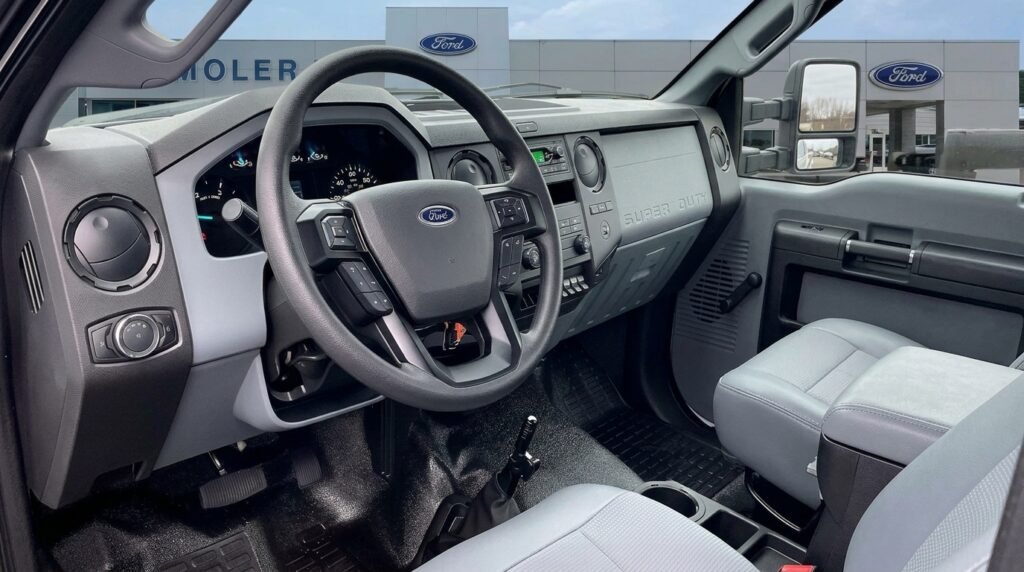
The F-650’s cab is designed for a full working day, not for comfort in the passenger-car sense. The three cab styles make different trade-offs: the Regular Cab keeps the truck compact and leaves more frame for the body, the SuperCab adds space behind the seats, and the Crew Cab seats a full crew, which matters for service, utility, and emergency operations that move several people to a site.
The base interior is utilitarian. The instrument cluster, steering-wheel-mounted controls, air conditioning, heating, and defrosting cover the essentials. The standard audio system is AM/FM with two speakers, supplemented by Bluetooth connectivity and USB connectivity. An optional 110V AC outlet can power small tools or equipment, and the available rear-view camera helps with the limited visibility behind a body-equipped truck. Four upfitter switches are standard on the diesel configuration, while they are optional on the gasoline version. Ford also offers an optional Upfitter Interface Module to support integration with specialized commercial equipment. Their availability and functionality depend on the selected chassis configuration and the final body installation.
The design priorities are ergonomics, durability, ease of entry, visibility, and practical operation. The cab is not a luxury space, and it should not be judged as one. We found nothing in the confirmed 2026 information that points to a large touchscreen, built-in navigation, premium audio, or luxury seating, and buyers shouldn’t expect them. What matters is that the driver can get in and out easily, see well, and operate the controls without distraction.
Upfitting and Commercial Applications
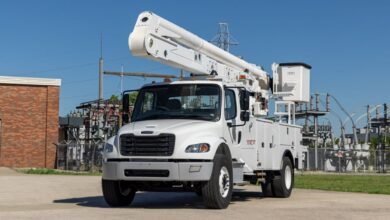
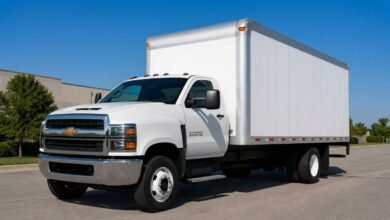
The straight-frame chassis is the F-650’s defining advantage, and it is why the truck shows up in so many industries. Box trucks, dump trucks, flatbeds, tow trucks, utility service trucks, beverage delivery trucks, bucket trucks, and selected emergency-service applications are all common builds. Each puts different demands on the chassis.
A dump truck leans on strong rear axle ratings, a robust frame, and PTO capability to run the hoist. A beverage delivery truck needs a long, stable body and good weight distribution across axles. A bucket truck or utility service truck depends on PTO-driven hydraulics and carefully managed weight at the rear and at the boom. A tow truck needs the frame strength and axle capacity to handle concentrated loads.
Wheelbase, cab-to-axle measurement, frame configuration, axle ratings, and PTO capability all influence which body is the right match. Professional upfitters typically install these bodies, and buyers should involve the upfitter early, before the chassis is ordered, so that the specification fits the body. Standard factory pricing does not include the finished body, and it would be incorrect to assume otherwise.
Ownership, Maintenance, and Commercial Value
Owning a medium-duty truck is a business decision that goes well beyond the purchase price. The first choice, gasoline or diesel, should follow the workload. A truck that runs lighter loads on local routes with moderate annual use may be well served by the simpler gas engine and its lower entry price. A truck that regularly works near its weight ratings, climbs grades, runs a PTO, or covers high annual hours is where the diesel’s low-rpm torque and 10-speed transmission earn their cost.
Diesel ownership brings emissions-system considerations. The particulate filter and regeneration process need to be understood and managed, and the operator-commanded regeneration features can help. Gas trucks avoid those requirements but have their own operating characteristics.
Beyond the engine, ownership means tires, brakes, and chassis. Commercial tires wear and need replacement, and a dual-rear arrangement means more tires to inspect. Brake systems should be inspected regularly, particularly on trucks that stop frequently or carry heavy loads. The chassis and body need attention too, especially on trucks that work in harsh conditions. Fuel capacity and refueling logistics also matter: a larger tank reduces the number of fuel stops, which can matter on long routes, while a smaller one may suit a truck that returns to a depot every day.
We haven’t included maintenance intervals, repair costs, fuel costs, or failure rates, because none of these are available in a form that can be responsibly generalized. Operators should get them from their dealer and from their own fleet records. What can be said is that downtime is expensive in commercial work, and planning service around the truck’s schedule, with upfitter support available, is part of the value of the platform.
Who Should Consider the F-650
The 2026 Ford F-650 is for businesses that need a real medium-duty truck and want to specify it around their work. Contractors who have outgrown a heavy-duty pickup, delivery operators who need a larger body than a pickup can support, municipal fleets, utility companies, and vocational operators who run dump, flatbed, bucket, or service bodies should all put it on the shortlist.
For lighter vocational work, local delivery, and applications where the truck runs well within its ratings, the 7.3L gasoline V8 with the 6-speed makes sense. It offers predictable power, a lower starting price, 87-octane fuel, and a straightforward design. It’s a good match for operators who value simplicity and don’t need the heaviest ratings. Its 37,000-pound maximum GCWR also makes it a poorer choice for work that approaches heavy combined weights.
For heavier and more demanding work, the 6.7L Power Stroke diesel with the 10-speed makes more sense. Dump operations, trucks with PTO-driven equipment, vehicles that regularly climb grades with loads, and applications that approach the truck’s upper weight ratings all benefit from its torque at 1,500 rpm, the standard live-drive PTO provision, and the higher 50,000-pound maximum GCWR. Among the three output levels, the standard 270-horsepower version suits moderate heavy work, while the 330-horsepower, 850 lb-ft version is the one to consider for the most demanding duty cycles. Operators should look at the actual workload before paying for more output than they will use.
The limitations deserve equal attention. Buyers must plan around the fact that payload, curb weight, and real-world fuel use are not fixed numbers and depend on the final build. The starting prices exclude the body and equipment. The cabin is built for work, not luxury. And a high GCWR is not a towing promise.
Within those limits, the F-650 is a flexible, well-engineered platform. Its value comes from matching the right engine, transmission, axle ratings, wheelbase, and PTO provision to the work, then having an upfitter build a body that respects the truck’s limits. Buyers who take that approach will get the most from it.
For official specifications and current configuration details, buyers can explore Ford Pro’s 2026 F-650 and F-750 overview, the 2026 Ford F-650 Gas Straight Frame, and the 2026 Ford F-650 Diesel Straight Frame. These manufacturer resources provide additional information about engine options, commercial configurations, and available equipment. Buyers should confirm the final specifications with a Ford commercial dealer and their chosen upfitter.