5 Backpack Sprayers for Farms Gardens and Large Properties
A closer look at manual and electric spraying equipment for acreage, garden maintenance, and demanding property work.

A fence line that runs four hundred feet looks manageable until you try to treat it with a one gallon handheld sprayer. The tank empties before you reach the second post, the walk back to the mixing spot eats more time than the spraying itself, and by the third refill the work has turned into a chore of logistics. The same thing happens along orchard rows, around pond edges, and across a pasture where thistle or multiflora rose keeps returning. A backpack sprayer solves the problem in a simple way, by putting several gallons of liquid on your shoulders and leaving both hands free for the wand and the work. It will not make the job effortless, but it changes the pace of it.
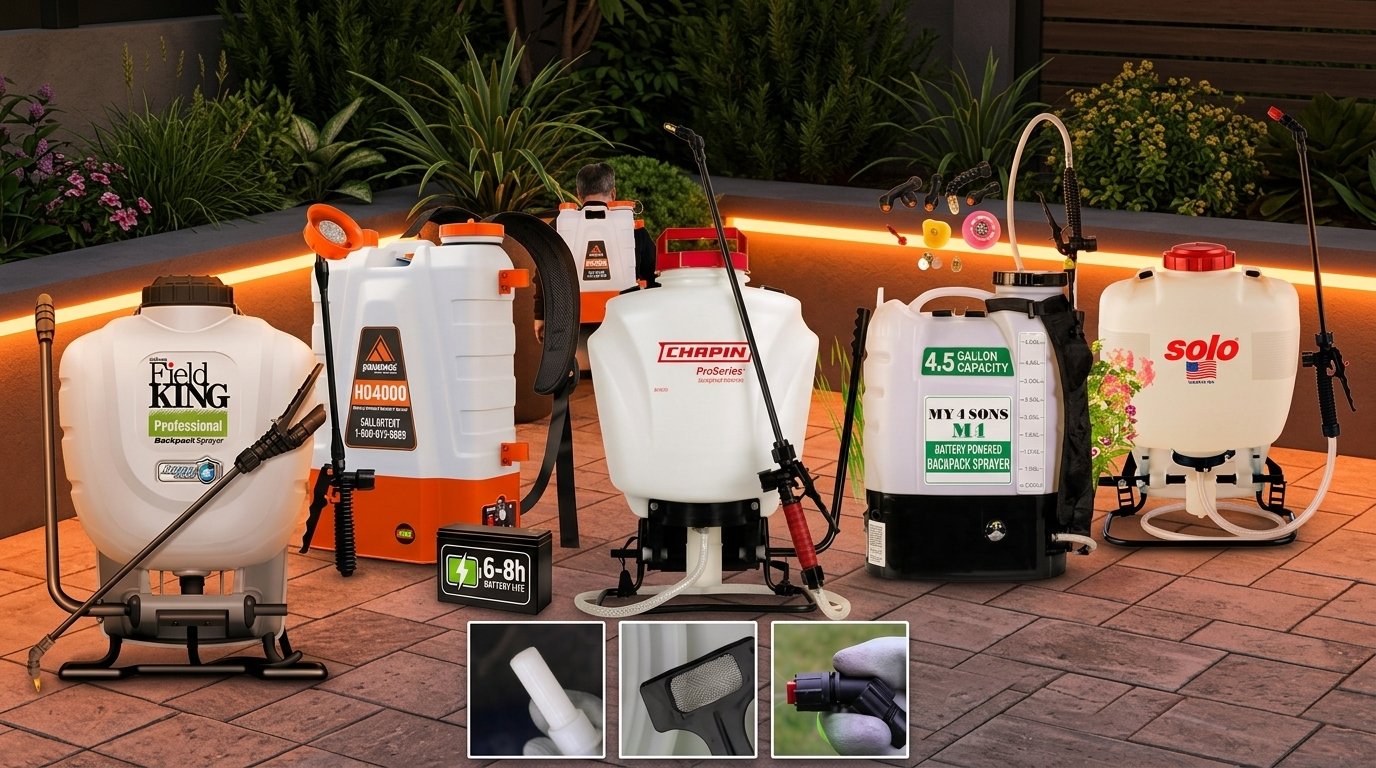
The category is wider than it first appears, though. Some models are pumped by hand and others use a rechargeable battery. Some prioritize filtration, some prioritize sealing, and some are built around a heavier frame meant to last through seasons of rough handling. The five sprayers here come from different manufacturers and take different approaches to the same task. All five are four gallon units, so tank size will not be the thing that separates them. Pumping method, pressure behavior, nozzle choices, and how the weight sits on your back will.
Our Take
The first question is whether you want to pump or not. A manual sprayer asks you to work the handle at intervals while you spray, and that rhythm becomes second nature quickly. For a half acre of garden beds, a few fruit trees, or an afternoon of spot treating weeds around outbuildings, it is a perfectly sensible way to work. The Field King, the Chapin, and the SOLO all fit this pattern. Manual pumps have fewer parts that can fail, nothing to charge, and nothing that goes flat before a job is finished. They also ask for a steady left arm or right arm, depending on how you set the handle, and the work gets tiring over a long session.
An automatic pump changes that equation. The PetraTools and the MY4SONS both use a battery to drive the pump, so the pressure stays consistent without you stopping to pump, and your attention can stay on coverage instead of on the handle. Over a large property or a long day, that consistency matters. It also reduces the common problem of uneven application that appears when pressure rises and falls with each stroke. The trade is a charger, a battery that needs attention between jobs, and a higher purchase price. Runtime figures from the manufacturers are useful for comparison, but they describe conditions that will not match every operator. Pressure setting, nozzle choice, and the kind of work all change how far a charge goes, so plan around the lower end of any advertised range.
Weight deserves more honesty than it usually gets. Four gallons of water weighs roughly thirty three pounds before you add the sprayer itself. SOLO lists the standard 425 at about eleven pounds dry and about forty three pounds when full of water, and the other four will land in a similar neighborhood in practice even though their weights were not supplied. Padded straps and a cushioned back panel make that load easier to tolerate, but they do not make it light. If you are covering ground on uneven terrain, climbing a slope, or working for an hour or more, you will feel the difference between a full tank and a half empty one. Filling the tank only as far as the job requires is a habit worth building, and it applies to every sprayer here.
The Field King and the Chapin illustrate two different ways of protecting the operator and the equipment. The Field King puts its attention on the pump, with an internal design meant to keep liquid from dripping down the back of the person wearing it. That matters because a leaky backpack unit is more than an annoyance when the tank holds a weed killer or a fungicide. The Chapin concentrates on what enters the system, using three stages of filtration to catch debris before it reaches the pump and the nozzle. One approach reduces the consequences of a leak, while the other reduces the odds of a clog. Neither one replaces good habits, and neither promises trouble free operation.
Pressure figures are easy to misread. A manual sprayer that reaches 150 PSI at its maximum is not meant to spray at 150 PSI, and the Field King makes that plain by regulating its working pressure to roughly 25 PSI. The SOLO can build up to about 90 PSI, but it does not include a standard pressure adjustment, so the operator relies on pumping technique and nozzle choice. The PetraTools offers a range of roughly 40 to 90 PSI, the MY4SONS goes up to 80 PSI with adjustable control, and the Chapin lists an operating range of about 40 to 60 PSI. Those numbers describe different things, and none of them says much about spray quality without the nozzle in the picture. A fine mist, a wide fan, and a solid stream each behave differently at the same pressure, and a lower pressure with the right tip will often do a better job than a higher pressure with the wrong one.
Chemical compatibility and cleaning round out the picture. Seals, hoses, and tank materials are chosen with certain products in mind, and manufacturers do not claim that every sprayer handles every liquid. MY4SONS, for example, states that the M4 is not compatible with muriatic acid. Always follow both the sprayer maker’s instructions and the label on whatever you are applying. After each use, rinse the tank, run clean water through the hose and wand, and clean the filters. Residue left to dry inside a pump or a nozzle is one of the most common reasons a sprayer starts performing badly, and it is entirely avoidable.
Field King 190328 Backpack Sprayer

- Internal No Leak Pump design is safer to use chemicals will not drip down your back. Internal piston pump delivers up to…
- Durable, 21 inch poly wand with the highest quality Viton seals can be used with Wet table powders and liquids for all a…
- Premium, lockable shut off with brass components and an in-line filter.
Anyone who has worn a leaking backpack sprayer remembers it. Liquid works its way past a worn seal or a loose fitting and runs down the spine, and what began as a routine job becomes something you want to end quickly. The Field King 190328 is built to avoid that scenario. Its No Leak Pump is an internal design, which means the pump sits inside the tank rather than attaching to the outside, so any weeping from the pump stays in the tank instead of reaching the operator. For people who spend long stretches with chemicals on their back, that arrangement is the most important thing about this sprayer.
It is also worth understanding how the 190328 handles pressure, because the numbers can mislead. The manual pump can reach up to 150 PSI, but that is a ceiling rather than a working setting. A built in regulator holds the pressure at about 25 PSI during continuous spraying, which is far more appropriate for most weed control and general property applications and helps produce a steadier pattern than an unregulated pump would. The practical benefit is less drift and less wasted product, along with a spray that does not change character every few strokes of the handle.
The shut off assembly uses brass components, includes an inline filter, and has a locking feature that lets you hold the trigger without gripping it constantly. Over a long afternoon that small detail saves a surprising amount of hand fatigue. The package includes six nozzle options, covering an adjustable brass nozzle, a high volume wide fan, a low volume wide fan, a low volume narrow fan, a jet stream, and a foaming nozzle, and the sprayer also accepts compatible TeeJet nozzles if you want to match a specific tip to a specific task. The wand measures 21 inches and the hose runs 50 inches, enough reach to get under shrubs or along a fence without bending constantly.
Maintenance is more forgiving than on many manual units. The pump uses Viton seals that can be replaced without tools, so a worn seal becomes a quick fix instead of a shop visit. Internal paddles keep suitable mixtures and wettable powders moving as you work, and the handle can be set up for left or right hand operation. This is a manual sprayer from end to end, with no battery involved, and it suits people who want a dependable, repairable tool for regular property work rather than the convenience of an automatic pump. The manufacturer provides a one year limited warranty.
PetraTools HD4000 Battery Powered Backpack Sprayer

- 6-8 Hours Long Battery Life: No more pumping with the HD4000 battery powered sprayer! The 12V8AH battery pumps 200+ gall…
- American Family-Owned & 24/7 USA Support: Since 2019, PetraTools has been turning customers into fans with the durable, …
- Double-Padded Straps and Back Pad for Maximum Comfort: Whether you’re a professional or a DIY homeowner with large lawns…
The appeal of the PetraTools HD4000 is easiest to appreciate in the middle of a long job. With a manual sprayer, your arm sets the rhythm, and you pause to pump whenever the pressure sags. With the HD4000, a battery driven pump maintains pressure automatically, and you simply squeeze the trigger and walk. That frees your attention for covering ground evenly and checking what you have already treated. For regular work on a large yard, a hobby farm, or a long fence line, that difference adds up.
The version covered here is the basic HD4000, which uses a rechargeable 12V 8Ah lead acid battery. PetraTools advertises roughly six to eight hours of runtime and more than 200 gallons of spraying per charge, and those figures are best read as a favorable estimate. Pressure setting, nozzle choice, ambient conditions, and how much of the time you spend with the trigger open will all shift the result, so an operator running at the higher end of the pressure range with a heavy nozzle should expect less. The practical habit is to charge the battery after every working session instead of waiting until it runs flat, since a battery that is left depleted is a battery that disappoints you later.
Adjustable pressure, from about 40 to 90 PSI, gives the sprayer more range than most manual units. Lower settings suit light applications and fine patterns, while higher settings help when you need more reach or more force. Six nozzle options are included, offering shower, adjustable mist to stream, double mist, single mist, flat fan, and brass patterns, so the same sprayer can move between garden beds and fence line work without any additional purchases. The translucent tank carries gallon markings, which makes it easy to see how much liquid remains, and the wide mouth opening simplifies both filling and cleaning. A screen filter and a locking spray handle round out the practical details.
The carrying system uses double padded shoulder straps and a cushioned back pad, and the extendable HD wand reaches approximately 34.5 inches with a 4 foot hose. The package includes the battery, charger, measuring cup, hose, wand, and six nozzles. A full tank on your back is still a full tank, and the battery adds its own weight, so this is not a sprayer that removes the physical effort of the task. What it removes is the interruption. One caution about shopping: this listing represents the basic HD4000, and the Pro bundle, wheeled cart package, and other configurations include different hoses, wands, and nozzles that do not belong to it.
Chapin 61800 ProSeries Backpack Sprayer

- Designed for homeowners and professionals: save time during lawn care with a large 5.25‑inch tank opening and built‑in f…
- Versatile spray options: handle weed control, pest treatments, and general lawn care using three included nozzles – bras…
- Reliable performance: keep spraying with fewer interruptions thanks to a 3‑stage filtration system that helps prevent cl…
Clogged nozzles are among the most irritating problems in sprayer work, and they usually trace back to something small. A grain of sediment, a fleck of plant matter, or an undissolved particle from a mixture can stop the flow and force you to break down the tip in the middle of a job. The Chapin 61800 is designed around that reality, and it treats filtration as the central feature instead of an afterthought.
The system works in three stages. A filter basket sits at the tank opening, which is about 5.25 inches across and wide enough to fill and inspect comfortably. A removable filter sits inside the tank, and a third removable filter lives in the shut off assembly. Each stage catches finer debris than the one before, and together they keep a good share of what could otherwise reach the pump and the nozzle from doing so. That does not mean the sprayer will never clog, and anyone who tells you any sprayer is immune to clogging is overselling. What it does mean is that you have more places to catch the problem and more filters you can pull and clean, which turns maintenance into a routine rinse instead of a teardown. Cleaning those filters regularly is part of owning this sprayer, and it is the habit that gets the most out of the design.
The 61800 is a manual sprayer, and its professional character comes from construction rather than power. The tank is chemical resistant polyethylene holding 4 gallons, the seals are described by the manufacturer as suitable for common fertilizers, weed killers, and pesticides, and the operating pressure is listed at roughly 40 to 60 PSI with a flow rate near 0.4 to 0.5 GPM. That is a working range well suited to landscape and property maintenance, and it reflects a sprayer meant to be used repeatedly rather than occasionally. The pump handle can be repositioned for left or right hand use, and the padded, adjustable shoulder straps help distribute the load.
Three nozzles come with the package, an adjustable brass cone, an adjustable poly cone, and a poly fan tip. That set is modest compared to some of the other sprayers here, but it covers the common tasks of broadcasting liquid fertilizer, spot treating, and covering broader areas. The 20 inch poly wand and 48 inch reinforced hose give reasonable reach, and the shut off assembly has a cushioned grip and a locking feature that makes longer sessions easier on the hand. For someone who sprays often, uses mixtures that can leave residue, and wants a manual unit built with care, the Chapin makes a persuasive case.
MY4SONS M4 Battery Powered Backpack Sprayer

- 12V POWER SYSTEM FOR STEADY SPRAY PERFORMANCE: The MY4SONS M4 Backpack Sprayer is powered by a 12V 8Ah sealed lead-acid …
- FULL BACKPACK SPRAYER KIT WITH ACCESSORY SET: Our backpack sprayer includes everything needed for professional and home …
- ADJUSTABLE PRESSURE CONTROL SPRAY SYSTEM: Easily control output with a rotary switch pressure adjuster ranging from 20 P…
The MY4SONS M4 sits at the premium end of this group, and its case rests on how it feels to use across a large area. An automatic pump holds pressure without any effort from your arm, and the pressure itself is adjustable up to 80 PSI. Compared with a manual piston or a lever style pump, the experience is different in a way that is hard to appreciate until you spend an hour with each. You are not counting strokes or pausing to bring the pressure back up. You are simply moving along the work, adjusting the pressure when the nozzle or the job changes.
The selected basic M4 uses a rechargeable 12V 8Ah battery. The manufacturer’s FAQ points to roughly four to five hours of operation on a full charge under its stated conditions, which is a more conservative figure than some competitors advertise and probably a more useful one for planning. Real results depend on how you use it, so the sensible assumption is a working day with a charge before and after, not an open ended supply. The translucent tank has a wide mouth opening and a screen filter, and the lid uses a watertight neoprene seal, which matters when you are walking with several gallons sloshing behind you.
Where this sprayer pulls ahead is in its reach and versatility. The listing describes a reinforced 5 foot PVC hose, a stainless steel wand adjustable from roughly 24 to 48 inches, and a second plastic wand of about 24 inches. Two wands make the M4 comfortable in different situations, with the longer adjustable one suited to fence lines, brush, and taller plants, and the shorter one useful close to the ground or in tight beds. The nozzle set includes adjustable brass, fan, cone, mist, and shower patterns. The carrying design adds padded shoulder straps, and the controls include a locking trigger, accessible on and off switches, and battery status indicators so you can see what the charge looks like before it surprises you.
The cost, the charging routine, and the weight of a full tank are the honest limits. MY4SONS also offers optional upgrades and accessories, including some that are not part of the basic listing, so a buyer should confirm exactly what arrives rather than assuming every manufacturer option is included. The manufacturer states that the M4 system is not compatible with muriatic acid, and as with any sprayer, the chemical label and the owner’s manual should guide what goes in the tank. A two year warranty from the manufacturer adds some confidence. For those who regularly cover larger areas and value consistency, this is the sprayer most clearly aimed at them.
SOLO 425 Piston Backpack Sprayer

- Easily spray liquid disinfectants, fertilizers, herbicides, pesticides with Solo’s high-performance piston pump for tree…
- Solo’s 425 backpack sprayer includes a 20-inch unbreakable wand that securely connects to a 48-inch nylon-reinforced hig…
- Four easily changeable commercial-grade spraying nozzles-Plastic Adjustable, Fan Spray, Hollow Cone, Jet Stream nozzle a…
SOLO has built backpack sprayers for a long time, and the 425 reflects a preference for sturdiness over novelty. The most visible clue is the rugged metal frame. Plastic frames are lighter and cheaper, but a metal one handles the small abuses of real property work better, including setting the tank down on gravel, tipping it while filling, and dragging it across a truck bed. The frame also gives you something solid to grab when lifting a full unit onto your back.
The pump is a connecting rod actuated piston design that can reach up to 90 PSI. Piston pumps have a long reputation in this category, and they build pressure efficiently with each stroke of the handle, which can be an advantage when you want a strong jet or need to reach higher growth. There is one point that deserves care. According to the manufacturer’s specification page, the standard 425 has no standard manual pressure adjustment, so it should not be thought of as a sprayer with an adjustable regulator. Control over the pattern comes from your pumping rhythm and from the nozzle you choose, and that is a different style of working than the regulated sprayers here. The 425 Deluxe and 425 Professional versions are separate products, and their features should not be assumed to apply to this one.
Four nozzle types come standard, including a plastic adjustable, a fan spray, a hollow cone, and a jet stream, and the sprayer is compatible with TeeJet nozzles for those who want to tailor the setup. The pump handle can be switched between left and right hand operation, which is useful for operators who favor one arm. The wand is a 20 inch polypropylene unit, the reinforced high pressure hose measures 48 inches, and the shut off valve has lock on and lock off positions. Viton seals are used in key locations, and the tank is high density polyethylene with ultraviolet inhibitors, a sensible choice for equipment that spends time outdoors. The tank opening measures about 4.25 inches.
Weight is where the 425 teaches its lesson. The manufacturer lists about eleven pounds dry and an average of about forty three pounds when filled with water. That is a lot to carry across rough ground, and it is a good reminder that a four gallon tank becomes demanding over time regardless of the brand. Consider filling it partway for long walks or hilly terrain. SOLO provides a one year warranty on the standard 425. For someone who wants a traditional, durable piston sprayer and is comfortable managing pressure by hand, it remains a reasonable choice.
Conclusion
Choosing a backpack sprayer starts with an honest estimate of how much work you actually do. If you treat a garden, a few fruit trees, and the occasional patch of weeds, a manual sprayer is usually enough, and it avoids the cost and the charging routine of an electric model. Its simplicity is a real advantage, especially for people who spray a handful of times each season and want something that will be ready when they pull it off the shelf. The Field King, the Chapin, and the SOLO each suit that kind of use, and the differences between them come down to what you value most, whether that is a pump that keeps liquid off your back, a filtration system that guards against debris, or a sturdy frame and a classic piston pump.
If you are treating larger areas often, such as acreage, long fence lines, or several outbuildings worth of perimeter, the case for an electric pump gets stronger. The PetraTools and the MY4SONS take the repetitive pumping out of the job and keep pressure steady across a long session. That convenience has a price, and it comes with a battery to maintain and a charger to remember. Think about how often you will spray, how long each session will last, and whether you will realistically keep the battery charged. A sprayer you dread preparing is a sprayer that stays in the shed.
Whatever you choose, give weight and comfort the attention they deserve. Try to imagine the full tank on your shoulders after an hour of walking, and consider whether you will fill it completely or only partway. Look at nozzle versatility in terms of the jobs you actually have, and treat pressure numbers as one piece of information rather than a score. Pair your sprayer with the other equipment on your property, too. The same acreage that calls for a backpack sprayer may also benefit from small rotary tillers for backyard gardens and small farms, and fence work often leads naturally to post hole diggers for fences, trees, and tough soil. If you also maintain a gravel drive or graded pad, tractor box blades for grading, leveling, and driveway maintenance belong in the same conversation about practical property equipment.
The best backpack sprayer is rarely the one with the highest pressure rating or the longest list of features. It is the one that fits the size of your property, the chemicals you use, and the way your back and shoulders handle a long day. Rinse it after every use, clean the filters, follow the labels, and it will keep doing quiet, useful work for years.