Small Rotary Tillers for Backyard Gardens and Small Farms
How corded, cordless, and gas-powered garden tillers differ, and which one fits your soil, your layout, and your property.

Every spring, the same question comes up in backyards across the country. The soil has been sitting through winter, packed down by rain and snow, and the vegetable bed needs to be loose enough for roots to travel. A shovel and a garden fork can handle a small raised bed, but they become a long weekend of sore shoulders once the plot grows to a few hundred square feet. A full-size tractor with a tractor-mounted implement is far more machine than a family garden or hobby homestead needs. A small rotary tiller fills that gap, giving property owners a way to turn soil, work in compost, and prepare planting rows without renting heavy equipment or hiring it out.
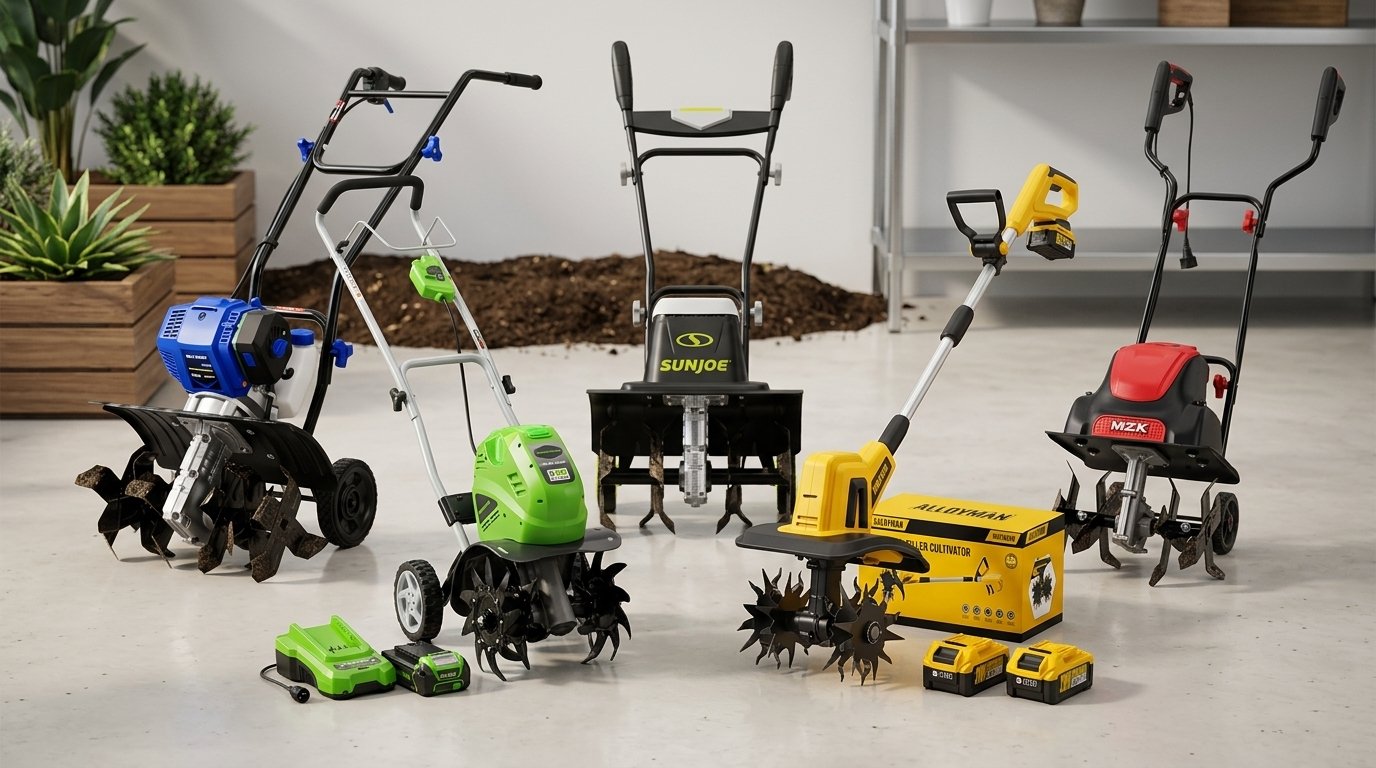
The category has also split into distinct camps. Corded electric models offer steady power and little maintenance, provided the outlet is close enough. Cordless garden tillers remove the cable entirely and trade it for battery limits. Small gasoline machines give the most independence and working width in this group, with a mechanical routine that some owners welcome and others would rather avoid. The five machines below cover all three approaches, and the right choice has more to do with your ground and your habits than with any number on a box.
Our Take
Before looking at individual machines, it helps to be honest about what this class of equipment can and cannot do. A small garden tiller is a soil preparation tool for ground that has already been worked, or for modest breaking of soft, workable earth. It is not a substitute for a tractor-mounted rotary tiller, and the spec sheets on compact machines should be read with that in mind. Maximum depth figures describe what a machine can reach under favorable conditions, not what it will deliver in dry clay, root-filled sod, or a patch of rocky fill.
That distinction between cultivating and tilling matters more than most buyers realize. Manufacturers often use the words loosely, but a lightweight cultivator is meant to stir the top few inches, break up crusted surface soil, mix in amendments, and keep weeds down between rows. Deep primary tillage, which means opening up ground that has never been cultivated or has been compacted for years, asks much more of an engine or motor and of the machine’s weight. Compact machines can sometimes manage it in stages, with several shallow passes, but a buyer who expects a lightweight cordless unit to chew through a neglected lawn in one afternoon will be disappointed. Soil moisture plays a role too. Ground that is too wet clumps and smears, and ground that is bone dry can bounce a light machine across the surface.
Power source is the next question. A corded electric tiller delivers consistent output as long as it is plugged in, starts with a switch, and asks for almost no upkeep. Its limits are practical ones: an extension cord of the right gauge, an outlet within reach, and constant attention to where the cord lies so you do not run over it. Cordless machines solve that problem and are easy to carry around raised beds and fences, but runtime is finite. Battery capacity, soil resistance, and how hard you push the machine all affect how long a charge lasts, so advertised runtime is best treated as a ceiling. Gasoline machines are free of both constraints, though they bring fuel, oil, spark plugs, air filters, off-season storage, vibration, and noise into the picture.
Working width deserves some skepticism as well. A wider path covers more ground per pass, which is a real advantage in an open rectangular plot. In a garden with narrow rows, tight spacing, or established beds, a wider machine can become an annoyance, forcing awkward turns or trampling plants you meant to protect. A 9-inch path can sit comfortably between rows where a 16-inch machine simply will not fit. Match the width to the layout, not to the biggest number available.
Finally, keep the larger picture in mind. If your plans extend past a large garden toward pastures, food plots, or ground measured in acres, a standalone tiller becomes the wrong tool. Haulizo’s New Holland Workmaster 25S review looks at what a compact tractor offers once a property outgrows hand-guided equipment, and the machines below are best understood as the step before that point.
Sun Joe TJ604E Electric Garden Tiller

- Powerful Electric Tiller: Electric rototiller with a 13.5-amp motor easily tills up to 16 inches wide and 8 inches deep …
- Durable Steel Tines: This corded electric tiller features 6 rust-proof, steel-angled tines for long-lasting performance …
- Compact and Convenient: This small garden tiller with a folding handle ensures easy storage and transport for gardeners …
The Sun Joe TJ604E is a corded electric machine built around a 13.5 amp motor, a 16-inch working width, and a maximum tilling depth of up to 8 inches. It uses six steel tilling tines and weighs about 26.5 pounds, which places it among the lighter machines that still offer a generous working path.
That combination of width and modest weight suits the homeowner who keeps a vegetable garden of moderate size and wants to prepare it each season without much fuss. A 16-inch path covers a bed quickly, and the stated depth is enough to blend compost into soil that has been worked before. Because it is corded, the motor does not fade the way a battery does. It will keep running as long as you have a power source, and for a gardener with an outdoor outlet near the plot, that means no charging schedule, no fuel can, and no pull cord.
The cord is the trade. Anyone who has worked in a garden with an extension cord knows how easily it snags on stakes, fencing, and plant edges, and tilling in a loop means constantly repositioning it behind you. A long run of cord also needs to be of suitable gauge for the motor, so it is worth checking the manufacturer’s guidance before buying one off the shelf. Within a garden close to the house, though, the cord is a manageable inconvenience in return for dependable power and low upkeep.
Compared with the cordless machines below, the TJ604E offers more width and more stated depth. Compared with the gasoline model, it asks less of its owner mechanically but gives up the freedom to work far from an outlet. It makes the most sense for a medium backyard garden on workable soil, where consistent power matters more than mobility. As with every machine in this group, the 8-inch depth figure should be read as a maximum under good conditions rather than a promise for stubborn ground.
Greenworks 40V 10-Inch Cordless Tiller

- 40V TILLER / CULTIVATOR – provides the power you need to break up hard, compact soil into loose, broken-up dirt that can…
- PERFECT FOR YOUR GARDEN – Up to 45 minutes of run-time on a fully charged 4.0Ah battery. The battery completely charges …
- LIGHTWEIGHT / EASY TO USE – 6” rear wheels for maximum maneuverability around the garden
The Greenworks 40V 10-Inch Cordless Tiller drops the cord completely. The package selected for this article includes a 4.0Ah battery and charger, and the working width adjusts from 8.25 to 10 inches. Maximum tilling depth is approximately 5 inches, and the advertised runtime is up to 40 minutes.
The appeal here is mobility. Anyone who has tried to till inside a raised bed, along a fence line, or between rows of established plants understands how much a trailing cord complicates the job. With no cable to manage, you can step from bed to bed, work in the far corner of a lot, and put the machine away without coiling anything. The adjustable width, which narrows to 8.25 inches, is useful in tight rows where a larger path would be intrusive.
Battery runtime is the practical consideration. Forty minutes is a useful working window for a few raised beds or a modest vegetable plot, but it is an advertised figure, and real runtime will shift with soil conditions and how hard the machine is working. A gardener tilling loose, previously cultivated soil will likely see better results than someone breaking into firm ground. Anyone planning a large garden should think of this tool as a task machine for individual beds and plan around charging time, or accept that one battery will not finish every job in a single stretch.
The 5-inch maximum depth is also the shallowest in this lineup, which shapes its role. It is well suited to refreshing soil in established beds, blending amendments, and preparing seedbeds, and it is less suited to opening up compacted ground. Compared with the corded Sun Joe, it gives up width and depth for freedom of movement. For small gardens where convenience matters and soil is already in decent shape, it is a sensible choice.
Alloyman 20V Cordless Garden Tiller

- 【CORDLESS CONVENIENCE】Are you annoyed that a power outlet isn’t always near work? Don’t worry. The Alloyman electric til…
- 【POWERFUL & EFFICIENT】The tiller cultivator is equipped with 4 durable steel tines and operates at speeds up to 360RPM, …
- 【COMFORTABLE ERGONOMIC DESIGN】This garden tools is very lightweight, easy to operate and carry. The auxiliary handle of …
The Alloyman 20V Cordless Garden Tiller is another battery-powered option, with a working width of approximately 9 inches and a maximum working depth of approximately 6.6 inches. It includes two 4.0Ah batteries and advertises a rotation speed of approximately 360 RPM.
Its narrow 9-inch path is the main story. In a vegetable garden with closely spaced rows, that width lets you work between plants or along a single planting line without disturbing neighbors. It also makes the machine a good fit for confined beds, where a 16-inch tiller would be impossible to turn. Gardeners who plant intensively, or who maintain several small beds rather than one large plot, may find that this tight footprint is exactly what they need.
The second battery is worth noting as a practical matter. A spare pack means you can swap one in rather than stopping to recharge, which stretches the amount of ground you can cover in a session. Even so, battery capacity, runtime, and soil conditions all work together here. A lightweight cordless machine can struggle in heavily compacted or previously uncultivated ground, and the Alloyman is no exception to that rule. It is best understood as a tool for targeted soil preparation, loosening ground that is already workable and mixing in amendments, rather than for turning raw earth.
Set beside the Greenworks, the Alloyman offers slightly more stated depth and a spare battery, while running on a lower voltage platform. Both cordless machines fit similar jobs, and the better choice may come down to which battery arrangement and working width suit your beds. For a small, carefully laid out garden, the Alloyman’s narrow path is a genuine strength.
BILT HARD 46cc Gas-Powered Garden Tiller

- Powerful 46cc 4-Stroke Engine: Powered by a 46cc four-cycle gas engine with maximum power of 1,400W and a blade speed of…
- Up to 7.84-inch tilling depth: With a maximum tilling depth of 7.84 inches (200 mm), this gas-powered garden cultivator …
- Adjustable Working and Transport Wheels: The adjustable wheels offer two positions for working and transport. Select the…
The BILT HARD 46cc Gas-Powered Garden Tiller is the one machine here with an internal combustion engine. It uses a 46cc four-stroke gasoline engine with advertised output of approximately 1.9 horsepower, a working width of 16 inches, and a maximum tilling depth of up to 8 inches. It also has adjustable wheels, a folding handle, and rotating tilling tines.
A small gasoline tiller differs from the electric and battery models in several ways. It is not tied to an outlet or a charge, so it can work anywhere on the property, including far corners and back plots that no extension cord would reach. That independence appeals to owners with larger backyard gardens, or to anyone who simply prefers a gas-powered machine and is comfortable with the routine that comes with it. The adjustable wheels help with transport and positioning, and a folding handle makes storage easier in a shed or garage, which matters because a gas engine needs somewhere dry to live.
Ownership asks more of you. A four-stroke engine needs fuel, oil, and periodic attention to air filters and spark plugs. Fuel left in the tank over winter can cause starting problems, so off-season storage deserves a plan. A gasoline engine is also louder than an electric motor and transmits more vibration through the handles, which becomes noticeable over a long session. Neighbors may notice the sound too.
It is important to keep expectations grounded. At 46cc, this is a compact homeowner machine, not a commercial agricultural tiller, and it is not appropriate for large farming operations. Its natural audience is the gardener whose plot has grown past what a corded or battery machine handles comfortably. Compared with the Sun Joe, it matches the 16-inch width and 8-inch stated depth, but adds the ability to work away from power in exchange for maintenance. For a larger backyard garden, that bargain can be worth it.
MZK 12-Inch 10.5A Electric Garden Tiller

- [Efficient Digging Power]:With a 12-inch cutting width and 8-inch digging depth, MZK electric tiller is perfect for brea…
- [Strong Motor and High-Speed Efficiency]:Featuring a powerful 10-amp pure copper motor and 430 RPM, MZK tiller for garde…
- [Low Maintenance, High Efficiency]:The MZK electric tiller is incredibly easy to use—just plug it in and get started. No…
The MZK 12-Inch 10.5A Electric Garden Tiller is a compact corded machine with a 10.5 amp electric motor, a 12-inch working width, and a maximum tilling depth of up to 8 inches. The listing does not supply further detail, so this review stays within those figures.
The 12-inch width sits between the narrow cordless machines and the 16-inch models, and that middle position is the point. It is wide enough to cover a garden bed in a reasonable number of passes, yet narrow enough to maneuver between planting areas and around established layouts. In a garden with defined paths and moderately spaced rows, a 12-inch swath can be easier to steer than a wider machine, and it leaves less room for error near plants you want to keep.
As a corded electric model, it shares the strengths and limits of the Sun Joe: steady power from an outlet, low maintenance, and a cord that must be managed. It carries a lower amp rating than the Sun Joe’s 13.5 amps, which is a reminder that machines in this class are matched to relatively light work. The stated 8-inch depth is a maximum, and soil conditions will determine how much of it you actually get. Soft, well-worked soil will respond far better than hard, rocky, wet, or compacted ground, and no machine in this lineup should be assumed to handle all of those equally.
Compared with the other four, the MZK is the one to consider if your garden is small, your layout is tight, and you have outlet access. It is the sort of tool that rewards matching it to real conditions instead of chasing the biggest specification. For a homeowner maintaining a handful of vegetable beds close to the house, that practical fit may matter more than raw width.
Matching the Machine to the Ground
The five machines here share a size class, but they point to different kinds of properties. A gardener with an outlet near the plot and a medium vegetable garden may be well served by a corded electric model, while someone working tight raised beds and fence lines will appreciate the freedom of battery power. A larger backyard plot, or one far from the house, may justify the maintenance that comes with a small gasoline engine. None of these is the universally correct answer, and the best choice depends on what your land actually looks like.
Start with the ground itself. Soil that has been cultivated for years and stays loose is the easiest case for any compact machine. Heavily compacted, rocky, or never-worked soil is a different problem, and expecting a light tiller to solve it in one pass is how people end up frustrated. Be realistic about moisture as well, since timing your work for soil that is neither soggy nor rock hard makes more difference than any specification.
Think also about scale. A homeowner preparing a few vegetable beds has very different needs from someone trying to work several acres of agricultural land. If your ambitions have grown beyond a garden, the answer is probably not a bigger tiller but a different class of equipment altogether. Haulizo’s Kubota BX23S review and Massey Ferguson 1GC.25 review are good places to see what compact tractors offer when a property calls for implements rather than hand-guided machines.
For most backyard gardens and small homesteads, the better strategy is to buy what fits. A machine that matches your garden’s width, your access to power, and your tolerance for maintenance will get used season after season. A more powerful machine that is awkward to store, tiring to handle, or too wide for your beds will sit in the shed. In small-scale gardening, the right-sized tool beats the most powerful one nearly every time.