Five Post Hole Diggers for Fences Trees and Tough Soil
Gas and electric augers compared by bit size, reach, and the soil you actually have

Picture a property owner with a quarter mile of new perimeter fence, a stack of treated posts on a trailer, and a weekend to get the line set before rain moves in. A manual clamshell digger turns the first dozen holes into a slow lesson in wrist strain and sore shoulders. By the fortieth hole, the spacing has drifted and the depth is inconsistent. The whole job starts to feel like punishment.
That scenario repeats across hobby farms, pastures, orchards, and suburban lots. Posts for fences, gates, and pole structures all need holes with predictable depth and width. Trees and shrubs need planting holes sized for the root ball. Even a small deck footing or a mailbox post benefits from a clean, vertical hole. Powered augers exist because repetition, not any single hole, is what exhausts a person.
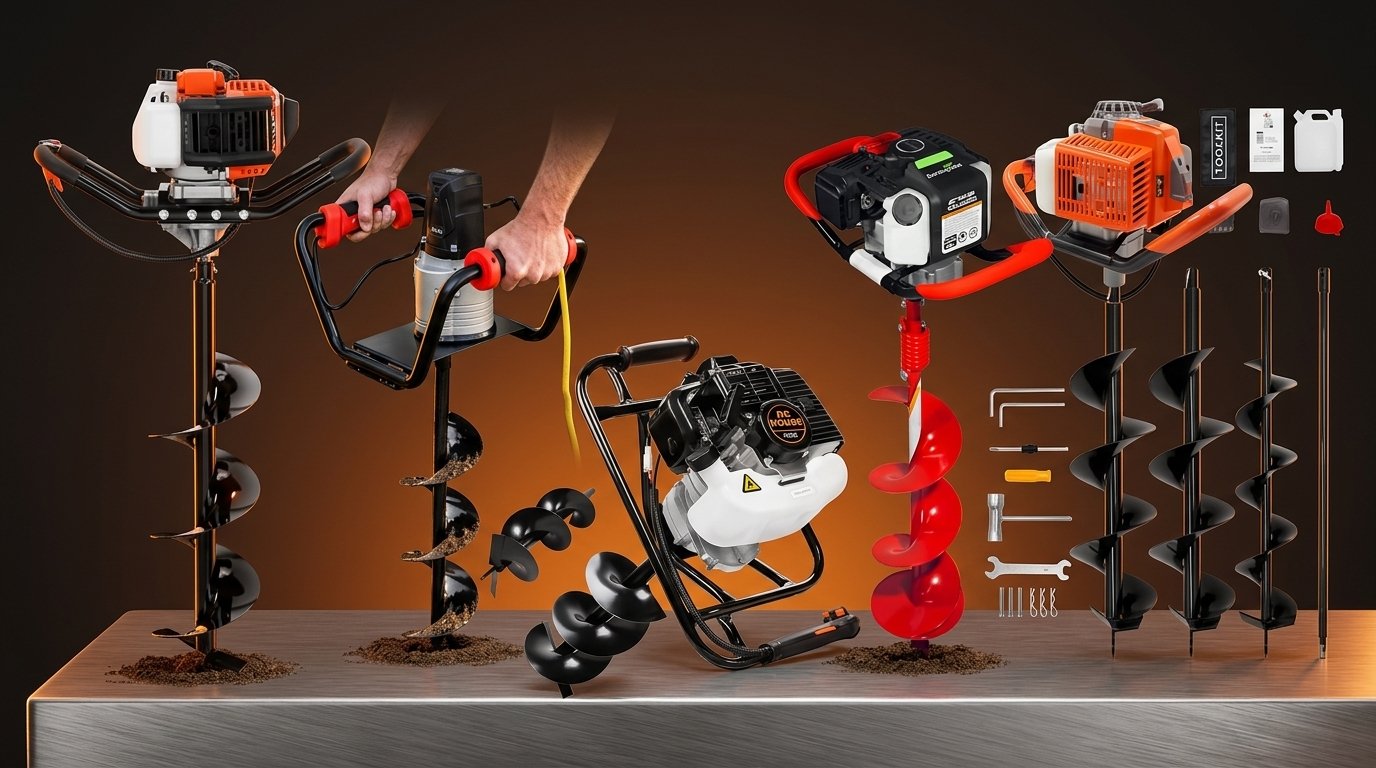
The post hole diggers covered here are portable machines. Each carries its own engine or motor, and one person can handle them on foot. That makes them a different proposition from the larger digging attachments some farms run, and a different budget conversation as well. The five below differ in power source, bit size, included accessories, and the kind of work they seem built for.
Our Take
Most buyers shop engine displacement first, and that is the wrong place to start. A bigger number on the spec sheet says little about whether a machine will dig the hole you actually need. The more useful questions are how wide, how deep, in what soil, how many times, and with what power available at the site.
Auger diameter comes first because it defines the job. A 6-inch bit suits many fence posts and small plantings. An 8-inch bit gives more room around a larger post or a modest tree. A 10-inch bit moves into planting work where the hole has to accommodate a real root ball. A wider bit also asks more of the machine and the operator, because the torque reaction when the flights bite is stronger. Digging depth matters just as much. Most portable augers are sold with a bit around 30 inches long, which covers many fence applications but leaves little margin for deep corner or gate posts unless an extension is added.
The power source splits the group in two. Gasoline machines are mobile, which matters on a pasture fence line a long way from any outlet. They also bring fuel mixing, spark plugs, air filters, and winter storage habits. Electric machines remove all of that and start with a switch rather than a pull cord. Their limit is the tether. You need a power supply near the work, and the extension cord you use matters for how the motor performs. For a backyard planting project, electric is often the calmer choice. For open ground far from a building, it becomes a logistics problem.
Operator control deserves more attention than it gets in most roundups. An auger can grab on a buried rock or root and twist the powerhead hard against the operator’s wrists. Handle design, vibration damping, throttle placement, and a reliable stop switch all influence how safely a machine handles that moment. Gearbox construction affects longevity more than the engine does, since the gearbox absorbs the shock when the bit stalls. Soil is the final variable. Loose loam, sandy ground, and moist garden soil let any of these machines work as intended. Dry clay, compacted fill, gravelly ground, and root-heavy areas slow every auger down, and none of them can promise to cut through large rock or thick roots without trouble. Probing the line with a digging bar before you commit saves time.
Property owners who already run a compact tractor, such as the one in our John Deere 1025R review, sometimes assume an auger must be an implement. These five are not. None is a three-point hitch or PTO attachment, and none connects to a tractor in any way. They are standalone tools meant to be carried to the hole.
VEVOR 43cc Gas-Powered Post Hole Digger: A Long Bit With Room to Spare

- Powerful Engine: VEVOR Fuel-powered Auger features a 43CC powerful engine with a maximum rotational power of 9350RPM. Th…
- Sturdy & Durable: The drill bit is made of alloy steel with a powder-coated surface, providing excellent corrosion resis…
- Efficient Operation: Equipped with a 1.2m thickened pull cord, which is 1/2 longer than a regular pull cord, making it e…
The VEVOR is built around a 43cc gasoline engine that the listing rates at 1250 watts, with a maximum engine speed of 9,350 RPM. That last figure describes the engine, not the auger. The gearbox reduces the speed substantially, so the bit turns far slower than the crankshaft, which is exactly what you want for biting into soil. It is worth keeping that distinction in mind when comparing spec sheets from different brands.
The included auger is an 8-inch alloy steel bit measuring 30 inches long. That diameter is generous for a machine in this displacement class and suits larger fence posts, small trees, and shrubs where the hole needs some breathing room. Whether 8 inches is the right size for your post depends on the post itself and on how much backfill you want around it. A wider hole also means more soil to move and more resistance, so a bit this large rewards workable ground and not much else.
Fuel capacity is a quiet strength here. The tank holds 1.2 liters, about 0.3 gallon, which is useful when you are working down a line of holes and do not want to refuel constantly. The listed mixing ratio is 40:1, and as with any two-stroke, it is wise to confirm the figure in the owner’s manual before the first fill. The listing describes a gearbox with ball bearing shafts and alloy gears, a welded steel handle structure, shock absorbing foam grips, and a reinforced pull cord about 1.2 meters, or roughly 4 feet, long. An emergency stop switch sits on the handle, which is the sort of detail you appreciate only when something goes wrong.
The package is practical rather than flashy: the main unit, the 8-inch bit, a spare spark plug, an oil mixing bottle, and a tool kit. The listing states the machine is EPA certified. This one suits an owner who wants a single bit size and a fair amount of reach, mostly for fence work in reasonably cooperative soil.
XtremepowerUS 1500W Electric Post Hole Digger: The Plug-In Option
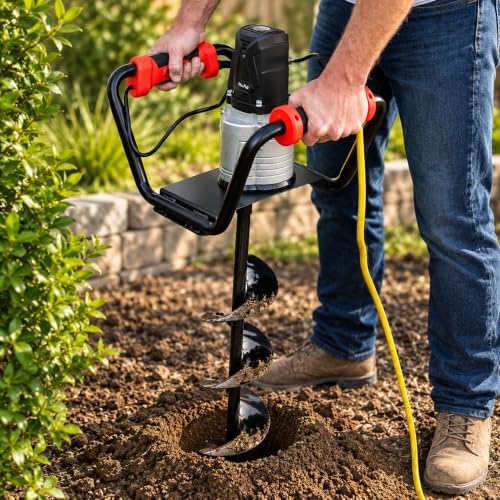
- HOLE DIGGER MACHINE – Perfect for installing fence post, deck, planting tree and many other lawn applications and even i…
- SAFETY LOCK – Powerhead is equipped with a safety lock function that prevents any accidental triggering for added securi…
- STRONG & DURABLE -The auger drill bit is made of high strength manganese steel, well withstand impact, extrusion, materi…
The XtremepowerUS Model 85060 is the odd one out in this group, and the difference is real. It is an electric machine with a 1500-watt motor rated at 10.9 amps, and it has no engine at all. That means no fuel can, no mixing, no spark plug, no carburetor, and no pull cord. You plug it in and squeeze.
The listing advertises 90 foot pounds of torque, a figure that should be read as a marketing claim rather than a guarantee of field performance. What the specification does tell you is that the motor is intended to deliver steady rotational force without the throttle variability of a small engine. The included bit is 6 inches in diameter with an advertised digging depth of about 28 inches, made from manganese steel on a 3/4 inch shaft. That puts the machine squarely in fence post, small shrub, and general landscaping territory. It is not the tool for large tree holes.
Control is where the design makes its case. The powerhead has a safety lock to prevent accidental activation, and the two handles carry anti-skid, vibration reducing grips. For someone digging in a yard, near a house, or around a garden, that kind of predictable behavior counts for more than raw size. Electric operation is also quieter than a two-stroke screaming at full throttle.
The honest limitation is power access. The listing does not state a cord length or operating voltage, so a buyer should check those details before purchase and plan on a suitably rated extension cord. A machine like this is at its best within reach of an outlet or generator. On a distant pasture line, it asks for infrastructure that a gas machine simply carries on its back.
DC HOUSE 52cc Gas-Powered Earth Auger: Two Bits, One Powerhead

- EPA Certified – The powerful 52CC engine is EPA-certified to ensure safety and environmental protection.
- Main Parameter – Engine: Single Cylinder,2-stroke, air-cooled;2 Cycle Oil/Gasoline Mixing Ratio:1:25; Safety: Bit Lock; …
- Comfortable to Operate – 1. Manual recoil easy start. 2. Ergonomic butterfly handles. The post hole digger auger is comf…
The DC HOUSE earns its place through versatility. The powerhead is a 52cc single-cylinder, two-stroke, air-cooled engine rated at 1800 watts, or 1.8 kilowatts, with a stated engine speed of 8,000 RPM. The listing identifies EPA certification. Two bits come in the box, a 6-inch and a 10-inch, both on a standard 3/4 inch shaft, with a maximum digging depth of about 2.6 feet using a single bit.
Having two diameters changes how the machine fits a property. The 6-inch bit handles narrower holes for slimmer posts and small plantings. The 10-inch bit opens the door to wider planting holes and larger post setting, which is the sort of work where a single small bit forces a lot of back and forth. The bits use alloy steel blades with screw style cutting tips, which help the auger start and pull itself into the ground. A buyer who wants a single machine for both fencing and planting will see the value here, provided the bigger bit is matched to the soil. A 10-inch bit in dense ground needs more from the engine and the operator than the same engine turning 6 inches.
The mechanical layout includes a recoil starter, a centrifugal clutch, a carburetor with a fuel pump, and a safety bit lock. The centrifugal clutch matters more than it sounds. It disengages the drive at idle so the bit is not spinning while you reposition. Butterfly style handles give the operator a wide grip, and a translucent fuel tank makes it easy to see how much mixture remains.
One caution deserves plain words. The listing is inconsistent about the gasoline to oil mixing ratio, giving different figures in different places. A buyer should not settle that question from the listing. Confirm the correct ratio in the operating manual that ships with the machine before the first tank is mixed, because the wrong ratio is an easy way to damage a two-stroke. This auger does not turn rocky or root filled ground into easy digging, and the 10-inch bit in particular will find those limits quickly.
Earthquake E43 1-Person Earth Auger: Built Around the Gearbox

- RELIABLE & POWERFUL: Outstanding power, durability and efficiency from a 1-man earth auger. Industrial air filtration ke…
- DURABLE & TOUGH: The Powerhead is lightweight yet built with heavy-duty construction using steel welded handlebars. The …
- COMFORTABLE – The powerhead features anti-vibration foam-grip handles, with an easy-to-grip fingertip throttle control.
- RUGGED: The included 8” auger is constructed of durable steel, heavy-duty welds and a powder coat finish. Complete with …
- RIGHT SIZED: With a 36” long auger, the Earthquake auger makes drilling easy for standing upright when starting or drill…
The Earthquake E43 reads differently from the others because more of its description concerns durability than raw size. It runs a 43cc two-cycle Viper engine with a manufacturer specified fuel mixture of 50:1. The transmission uses a 30:1 gear reduction, built with ball bearings and hardened steel gears. In an auger, that is where the work of absorbing torque shock actually happens, and it is a sensible place to spend manufacturing effort.
This Amazon listing includes an 8-inch steel auger measuring 36 inches in length, which is the longest bit in the roundup. Buyers should note that Earthquake also sells powerhead only models, and those are a different purchase. This listing is the one with the auger included. The bit has a fishtail cutting point, a pilot plate, a replaceable abrasion resistant blade, and a Flex-Coil shock absorber, which is intended to cushion the machine when the bit stops suddenly against an obstruction. A replaceable blade matters over time, because a worn cutting edge slows every hole and makes the engine work harder than it should.
Operator comfort gets real attention. The powerhead has welded steel handlebars, foam grips designed to reduce vibration, a fingertip throttle, and industrial air filtration, a useful feature in dusty ground where a clogged filter can quietly ruin an engine. It is designed for one person to run.
The warranty is the other reason this machine is worth considering. The manufacturer confirms a five year limited warranty on the powerhead and a one year limited warranty on the auger bit. Warranty terms never prove reliability, but a long powerhead warranty signals confidence in the engine and gearbox. For someone who expects to use an auger every season rather than once, that coverage is a reasonable factor to weigh alongside the cost of ownership.
Prowoo 72cc Gas-Powered Post Hole Digger: The Large-Displacement Option

- 【POWERFUL GASOLINE ENGINE】The Auger Post Hole Digger easily drills into the earth to set fence posts, poles, trees, and …
- 【ERGONOMIC DESIGN】Designed with comfortable ergonomic hand grips, this post hole digger offers easy-to-grip finger throt…
- 【MULTIPLE DRILL BITS】The ultra blade system can be changed, sharpened, or replaced auger, making it easy to use in a var…
The Prowoo has the largest engine in the group, a 72cc two-stroke, and the listing describes it as a lightweight, powerful, one-person earth auger. Two bits are included, a 6-inch and an 8-inch, along with a 60 centimeter extension rod, a fuel mixing bottle, and a tool kit. The listing does not give a verified fuel tank capacity, horsepower, engine speed, or mixing ratio, so those should be confirmed from the manual rather than assumed.
The extension rod is the most interesting accessory. Sixty centimeters is roughly 24 inches, and added to the bit it extends the reach for deeper holes. The listing does not state a maximum digging depth, so a buyer should not assume one. What the rod does is give the machine more flexibility on holes where a standard bit length would run short.
Larger displacement is the machine’s selling point, but displacement alone does not make a better auger. Extra engine capacity can help in firmer soil, with the wider bit, or when drilling deeper with the extension attached. It also means more weight and more torque reaction in the operator’s hands, even when the listing calls it lightweight. The quality of the cutting blades, the way the handlebar and throttle work, and the soil all end up mattering as much as the cubic centimeters. The blade system is described as replaceable and sharpenable, which is the right approach for long term use.
The listing mentions an easy pull recoil start, ergonomic grips, fingertip throttle control, and a handlebar switch. The intended uses are fence posts, poles, trees, shrubs, and general farm or garden work. This machine fits a buyer who digs frequently, wants two bit sizes with deeper reach, and is prepared to handle a bigger engine, while recognizing that tough ground will still slow it down.
Matching the Machine to the Work
The best way to choose among these post hole diggers is to start with the hole, not the engine. Measure the post or the root ball you will be placing, then decide how much clearance you want around it. That gives you a diameter. A fence of standard posts may be perfectly served by a 6-inch bit, while a row of nursery trees points toward 8 inches or more. Depth is the next question, and it is worth being honest about the deepest hole you will dig rather than the average one. A machine that falls short on gate posts or corner posts will be irritating every time you reach those spots.
Power source should follow the site. If the work is near a building and you can run a cord, an electric machine removes a whole category of maintenance. If the work is on open ground, fuel and a pull cord are simply the cost of mobility. Frequency of use matters too. Someone installing one fence and never digging again has little reason to chase a long warranty or a large displacement engine. Someone who plants and fences across several acres each year may care a lot about gearbox build, replaceable blades, and parts availability.
Soil should temper every decision. Walk the line with a digging bar before you buy. If the ground is stony, root filled, or baked hard, any auger will struggle, and a bigger engine only changes how loudly it does so. Open space for the operator matters as well, because a tight corner or a fence line against a wall changes how safely you can handle a stalled bit. The largest engine or the highest rating will not solve the wrong diameter or the wrong power source. The right machine is the one that fits the holes you actually have to dig. If your project also involves grading the ground first, our look at tractor box blades covers that side, and for preparing planting beds afterward, small rotary tillers are worth a read.