KIOTI CK3520 Review Compact Tractor Power and Loader Value
A closer look at the CK3520’s diesel power, loader capability, implement options, and value for American property owners.

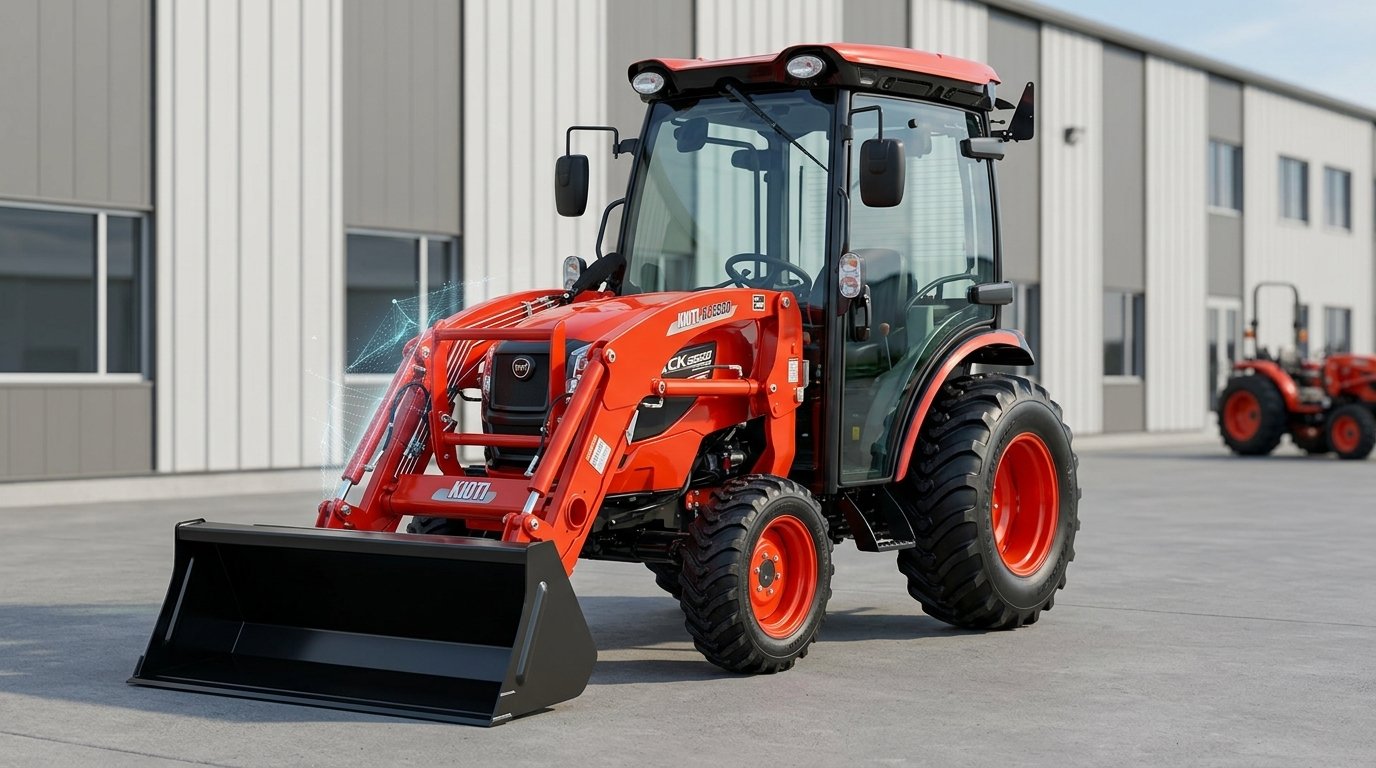
A closer look at the CK3520’s diesel power, loader capability, implement options, and value for American property owners.
The KIOTI CK3520 review starts with a familiar question for buyers who have outgrown a subcompact tractor: can a 34.9-horsepower compact utility machine deliver the power, loader capability, and versatility needed to manage a larger property? Every year, a certain kind of buyer discovers that the property is larger than expected, the gravel driveway needs more material than a small loader can handle, and the brush hog that seemed fine on paper struggles in thick pasture grass.
The question is whether it delivers a useful balance of power, loader capability, versatility, and ownership value, or whether its starting price hides a machine that only makes sense once you add several thousand dollars in equipment. The answer depends on how you configure it and how honestly you assess your own workload.
Our Take: A KIOTI CK3520 Review in Brief
The most interesting thing about the CK3520 is not a single number. It is the way KIOTI has built a platform around choice. A buyer can pick a conventional manual transmission, a Synchro Shuttle, or a hydrostatic drive, and can add a factory cab, two different front loaders, or a backhoe. Few tractors in this class let you tailor the machine to your habits and your property quite so deliberately.
The engineering choices make the most sense where the work is repetitive and physical. Loader work, with its constant cycle of forward, reverse, lift, and dump, is where this tractor is likely to earn its keep. The available loaders, the hydraulic system, and the HST option all point toward that kind of use. The manual and SE versions, with higher published PTO output, point toward owners who spend more time behind a mower or tiller.
The limitations are just as real. The rear hitch lift rating is modest for a tractor this size. The HST versions give up some PTO horsepower. The starting MSRP covers a tractor, not a working package, and a loader, tires, and implements can add a large share to the final cost. We have not operated this tractor, so this assessment rests on published specifications, KIOTI’s own information, and carefully qualified owner feedback. On that basis, the CK3520 looks like a capable and flexible compact utility tractor that rewards careful configuration and a strong local dealer, and punishes a buyer who shops on starting price alone.
Where the CK3520 Sits in the Compact Tractor Market
The CK3520 belongs to KIOTI’s CK Series of compact utility tractors. It is aimed at large property owners, hobby farmers, small ranchers, landscapers, and small business owners who need more than a subcompact can offer but do not want the size and cost of a larger agricultural machine.
The distinction between subcompact and compact utility tractors matters. Subcompact machines tend to be lighter and more focused on mowing, light loader work, and small garden tasks. Readers who want to see that end of the market can look at our reviews of the John Deere 1025R or the Kubota BX23S. Those tractors are useful context, not direct rivals. They show where the CK3520’s extra power, hydraulic capacity, and attachment range begin to change what a buyer can reasonably ask of a machine.
For anyone still deciding which category fits, our Tractors category collects the machines we have covered across the size spectrum.
Engine and Practical Performance
The standard CK3520 uses KIOTI’s own 3H-TM4A diesel engine, a three-cylinder unit with a displacement of 111.4 cubic inches (1,826 cc). KIOTI rates it at 34.9 gross horsepower (26 kW) at 2,600 RPM, and describes it as a Tier 4 CRDI diesel. The fuel tank holds 9 U.S. gallons (34 liters). KIOTI’s main CK3520 product page is the primary reference for these figures.
Displacement matters because tractors rely on low-speed torque and sustained load capacity more than on peak output. A diesel of this size gives the machine the staying power for loader cycles, mowing thick growth, and pulling ground-engaging implements. It is a more substantial powerplant than what typically sits in a subcompact, and that difference shows up under sustained load rather than in a brochure.
Gross engine horsepower is not the figure that reaches your implement. It is measured at the engine, before drivetrain losses and accessory demands. PTO horsepower, which we cover below, is the more relevant number for powered attachments. We are also deliberately not quoting torque or fuel consumption. KIOTI does not publish a verified hourly fuel-use figure on the specification page we used, and we will not invent one. Likewise, we are not describing the engine as turbocharged, because the documentation for this configuration does not support that claim.
Transmission Choices and Model Variations
The CK3520 comes in several configurations, and the differences go beyond the gearbox.
The standard CK3520 has a manual transmission and a published PTO output of 30.9 horsepower. Manufacturer pages and older literature describe speed counts differently, so we are not stating a specific number of gears. The practical point is that it suits operators who like conventional gear-based control.
The CK3520H uses a hydrostatic transmission with three speed ranges and infinitely variable speed within each range. Its published PTO output is 28.9 horsepower. The CK3520SE uses a Synchro Shuttle transmission, keeps the 30.9 PTO horsepower figure, and adds a package of comfort and convenience equipment: synchronized shuttle shift, automatic and manual PTO features, a telescoping rear hitch, rear hydraulic remotes, tilt steering, a premium seat, and a rubber floor mat.
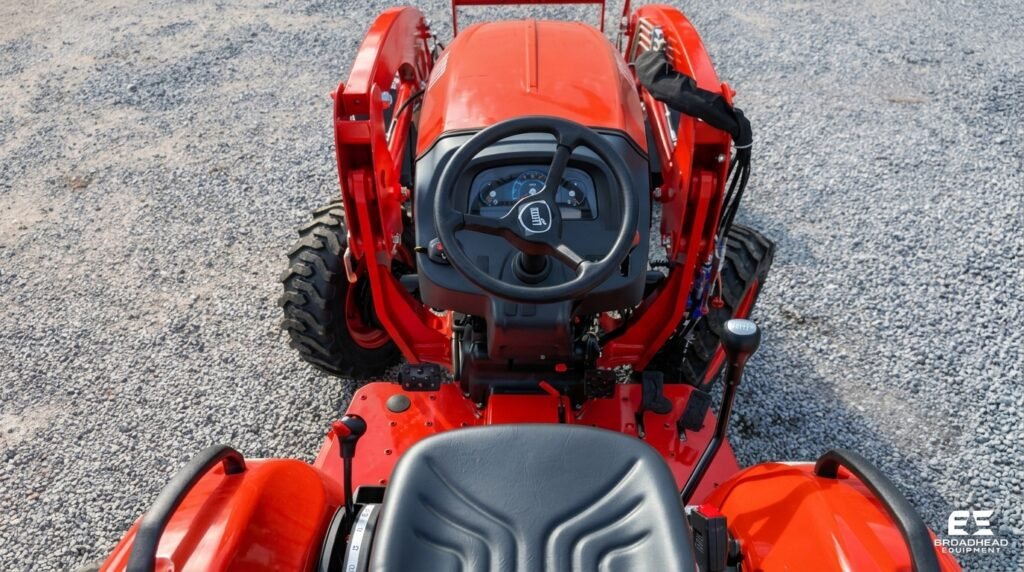
The CK3520SEH pairs the hydrostatic transmission with that SE equipment, at 28.9 PTO horsepower. The CK3520SEH Cab adds a factory-installed full-size cab with heating and air conditioning, again at 28.9 PTO horsepower.
The real-world differences are straightforward. A manual gearbox rewards owners who value direct mechanical control and mostly work in steady, predictable conditions. A synchronized shuttle makes frequent forward and reverse changes less tiring, which matters for loader work and moving material around a yard. Hydrostatic drive goes further, letting the operator adjust speed and direction with a pedal, which is easier when maneuvering around obstacles or working in tight spaces. The tradeoff is the lower published PTO horsepower on HST models, a difference that matters most for owners who run power-hungry implements for long periods.
PTO and Hydraulic System
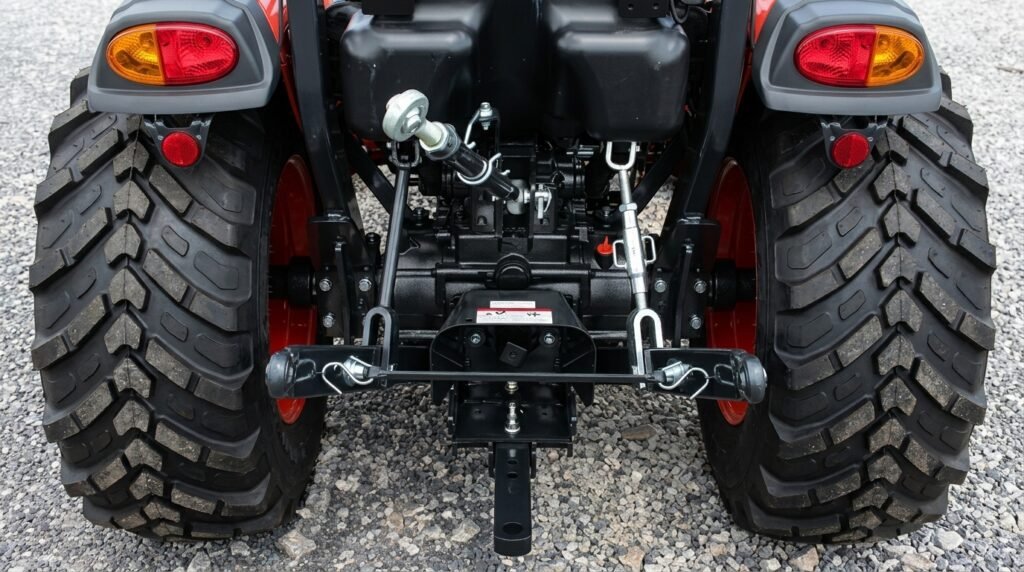
On the standard manual CK3520, the rear PTO is live and runs at 540 RPM, with an optional mid-PTO at 2,000 RPM. The published PTO horsepower is 30.9. That number matters because rotary cutters, finish mowers, tillers, and other driven implements draw power through the PTO, not directly from the engine’s gross rating. An owner who plans to run a tiller or a larger rotary cutter should look closely at PTO output and not stop at the headline engine figure.
The standard configuration uses a gear-type hydraulic pump with a published maximum capacity of 11.7 GPM (44.4 L/min). The standard three-point hitch is Category I with position control, and its published lifting capacity is 1,631 pounds (740 kg).
That hydraulic pump capacity is a property of the tractor as a whole. It is not the same thing as the front loader’s rated flow, which KIOTI publishes separately, and the two should not be read interchangeably. The tractor’s hydraulics serve the loader, the rear implements, and compatible hydraulic accessories, and the way that capacity is divided affects how the machine feels in use. We have also cited these hydraulic figures for the standard configuration only. Buyers considering an SE or HST model should confirm those specifications on the corresponding KIOTI page and not assume they carry over unchanged.
Front-End Loader: KL4030 and KL4030C
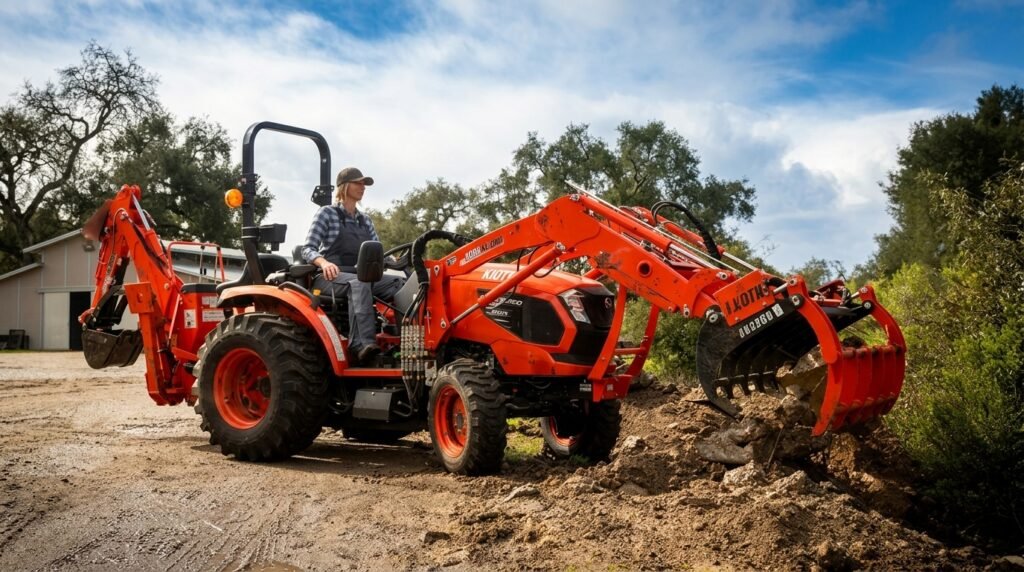
For many buyers, the loader is the reason to buy this tractor. KIOTI’s build page offers two options, the KL4030 and the KL4030C, both described on KIOTI’s front-end loader page. Both use single-lever joystick control, a float function, and a bucket-level indicator.
The KL4030 reaches a maximum lift height of 98.4 inches at the pivot pin, with 93 inches of clearance under a level bucket and 79.1 inches with the bucket dumped. Reach at maximum height is 27.2 inches, and reach at ground level is 62.2 inches. It offers a 48 degree dump angle and a 28 degree rollback angle. Published lift capacity to full height is 1,835 pounds, and breakout force at the pivot pin is 3,464 pounds. It carries a 60 inch bucket and weighs about 959 pounds.
The KL4030C also reaches 98.4 inches at the pivot pin, but its clearance is 88 inches with a level bucket and 74 inches dumped. Reach at maximum height is 11.3 inches, and reach at ground level is 63.4 inches, with the same 48 degree dump angle. Its published lift capacity is 1,969 pounds, breakout force is 2,989 pounds, the bucket is 66 inches wide, and the loader weighs about 928 pounds.
The numbers point in different directions, so neither loader is automatically better. The KL4030C has the higher published lift capacity, while the KL4030 has the higher breakout force and more reach at maximum height. Those figures describe different things. Lift capacity is how much weight the loader can raise under specified conditions. Breakout force is the digging and curling power available to pry a bucket free of packed material. Maximum height governs whether you can load a tall trailer or truck. Reach determines how far forward the load sits, which affects both placement and stability. A buyer moving gravel and soil may care more about breakout force, while someone stacking pallets or loading bulky material may care more about lift and the geometry at height.
None of these ratings tell you what you can safely lift on your own ground. Actual capability depends on load position, ballast, tractor stability, terrain, attachment weight, and the manufacturer’s operating limits. A loader can lift more than a tractor can safely carry on a slope, so counterweight at the rear matters.
Rear Backhoe: KIOTI KB2475L
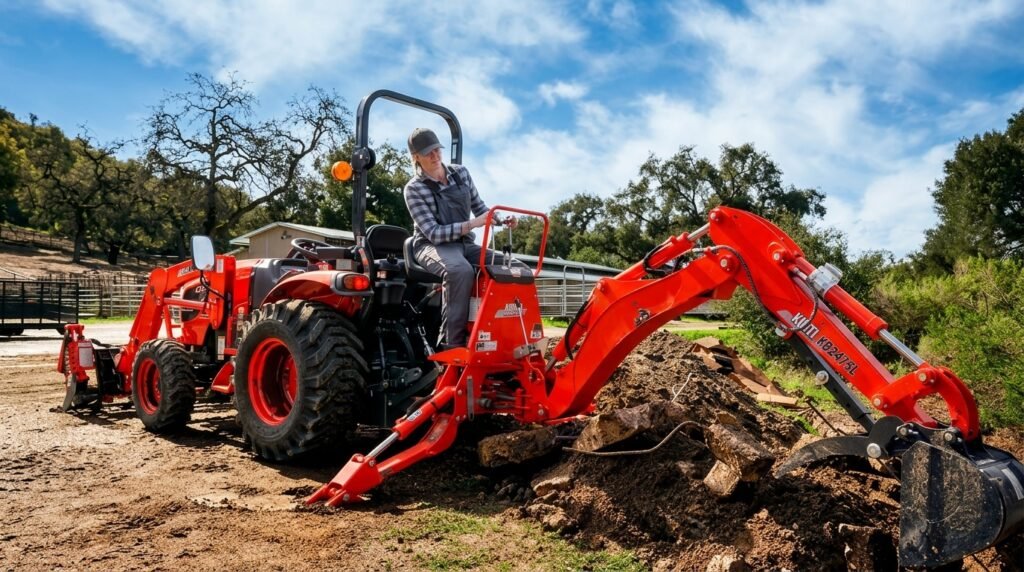
The CK3520 can be fitted with the KB2475L, which KIOTI lists on its backhoe page. It mounts on a subframe and uses hydraulic controls. Published figures include a digging depth of 89.7 inches, a reach of 125.1 inches, and a loading height of 72.4 inches. Swing arc and bucket rotation are both 180 degrees. Bucket digging force is 2,817 pounds, dipperstick digging force is 2,105 pounds, hydraulic operating pressure is 2,466 psi, and the unit weighs 880 pounds. According to KIOTI’s attachment information, the subframe and bucket are sold separately.
For trenching, drainage work, utility preparation, landscaping, and smaller excavation jobs, this gives the CK3520 a capability that a loader alone cannot match. It also needs perspective. This is a compact tractor with a backhoe attachment, not a dedicated excavator. Digging depth, stability, and cycle speed will not match purpose-built equipment, and the machine is best viewed as a way to handle occasional projects without hiring them out.
Attachments and Agricultural Implements
The CK3520’s appeal is partly the ecosystem around it. KIOTI lists finish mowers such as the FM2005 and FM2006, and rotary cutters including the RC1048, RC1072, RC2005SP, RC2006SP, RC2005SC, RC2006SC, and RC3006. Tillers include the RT2048, RT2560, RT2565, RT2573, and RT2048R. There is a DH2006 disc harrow, and grapples such as the KG2054, KG2060, and KG4060. Other options include bale spears, pallet forks, four in one buckets, rear blades, box blades, grading scrapers, landscape rakes, field cultivators, moldboard plows, and snow pushers.
In practice, finish mowers and rotary cutters handle lawn and pasture maintenance, with cutters better suited to brush and rougher growth. Tillers and cultivators prepare gardens and soil. Blades, scrapers, and rakes keep gravel driveways in shape. Bale spears and pallet forks move hay and freight, grapples clear brush and handle logs, and snow pushers help in winter.
Choosing among them takes more than picking the biggest one. PTO horsepower, implement weight, hydraulic requirements, hitch compatibility, working width, and operating conditions all matter. A very wide implement can overwhelm the tractor on uneven ground or in dense material. The largest listed option is not necessarily the right one for a particular property.
Dimensions, Weight, Tires, and Maneuverability
For the standard configuration, KIOTI publishes an overall length of 120.9 inches with the three-point hitch, a width of 54.5 inches, and a height of 92.9 inches. The wheelbase is 65.7 inches, ground clearance is 13.4 inches, front tread is 48.2 inches, and rear tread is 47.6 inches. The turning radius is 8.96 feet, and the standard weight is 2,678 pounds.
These numbers shape how the tractor behaves. Weight contributes to traction and stability, though it also affects turf protection. Wheelbase influences how stable the tractor feels under load, and ground clearance helps on rough or uneven terrain. A compact footprint and tight turning radius make the CK3520 easier to use around buildings, fences, and wooded areas than larger utility tractors.
Tires come in Agricultural, Industrial, R14, and Turf categories, and the choice should follow the work. Agricultural tires prioritize traction in soil and mud, turf tires protect lawns, and industrial tires fall in between. That 2,678 pound figure should not be read as the operating weight of a fully equipped machine. Configuration, tire selection, loader, cab, and attachments all change the total, sometimes substantially.
Operator Station and Cab Equipment
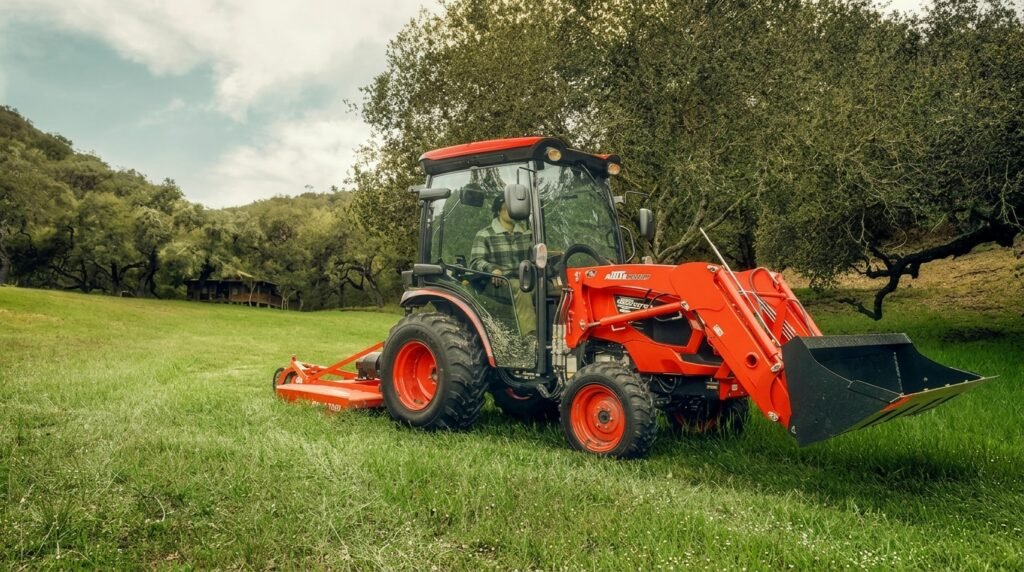
The open-station configurations suit mild climates and shorter sessions, while the SE versions add a premium seat, tilt steering, and a rubber floor mat. For long days, those details make a difference. An HST pedal arrangement also makes frequent directional changes and loader work less demanding.
KIOTI describes the factory cab as full size, with heating and air conditioning. It adds meaningful cost, as the pricing section shows, but it has real value for snow removal, long operating sessions, and hot or cold weather. We are not describing any digital display, touchscreen, sound system, or suspension, because none is confirmed for these configurations.
Maintenance and Long-Term Ownership
The basics are familiar to any diesel owner. Check engine oil, coolant, and hydraulic fluid regularly. Maintain the fuel system, inspect tires, belts, and filters, keep the cooling system clean, and look over attachment connections before each job. Follow the owner’s manual for your specific transmission and configuration. We are not publishing service intervals, capacities, or part numbers, because those belong to the manual and should not be guessed.
The CK3520 uses a Tier 4 CRDI diesel, so owners should follow KIOTI’s instructions for emissions system warnings and any regeneration procedures that apply. Emissions hardware and requirements may differ by model year and configuration, so we are not assuming they are identical across every unit. Because no official fuel consumption or operating range figure exists on the page we used, a buyer who wants those answers should ask a dealer or consult owners.
Pricing and Configuration Costs
The figures below are KIOTI’s manufacturer listed U.S. MSRP, checked on November 6, 2026, and they are not guaranteed transaction prices. The CK3520 manual starts at $24,265, the CK3520H at $25,171, the CK3520SE at $26,535, and the CK3520SEH at $28,111. The CK3520SEH Cab starts at $36,937. KIOTI’s Build & Price page shows the KL4030 and KL4030C loaders at $5,944 each, the KB2475L backhoe at $8,896, the FM2005 finish mower at $3,156, and the FM2006 at $3,518. Agricultural, Industrial, R14, and Turf tire packages are each listed at $2,630.
The starting price is therefore not the price of a working machine. A manual CK3520 with a loader and a tire package already sits well above its base figure, and a backhoe, a mower, setup, delivery, dealer fees, taxes, and financing push it further. Prices and availability can change, so buyers should request a current quote from an authorized dealer before deciding.
Warranty and Dealer Support
KIOTI’s official warranty page describes a 24 month parts and labor limited warranty for non commercial tractor use. Front loaders, backhoes, mid mount mowers, and snow blowers carry 12 months of parts and labor coverage. An additional 48 month extended powertrain and driveline warranty is listed for eligible non commercial applications. For rental and commercial use, the page lists 24 months or 1,500 hours for the limited warranty, and 36 months or 2,000 hours for extended coverage, whichever comes first in each case. KIOTI also advertises a limited time total of 72 months of extended powertrain coverage for eligible purchased units.
That last figure should not be read as six years of full tractor coverage. Eligibility, exclusions, covered components, purchase dates, and terms all need to be confirmed with an authorized dealer. Warranty on paper is also only as good as the service behind it, so dealer proximity, technician experience, parts availability, and how smoothly claims are handled deserve as much attention as the coverage length.
Reliability and Owner Feedback
Owner discussions are secondary context, and they should be treated as such. Some CK3520 owners report positive experiences with loader capability, general property maintenance, and overall usefulness. Others describe individual problems, including early electronic sensor faults, fuel delivery concerns, and opinions about loader hydraulic smoothness.
These are isolated reports, not evidence of a recurring defect, and we are not assigning reliability ratings or failure rates, because no documented data supports them. The sensible response is to separate what KIOTI publishes from what individual owners say, then check local dealer support and inspect the specific tractor before buying.
Who Should Consider the CK3520, and Who Should Look Elsewhere
The CK3520 makes the most sense for someone with several acres, regular loader work, and a mix of mowing, material handling, and light agricultural tasks. Buyers who want a manual or Synchro Shuttle with strong PTO output will find it in the base and SE models, while those who prioritize easy operation will lean toward HST. Anyone facing harsh winters or long days in the seat should seriously consider the cab.
It is less well suited to buyers whose main work involves heavy rear implements, since the 1,631 pound hitch rating is a real constraint. It also may not suit anyone who wants a fully equipped machine at the starting price, or who lives far from a capable dealer. A smaller tractor may be enough for light jobs, and a larger one is the better choice for demanding implements.
Conclusion
This KIOTI CK3520 review comes down to configuration and honesty about workload. The 34.9 horsepower diesel, flexible transmission choices, two capable front loaders, backhoe compatibility, and wide implement range give it real breadth. Its limits are equally clear: a modest hitch rating, lower PTO output on HST models, and a final price that climbs quickly once the machine is equipped for work.
For the right buyer, a property owner with real acreage and a loader heavy routine, it is a sensible and versatile choice. The deciding factors will be a quote that reflects the whole package, a dealer you trust, and a clear idea of what you will actually ask the tractor to do.