Flatbed Trailers Types Dimensions and Capacity
How construction, structural ratings, and road regulations decide what an open-deck trailer can actually haul

Plenty of freight never fits through a pair of rear doors. A forty-foot steel girder, a coil that has to be lifted from above, a generator that needs a crane at one end and a forklift at the other: none of these were designed around an enclosed box. The open-deck semitrailer exists to move them. Its deck is bare, its sides and roof are absent, and nothing stands between the load and the equipment that places it. That openness is why flatbed trailers remain a staple of American freight, from structural steel and building materials to machinery and farm equipment.
The same openness shifts responsibility onto the people operating the trailer. A van protects its cargo and contains it. A flatbed does neither unless the driver, the carrier, and the shipper make it so. The trailer’s structure has to carry the load, its axles have to distribute the weight legally, and every piece of freight has to be restrained against forces that are easy to underestimate. Choosing the right trailer therefore means weighing cargo geometry, structural ratings, axle arrangement, and securement hardware together, not simply picking a length.
Our Take
A flatbed looks like the simplest trailer on the road: two main beams, a row of crossmembers, a floor, and a set of wheels. That simplicity is misleading, because nearly every important decision is hidden in what the deck cannot show. Two trailers that look nearly identical from the curb can differ in main beam design, floor construction, empty weight, and structural rating by margins that decide which freight each can handle. A trailer built to carry a single heavy coil in a concentrated footprint is engineered differently from one built to move palletized building materials at maximum payload.
The flexibility that makes the platform valuable is also what makes it demanding. A dry van arrives at the dock with its cargo already contained. A flatbed arrives with a driver who has loaded, blocked, strapped, chained, and often tarped the freight alone. That workload affects labor time, injury exposure, and compliance risk, and it belongs in any honest ownership calculation.
Our view is that buyers should resist shopping by deck length and sticker price. The more useful questions concern what will ride on the deck: how heavy it is, how much of the deck it covers, how it is lifted, and what it needs to be held in place. A longer trailer is not automatically a more capable one, and a lighter trailer is not automatically a better one. The right trailer is the one whose structure, weight, and securement features match the cargo it will actually carry, week after week.
How an Open-Deck Trailer Works
A flatbed is a semitrailer whose load-bearing deck sits on a frame of longitudinal main beams joined by crossmembers. The front of the trailer carries a kingpin that locks into the tractor’s fifth wheel, which transfers part of the trailer’s weight to the tractor’s drive axles. The rest rides on the trailer’s own axle group at the rear. This arrangement means that cargo position matters at both ends. Freight placed toward the front loads the tractor, and freight placed toward the rear loads the trailer axles, so where the cargo sits on the deck determines how the combination’s weight is split.
Because there are no permanent sidewalls or roof, the deck can be reached from three directions. A forklift can enter from either side, an overhead crane can lower a load directly onto the deck, and a loading dock or rear ramp can serve freight that slides on from the back. That access is the central difference from enclosed trailers. Enclosed dry van trailers protect freight behind permanent walls and a roof, which makes them excellent for palletized, weather-sensitive goods but limits loading to the rear doors. A flatbed gives up that protection in return for open access from the sides and above, along with the ability to carry freight that is taller, wider, or longer than a box can contain.
The uninterrupted deck also tolerates awkward geometry. A piece of machinery with an irregular profile, a bundle of pipe that overhangs the rear, or a stack of fabricated steel can all ride on a surface that imposes no walls or ceiling on their shape. The trade is that nothing in the trailer contains the load. Whatever keeps the cargo in place has to be added deliberately.
Common Flatbed Configurations
The standard straight-frame flatbed has one continuous deck height from front to rear and serves the broadest range of everyday freight. Great Dane, for one, offers its Freedom Steel line in straight-frame lengths of 28, 45, 48, and 53 feet. The straight deck is the baseline against which the specialized platform trailers are measured.
Construction material divides the category further. All-steel trailers favor durability and concentrated-load capability, all-aluminum trailers favor lighter empty weight, and combination trailers pair steel main beams and crossmembers with aluminum side rails and flooring. Fontaine describes its Infinity Combo that way, with steel main beams and crossmembers under aluminum siderails and flooring that includes wood nailer strips.
Axle arrangement is another variable. A sliding axle configuration lets the position of the axle group be adjusted along the frame, which shifts how weight is shared between the tractor and trailer axles and helps operators meet axle limits for a given load. Great Dane lists standard, heavy-duty, tridem, quad, and sliding axle packages for its Freedom Steel trailers, with the aim of matching payload and regional weight requirements. Axle position can also bear on state rules, since some states regulate the distance between the kingpin and the rear axle, so adjustability is useful rather than a guarantee of compliance everywhere.
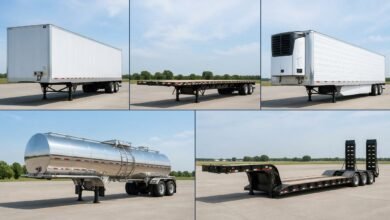
Several related trailers share the open-deck concept but are built for different problems. A step-deck, or drop-deck, trailer lowers the main deck behind a raised front section to gain vertical clearance for taller freight. Double-drop and lowboy trailers drop the deck further, with deck geometry designed around heavy equipment that would otherwise exceed height limits. They are specialized platforms, not larger flatbeds, and belong in their own discussion.
Extendable flatbeds address length instead of height. Great Dane’s Freedom Steel offers extendable configurations that run from 48 to 80 feet or from 53 to 90 feet, intended for beams, poles, and structural steel. For freight that needs weather protection without giving up side and overhead access, Conestoga-style rolling-tarp systems add a retractable cover over the deck. East Manufacturing notes that its narrow-neck aluminum flatbed can be fitted with curtainside and rolling-tarp systems, with up to 106 inches of clear inside height. Side kits, removable boards that rise from the stake pockets, add containment for suitable loads such as bundled or boxed freight that needs a barrier along the edge. They do not turn a conventional flatbed into a purpose-built bulk-hauling trailer, and bulk materials that require full containment belong in equipment designed for that application.
Dimensions and Deck Height
Two sizes dominate American flatbed work: 48-foot and 53-foot trailers. Both ride on a standard overall width of 102 inches, which matches the width standard that applies on the National Network of highways. These figures describe the trailer itself. The tractor adds length, and the combination’s overall dimensions are a separate matter from the trailer’s deck length.
Deck height is where trailers diverge in ways that matter to real freight. It depends on frame depth, suspension, tire size, and fifth-wheel height. Utility Trailer publishes specifications for its 48-foot, 102-inch-wide flatbeds that show front deck heights of 59⅝ inches and 58³⁄₁₆ inches on a fifth wheel 47 inches high, depending on the configuration. One Utility drop-deck configuration lists a 21-inch drop, with an 11-foot front deck and a rear deck height of 40¼ inches. Those are model-specific figures, not universal flatbed dimensions, and they change with fifth-wheel height and suspension choice.
Deck height feeds directly into loaded height. Under a common 13-foot, 6-inch state limit, a trailer with a deck near 59 inches leaves a little over 100 inches for cargo, before any allowance for chains, tarps, or the load’s own shape. A drop-deck lowers the starting point and so recovers inches for tall machinery or industrial freight. Because the 48-foot semitrailer length is a minimum states must allow rather than a ceiling, longer trailers can be legal where a state permits them.
Construction, Materials, and Structural Components
The main beams carry the trailer’s bending loads between the kingpin and the axles. Crossmembers tie the beams together, support the floor, and resist twisting. The floor transfers cargo weight into the crossmembers, and the side rails and rub rails provide attachment points and protection along the edges. At the front, an approach plate and kingpin plate handle the connection to the tractor, and landing gear supports the trailer when it is parked. The suspension, axles, brakes, wheels, and tires carry the load to the road.
Steel remains the traditional choice for durability and for the concentrated loads of coils and machinery. Great Dane describes its Freedom Steel with 100 KSI steel flanges and a one-piece steel web main beam, and it lists apitong hardwood flooring as standard with aluminum floor options. Steel adds empty weight and is susceptible to corrosion without good coatings. Certain steel repairs may be more straightforward than their aluminum equivalents, but repair complexity depends on the type and location of the damage, the structural design, the manufacturer’s repair procedures, and the qualifications of the repair facility, so neither material can be called universally easier or cheaper to fix.
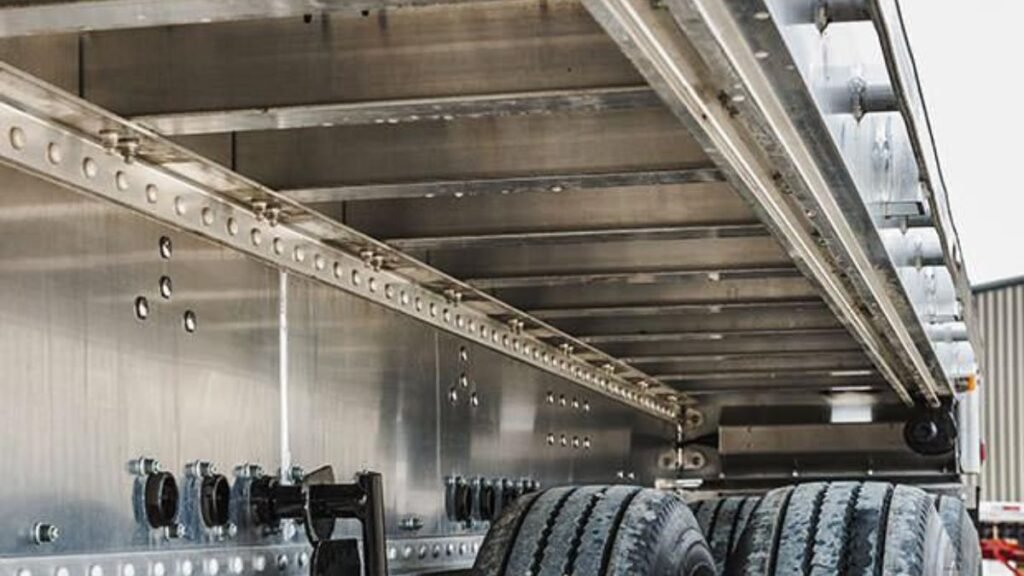
Aluminum reduces tare weight and resists rust, but it demands careful engineering because the metal behaves differently under load and fatigue. East builds its flatbeds around 6061-T6 aluminum main beams and tubular crossmembers, with a double T-shape extruded main beam welded in the neutral axis where stress is lowest. Fontaine’s Revolution uses a StirLITE aluminum floor whose supports are built into the floor and joined by friction stir welding. Fontaine states that an all-aluminum trailer typically saves at least 10 percent in weight compared with a steel trailer. That is a manufacturer’s comparison, not an independent measurement, and actual savings depend on the trailer’s design and configuration. It does not describe steel-aluminum combination trailers.
Combination construction splits the difference. The Infinity Combo keeps steel main beams and crossmembers for the structural loads while aluminum siderails and flooring trim weight where it is less critical. How the floor and beams are built affects how cargo weight spreads through the frame, which is why no single component’s strength can stand in for the capacity of the whole trailer. A strong beam under a weak floor, or a strong floor on a lightly built crossmember layout, is limited by its weakest link.
Weight Capacity, Payload, and Structural Ratings
Several terms get used interchangeably in trucking conversation, and they should not be. Trailer GVWR is the manufacturer’s gross vehicle weight rating for the trailer, covering its own weight plus cargo. GAWR is the gross axle weight rating: the manufacturer-specified load-carrying capacity of a single axle system, measured at the tire-ground interfaces. It is not automatically the rating of an entire axle group, and it is not the same thing as the legal tandem or tridem axle weight limits that apply on the road. Axle ratings, tire ratings, suspension specifications, and the manufacturer’s stated ratings all affect the load a given trailer can actually be allowed to carry. Tare weight is the trailer’s empty weight. Payload is the cargo weight that can actually be carried once every relevant equipment and operating limit is respected. Usable payload can be lower than GVWR minus tare weight, because axle, tire, suspension, structural, and legal road-weight limits must all be respected.
Two further ratings describe structure. A distributed load rating addresses cargo spread over a specified deck area or the length of the trailer. A concentrated load rating addresses a heavy load bearing on a short span or small footprint. The two are not interchangeable. A trailer rated for a large distributed load may handle a much smaller weight when it is concentrated, because the beams and floor see very different stresses.
Manufacturer ratings show how much trailers differ. Great Dane lists Freedom Steel at an 80,000-pound distributed load rating and a 50,000-pound concentrated load rating over a four-foot span in standard configurations, and says those ratings can change with trailer length, axle configuration, suspension, and other specifications. East publishes different ratings across its aluminum models. For wide-spread 48-foot configurations, East lists its Beast at 52,000 pounds concentrated in four feet, 60,000 pounds concentrated in ten feet, and 90,000 pounds distributed. The Beast II is listed at 65,000 pounds in four feet, 72,000 pounds in ten feet, and 100,000 pounds distributed. The MMX, listed for multi-axle configurations, is rated at 80,000 pounds in four feet, 89,000 pounds in ten feet, and 145,000 pounds distributed.
These are structural ratings tied to specific models and specific spans. They are not legal payload figures, and they do not permit loading a tractor-trailer combination beyond road limits. Real freight capacity depends on the combined empty weight of tractor and trailer, axle configuration, tire and suspension ratings, cargo footprint and placement, axle weight distribution, bridge formula compliance, and state law. A trailer’s structural rating describes what the steel or aluminum can take. The road decides how much of that you may use.
American Weight and Size Regulations
On the Interstate Highway System, federal standards cap a single axle at 20,000 pounds, a tandem axle at 34,000 pounds, and gross vehicle weight at 80,000 pounds, according to the Federal Highway Administration’s commercial vehicle size and weight program. The Federal Bridge Formula, introduced in 1975, can reduce the allowable gross weight further depending on the number and spacing of axles, because bridges are protected by requiring more axles or a longer wheelbase as weight rises. Off the Interstate System, states may set their own weight standards.
These limits describe the whole vehicle combination, not the flatbed alone. A heavy trailer with a high structural rating still has to fit inside the combination’s axle and gross limits, so a trailer that weighs more empty leaves less room for cargo under the same 80,000-pound ceiling.
Size rules follow the National Network, which includes the Interstate System and other highways certified by the states as capable of handling larger vehicles. On that network, federal law bars states from setting a width limit above or below 102 inches. It also bars a trailer length limit under 48 feet for a semitrailer in a tractor-semitrailer combination, subject to grandfather rights, and states may permit longer trailers. Federal law sets no single height limit; states establish their own. Common state height limits generally range from 13 feet, 6 inches to 14 feet, although individual state rules and exceptions can differ. Route restrictions, special permits, and non-divisible-load requirements can change what is allowed on a given road, so a 48-foot or 53-foot flatbed has no single legal payload.
What Flatbed Trailers Carry
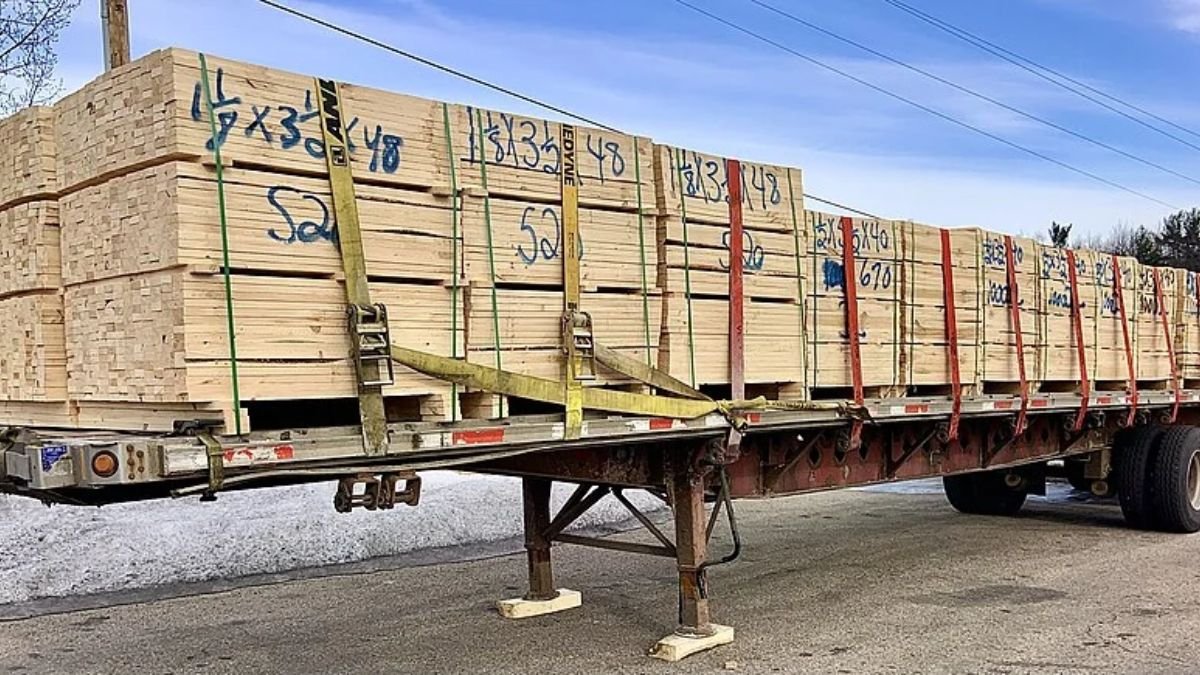
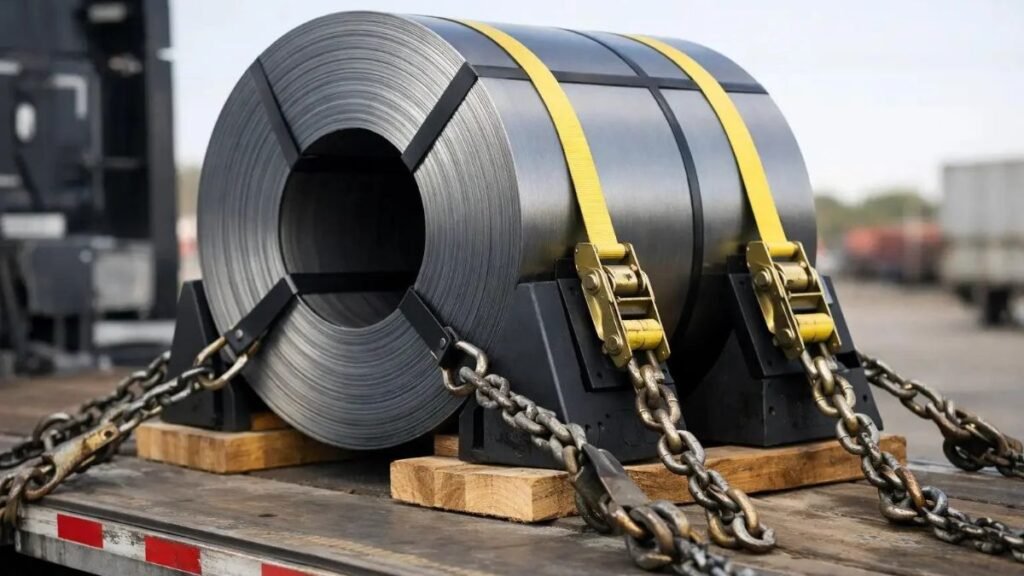
The freight that suits a flatbed shares a common trait: it is heavy, long, bulky, or awkwardly shaped, or it is handled by a crane or forklift. Structural steel, steel beams, plates, and rebar ride well on a flat deck and are usually loaded from above or the side. Steel coils are dense, concentrate their weight in a small footprint, and need cradling and a deck built for concentrated loads. Lumber and dimensional timber move in unitized bundles that a forklift can place from the side. Concrete products, pipe, and roofing materials benefit from side access and overhead lifting.
Industrial machinery and generators are often too tall, wide, or irregular for an enclosed trailer and are lifted into place. Agricultural equipment rolls or is lifted onto the deck, and because it has attachment points and a center of gravity unlike palletized freight, it often calls for specific securement arrangements. Fabricated steel assemblies and construction supplies fit the same pattern.
Weather sensitivity separates exposed freight from covered freight. Rough steel stock may travel uncovered, while lumber, finished building products, and machinery often need protection. Temperature-controlled goods are a different matter, since an open deck cannot hold a temperature, and freight that needs continuous refrigeration belongs in an insulated compartment such as those described in our guide to reefer trailers. Cargo shape, weight concentration, handling method, and sensitivity to weather together steer the choice among a conventional deck, a drop deck, an extendable, or a covered system.
Loading and Weight Distribution
How freight reaches the deck affects the trailer and the load. Forklift loading from the side suits palletized and bundled freight. Crane loading handles machinery, large assemblies, and anything that cannot be lifted any other way. Equipment options vary by manufacturer and should not be confused with one another. East Manufacturing, for example, lists a Built-In Traveling Unloading Crane among its optional flatbed features, and Great Dane lists forklift kits among its available rear-end options. A forklift kit is a different piece of equipment from an unloading crane, and neither is standard on flatbeds in general. Rear loading and specialized equipment serve rolling or self-propelled cargo.
Placement along the deck changes axle weights. Cargo too far forward loads the tractor’s drive axles and can strip weight from the trailer axles, and cargo too far rearward does the opposite, which can reduce steering weight and affect handling. Either extreme can push an axle group over its limit while the gross weight stays legal. Coordinating placement with the tractor, trailer, fifth-wheel position, axle group, and the equipment manufacturer’s specifications is what keeps the load both safe and compliant. A sliding axle can help correct a distribution problem once the load is on the deck, but it does not excuse poor placement.
Dunnage, blocking, and bracing do more than fill gaps. Dunnage lifts cargo off the deck so a forklift can slide out the forks or a strap can pass beneath, blocking and bracing keep articles from moving forward or sideways, and proper support under long or heavy pieces keeps loads from bending or crushing. These are structural choices in their own right, and they interact with the tiedowns that hold everything together.

Cargo Securement and Driver Responsibilities
Chains, web straps, winches with ratchet mechanisms, binders, anchor points, and edge protectors form the working vocabulary of flatbed securement, along with coil racks, blocking, and dunnage. Each device has a rated strength, and each suits different cargo. Chains hold heavy, dense, rigid freight, straps suit lighter or more delicate loads and surfaces they could damage, and edge protection prevents a strap or chain from being cut or abraded where it crosses a corner. The match between method and cargo depends on weight, shape, surface, center of gravity, and how the load could move.
The Federal Motor Carrier Safety Administration’s cargo securement rules apply to cargo-carrying commercial motor vehicles in interstate commerce, and the underlying text sits in 49 CFR Part 393, Subpart I. Section 393.102 sets two separate performance requirements for tiedown assemblies, and they are not interchangeable. Measured against breaking strength, the forces acting on a tiedown must not exceed the manufacturer’s breaking strength rating under 0.8 g of deceleration forward, 0.5 g of acceleration rearward, and 0.5 g of acceleration laterally. Measured against working load limit, the forces must not exceed the working load limit under 0.435 g forward, 0.5 g rearward, and 0.25 g laterally. Each set of conditions is applied separately.
Section 393.106 adds a further requirement: the aggregate working load limit of the tiedowns securing an article or group of articles must equal at least one-half the weight of the cargo. That aggregate depends on how each tiedown is configured. A tiedown running from a vehicle anchor point to an attachment point on the cargo counts for half its working load limit. A tiedown that attaches to a vehicle anchor point, passes through, over, or around the cargo, and then attaches to an anchor point on the same side of the vehicle also counts for half its working load limit. A tiedown that runs from an anchor point through, over, or around the cargo and attaches to an anchor point on the other side of the vehicle counts for its full working load limit. The rules also set minimum tiedown counts that scale with the length of the article and whether it is blocked against forward movement, in addition to the working load limit, so there is no single number of straps or chains that suits every load.
Commodity-specific rules add detail for freight that has proven difficult to secure, including dressed lumber, metal coils, concrete pipe, and heavy vehicles and machinery. Where a specific rule applies, it takes precedence over the general rule. FMCSA also directs that tiedowns sit inboard of the rub rails whenever practicable, and that edge protection be used where a tiedown would be cut or abraded.
Securement does not end when the trailer leaves the yard. Under 49 CFR §392.9, the driver must inspect the cargo and its securement devices within the first 50 miles after beginning a trip and make any adjustments needed to keep the cargo from shifting or falling, including adding securement devices. Further examinations, with necessary adjustments, are required whenever the driver changes duty status, after 3 hours of driving, or after 150 miles, whichever occurs first. The en-route inspection rules have two exceptions: a sealed commercial motor vehicle whose driver has been ordered not to open it, and a vehicle loaded in a way that makes inspection of the cargo impracticable. Neither exception removes the driver’s earlier responsibility to confirm before departure that the cargo is properly distributed and adequately secured. These exceptions generally do not apply to ordinary exposed flatbed loads, which are usually accessible for visual inspection. Drivers and carriers remain responsible for the applicable commodity rules, the equipment’s own ratings, and the current regulations, and nothing here substitutes for reading them.
Tarps, Weather Protection, and Open-Deck Tradeoffs
Not every flatbed load needs a cover. Rough steel and other weather-tolerant freight can travel exposed, but lumber, finished materials, and machinery frequently require protection, sometimes by cargo specification and sometimes by customer expectation. Lumber tarps, steel tarps, and machinery covers are shaped for different loads, and each must be properly secured to avoid flapping, tearing, or loosening in transit.
Tarping has real cost. It takes labor and handling time, it exposes the person doing it to weather and height, and a poorly secured cover can become a hazard of its own. Conestoga and rolling-tarp systems reduce that burden by letting the driver slide a cover over the deck. They add weight and cost, and they limit overhead loading unless the system is retracted. East’s narrow-neck flatbed, for example, is designed to accept an enclosure, which shows how structure and cover systems are planned together. Open-deck flexibility always comes with weather exposure and securement responsibility, and a covering system moves the balance rather than removing it.

Maintenance and Long-Term Ownership
A flatbed’s service life depends on attention to a handful of areas. The deck takes the abuse of loading, so floor wear and damage deserve regular checks. The main beams, crossmembers, and welds carry the structure, and cracks or distortion there are serious. Side rails, anchor points, and winches work every trip and wear in ways that matter to securement. Landing gear, suspension, axles, wheels, tires, and brakes follow normal heavy-trailer maintenance, and lights and electrical wiring suffer from exposure and impact.
Corrosion, impact damage, loose hardware, damaged securement points, and worn flooring each reduce usefulness and shorten life if ignored. The materials differ in what they ask of the owner. Steel needs coatings maintained and corrosion watched, aluminum resists rust but requires attention to fatigue and impact damage, and combination trailers combine the concerns of both. Fontaine’s own maintenance guidance for the Revolution emphasizes routine items like draining air reservoirs, checking tire pressure and wheel-end leaks, and inspecting wiring. Exact service intervals belong to the manufacturer’s manuals and the operator’s duty cycle.
Choosing the Right Flatbed
The sound starting point is the freight. What will ride on the deck, how heavy is it, how much deck does it occupy, how is it loaded, and how will it be restrained? Answers to those questions narrow the field faster than length or price. Cargo dimensions determine whether a conventional deck is enough or whether a step deck, double drop, lowboy, extendable, or Conestoga configuration fits better. Weight distribution and structural ratings determine whether the frame can handle concentrated loads, and tare weight and axle configuration determine how much of the legal limit remains for cargo.
Flooring, securement hardware, tarp requirements, forklift or crane access, and the regulations on the routes an operator runs all belong in the decision. A conventional flatbed suits mixed freight of ordinary height. A drop deck becomes the better tool when height is the constraint, an extendable when length is, and a covered system when weather protection matters more than overhead access.
The economics involve real tradeoffs. A lower purchase price can mean higher tare weight, less payload, or a floor and beam structure that suffers under hard use. A lighter aluminum trailer can improve payload on weight-limited freight but may cost more at purchase and demands careful handling. Durability, maintenance, flexibility, and resale all pull in different directions, and the answer depends on how the trailer will actually be worked.
Where the Flatbed Earns Its Place
The flatbed endures because it solves a problem that enclosed trailers cannot: it carries freight defined by its shape, weight, or handling instead of its packaging. Its structure, which looks plain, is a careful balance of beam design, floor construction, axle arrangement, and material choice, and the differences between trailers are large enough to decide which freight each one handles well. Structural ratings describe what the trailer can bear, while federal and state rules decide how much of that capacity can legally travel, and the gap between the two is where informed operators earn their margin.
Its value ultimately lies in how well the equipment and the operator work together. A trailer matched to its freight, loaded with care, and secured to the rules that apply will serve for years. A mismatched one will frustrate its owner at every weigh station and loading dock. The open deck rewards those who respect what it leaves unprotected, and for freight that cannot go anywhere else, that is a fair bargain.