Volvo VNX Review Specs Engines & Heavy-Haul Uses
Explore the all-new Volvo VNX, from its D13 engine and three configurations to its heavy-haul capabilities, advanced safety systems, and jobsite technology.

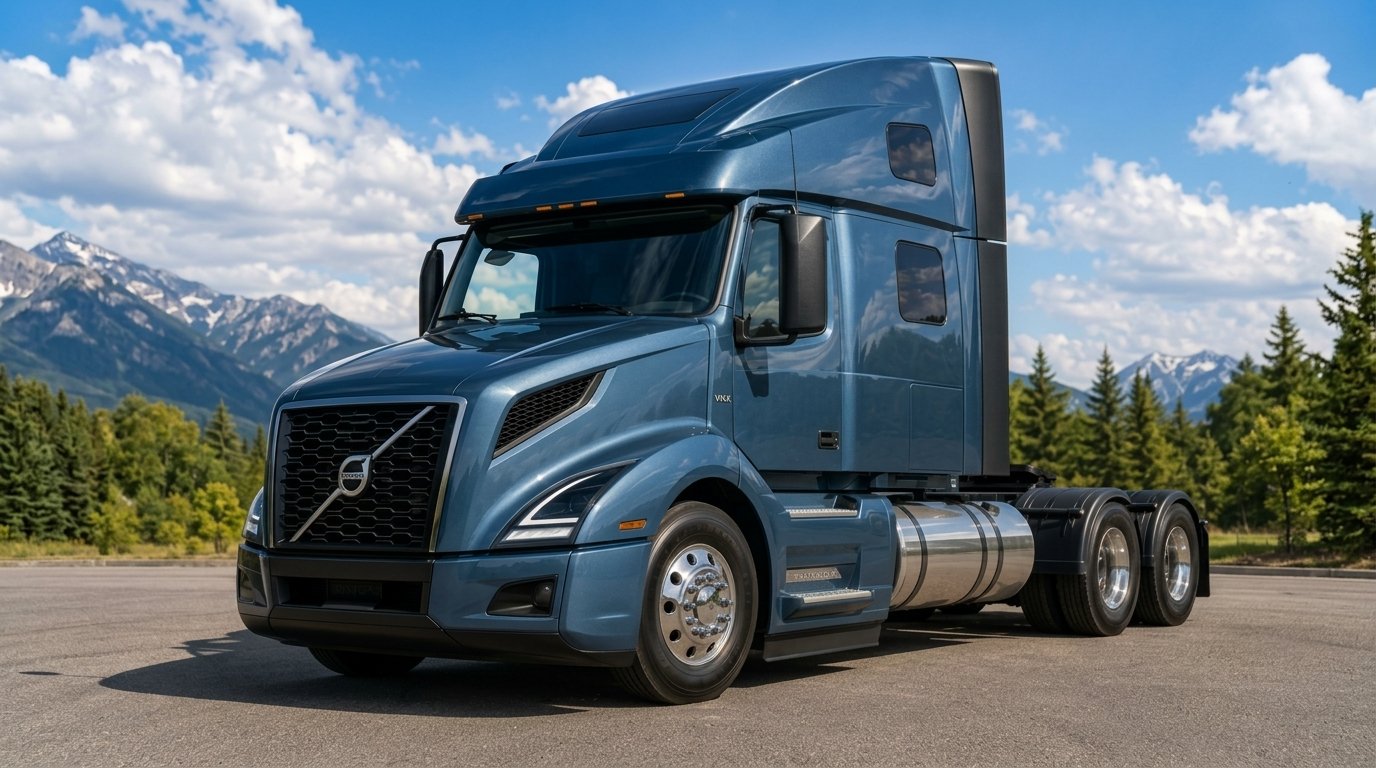
When Volvo Trucks North America unveiled the all-new Volvo VNX on October 14, 2026, the company was finishing a job it started three years earlier. The long-haul VNL came first, then the regional VNR, and now a truck aimed at an entirely different environment: the construction site, the quarry, the logging road, and the heavy-haul corridor. The VNX is built around a D13 diesel certified to EPA 2027 standards, a cab family that runs from a day cab to a 62-inch sleeper, and a set of jobsite technologies, including a system that lets an operator steer the truck from outside the cab, that have little precedent in a North American vocational truck.
This review works through what Volvo has published, what independent coverage adds, and where the evidence ends. That last part deserves emphasis. The truck was unveiled only days before this article’s October 17, 2026 research cutoff, so there is no public price in the sources reviewed, no real-world fuel economy, no maintenance history, and only a brief independent drive to draw on. The sections below treat Volvo’s claims as Volvo’s claims and keep the line between specification and proof visible.
What the All-New Volvo VNX Is Meant to Be
The most useful way to understand the VNX is to start with what it is not. It is not a highway tractor with a heavier bumper. Truck News described a truck that shares its underlying platform and redesigned cab architecture with the VNL and VNR but has been extensively adapted for vocational work, backed by what Volvo describes as a $3 billion investment across its product development and manufacturing. The target work is broad: concrete mixers, dump trucks, roll-off bodies, equipment transport, logging, agriculture, waste and recycling, municipal snowplow duty, and highway heavy haul.
The strategic logic is visible in the market numbers Truck News reported. Volvo holds only about 2% to 3% of the North American vocational segment, according to Volvo Trucks North America president Peter Voorhoeve, even though that segment represents roughly a quarter of U.S. truck demand. Voorhoeve also pointed to a structural advantage unusual among truck makers: Volvo builds both trucks and construction equipment, and the VNX draws on that experience, along with Volvo’s vocational business in Brazil and Europe and feedback from existing VHD owners.
That difference between a work truck and a highway truck shows up in details that long-haul buyers rarely think about. A highway tractor spends most of its life at steady speeds on paved roads, so aerodynamics, sleeper living, and fuel economy at cruise dominate its design. A vocational truck spends its day backing into tight yards, climbing loose gravel, idling beside a pour, and shaking over uneven ground with a body or equipment bolted behind the cab. Truck News reported that Volvo’s designers kept tactile switches in place of burying frequently used functions in touchscreen menus, and that the switch banks can be physically rearranged so a fleet can standardize layouts across trucks. That is a small decision that only makes sense once you imagine operating a truck over rough terrain.
Volvo’s existing vocational offering also frames the VNX. The company has sold the VHD in North America since 2000, and Haulizo’s Volvo VHD review covers a truck with a loyal following in applications such as municipal work. Truck News noted that Volvo itself acknowledged its vocational lineup had been relatively limited. The VNX is the answer to that limitation, built for a wider application range and for heavier ratings than the VHD has traditionally addressed.
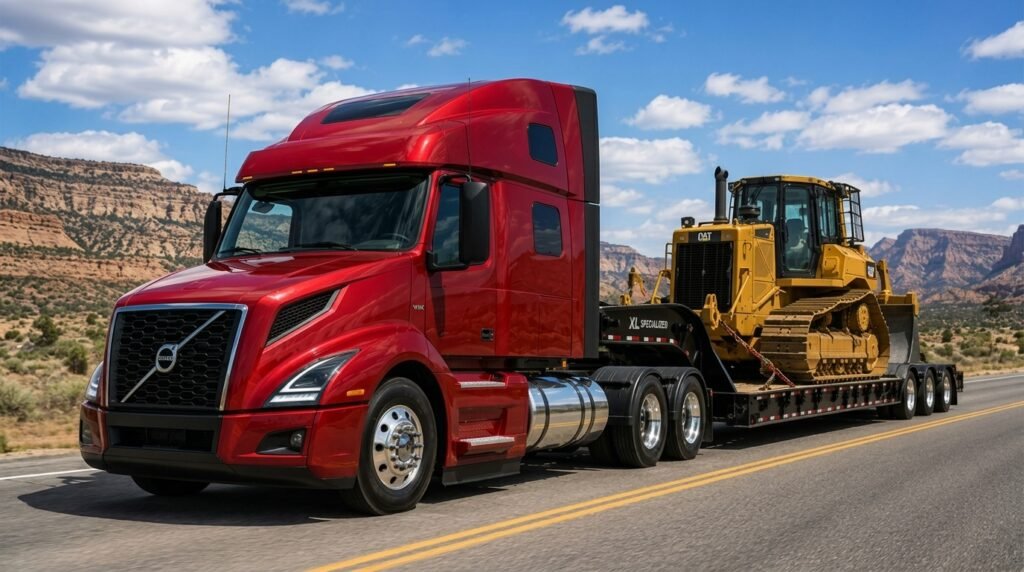
Volvo VNX 300 vs. 440 vs. 640: Understanding the Differences
Volvo built three configurations because vocational and heavy-haul work does not share a single cab requirement. A driver shuttling aggregate between a quarry and a plant all day has no use for a bunk, while a driver moving a lowboy with an excavator across several states needs a place to sleep and a truck that can legally and mechanically carry the load. The three cabs reflect that spectrum, and the published ratings climb with them. All three can be specified with axle-forward or axle-back layouts, Truck News reported, and the figures discussed below are the maximums listed in Volvo’s official VNX specifications, not the ratings of every truck built under each model name.
The VNX 300 is the day cab, offered as either a tractor or a straight truck. A tractor pulls a trailer through a fifth wheel or pin, while a straight truck carries its body on its own frame, which is how concrete mixers, dump bodies, and roll-offs are typically built. That dual availability is the reason the 300 can serve local heavy haul, agriculture, waste handling, and recycling from a single cab. Volvo’s published D13 range for the 300 is 405 to 450 horsepower, with a maximum stated torque of 1,700 lb-ft. Its model-specific gross combination weight rating, the weight of the truck and trailer together, reaches up to 180,000 lb. Front axle capacity goes up to 18,000 lb and rear axle capacity up to 40,000 lb, and ground clearance reaches 11 inches. The center tow-pin rating is 70,000 lb and each tow hook is rated at 35,000 lb. Those last numbers describe the strength of attachment points used for recovery and towing, which matters on a site where a stuck truck is a routine event, but they say nothing about how much the truck may carry. The 300 also gets a 10-inch driver information display, with an optional 7-inch infotainment center.
The VNX 440 adds a 42-inch sleeper and, like the 300, comes as a tractor or a straight truck. A bunk of that size is a regional-haul tool: it suits logging operations, equipment delivery, and runs long enough to require an occasional night away from home but not a team’s worth of living space. Volvo lists its D13 at 450 to 500 horsepower and a maximum torque of 1,850 lb-ft, with a GCW rating of up to 200,000 lb. The front axle goes up to 20,000 lb and the rear up to 46,000 lb. Ground clearance reaches 12 inches, which matters for logging roads and rough staging areas where a low bumper or crossmember can end a trip. The center tow-pin rating is 88,000 lb, with tow hooks at 44,000 lb each. Inside, the 440 steps up to a 12-inch driver information display and an optional 9-inch infotainment center.
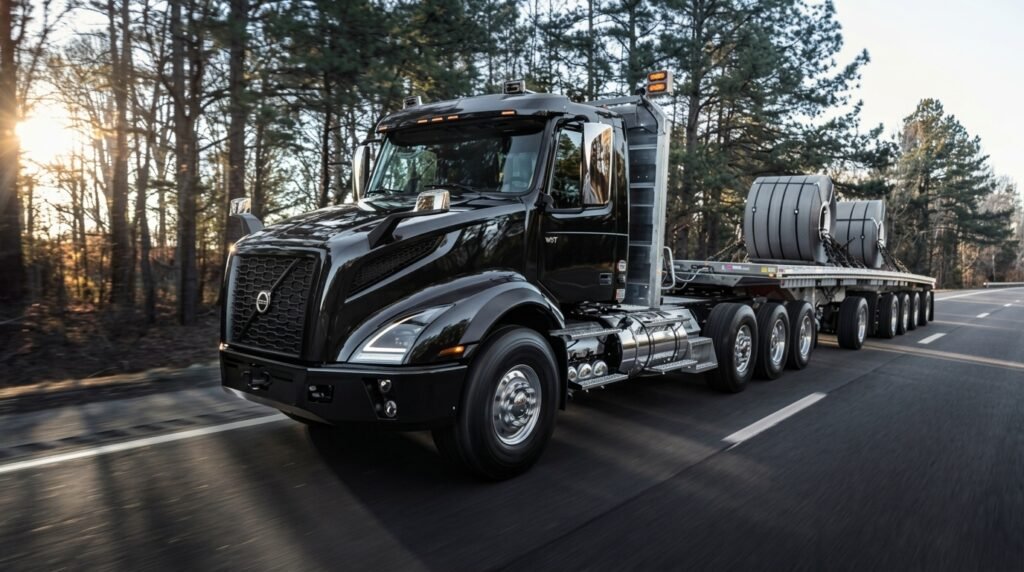
The VNX 640 is the long-distance heavy-haul configuration, a tractor-only truck with a 62-inch mid-roof sleeper. This is the truck Volvo used at its launch event to haul one of Volvo Construction Equipment’s large excavators, as Heavy Duty Trucking reported. Its D13 range is 500 to 540 horsepower, with up to 1,950 lb-ft of torque, the highest figures in the family. The model-specific GCW rating in the detailed specifications reaches up to 210,000 lb, with front axles up to 22,000 lb and rear axles up to 52,000 lb. Ground clearance goes up to 13 inches. The center tow pin is rated at 90,000 lb and the tow hooks at 45,000 lb each. It shares the 12-inch display and optional 9-inch infotainment center with the 440.
The pattern across the three is deliberate, but it is easy to misread. Volvo’s broader marketing describes the family as capable of up to 200,000 lb or more with application approval, while the detailed table lists 210,000 lb for the 640, and the prudent reading is that the model-specific table governs, with approval depending on how the truck is actually built. Horsepower and torque rise as the weight ratings rise, which makes sense, but the numbers can mislead a buyer who treats them as a ladder. A 640 is not automatically the right truck for a job just because its figures are largest. A fleet running dump trailers in a short cycle would pay for a sleeper it never uses, and a heavy-haul carrier needs the right axle arrangement, suspension, and permits long before it needs the biggest engine rating. Volvo lists axle arrangements including 4×2, 4×4, 6×2, 6×4, 6×6, 8×2, 8×4, and 8×6 across the family, but not every arrangement is available on every variant.
Specifications alone cannot decide the choice. Duty cycle, trailer type, route terrain, body weight, and the legal limits of the jurisdictions involved all shape what a given truck can do, and several of them sit entirely outside the spec sheet. The differences between the three models are best understood as a sorting mechanism for the first decision, which is how much cab and how much capability the work requires, with the second decision, the exact specification of that truck, still ahead.
The D13 Engine and I-Shift Transmission
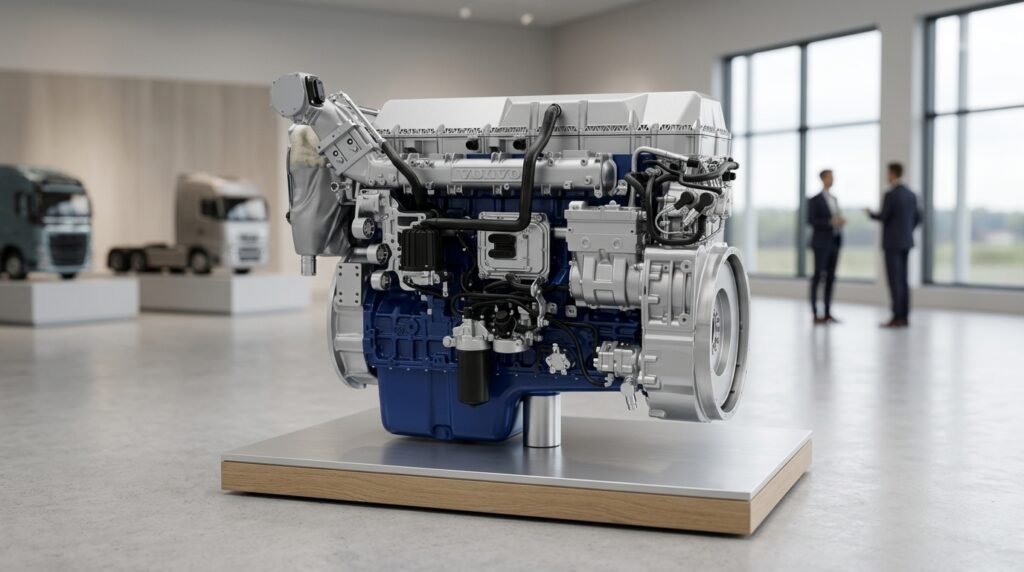
Every VNX uses the Volvo D13, a 13-liter diesel. Across the family, Volvo lists 405 to 540 horsepower and up to 1,950 lb-ft of torque. Truck News reported that this is the new EPA 2027 version of the engine, an increase over the previous D13’s maximum of 500 horsepower and 1,850 lb-ft, and that unlike Volvo’s other North American models, the VNX will be offered only with the 2027 powertrain, with no legacy-engine option.
It helps to separate what the two main numbers do. Horsepower is the rate at which the engine can do work, and it matters most for sustained speed under load, such as holding a pace on a long grade. Torque is the twisting force at the crankshaft, and it matters most when starting a heavy combination from a standstill. Neither number reaches the ground without the transmission, which multiplies torque through its gear ratios. That is why a heavy-haul truck’s gearing matters as much as its engine rating, and why the engine and transmission are specified together.
Volvo pairs the D13 with its I-Shift automated manual transmission, and the official specifications list 12-, 13-, and 14-speed configurations depending on the specification. Truck News emphasized the 13- and 14-speed versions with crawler gears, which are extra-low ratios for very slow, controlled movement. The publication reported that the ultra-low crawler gear can hold roughly 0.6 mph at 520 rpm, which is useful for work such as road milling or curb installation, where the truck must creep steadily while another machine does the actual work. The same report said the updated I-Shift shifts up to 30% faster. That is a Volvo-supplied figure reported at the launch, without a stated comparison baseline or test conditions, so it should be read as a manufacturer claim. Equipment World added that the transmission has selectable drive modes, grade and load sensing, and enhanced PTO capability. A power take-off, or PTO, is a driveline connection that lets the engine run auxiliary equipment such as hydraulic pumps for a dump body or mixer drum, and available PTO options vary by model and application.
Engine braking is the area where the VNX 640 stands out. Volvo advertises up to 630 braking horsepower, which Truck News reported as an increase from 500. That figure describes retarding force, the engine’s ability to slow the truck by acting against its own motion, and it is not additional propulsion power. The distinction matters on steep descents with heavy combinations. Service brakes convert motion to heat, and when a loaded truck descends a long grade on service brakes alone, they can overheat and fade. Volvo’s John Moore told Truck News that on extreme negative grades it is important to use as much of the engine brake as possible, which is exactly the situation the larger figure is meant to address. Whether it delivers the same advantage in real operation is something only in-service experience will show.
Volvo has also claimed a 4% fuel-efficiency improvement for the new powertrain, according to Truck News. The sources reviewed do not say what that is measured against or under what conditions, so a buyer cannot use it as a planning number. Nothing in the available material allows a payload or acceleration figure to be inferred from horsepower and torque alone, and none is offered here.
Frame, Axles, and Weight Ratings
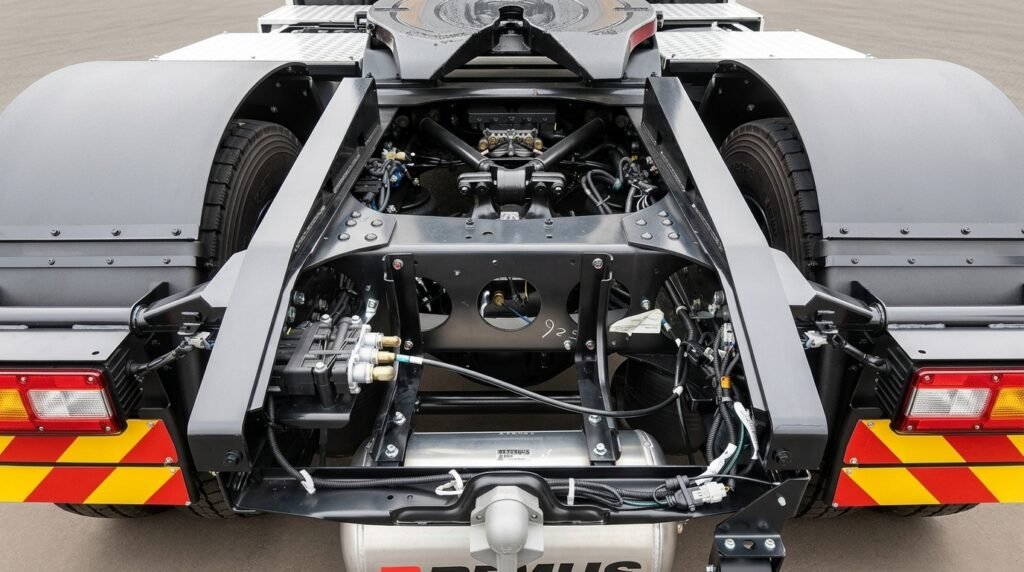
The chassis is where a vocational truck earns or loses its reputation. Volvo describes high-tensile-strength, heat-treated steel frame rails rated for 160,000 lb GVW, with higher ratings possible after application approval, a figure Truck News also reported. In front, an all-metal grille with steel mesh backing is meant to protect the radiator and other components from debris while keeping airflow, and a three-piece steel bumper accommodates frame extensions, attachments, and a center tow pin. The design logic is that on a job site, damage comes from rocks, equipment, and contact, and a bumper that can be configured in sections is easier to adapt to the body or attachment going on the truck.
Ground clearance and suspension work together here. Volvo lists VOAS, GRAS T-Ride, Volvo L76, Hendrickson HAS, and Hendrickson Haulmax suspensions. Truck News gave articulation figures for three of them: up to 17 inches for the mechanical T-Ride, 11 inches for the Global Rear Air Suspension, and 9 inches for the Volvo Optimized Air Suspension. Articulation is how far a suspension can move to keep the wheels in contact with uneven ground, and it matters because a wheel that loses contact stops providing traction and shifts load to the others. A mechanical suspension with more travel suits rough, broken terrain, while an air suspension generally trades some of that travel for a different ride. The sources reviewed do not provide comparable figures for the other options, so this review does not claim any.
How the truck is prepared for the body matters as much as the truck itself. Vocational trucks often leave the factory as incomplete chassis, and a body builder then installs a mixer, dump body, crane, or hydraulic system. Volvo kept the top of the frame rails clear behind the cab, offers pre-drilled mounting holes, and left the back of the cab uncluttered, according to Truck News, which also described optional batteries mounted under the passenger seat to free rail space and multiple air, DEF, and fuel tank configurations. Volvo’s specifications identify a 29-pin BodyLink connection and dedicated body-builder electrical provisions, and a toolless passenger-side panel provides access to fuses and the body-builder electrical center. Every hour a body shop does not spend rerouting wiring or relocating components is an hour the truck spends earning, which is why these provisions matter to a fleet even though they never appear in an engine rating.
The weight vocabulary deserves careful treatment, because confusion about it produces expensive mistakes. GVW is the gross weight of the truck itself, including its body and load. GCW, or GCWR when expressed as a rating, is the weight of the truck and trailer together. Axle ratings are the capacity of each axle, and loads must be distributed within them. Center tow-pin and tow-hook ratings describe the strength of those fittings, typically for recovery or towing. Payload and legal weight are different again, set by the truck’s configuration, the body weight, and the limits of the roads and jurisdictions involved. A buyer who reads a 210,000 lb GCW as the weight the truck can legally haul, or a 90,000 lb tow-pin rating as a payload figure, could end up with a truck that is wrong for the job or illegal on the route. Component ratings and application approval have to be considered together, and Volvo’s own phrasing about approval for higher ratings makes clear that the published maximums are not a blanket permission.
Remote Steer: Driving the Truck From Outside the Cab
Remote Steer is the feature most likely to be remembered from this launch. It lets an operator steer the truck while standing outside the cab, at speeds up to 5 mph. Heavy Equipment Guide described it as the first vocational truck in North America available with remote control, and Volvo aims it at concrete mixers, crane trucks, vacuum trucks, and other work that demands precise placement in tight spaces.
The problem it addresses is familiar to anyone who has watched a large truck back into a confined site. Truck News quoted Volvo brand ambassador Rob Simpson describing the standard method, in which a spotter guides the driver, and the failure points are communication, confusion over whose left and right, and misjudged distance. A spotter can see the obstacle but cannot control the truck, and the driver can control the truck but cannot see the obstacle. Remote Steer puts both in one person, standing where the hazards are visible. Truck News reported an operating range of roughly 50 yards, and Volvo’s Moore noted the operator needs to be close to the truck to see what is around it.
The applications extend beyond concrete. Truck News said Moore sees potential in heavy-haul tractors that must align precisely with specialized trailers, and that Volvo hopes eventually to integrate body controls with the system. The mixer example is the most concrete one: positioning a chute over a pour area is exactly the kind of low-speed, high-precision job where a slightly different angle changes the result.
It is important to be precise about what this is. Remote Steer is operator control, not autonomous or self-driving technology. A person remains responsible for the truck, the speed is capped, and the range is short. It does not remove the responsibility to assess the surroundings, and it adds a new one: the operator is now on foot near a moving truck. The sources reviewed describe the system at the level of a launch demonstration, so how it performs across daily operation, in rain, mud, or crowded sites, is not yet known.
Terrain Brake and the Low-Speed Control Features
Terrain Brake addresses a different hazard, the unintended movement of a truck on uneven or sloped ground. Truck News described it as automatically stopping the truck when the driver releases the accelerator on difficult terrain, working forward or in reverse. Volvo describes it as designed to stop sudden forward or backward movement on rugged ground and as responding faster than a driver can apply the service brakes under the conditions Volvo outlines.
The hazard is real in vocational work. A loaded truck on a steep, loose, or rutted surface can roll or lurch when the driver lifts off the pedal, especially after a gear change or direction change, and a few feet of unintended movement near equipment or people is enough to cause a serious incident. The value of an automatic system is that it does not depend on the driver’s reaction time. The limits are equally clear. Terrain Brake does not eliminate the need for ordinary braking procedures, safe operating practice, or attention to the ground, and the speed advantage Volvo cites applies to the specific conditions it describes, not to every situation.
Truck News described several related functions that borrow from Volvo’s wheel loaders and other construction machines. Change Direction lets a driver reverse the direction of travel without first applying the service brakes, with the system managing the braking and the transition between forward and reverse gears. Power Launch delivers controlled maximum driveline torque to help a loaded truck start on a steep, slippery, or uneven surface while limiting wheelspin and driveline stress, and Auto Hold prevents rollback on an incline until the driver applies the accelerator. Together with the crawler gears discussed earlier, they show a design philosophy in which low-speed behavior is treated as a first-order requirement and not an afterthought. The sources reviewed describe these functions as presented at the launch, and independent evaluation of how well they work is not yet available.
Safety, Visibility, and Driver Assistance
Volvo calls the VNX the safest vocational truck it has built. That is a statement of the company’s intent, not an independent rating, and no crash or safety-test results for the truck appear in the sources reviewed. What the sources do describe is a layered set of features. Volvo Active Driver Assist, or VADA, includes forward collision warning, automatic emergency braking, and forward pedestrian detection, with enhanced VADA Plus functions available. Volvo states that its pedestrian-detection system scans from 23 to 230 feet in the operating context it describes. That matters in a vocational environment, where workers on foot share space with heavy vehicles in a way highway drivers rarely face, and where a truck moving slowly can still cause grave harm.
Blind-spot detection is available on both sides, with visual and audible warnings, and lane-departure warning is included with additional lane-support features optional. On a job site, those lane features matter less than on a highway, but on a heavy-haul route between sites they do real work. Visibility is addressed more physically as well. Truck News reported that the designers reshaped the upper dash to improve downward visibility of the ground just ahead of the truck, and that its test truck carried Volvo’s camera monitoring system, which can be specified alongside taller conventional mirrors for heavy-haul applications, with downward-facing and backup cameras for maneuvering. The sources do not establish a standard 360-degree camera system, so none is claimed here. Volvo Dynamic Steering is also available to reduce steering effort and help stabilize the truck over uneven surfaces, which Truck News’s editor experienced on the test course, and emergency-call capability is listed.
Structural safety rests on the cab. Volvo’s launch release says the cab uses one-third more Ultra High Strength Steel than its legacy vocational products, a claim that is Volvo’s and cannot be independently confirmed from the sources reviewed. Airbag equipment needs conservative handling. Volvo’s launch narrative describes driver-side curtain airbags as standard, while the product-specific summary lists side-curtain airbags as optional or available for certain configurations. Because those descriptions disagree, this review does not state one airbag specification for every VNX, and a buyer should confirm the equipment list for the exact configuration.
The optional windshield is a safety and durability feature in its own right. Truck News reported that the Corning Fusion Five Tough Shield windshield uses modified borosilicate laminated safety glass developed with Volvo, and that Corning says it offers roughly twice the resistance to sharp impacts and thermal shock and five times the scratch resistance of a conventional windshield. At the launch event, Corning fired 1.5-inch ice balls at about 70 mph at the glass, which withstood repeated impacts. That was a staged demonstration, and the figures are Corning’s and Volvo’s, not independent laboratory findings. The practical argument is that smaller, localized damage may avoid the spreading cracks that force a replacement and that scratching can cause glare at night. The counterweight is cost: Truck News noted Volvo had not yet provided the replacement price, which fleets will need before judging the option.
Cab Design, Sleeper Options, and Driver Comfort
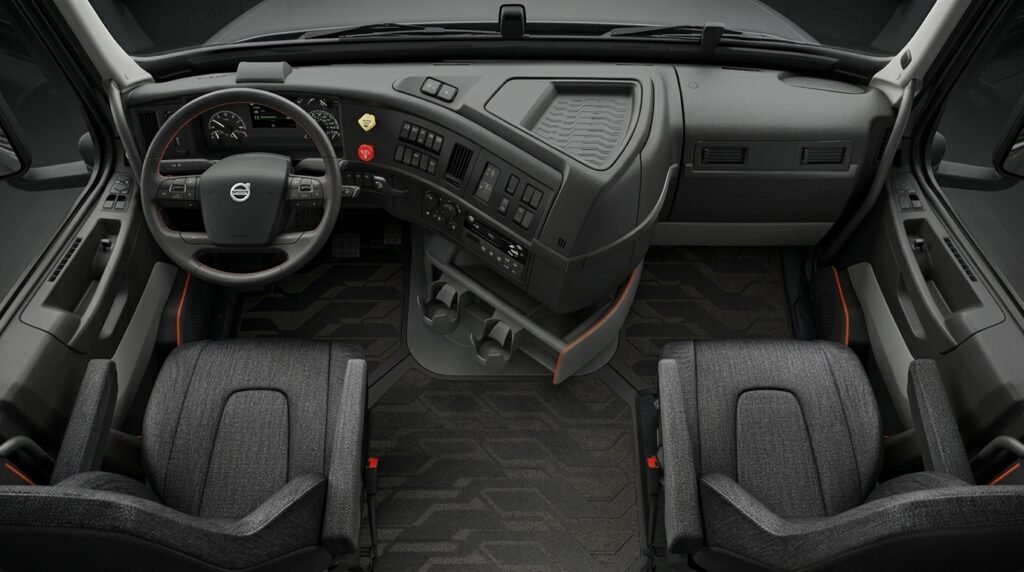
The three cabs serve different working lives, and the differences are as much about schedule as about space. The day cab on the VNX 300 assumes the driver goes home every night, so its interior is built around the working day: the 10-inch driver information display, durable materials, and the controls a driver reaches for constantly. The 42-inch sleeper on the 440 supports occasional overnights on regional work, and the 62-inch mid-roof sleeper on the 640 serves drivers who spend several nights a week in the truck. The 440 and 640 share a 12-inch display and an optional 9-inch infotainment center, while the 300 offers an optional 7-inch unit, and Apple CarPlay and Android Auto are supported.
How the cab handles controls matters more in a vocational truck than the screen sizes suggest. Truck News reported that Volvo’s designers deliberately kept physical switches that drivers can find by feel, because adjusting a touchscreen menu on a bouncing truck is frustrating at best and distracting at worst. The switch banks can be rearranged, and because the electrical architecture recognizes each switch’s function regardless of position, a fleet can set a consistent layout across trucks so drivers do not relearn the cab when they change vehicles. Other details reflect the same thinking: modular floor mats designed to catch mud, dirt, and snow, removable and repositionable cup holders, and a reshaped map pocket that is easier to reach and less likely to catch an elbow as the seat moves over rough ground. Volvo identifies seat options from X1 through X5, and offers two interior trim levels. Core emphasizes durable, easy-to-clean materials, while Edge Black adds brushed satin metallic finishes, soft-touch surfaces, and a leather-wrapped steering wheel.
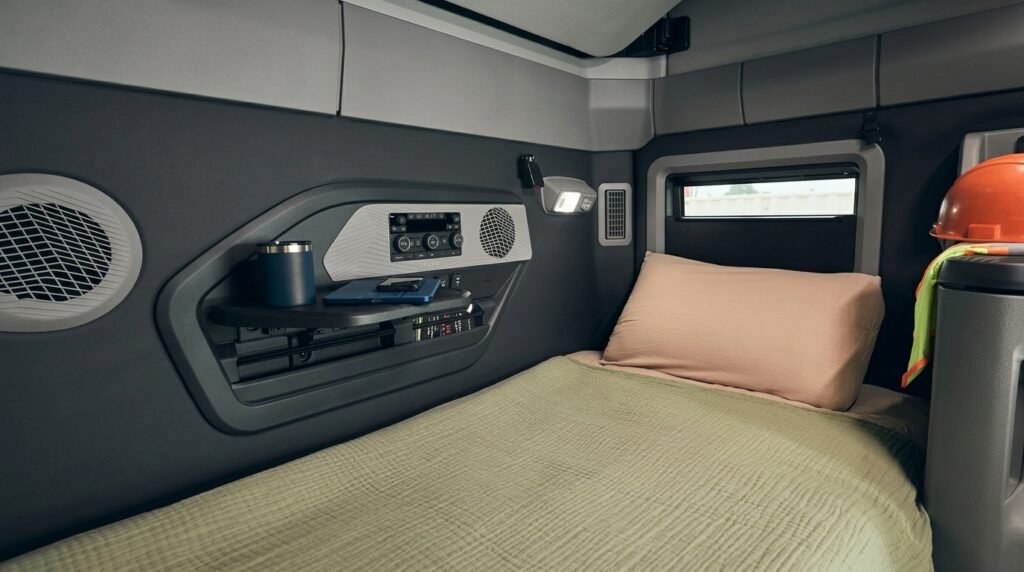
On the sleeper side, Volvo’s sleeper page frames the design around recovery, a sensible emphasis for heavy-haul drivers whose hours are long and whose work is physically and mentally demanding. It lists spacious bunk options, with a reclining mattress available on the VNX 640, enhanced insulation to reduce outside noise and improve comfort, and an optional sleeper upgrade that Volvo says provides 82% more insulation. That figure is Volvo’s, and the page does not give the baseline or any sound measurements, so it should not be read as a quantified noise reduction. Blackout curtains and window shades block light for daytime sleep, and climate-management features are meant to hold a comfortable cab temperature while cutting idle time and fuel use. Idle-free parking heaters in 2 kW and 6 kW versions are available for cold nights, which matters because running the main engine all night to stay warm costs fuel and adds engine hours.
The only independent impression in the sources reviewed comes from Truck News, whose editor drove a VNX 640 around a test course at Volvo’s Shippensburg, Pennsylvania facility with a combination weighing about 80,000 lb. He reported that the cab stayed quiet enough to hold a conversation over rough sections and that the ride was smooth for a heavy-haul truck with a mechanical rear suspension, and he noted that he still instinctively looked to the conventional mirrors despite the camera displays. The publication was explicit that the short drive was not enough to evaluate the truck under the most demanding heavy-haul conditions. A launch-event drive on a prepared course cannot establish long-term comfort, durability, or real-world fuel economy, and nothing in this review claims it does.
Connectivity and Fleet Operations
Every new VNX comes with a factory-installed 4G telematics gateway, according to Volvo and Heavy Equipment Guide. That hardware is what makes the connected services possible, and its value is largely about time. Remote Diagnostics monitors fault codes and, when a problem arises, lets Volvo’s support staff and the servicing dealer see what is happening before the truck reaches the shop. Volvo’s 2013 launch material described this kind of service as helping technicians prepare repair instructions and parts before arrival, and the idea remains the same: a truck that arrives with a known problem and the right parts on the shelf spends less time on a lift.
Remote Programming extends the idea to software. Updates to software and parameters can be delivered over the air instead of requiring a dealer visit, which for a fleet with trucks scattered across job sites can avoid pulling vehicles out of service for a routine update. Volvo Connect provides reporting on fuel efficiency, location, and safety, which gives fleet managers data to plan around, and Volvo Action Service is described by Volvo as providing 24/7 support across the United States and Canada. FleetOwner noted that the lineup uses Volvo’s 24V electrical architecture, shared with the VNL and VNR.
The practical decisions these tools touch are real ones. A maintenance manager can use diagnostic data to decide whether a truck should keep working or come in, order parts ahead of a repair, schedule service around a job instead of in the middle of it, and watch how each truck is being operated. Volvo has claimed that updated trucks can reduce unplanned stops by up to 25%. That is a Volvo-stated claim, and nothing in the sources reviewed validates it independently, least of all a brief launch report. The size of any benefit would depend on the fleet, the duty cycle, the quality of dealer support in the region, and how consistently the data is acted on, so it would be unwise to assume equivalent results for any given operator.
From the 2013 Original to the 2026 Redesign
The VNX name has now been used for three different trucks, and the earlier figures belong to those trucks, not this one. Volvo introduced the original VNX in March 2013 as a heavy-haul tractor built around a new 16-liter D16 engine rated at 600 horsepower and 2,050 lb-ft, paired with the I-Shift. The company described it for applications up to 225,000 lb, including long combination vehicles, equipment hauling, logging, oil field, and mining work, and offered it in 6×4 and 8×4 configurations with front axles from 16,000 to 20,000 lb and rear axles from 46,000 to 52,000 lb. It used Volvo’s full-size day cab, and its signature features were a honeycomb grille and a steel bumper with a center tow pin.
The 2018 generation reorganized the line into three cabs and designations: the VNX 300 day cab, the VNX 400 flat-roof 42-inch sleeper, and the VNX 740 with a 70-inch sleeper. The standard powertrain was a D13 at 500 horsepower and 1,850 lb-ft with the 13- or 14-speed I-Shift, and a Cummins X15 Performance Series engine was available at up to 605 horsepower and 2,050 lb-ft behind an Eaton transmission. Volvo stated approved GCWR from 125,000 to 160,000 lb, with up to 225,000 lb available with application approval and appropriate components, and offered 6×4 tandem, 8×4 tandem, and 8×6 tridem arrangements.
What changed in 2026 is as notable as what continued. The designations became 300, 440, and 640, with the 440 and 640 replacing the 400 and 740 and the 640’s sleeper shrinking from 70 to 62 inches. The D13 now covers the whole range, and the D16 and the Cummins X15 figures from earlier generations do not apply to the new truck, since none of the sources reviewed list them for it. The straight-truck option on the 300 and 440 signals a broader vocational scope than the tractor-oriented earlier models. What continued is the heavy-haul purpose, the I-Shift, the emphasis on a strong frame and a center tow pin, and the idea that remote diagnostics and over-the-air updates belong on a work truck. Volvo has not explained its reasons for the changed configuration strategy in the sources reviewed, and this review does not speculate.
Price, Availability, and the Cost of Ownership
A buyer cannot sensibly evaluate a commercial truck without a price, and the VNX does not yet have a public one in the sources reviewed. No MSRP, starting price, or range was published, and the replacement cost of the optional Tough Shield windshield has also not been disclosed. That leaves a purchasing decision incomplete in a basic way. A fleet cannot calculate payback, compare financing, or weigh the optional equipment against its cost until a quote exists, and anyone offering a figure before Volvo does is guessing.
The timing is also unsettled. Volvo’s announcement reportedly gave October 26, 2026 as the start of sales, and since this article’s research cutoff is October 17, 2026, that date is still in the future. Other coverage points in different directions. FreightWaves reported that Volvo said it would announce the start of sales later this year, and Truck News reported that production is expected to begin in mid-2027. Those statements may refer to different milestones, such as the opening of orders, the start of sales, and the start of production, and a truck can be orderable long before it is built. But the sources reviewed do not reconcile them, and this review does not invent an explanation. A buyer should ask a Volvo dealer which milestone the October 26 date represents and when a truck ordered now would be delivered.
Beyond price and timing, the evidence that normally informs a purchase is missing. Real-world fuel economy depends on configuration, payload, route, terrain, gearing, idle time, and driving style, and no figure exists for this generation. The 4% claim lacks a stated baseline. Reliability is the largest unknown. A truck introduced days ago has no multi-year record, and Truck News’s brief launch drive, however favorable, was not designed to test durability. Maintenance cost and resale value are equally unestablished, and the latter will take years to develop.
What a buyer can do is evaluate the factors that will decide the outcome. Fuel consumption should be judged against the intended duty cycle, not a brochure. Maintenance requirements and intervals should be compared once published, along with how much downtime a repair actually causes. Body integration should be judged by how much work the body builder needs to do. Dealer and parts access in the operating region matters as much as the truck, particularly for a manufacturer with a modest share of the vocational market. Optional equipment such as the windshield and sleeper insulation upgrade should be priced against their benefits, and insurance and expected resale value belong in the total. These are general purchasing considerations, not verified VNX figures.
How the Volvo VNX Fits Among Other Heavy-Duty Trucks
A comparison with other trucks only makes sense where the jobs overlap, and no head-to-head test data exists in the sources reviewed. The closest relative is Volvo’s own VHD, a long-serving vocational truck. The VNX is the newer platform, shares its architecture with the VNL and VNR, and extends Volvo into a broader range of vocational and heavy-haul work, but which of the two suits a given operation depends on the application and the rating required, not on a simple hierarchy.
Among competitors, Haulizo’s Kenworth C500 review covers a severe-duty chassis built for demanding applications, which makes it a relevant reference for readers weighing heavy-haul and specialized work. The Western Star 4900 review covers another heavy-duty vocational platform with its own range of configurations. Both are useful starting points for understanding how other manufacturers approach demanding work, but neither should be treated as an equivalent of a particular VNX model, since configuration, vocation, and rating decide whether a comparison is meaningful.
The distinction becomes clearer with trucks aimed at other missions. The Peterbilt 389X review covers a limited-edition, highway-oriented truck, a different proposition from a vocational platform built around body-builder access and jobsite capability. The Mack Anthem review covers a truck aimed more directly at regional and highway hauling, which sharpens the contrast with a truck whose features include remote steering and crawler gears. Even further from the VNX is the medium-duty International CV515, included here only as a reminder that the commercial-truck market spans very different duty classes and is not a direct Class 8 competitor.
For buyers deciding whether the VNX fits their operation, the choice begins with the work itself. The VNX 300 is suited to local vocational applications, while the VNX 440 adds a 42-inch sleeper for regional hauling and equipment delivery. The VNX 640 is designed for long-distance heavy haul, with a 62-inch sleeper and the highest stated engine output in the family. Across the lineup, the Volvo D13 delivers between 405 and 540 horsepower, with maximum stated torque ranging from 1,700 to 1,950 lb-ft. Published GCW ratings reach 180,000 lb for the 300, 200,000 lb for the 440, and 210,000 lb for the 640, although the ratings available on an individual truck depend on its configuration and application approval. Features such as Remote Steer, forward collision warning, automatic emergency braking, pedestrian detection, and available blind-spot monitoring add to the truck’s vocational capabilities, but the exact equipment should be confirmed when specifying a vehicle.
The remaining questions concern ownership rather than basic capability. As of October 17, 2026, no public price or verified real-world fuel economy figure for the new generation was available in the sources reviewed, and its long-term reliability has yet to be established through years of service. Volvo announced October 26, 2026, as the sales-start date, while other reports refer to production beginning later, so prospective buyers should confirm ordering and delivery timing with a Volvo dealer. Ultimately, the VNX should be evaluated against the demands of the intended job, including body or trailer requirements, axle configuration, terrain, legal weight limits, dealer support, fuel use, and maintenance costs. Its specifications establish what the platform is designed to offer; operating experience and configuration-specific pricing will determine how well that capability translates into value for an individual fleet.