5 Tractor Box Blades for Grading, Leveling, and Driveway Maintenance
How width, weight, and hitch category decide which box blade your compact tractor can actually handle

A gravel driveway rarely fails all at once. Rain pushes fines downhill, tires polish a washboard pattern into the surface, and shallow ruts hold water until they turn into potholes. Tractor box blades are one of the few attachments that address all of this in one pass. They loosen compacted ground, carry loose material, and drop it where it is needed. That makes them useful on farm lanes, small acreage, and rural property, and for grading, leveling, and soil preparation around a home or barn.
The widest or heaviest box blade is not automatically the right one. A box blade hangs off the rear three-point hitch, so the tractor has to be able to lift it, carry it, and stay stable while it works. This article looks at five box blades sold on Amazon and explains the hitch, weight, and lifting questions that decide whether one suits a given compact tractor.
Our Take
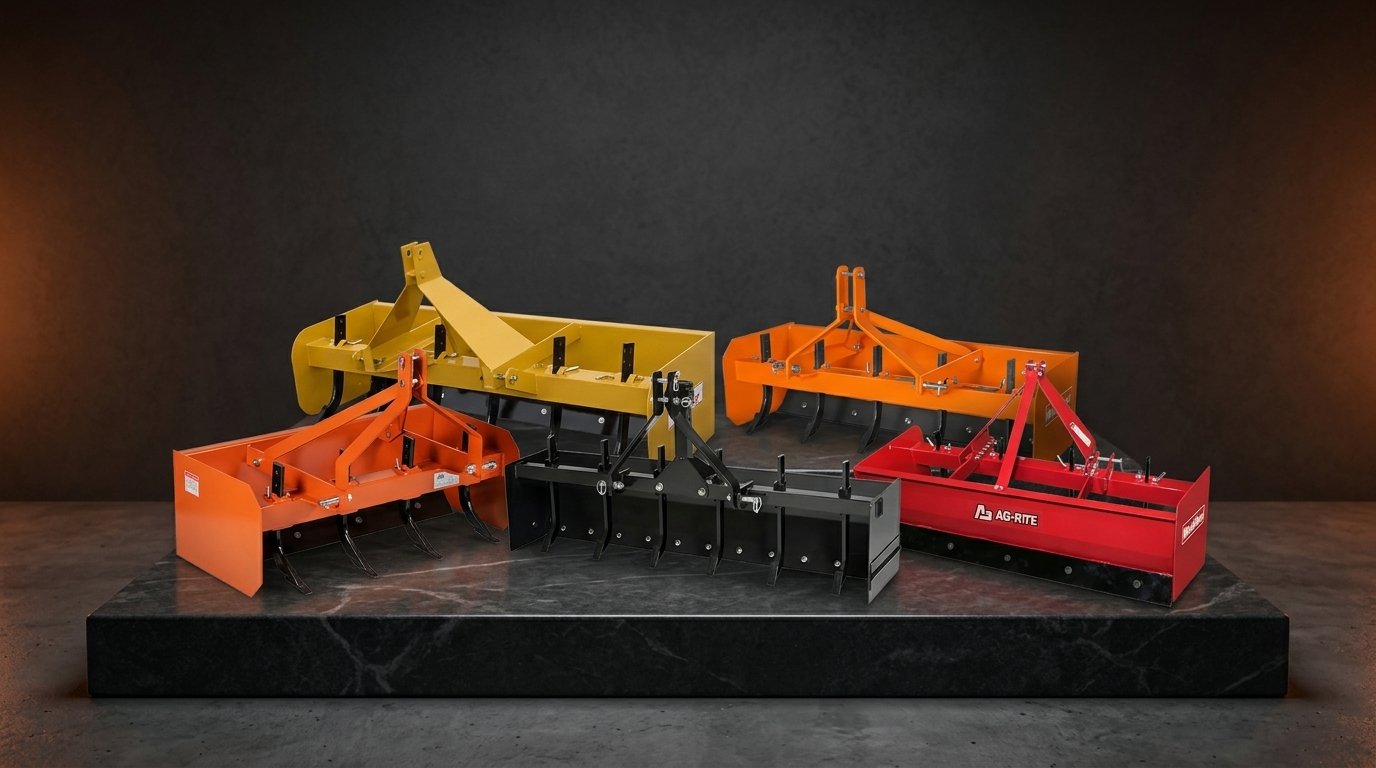
The five implements covered here differ more than their similar names suggest. The Impact Implements 55″ is a Category 0 attachment with a manufacturer-listed weight of 135 lb. The Titan Attachments 4 FT is listed for both Category 0 and Category 1 hitches and weighs approximately 300 lb. The Ag-Rite 60″ and MechMaxx BB60 are both 60-inch Category 1 blades, but the MechMaxx has five shanks and a net weight of 379 lb. The King Kutter BB-72 is the widest at 72 inches, but its manufacturer page gives no weight or horsepower recommendation.
Those differences matter more than any single headline number. The right choice depends on the tractor, its hitch, its lifting ability, and the work you actually do. None of these is a universal pick.
What Is a Tractor Box Blade and How Does It Work?
A box blade is an open-bottomed steel box with a cutting edge at the front and another at the rear. Scarifier shanks, sometimes called ripper shanks, are heavy teeth mounted on the implement that can be lowered into the ground or raised clear. Because the box is enclosed on its sides, material that gets cut or loosened stays inside and moves with the tractor instead of spilling out, as it can with a simple blade.
Two jobs are worth separating. Scarifying means loosening hard or compacted ground, such as a driveway surface packed down by years of traffic or a lane that has turned to hardpan. The shanks fracture that surface so it can be reshaped. Grading is different. It means moving loose material, whether gravel, soil, or the surface you just scarified, from high spots to low ones. The cutting edges shave and carry, and the box holds the load until you lower it into a depression and let it release.
In practice the two jobs often go together. You might rake a washboard driveway with the shanks, then raise them and pull material back toward the center. Filling a rut means carrying material from a nearby high area, and leveling a small patch of ground comes down to cutting and filling in short passes. How well the implement does this depends heavily on how well its weight, width, and settings suit the tractor pulling it.
What to Consider Before Choosing a Tractor Box Blade
Working width and weight are linked. A wider implement covers more ground per pass, but it also tends to be heavier and demands more from the tractor. A blade much wider than the tractor’s rear tires can be awkward in tight spots and can swing sideways on uneven ground. A very wide blade may be more than a subcompact tractor should be asked to lift, even if the hitch connection appears to line up.
Engine horsepower and PTO horsepower are different numbers, and neither settles the question. Engine horsepower is measured at the engine, while PTO horsepower is what reaches the power takeoff shaft, so the two should never be treated as interchangeable. A box blade is not driven by the PTO, so PTO horsepower says little about it. Engine horsepower affects how hard the tractor can pull through resistance, but lift capacity and stability usually decide whether a heavy rear attachment is practical. A published range such as “16–35 HP” describes a general fit and does not prove that a particular tractor can safely lift and operate the implement.
Lift capacity must be read carefully. Manufacturers measure rear lift capacity at different locations. Some publish a figure at the lift points, meaning the ends of the lower link arms. Others publish a figure 24 inches behind those points, which is lower because the load is farther back and the leverage is worse. A number measured at one location cannot be compared directly with a number measured at the other. And even when a published capacity exceeds an implement’s weight, that does not establish that the tractor can use it safely. Weight distribution, how far back the implement’s center of gravity sits, hitch geometry, and the load of material in the box all change what the tractor must handle.
Hitch category is not a detail. Three-point hitches are grouped into categories based on pin sizes and the spacing between the lower hitch points. Category 0 is the smallest and is meant for the lightest tractors. Standard Category 1 is the most common size on compact tractors. Some tractors, including the John Deere 1025R, carry a hitch Deere designates as Limited Category 1. Limited Category 1 should not be treated as identical to standard Category 1, so the implement’s hitch dimensions should be confirmed against the tractor manual and with the implement maker. A Category 0 attachment should likewise not be treated as interchangeable with a Category 1 implement, and a manufacturer-approved adapter is the only reasonable route if you try to bridge the two.
Shanks and cutting edges affect how the blade works. More shanks, and more adjustment positions for them, give you more control over how aggressively you break up the ground, but they also add weight and resistance. Reversible, replaceable cutting edges extend the life of the implement, since the edges wear faster than the rest of the steel.
Ballast and stability matter as much as lifting. A heavy rear implement shifts weight to the back of a tractor and can lighten the front end, which affects steering and braking. Front ballast, such as a loader or weights, may be necessary, and the tractor’s manual is the place to find what is recommended. Quick-hitch compatibility can make connecting easier, but it can also change how far back the load hangs.
Finally, match the implement to the work. A tractor that mostly smooths a short gravel drive does not need the same equipment as one that regularly breaks up compacted farm lanes.
Five Tractor Box Blades for Grading, Leveling, and Driveway Maintenance
King Kutter BB-72

- 20in. specially formed self-cleaning moldboard
- 2 high carbon steel reversing cutting edges (one front and one rear)
- Heavy-duty, heat-treated ripper shanks with replaceable heat-treated teeth
The BB-72 is the widest implement here, with a 72-inch working width. According to the King Kutter product page, it has six ripper shanks, a 20-inch specially formed self-cleaning moldboard, and two reversible high-carbon-steel cutting edges, one at the front and one at the rear. The ripper teeth are replaceable and heat-treated, and the shanks can be set in four positions using adjustment holes. The hitch is listed as Category 1 with quick-hitch compatibility and a clevis hitch.
A 72-inch blade covers a driveway or farm lane quickly, and six shanks give meaningful control over how deeply you scarify. The adjustable positions help when surfaces vary in hardness, and the self-cleaning moldboard is designed to keep material moving through the box.
The main caution is size. The manufacturer page does not provide a weight or a recommended tractor horsepower for this model, and neither is supplied here. Without those figures, a buyer should confirm the implement’s weight with King Kutter before deciding whether a compact or subcompact tractor can lift and carry something this wide. Working width, lifting ability, and ground conditions all need to be weighed together.
Titan Attachments Standard Series – 4 FT

- 7 FT BOX BLADE SCRAPER: The 7 FT Box Blade Attachment is an essential lawn tractor implement intended for various jobs, …
- REVERSIBLE CUTTING EDGES: You will receive two reversible, replaceable, curved cutting edges with your purchase. The cut…
- SCARIFIER TEETH: This device packs a punch, using seven powerful scarifier teeth. These heavy-duty teeth cut and tear th…
The Titan is the narrowest of the Category 1 options, at roughly 48 inches nominal working width and a listed overall width of 48.75 inches. According to the Titan product listing, which is a distributor listing rather than a manufacturer page, it has four adjustable scarifier shanks, reversible and replaceable curved cutting edges, adjustable and replaceable scarifier teeth, and heavy-duty square-tube shank support. The hitch is pin-style, and the listing states Category 0 and Category 1 compatibility.
The listing also shows a 45 HP machine rating. That is a figure published in the listing and should not be read as a minimum horsepower requirement.
The narrower width is the draw for tight driveways, short farm lanes, and small leveling jobs where maneuvering matters. Curved cutting edges are generally intended to help material roll through the box, and the replaceable parts keep maintenance simple.
Weight deserves attention. The listing gives approximately 300 lb, which is more than twice the Impact Implements blade. On a smaller compact or subcompact tractor, that is a meaningful load behind the rear axle. The dual Category 0 and Category 1 listing also does not remove the need to check pin sizes and hitch geometry against your own tractor.
Impact Implements 55″ Box Scraper

- CAT 0/CAT 1 USE: The Impact Implements Box Scraper comes with an integrated Cat-0 adapter but is robust enough for large…
- SIX ADJUSTABLE RIPPER TINES: The Impact Implements Cat-0 Box Scraper includes six fully adjustable and replaceable rippe…
- REVERSIBLE WEAR BAR: The Impact Implements Box Scraper Blade has a reversible and replaceable blade wear bar to protect …
Impact Implements builds this blade for Category 0 systems. The manufacturer’s page lists a 55-inch working width and a weight of 135 lb, along with front and rear cutting edges. It describes uses including grading, filling ruts, backfilling, driveway and farm-lane maintenance, and soil management. Other listings show a different weight, but the manufacturer’s 135 lb figure is the one used here.
The low weight is the obvious advantage for lighter tractors with Category 0 hitches. A lighter box scraper puts less strain on a small lift system and suits lighter work like smoothing a gravel drive, backfilling, and filling shallow ruts. Front and rear edges let it cut in one direction and carry or spread in the other.
The warning is the hitch. This is a Category 0 attachment, not a standard Category 1 implement, and it should not be assumed to fit the John Deere 1025R, Kubota BX23S, Massey Ferguson 1GC.25, or New Holland Workmaster 25S. Pin sizes, geometry, and any manufacturer-approved adapter need to be checked before buying.
Ag-Rite 60″ Box Blade
- HEAVY-DUTY BOX BLADE: Built from durable 4 mm (.15 in.) steel, designed for demanding land management tasks including dr…
- 60-INCH WORKING WIDTH: The 5-foot working width covers more ground with every pass to improve efficiency when grading dr…
- 4 ADJUSTABLE SCARIFIER SHANKS: Loosen compacted soil and hard-packed gravel before grading to improve material movement …
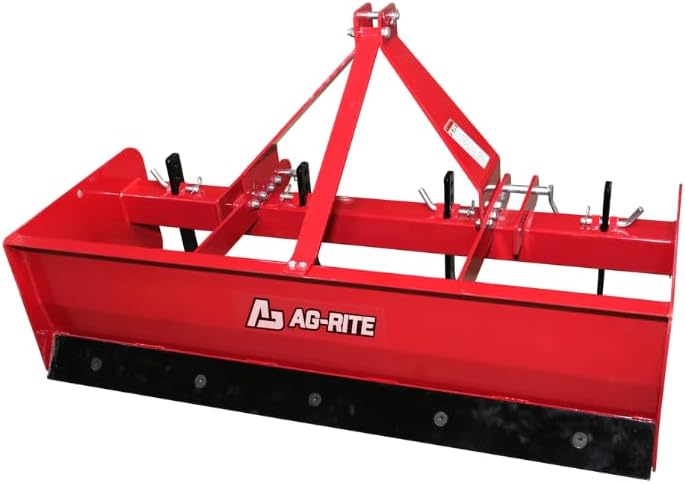
The Ag-Rite is a 60-inch Category 1 blade. According to the published product specifications, which come from a distributor listing, it has four adjustable scarifier shanks, 4 mm steel thickness, and a weight of 320 lb. The listing gives a tractor horsepower range of 16–35 HP and describes uses including driveway grading, gravel redistribution, land leveling, soil preparation, and landscaping.
A 60-inch width sits between the narrow Titan and the 72-inch King Kutter, and it can be a sensible size for a driveway wider than a single narrow pass. Four shanks are enough for loosening typical gravel surfaces and breaking up moderate compaction.
The horsepower range is attributed to the published specifications. It is not evidence that every tractor in that range can safely lift and operate the blade. At 320 lb, the implement is heavy enough that a smaller compact tractor’s lifting capacity, ballast, and stability become real concerns, and the listed weight should be compared with the tractor’s capacity as measured at the correct location.
MechMaxx BB60 – 60″ Box Blade

- Adjustable Ripper Shanks: Easily tear through tough soil and rocks, varying the depth for different tasks.
- Reversible Steel Cutting Edges: Front and back blades for forward and reverse work, doubling cutting life.
- Heavy-Duty Frame: Strong welds and powder-coated finish protect against corrosion and rough use.
The BB60 has the most detailed published specifications of the group. The MechMaxx product page lists an overall width of 60 inches, depth of 28 inches, and height of 33.8 inches. It has five scarifier shanks measuring 1.26 × 18.5 inches, built from Grade 50 heat-treated steel, and two cutting edges measuring 0.4 × 6 inches. The moldboard is 17.1 inches high. The hitch is Category 1 and quick-hitch compatible, and MechMaxx recommends a tractor of 20–50 HP.
Net weight is 379 lb. The gross shipping weight is 417 lb, but the net figure is the one that reflects the implement itself.
Five shanks put more teeth in the ground than the Ag-Rite’s four, which can help on hard or compacted surfaces. The tradeoff is resistance and weight. At 379 lb, this is the heaviest listed implement with a confirmed weight, and that matters for smaller tractors, where a heavy rear load can strain the lift system and reduce front-end stability. The recommended horsepower range, like the others, is a general guide and does not confirm that a particular tractor can lift and operate it.
Matching Box Blades to Compact and Subcompact Tractors
Four compact and subcompact tractors show how the specifications interact. None of this confirms that any specific box blade fits any specific tractor, and nothing here should be read as saying all five implements suit all four tractors. It shows what to compare.
Start with the hitch. The John Deere 1025R review covers a tractor that Deere lists with a Limited Category 1 hitch, 23.9 gross engine horsepower, and 18.2 PTO horsepower. Its rear three-point lift capacity is 758 lb, measured 24 inches behind the link arms. The distinction between Limited Category 1 and standard Category 1 is the most important point for this tractor. Limited Category 1 is not automatically identical to standard Category 1, so a Category 1 box blade should not be assumed to connect or work properly without checking hitch dimensions against Deere’s documentation and with the implement manufacturer. A Category 0 blade like the Impact adds a second layer of uncertainty.
The Kubota BX23S review covers a tractor with an SAE Category 1 hitch. On the BX23S, the rear three-point hitch is optional equipment, and Kubota’s detailed specifications publish two lift figures that apply when the tractor is equipped with that hitch: 1,213 lb at the lift points and 680 lb 24 inches behind them. The gap between those two numbers is a reminder of why measurement location matters. The 1,213 lb figure is not the right number to compare with a rear-mounted implement’s weight, and a tractor without the optional hitch cannot use any of these blades at all.
The Massey Ferguson 1GC.25 review covers a tractor that Massey Ferguson lists at 24.5 rated engine horsepower and 18.5 PTO horsepower, with a Category 1 hitch and 661 lb of lift capacity 24 inches behind the lift points. That is the lowest of the three 24-inch figures in this group, so implement weight deserves the closest attention here.
The New Holland Workmaster 25S review covers a tractor that New Holland lists with 24.7 gross engine horsepower, 17.2 PTO horsepower, a Category 1 hitch, and a published three-point lift capacity of 992 lb. That figure should not be presented as a capacity measured 24 inches behind the hitch points, and it should not be compared directly with the 24-inch numbers for the other tractors unless the measurement locations are confirmed to be equivalent.
What do these numbers say about choosing a box blade? Engine horsepower is the least useful figure. A box blade is a ground-engaging implement, and a tractor’s published engine horsepower or implement horsepower range does not tell you whether it can lift the blade and stay stable under load. Lift capacity, read at the right measurement point, is more informative, but it is still only a starting point. The Titan, Ag-Rite, and MechMaxx weigh approximately 300, 320, and 379 lb, while the published 24-inch figures for the Deere, Kubota, and Massey Ferguson are in the 600-to-800 lb range. A capacity larger than the implement’s listed weight is not an approval. A box blade filled with gravel, a slope, and a lightly loaded front end all reduce the margin. The King Kutter’s 72-inch width adds another reason for caution on a subcompact, and its manufacturer page gives no weight to check.
The practical advice is to start with the tractor manual, which states the hitch category, the lift capacity and where it is measured, and any limits on rear implement weight or ballast. Then ask the implement maker or seller to confirm the exact hitch dimensions, weight, and any tractor requirements. If the two do not agree, or either is unclear, do not guess.
Practical Applications and Operating Considerations
Gravel driveway maintenance usually starts with deciding whether the surface needs scarifying or only regrading. If it is compacted, set the shanks shallow, make a pass, then raise them and use the cutting edges to redistribute the loosened material. Going too deep on the first pass can pull up base material you did not intend to move.
Correcting washboard surfaces means cutting off the ridges and filling the valleys. Washboarding often develops from traffic and speed acting on loose gravel, so fixing it is a matter of reshaping the surface and redistributing material so it stays in place.
Filling shallow ruts is a cut-and-fill job. Take material from a nearby high spot or the shoulder, carry it in the box, and lower the implement over the rut to release it. Several short passes tend to work better than trying to fill a deep rut in one go.
Redistributing gravel follows the same idea. Material migrates toward the edges and low spots, and dragging it back toward the center can restore the crown that helps water shed off the drive.
Leveling small areas and preparing ground for landscaping rely on consistent passes. The box carries material from high spots to low ones, and the shanks can loosen firm soil first. Where ground is wet, rocky, or heavily compacted, results vary a lot.
Four factors largely decide the outcome. Scarifier depth controls how aggressively you break the surface. Cutting-edge position, adjusted by tilting the implement with the top link, changes whether it cuts or carries. Ground conditions determine how much resistance the tractor faces. And working speed matters because a slow, steady pace generally gives the box time to fill and release material evenly, while going too fast can leave a rough surface and add stress to the tractor and hitch.
Whatever the job, follow the tractor and implement manuals for setup, operating limits, and safety. If anything about hitch, weight, or stability is uncertain, resolve it before the first pass.
Conclusion
The five box blades here differ in width, weight, hitch category, and what their manufacturers publish. The Impact Implements 55″ is the lightest and the only one built for Category 0. The Titan is the narrowest of the Category 1 options and carries a meaningful 300 lb. The Ag-Rite and MechMaxx share a 60-inch width with different weights, shank counts, and published horsepower ranges. The King Kutter offers the widest working width but publishes no weight or tractor recommendation.
Tractor compatibility matters more than choosing the widest or heaviest implement. The right box blade is the one that matches your tractor’s hitch, lifting capability, physical dimensions, and intended workload. A larger blade is no better if the tractor cannot lift it, and one that does not fit the hitch is no bargain at any price. Before buying, check the manufacturer’s specifications and the listing for the exact model, hitch category, and stated weight, and if anything is unclear, ask the implement maker or a tractor dealer first.