Scania 770S V8 Review Engine Specs Power and Heavy Haul Capability
An in depth review of Scania’s high output V8 tractor, examining its engine, drivetrain, sleeper cab, heavy haul engineering, and operating considerations.

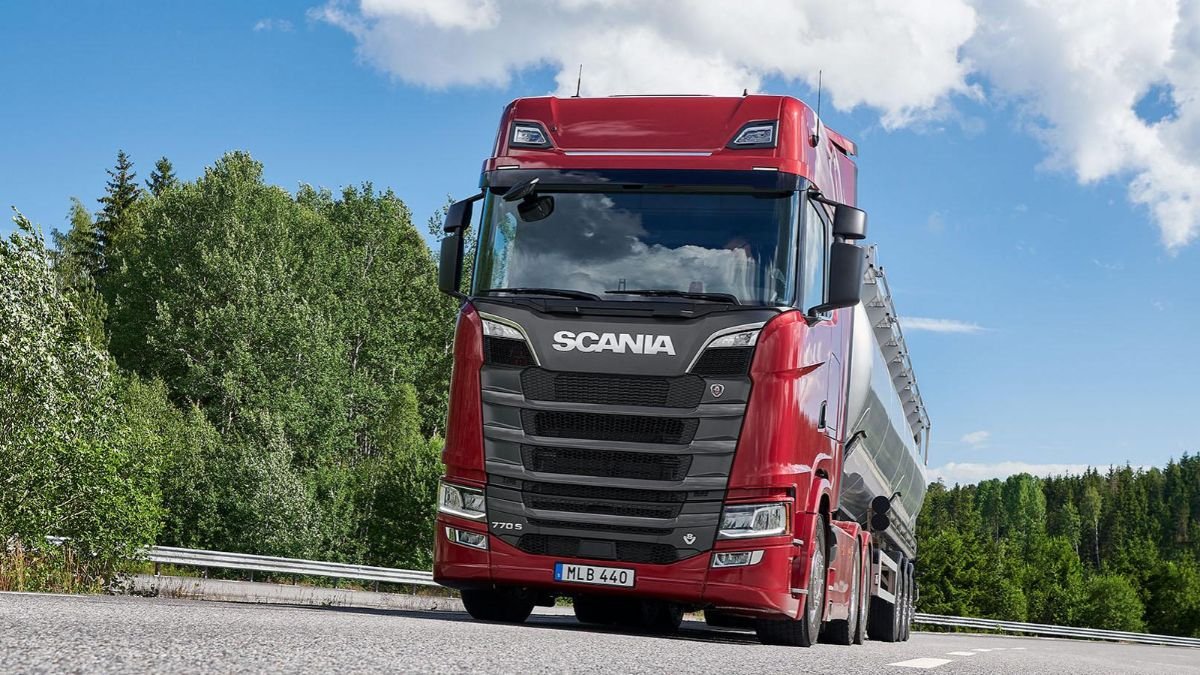
Scania 770S V8 is the name for the top of Scania’s S-Series tractor range, a sleeper cab semi truck built around a 16.4 liter, 90 degree V8 diesel. The engine produces 770 hp and 3,700 Nm of torque, roughly 2,730 lb ft. American readers are used to inline six diesels of about 13 to 15 liters, so the layout alone stands out. The Scania DC16 123 displaces about 1,001 cubic inches. It reaches peak torque between 1,000 and 1,450 rpm, which is where a heavy combination spends much of its working life when it leaves a dock or climbs a grade.
The truck draws attention for more than its headline numbers. Heavy haul operators care about how an engine behaves at low speed under load, how a drivetrain manages a very large gross combination weight, and how well a driver holds up after a long day. Enthusiasts care about the engineering, and a large displacement V8 in a modern tractor is rare. Scania pairs the engine with an S-Series cab designed for long distance living, so the 770S is as much a driver’s workplace as a pulling machine. It is an international market truck. Its engineering is easiest to understand in terms American readers already know, as long as the general S-Series characteristics stay separate from the equipment on any one heavy haul build.
Scania 770S V8: Our Take
This assessment rests on Scania’s published specifications rather than a road test. The most interesting thing about the 770S V8 is how it uses displacement. Scania’s V8 range has long been associated with torque at low engine speed, and the 770 hp version extends that idea with peak torque available from 1,000 rpm. The engineering logic is simple. Torque at low rpm gives the transmission more freedom to hold a taller gear on a grade, and it lets the engine move a heavy load without being revved hard. That is why torque matters more than the horsepower figure on this truck, and why it appeals to operators whose work is defined by weight rather than speed.
The premium sleeper cab supports the same long distance mission. The Mack Anthem, another heavy duty tractor Haulizo has examined, is a US market truck aimed at regional haul work. Set beside it, the Scania takes a very different engineering path. It has a V8 at the top of its range and an S-Series cab with a flat floor, a high roof option, and sleeper arrangements built for extended time away from home.
The limitations are as clear as the strengths. A 770 hp engine is not economically necessary for every fleet. Scania lists S-Series powertrains from 370 to 770 hp across its sleeper cabs, and an operation that rarely needs the top torque reserve may be better served by a lower rated engine. Many of the most detailed specifications also belong to a particular heavy haul build, not to every 770S, and that distinction matters throughout the technical picture.
Scania 770S V8 Engine and Powertrain
The DC16 123 is a 16.4 liter, 90 degree V8. A V8 fits that much displacement into a shorter engine than an inline layout would need, which matters in a cab over design where the engine sits beneath the cab. Scania introduced the 770 hp engine in 2020 as the top of a four engine V8 range. According to the history of Scania’s 770 hp V8 development, that generation brought a complete powertrain update with a new gearbox, an improved turbocharger, reduced internal friction, and an improved SCR aftertreatment system. Those are the manufacturer’s descriptions, and they frame the engine as part of a redesigned system rather than a bigger version of an older one.
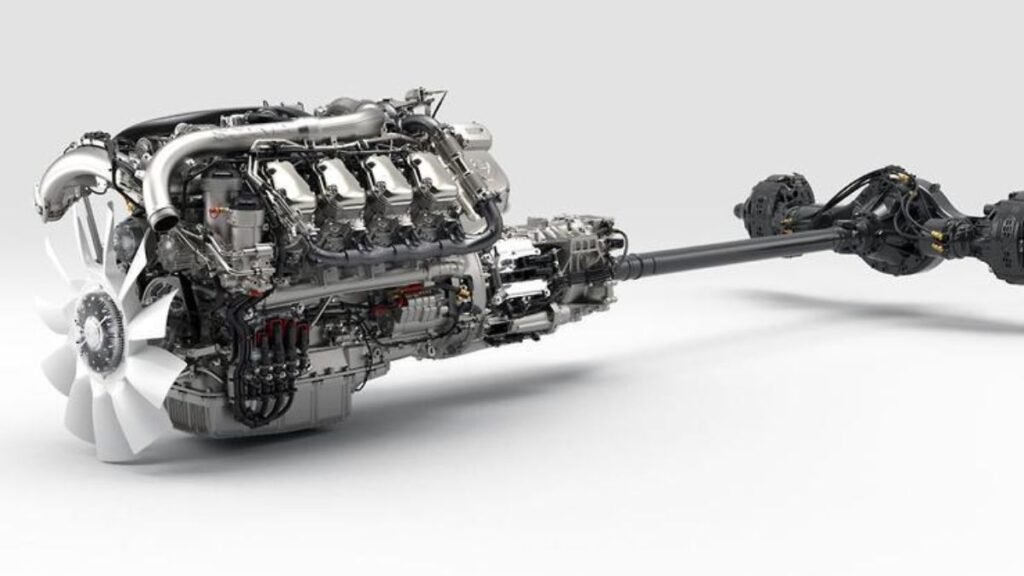
Scania’s published output is 770 hp, which corresponds to 566 kW. Under the US mechanical horsepower convention, 566 kW works out to approximately 760 hp. The 770 designation is a metric horsepower figure, so the model name stays as Scania uses it while the conversion gives American readers a fair comparison with domestic ratings. In Scania’s 2025 heavy haul specification, maximum power arrives at 1,800 rpm. Maximum torque is 3,700 Nm, about 2,730 lb ft, held across a range of 1,000 to 1,450 rpm. A broad torque band means the engine can pull a load across many speeds without constant downshifting, which reduces how often the transmission has to intervene. Scania also lists an engine PTO rating of 800 Nm, approximately 590 lb ft, for powering hydraulic pumps and auxiliary equipment. That is a separate figure from crankshaft torque and applies only to power taken off the engine.
Air and fuel delivery follow a conventional high output pattern. The engine uses Scania XPI high pressure fuel injection, which allows precise control of injection timing and pressure. The heavy haul configuration has four valves per cylinder, a fixed geometry turbocharger, and a charge air cooler. A fixed geometry turbocharger has no moving vanes, so it avoids that mechanical complexity. The charge air cooler lowers the temperature of compressed intake air so more of it fits into each cylinder.
Emissions control uses Scania SCR, selective catalytic reduction, which injects a urea solution into the exhaust to convert nitrogen oxides into nitrogen and water. The referenced heavy haul truck is specified to Euro 6, a European standard that is not the same as US EPA certification. The engine is listed for diesel and HVO. HVO is hydrotreated vegetable oil, a renewable paraffinic diesel fuel. Scania’s compatibility information for this engine lists diesel and HVO, so it should not be assumed to accept every biodiesel blend.
Engine braking matters on a truck like this. The heavy haul configuration lists exhaust brake output of 300 kW at 2,400 rpm, about 402 mechanical horsepower of retarding power. On a long downhill grade with a heavy combination, a strong engine brake carries much of the work of holding speed. That keeps the service brakes cooler and available for the moments when they are really needed.
Scania 770S V8 Performance and Heavy Haul Capability
Torque characteristics shape nearly everything about how this truck works with a load. Peak torque from 1,000 rpm lets a heavy combination start moving without high engine speed, and it helps the truck hold a gear on a grade rather than shedding speed and dropping several ratios. On the highway, the same low speed torque lets the engine run slowly in a high gear. Acceleration under load still depends on combination weight, gearing, and grade, and no acceleration time or top speed figure should be inferred from the power rating alone.
The gearbox is central to this behavior. Scania identifies its Opticruise G38CM and G38CH gearboxes as available for the highest output 770 hp engine, and the company describes the wide gear spread as making it possible to optimize the rear axle ratio for low engine speed at cruising speed without compromising starting ability. More detail on the powertrain philosophy is on the Scania V8 powertrain page. Scania’s 2025 heavy haul 770S uses the G38CH, a heavy duty 14 speed transmission with crawler gearing and overdrive. Its lowest gear ratio is 20.81:1, its highest is 0.78:1, and the total spread is 26.81. A planetary reversing arrangement provides up to eight reverse gears in that configuration. Available transmissions vary with the vehicle configuration and assignment, so no one gearbox describes every 770S.
The numbers translate into practical behavior. Crawler gears multiply torque at the wheels, allowing a very heavy combination to start and maneuver slowly and with control. The 0.78:1 overdrive lets the engine turn slower than the driveshaft at highway speed. Opticruise is an automated transmission, so the system selects gears and manages engine speed, which takes variable shifting technique out of the equation. That matters most when a driver is tired or when conditions change quickly under a heavy load.
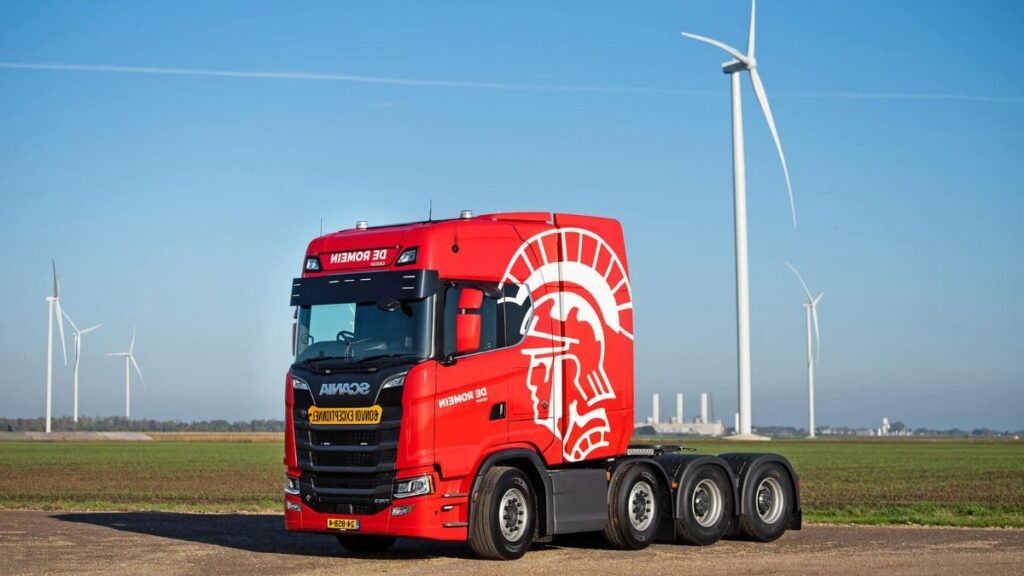
Traction management completes the picture. Differential locks keep the wheels on an axle turning together, so one slipping wheel cannot take all the power on a wet or loose surface. Traction control works at the brakes and engine to limit wheel spin. These systems matter most in the unpredictable ground conditions that heavy haul work can involve.
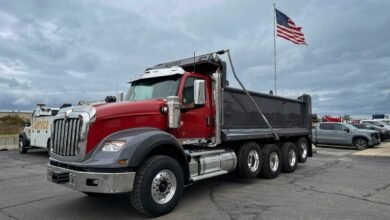
For readers who follow demanding heavy duty applications, the International HX620 offers a useful contrast. It is a Class 8 severe duty vocational truck, not a long haul sleeper tractor, and it is not a direct Scania competitor. The comparison shows how the heavy haul world divides between specialized vocational builds and highway tractors, and where the 770S falls between them. It combines a long distance sleeper cab with a drivetrain capable of heavy specialized work.
Scania 770S V8 Cab and Chassis
The S-Series cab is Scania’s premium long distance offering, and the Scania S-Series cab is built around a flat floor with no traditional engine tunnel. Inside a sleeper, that flat floor lets a driver move between seat and bunk without stepping over a raised hump, and it makes the space feel more like a room than a corridor. The high roof heavy haul specification provides 2,070 mm of standing height, about 81.5 inches, and accommodates up to two sleeping berths. For the S-Sleeper Highline, Scania lists a lower bed of 800 to 1,000 mm, about 31 to 39 inches wide, and an upper bed of 700 or 800 mm, about 28 or 31 inches. Interior length is 2,060 mm, about 81 inches. Cab dimensions and equipment depend on the selected cab configuration and market, so these figures should not be read as standard on every 770S.
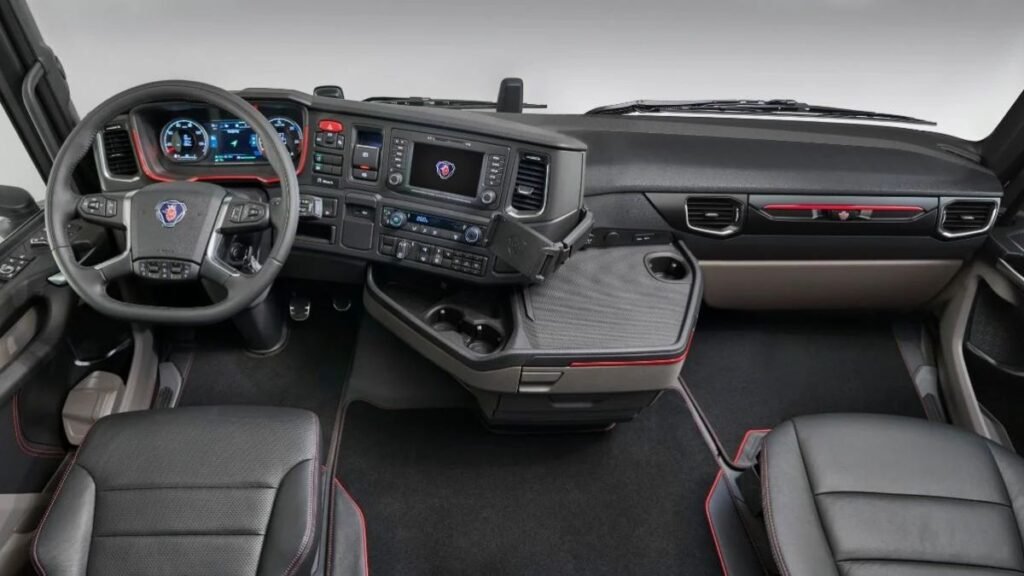
Scania describes the driving position as the starting point of the cab’s design. The driver’s seat sits in an improved position, the side window is lowered, the glass area is larger, and the dashboard is lowered slightly to improve forward visibility. A larger display, improved graphics, and intuitive controls round out the dashboard. Seating includes reclining functions and adjustment for finding a driving position, and storage includes interior compartments plus a fridge and freezer that can be customized. Climate control uses an improved system with better insulation, integrated auxiliary heaters, and coolers, and interior lighting is designed to support both work and rest. These features matter because rest quality affects how drivers perform over a long trip, though how well any of them work in practice is something only extended use can show.
The chassis side depends heavily on application. Scania offers multiple tractor and rigid chassis configurations across its V8 range, and axle layouts are specified by assignment, so not every configuration is available on every 770S. Scania’s 2025 heavy haul example uses an 8×4/4 layout with a high roof S-Series sleeper cab and a 3,950 mm axle distance, about 155.5 inches. It carries a heavy duty fifth wheel and a front axle rated at 9,000 kg, about 19,842 lb. The rear axle assembly is rated at 32,500 kg, about 71,650 lb, spread across three rear axles. These are European component ratings for one specialized truck, not American GVWR or GCWR figures and not universal specifications for all 770S tractors.
Each component has a job. Parabolic front springs give a controlled ride with fewer leaves than a conventional multi leaf spring, and rear air suspension protects the load and the driver from road shock. Hub reduction drive axles gear the torque down at the wheel ends, so the axle shafts and differential handle less torque for the same force at the road. A liftable pusher axle adds load capacity when needed and can be raised when running light. Load transfer functionality typically moves weight onto the driven axles when extra traction is required. American readers will recognize the principle from vocational trucks like the Western Star 4900, where axle layout, suspension, and ratings are chosen around the job. The same example carries two 440 liter fuel tanks, 880 liters in total, about 232 US gallons, and that capacity belongs to this configuration alone.

Fuel Economy and Operating Costs
Fuel consumption on a truck with this much power cannot be read from the engine alone. Engine load, trailer type, gross combination weight, road grade, cruise speed, and aerodynamic drag all play a part. Rear axle gearing and tire selection change engine speed at a given road speed, and weather and driver behavior add further variation. A 770 hp engine pulling a very heavy combination over hilly terrain works in a very different part of its map than the same engine pulling a lighter load on flat road. No verified standardized US MPG figure exists for the 770S V8, and any fuel economy number would be a guess dressed up as data.
Scania does make an efficiency claim, and it needs careful reading. The company says its V8 powertrain, combined with the new Opticruise gearbox and a rear axle gear adapted for cruising in direct drive, can deliver fuel savings of up to six percent. The example it gives is a 590 hp truck in long haul operation in hilly topography, where the engine accounts for two percent, the gearbox for three percent, and the rear axle for one percent. That is a manufacturer comparison for a specific 590 hp configuration. It is not a measured saving for the 770S, and it should not be transferred to this truck.
Ownership costs deserve the same restraint. Scania says the new gearbox generation allows oil change intervals of up to one million kilometers, roughly 621,000 miles, but actual intervals depend on the application. Maintenance, parts, insurance, and resale all depend on market, configuration, and service network, and they cannot be reduced to a single American figure. The more useful question is whether the added power matches the work. A fleet that regularly moves very heavy combinations over demanding terrain may use the torque reserve every day. A fleet running lighter loads on gentler routes may pay for capability it rarely uses. The sensible comparison is between the actual hauling requirement and total operating economics, not between engine ratings.
Safety and Driver Assistance
Safety technology on a heavy truck centers on helping a driver stop, stay stable, and see. Systems relevant to this class include electronic brake control, stability control, advanced emergency braking, adaptive cruise control, forward distance alerts, lane assistance, blind spot monitoring, and driver attention support, depending on specification. Their value is in supporting an attentive driver, not replacing one. An alert that warns of a closing gap or a braking system that reduces collision severity lowers operational risk, but only when the driver is still doing the driving.
Equipment varies by model year and configuration, so none of these systems should be assumed standard on every 770S. Features also differ between earlier S-Series trucks and newer ones. The Scania Dynamic S-Series update brings aerodynamic changes, digital rear view mirrors, ambient lighting, an adjustable reclining bed, and a driver assistance package that Scania lists as including safe stop assist, forward distance alert, vulnerable road user braking, moving off inhibit, speed sign cruise control, and curve speed cruise control. Scania also states that the cab is engineered to high passive safety standards. Those updates belong to the Dynamic generation and should not be attributed to older trucks without confirming the specific vehicle.
The Scania 770S in the American Trucking Context
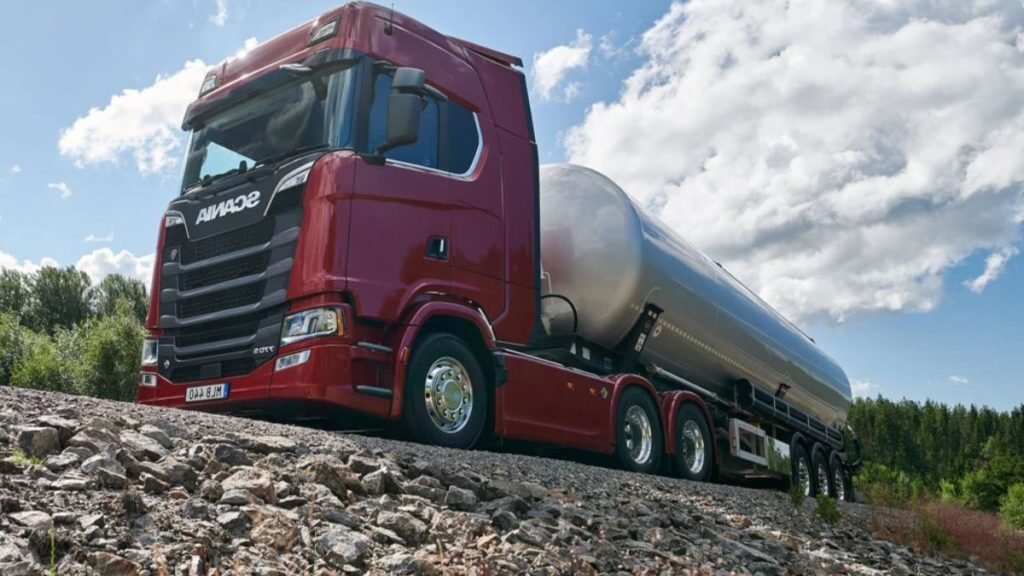
American readers should understand first that the 770S is an international market truck. Scania’s North American public product portfolio centers on power solutions and industrial applications, and the S-Series is not listed as a standard North American highway tractor. It should not be treated as an ordinary US dealer offering, and no US MSRP is established. Anyone interested in importing, certifying, or registering a Scania for US roads would need to verify those questions separately.
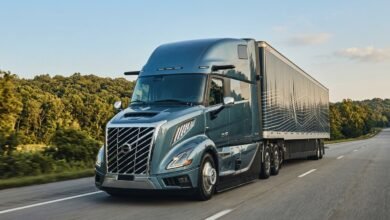
The engineering philosophy also differs from what most American long haul fleets run. The S-Series is a cab over engine design, a layout common in markets where overall length limits favor it. Most American highway tractors use a conventional hood. The Scania’s flat floor and high roof come from that cab over layout, and its large displacement V8 contrasts with the inline sixes of domestic tractors. The Volvo VNL long haul truck is an established American market reference for sleeper tractor design, and comparing its approach to premium sleeper accommodation and long distance operation shows how differently the two industries answer similar questions.
A global specification also cannot be treated as an American road legal specification. Euro 6 is not EPA certification. European axle ratings are not American legal axle ratings, GVWR, or GCWR, and US federal and state weight rules work differently. A heavy haul configuration that is legal and sensible in its home market may not satisfy American requirements without changes.
Conclusion
The Scania 770S V8 is a study in how far torque, gearing, and cab design can be pushed in one tractor. The 16.4 liter V8 delivers 770 hp and about 2,730 lb ft from 1,000 rpm, the Opticruise gearbox and its wide ratio spread let that torque work across heavy loads, and the heavy haul chassis adds axles, locks, and suspension built for weight. The S-Series sleeper cab supports the driver through a flat floor, a high roof, and real sleeping space. Against that, the engine is more power than many operations need, fuel economy cannot be stated for American conditions, and most specifics depend on configuration and market.
The operators who benefit most are heavy haul carriers in markets where Scania sells the truck, particularly those moving very heavy combinations over demanding terrain who use torque every day and who value driver comfort for retention. Fleets with lighter loads or flatter routes are better matched to a lower rated Scania engine or to a US specification tractor. For American enthusiasts, the 770S is a window into a different engineering tradition. As a purchase for US highway work, it raises questions of import, certification, and registration that have to be answered before the first mile.