Subcompact vs. Compact Tractors How to Choose the Right Size for Your Property
How PTO power, loader ratings, hydraulics, and hitch capacity should guide your choice, not acreage alone.


The question of subcompact vs. compact tractors usually comes up at an expensive moment: a dealer quote on the table, a list of attachments to price, and a property that does not fit neatly into either class. Picture one owner with four acres of lawn, garden beds, and a long driveway to maintain, and another with a single acre who needs to move gravel regularly and regrade a sloped access road. The first may be well served by a smaller tractor for years. The second may discover that a compact utility tractor is a better investment despite having less land.
Choosing by engine horsepower or acreage alone is how expensive purchasing mistakes happen. An undersized tractor can limit what an owner can lift, pull, and power, and those limitations often become apparent during the first demanding project. An oversized machine can increase the purchase price, attachment costs, and difficulty working around trees, fences, and narrow gates. Its additional weight may also be unnecessary for properties where protecting lawns and finished ground matters.
The right tractor size depends on the work the machine must perform, the implements it needs to operate, the materials it must move, its hydraulic capacity, and the type of terrain it will encounter. Future requirements matter too. A machine purchased for mowing and routine maintenance today may eventually need to handle heavier landscaping, livestock operations, or agricultural implements.
Six tractors already reviewed on Haulizo provide useful examples of how these differences affect practical ownership. The John Deere 1025R, Kubota BX23S, New Holland Workmaster 25S, and Massey Ferguson 1GC.25 represent the subcompact segment. The KIOTI CK3520 and Mahindra 1635 represent the compact utility segment. Their specifications help explain the differences between the two categories, although individual ratings must always be understood in the context of the model, transmission, attachments, and measurement method.
Our Take on Choosing Between Subcompact and Compact Tractors
Our practical advice is to size a tractor around the work you expect to perform regularly, rather than an occasional job that may never become part of your routine. If you move gravel every week, operate a heavy rotary cutter, or regularly lift materials, those tasks deserve more weight in your decision than a one-time project. The additional horsepower, lifting capability, hydraulic capacity, and operating weight of a compact tractor may justify its higher purchase cost.
On the other hand, a property owner who mainly mows grass, maintains garden areas, clears snow, and moves smaller amounts of mulch may gain very little from purchasing a substantially larger machine. A subcompact can be easier to maneuver, less demanding on finished lawns, and more practical around residential buildings and narrow access points.
There is also a financial consideration. Renting equipment for occasional excavation or hiring a contractor for a specialized job may cost less than purchasing a larger tractor that is unnecessarily difficult to maneuver during everyday maintenance. Buyers should consider their current workload, the attachments they genuinely expect to use, and the additional tasks they realistically anticipate over the next several years.
The best tractor is not necessarily the largest or most powerful one available. It is the machine that performs the owner’s regular work comfortably, has sufficient capacity for the necessary implements, and provides enough flexibility for future projects without adding unnecessary expense.
Subcompact vs. Compact Tractors: Understanding the Real Difference
Subcompact and compact tractors share many features, including diesel engines, four-wheel drive, front loaders, three-point hitches, and power take-off systems. However, their frames, operating weights, power outputs, lifting capacities, and intended applications create meaningful differences in how they perform.
Manufacturers do not use one universal horsepower threshold to define these categories. It is more useful to understand how each manufacturer positions its own machines and what their specifications reveal about their intended work.
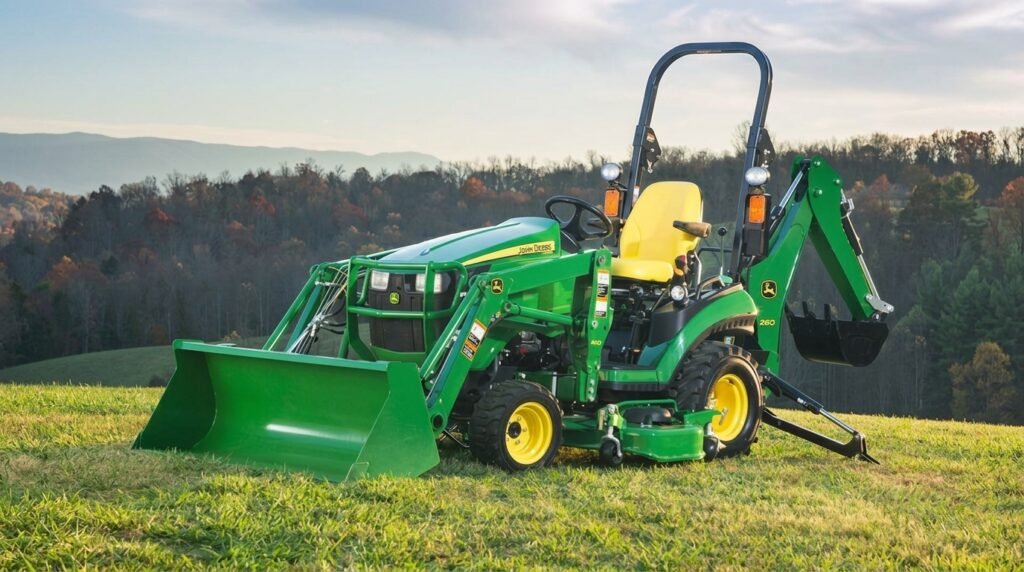
The John Deere 1025R is a subcompact tractor rated at 24 gross engine horsepower and 18 PTO horsepower. Its two-range hydrostatic transmission, relatively small footprint, and Limited Category 1 rear hitch make it appropriate for mowing, snow clearing, landscaping, and routine property maintenance. Its published base machine weight is 1,556 pounds. Our John Deere 1025R review examines its dimensions, loader performance, and practical limitations in greater detail.
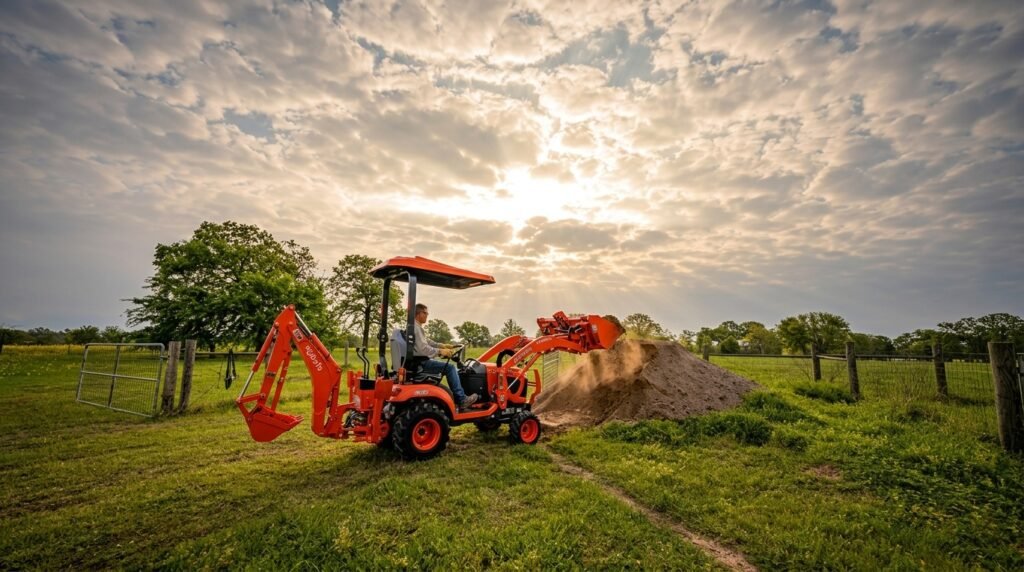
The Kubota BX23S follows a slightly different approach by combining subcompact dimensions with front loader and backhoe equipment. Its 21.6 gross engine horsepower and 17.7 PTO horsepower support property maintenance, gardening, landscaping, and smaller excavation projects. Its integrated equipment makes it particularly interesting for homeowners who want digging capability without moving into a larger tractor category. The Kubota BX23S review explores how its configuration affects everyday work.
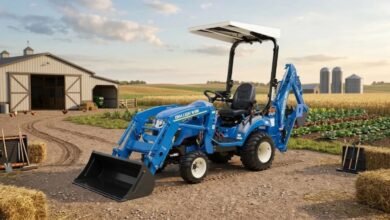
The New Holland Workmaster 25S produces 24.7 gross engine horsepower and 17.2 PTO horsepower. It combines a two-range hydrostatic transmission with a choice of cab or open-air ROPS configurations and several compatible attachments. Meanwhile, the Massey Ferguson 1GC.25 produces 24.5 engine horsepower and 18.5 PTO horsepower. Its compact dimensions and equipment options make it another representative example of the subcompact segment.
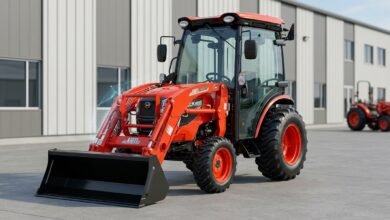
The larger machines offer a different level of capability. The KIOTI CK3520 produces 34.9 gross engine horsepower and has a published weight of 2,678 pounds in its gear-drive configuration. Its hydrostatic CK3520H counterpart weighs approximately 2,734 pounds. Both configurations offer greater operating weight and PTO capacity than the subcompact examples.
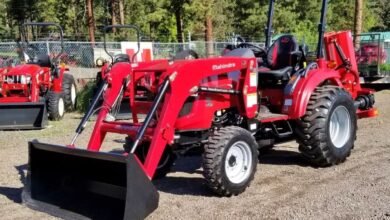
The Mahindra 1635 produces 36.2 gross engine horsepower and is available with HST and Shuttle transmissions. Its published base weights differ substantially by configuration, ranging from approximately 3,075 pounds for the Shuttle to 3,086 pounds for the open-station HST and 3,527 pounds for the HST Cab.
These figures illustrate the difference in scale, but they should not be interpreted as proof that every compact tractor is better suited to every job. A larger frame brings more weight and lifting potential, but it can also reduce maneuverability and increase the cost of ownership. The best choice depends on the work rather than the category name.
Why Property Size Is Not the Only Factor When Choosing a Tractor
Property acreage describes the amount of land an owner maintains, but it says very little about the actual demands placed on a tractor.
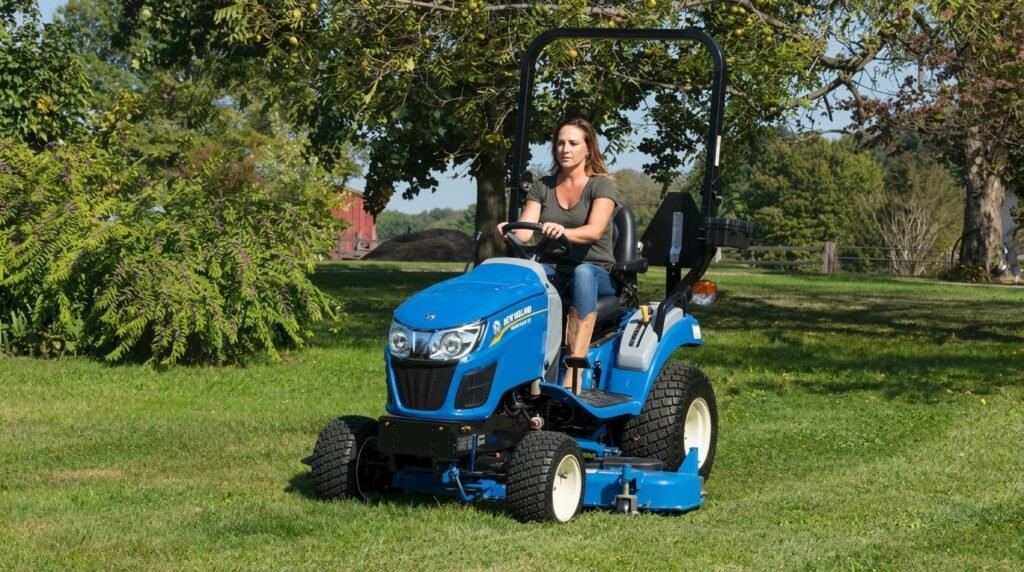
A residential property may contain several acres of open lawn, garden beds, trees, and landscaping that require regular mowing and light maintenance. A subcompact tractor can handle these jobs with the appropriate mower deck and attachments. The same amount of land could require a compact utility tractor if the owner regularly moves gravel, handles livestock materials, grades driveways, and operates heavier agricultural implements.
Soil conditions also influence the decision. Loose soil may be relatively easy to work, while compacted clay, rocky ground, and uneven surfaces place greater demands on the tractor’s traction, weight, and available power. A box blade working through dense soil creates a different workload from a mower cutting maintained grass.
Terrain matters just as much. Slopes, muddy areas, ditches, and rough ground can expose the limitations of a lightweight machine. A heavier tractor may provide more traction and a substantial platform for loader work in appropriate conditions, but additional weight can also damage lawns and increase soil compaction.
Access restrictions can reverse the decision. A relatively narrow subcompact may pass through residential gates that a larger compact tractor cannot. Similarly, a tall rollover protective structure may prevent indoor storage unless the structure can be folded in accordance with the manufacturer’s instructions.
The Kubota BX23S, for example, has a published minimum-tread width of approximately 45.1 inches and a ROPS height of 86.2 inches. The Mahindra 1635 has a published overall width of 64 inches. These dimensions illustrate why measuring gates, storage buildings, and working passages before purchasing is important.
Owners should also consider future projects. Someone planning to establish an orchard, expand livestock operations, or maintain larger areas of rough pasture may benefit from purchasing a compact tractor earlier rather than replacing a smaller machine later.
A property owner who only needs to dig a few fence-post holes every year may find it more practical to rent a dedicated auger or hire a contractor rather than purchase a larger tractor solely for that occasional job. Owners who expect regular post-hole work, however, should compare PTO-powered diggers with their tractor’s available horsepower and three-point hitch capacity, as explained in Haulizo’s post hole digger guide.
The important distinction is that tractor selection should begin with the most demanding recurring jobs, not simply the number of acres on the property.
Engine Horsepower vs. PTO Horsepower: Understanding Real Working Power
Engine horsepower is one of the most visible numbers in tractor advertising, but it does not tell the whole story. Gross engine horsepower represents the rated output at the engine, while PTO horsepower measures the power available at the power take-off shaft to operate compatible implements.
Power is lost through the drivetrain and other systems before it reaches the PTO. That difference matters whenever an owner plans to operate equipment such as rotary cutters, rear tillers, post hole diggers, and mid-mount mower decks.
The four subcompact tractors provide useful examples. The John Deere 1025R produces 24 gross engine horsepower and 18 PTO horsepower. The Kubota BX23S produces 21.6 gross horsepower and 17.7 PTO horsepower. New Holland lists 24.7 gross horsepower and 17.2 PTO horsepower for the Workmaster 25S, while the Massey Ferguson 1GC.25 produces 24.5 engine horsepower and 18.5 PTO horsepower.
These figures demonstrate why comparing tractors by engine horsepower alone can be misleading. The Workmaster 25S has the highest gross engine rating among these four examples, but its published PTO output is lower than the Massey Ferguson’s.
The compact models create another useful comparison. The KIOTI CK3520 produces 34.9 gross engine horsepower, with PTO output of 30.9 horsepower in its manual configuration. The hydrostatic CK3520H provides 28.9 PTO horsepower. The Mahindra 1635 produces 36.2 gross engine horsepower, with 26 PTO horsepower in its HST configuration, 25.9 in the HST Cab, and 27.6 in the Shuttle version.
The transmission and configuration must therefore be considered alongside the tractor model itself. Buyers should not assume that every version of a particular tractor has identical implement performance.
PTO speed and engagement are also important. All six models provide a 540 rpm rear PTO, while mid-PTO systems used for compatible mower decks differ in speed and availability. The John Deere 1025R uses a 2,100 rpm mid PTO, the Kubota BX23S and New Holland Workmaster 25S use 2,500 rpm mid-PTO systems, and the Massey Ferguson 1GC.25 uses a 2,000 rpm mid PTO. The KIOTI CK3520 and Mahindra 1635 offer optional 2,000 rpm mid-PTO configurations.
PTO engagement arrangements also differ. An independent PTO can continue operating while the tractor’s ground speed changes or the machine stops, depending on the transmission and control arrangement. Mahindra identifies live PTO with an overrunning clutch on the 1635 HST versions and independent PTO on the Shuttle version. Buyers should confirm the precise arrangement rather than assuming every configuration works the same way.
Implement requirements ultimately determine whether the available power is sufficient. A rotary cutter designed for a larger tractor can place too much demand on a smaller machine, particularly in dense grass or brush. A tiller working hard soil also needs sufficient power to maintain its operating speed.
The manufacturer’s recommended horsepower requirement should always be checked before purchasing an attachment. Buyers should also determine whether that requirement refers to engine horsepower or PTO horsepower, because the distinction can change whether a particular combination is suitable.
Front Loader Capacity and What the Numbers Really Mean
Front loader performance is one of the most important considerations when comparing subcompact and compact tractors. Owners use loaders to move soil, gravel, mulch, firewood, manure, feed, and landscaping materials, but the advertised lifting capacity does not always describe the weight that can be safely carried in a real bucket.
Several measurements determine loader performance. Lift capacity describes the weight the loader can raise under specified conditions. Breakout force describes the force available when the bucket curls or digs into a pile. Maximum lift height determines whether the bucket can reach a trailer or truck bed, while reach determines how far forward the bucket extends when raised.
The measurement point is particularly important. A load positioned at the bucket pivot pins places less leverage on the loader than the same load positioned farther forward. Consequently, capacity measured at the pivot pins cannot be compared directly with a rating measured at the bucket edge or at a specified distance in front of the pins.
The New Holland Workmaster 25S provides a clear example. Its compatible 100LC loader is rated at approximately 1,005 pounds at the bucket pivot pins when raised to maximum height. At a point 500 millimeters, or approximately 20 inches, forward of the pivot pins, the published capacity drops to 693 pounds. Breakout force also changes between the two measurement locations, falling from approximately 2,078 pounds at the pivot pins to 1,426 pounds at the forward measurement point. The Workmaster 25S review explains these measurements in greater detail.
The Massey Ferguson 1GC.25 illustrates the same issue from another perspective. Its manufacturer lists a maximum loader capacity of 662 pounds at maximum height, measured 19.5 inches forward of the pivot pin. That measurement position gives buyers a more useful reference for understanding the loader’s actual working geometry.
Kubota lists a series maximum loader capacity of 739 pounds for the BX23S with its rigid bucket configuration, while the quick-attach bucket configuration is rated at 613 pounds. These are different equipment configurations, not two interchangeable ratings for an identical setup.
The compact tractors offer higher published ratings. KIOTI lists two loader configurations, the KL4030 and KL4030C. The KL4030 is rated at 1,835 pounds of lift capacity to full height and 3,464 pounds of breakout force at the pivot pin. The KL4030C increases the published lift capacity to 1,969 pounds, but its breakout force is lower at 2,989 pounds.
The difference becomes more interesting when reach is considered. The KL4030 provides 27.2 inches of reach at maximum height, compared with 11.3 inches for the KL4030C. The larger lift rating therefore does not automatically make the second loader a better choice for every material-handling task. Buyers should confirm the loader configuration offered for their exact CK3520 build. The KIOTI CK3520 review provides a closer explanation of the tractor’s loader options.
Mahindra rates the 1635L loader at 1,830 pounds of lift capacity, with a maximum lift height of 92 inches. Its published breakout force is 2,777 pounds with the standard 64-inch bucket. Buyers should confirm the exact measurement point for the lifting-capacity figure when comparing it with other loaders, particularly when manufacturers use different load positions.
In daily operation, tractor stability is just as important as loader strength. Gravel, wet soil, stones, and other dense materials can increase bucket weight quickly. A raised load shifts the center of gravity forward and upward, increasing the demands placed on the front axle and reducing the weight carried by the rear wheels.
Rear ballast, tire selection, tractor weight, terrain, and operating technique all influence safe loader operation. Carrying loads low, avoiding abrupt turns, and following the manufacturer’s loading and ballast instructions remain essential.
A loader rating describes what the loader can lift under specified conditions. It does not mean the tractor can safely carry that load on every surface or slope.
Hydraulic Flow and Compatibility With Tractor Attachments
The hydraulic system influences how quickly the tractor responds to controls and which attachments it can operate. Front loaders, backhoes, hydraulic grapples, top links, and other equipment depend on hydraulic pressure and flow, but those two measurements describe different properties.
Flow, usually measured in gallons per minute, influences the speed at which hydraulic cylinders operate. Pressure affects the force that the hydraulic system can develop. Cylinder dimensions, mechanical leverage, and the design of the attachment also influence the final result.
A common mistake is to assume that total hydraulic pump output is fully available to the loader or an auxiliary attachment. In many tractors, the hydraulic system serves separate functions, including steering and implement operation.
The New Holland Workmaster 25S has a published total hydraulic flow of approximately 6.7 gallons per minute, divided between a 4.6 gallon implement pump and a 2.1 gallon steering pump. The two circuits serve different purposes, so the total figure should not be treated as implement flow.
Mahindra divides the 1635’s maximum total hydraulic output of approximately 10.8 gallons per minute between a 7.5 gallon main pump and a 3.3 gallon steering circuit. Kubota lists approximately 6.2 gallons per minute of total hydraulic flow for the BX23S, while KIOTI publishes an 11.7 gallon per minute pump capacity for the CK3520.
These figures describe different hydraulic system arrangements and should not be ranked as though every gallon is available to the same attachment. The amount of implement flow available at a particular connection is more useful than the headline total when evaluating a hydraulic implement.
The hydraulic system becomes especially important when an owner plans to install attachments that need continuous or additional hydraulic operation. Grapples, hydraulic top links, hydraulic angle blades, and some specialized equipment require suitable valves, couplers, and sufficient available flow.
A tractor may be physically compatible with an attachment but still lack the necessary auxiliary hydraulic equipment. The Kubota BX23S and Mahindra 1635, for example, have configuration-specific options for additional hydraulic connections. Buyers should check whether the necessary valves and connections are included in the equipment package.
Buyers should therefore check the attachment’s required flow and pressure, the tractor’s available implement circuit, and whether the necessary valves and connections are included. A complete hydraulic compatibility check is more useful than relying on the total pump output printed in a specification summary.
Three-Point Hitch, PTO, and Agricultural Implement Compatibility
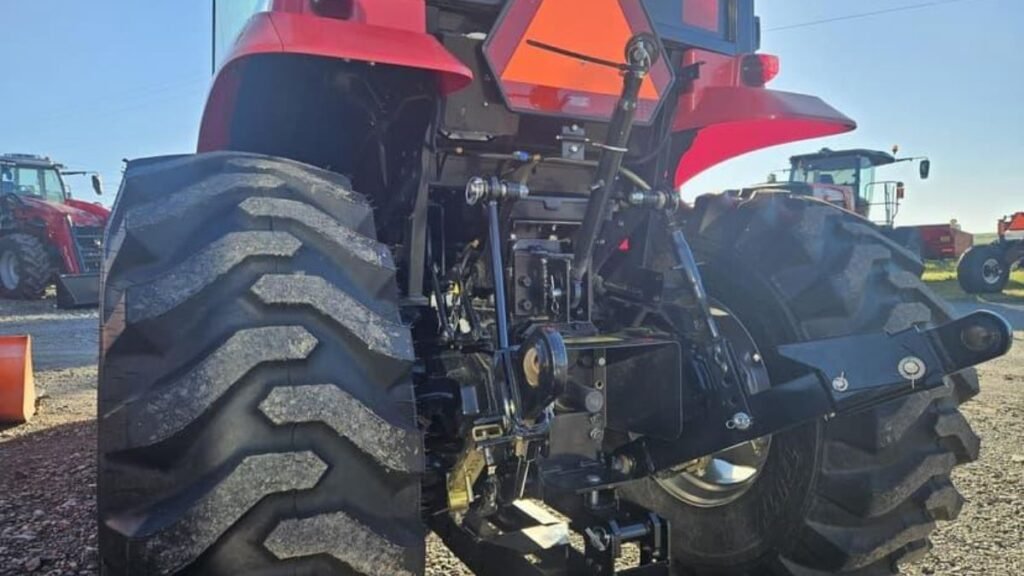
The rear three-point hitch determines which agricultural implements a tractor can carry, raise, position, and operate. Subcompact and compact tractors commonly use Category I equipment, but the category designation alone does not establish complete compatibility.
John Deere identifies the 1025R hitch as Limited Category 1. Some standard Category I implements may require adjustments or may not be suitable for the machine. Owners should confirm dimensions, pin sizes, lift geometry, and implement weight before purchasing equipment.
Lift capacity also changes according to the point at which the measurement is taken. A capacity figure measured directly at the lift points will be higher than a rating taken 24 inches behind the lift points because the farther rearward load creates more leverage against the hitch.
Kubota lists a hitch lift capacity of approximately 683 pounds for the BX23S. Buyers should confirm the applicable hitch equipment and measurement method when comparing this rating with other machines.
New Holland lists 992 pounds of three-point lift capacity at the link ends for the Workmaster 25S. Its published technical specifications also distinguish the capacity measured at the ends from the lower capacity available 24 inches behind them, which is more representative of the leverage created by an actual rear-mounted implement.
Massey Ferguson lists 661 pounds of rear lift capacity for the 1GC.25 measured 24 inches behind the lift points. This provides a clearly defined measurement location for owners comparing the tractor with other subcompact machines.
KIOTI lists 1,631 pounds of three-point hitch lift capacity for the CK3520. Its technical documentation distinguishes this 24-inch-behind-the-lift-point rating from the higher figure measured directly at the lift points.
Mahindra publishes 1,720 pounds for the 1635 measured 24 inches behind the lift points. This gives the compact tractor considerably more rear implement capacity than many subcompact models.
Implement weight is only one factor in compatibility. Width, center of gravity, rear overhang, working depth, and operating resistance can all affect whether a particular attachment is suitable.
A box blade may weigh less than the published hitch capacity but still create excessive leverage if it is long or carries its weight far behind the tractor. The same consideration applies to rear blades, tillers, rotary cutters, and post hole diggers.
Haulizo’s tractor box blade guide explains how blade weight, working width, shank arrangement, and hitch compatibility influence selection. Matching the attachment to the tractor requires considering both its physical connection and its operating demands.
The PTO introduces another compatibility requirement. A rear-mounted attachment may fit the Category I hitch but still require more PTO horsepower than the tractor can provide. Buyers should therefore evaluate the hitch, driveline, PTO rating, and implement specifications together rather than treating any single specification as proof of compatibility.
Hydrostatic vs. Gear and Shuttle Transmission
Transmission selection can make a noticeable difference in how comfortably and efficiently a tractor performs its daily work.
A hydrostatic transmission uses a hydraulic pump-and-motor system to control ground speed and direction, usually through foot pedals. Instead of shifting through conventional forward and reverse gears for every maneuver, the operator can vary speed smoothly within the selected range. The tractor still has mechanical range selections, but everyday direction changes require far less shifting and clutch operation.
All four subcompact examples use two-range hydrostatic transmissions. This arrangement suits property maintenance because operators frequently move between forward and reverse, especially when working with a loader or maneuvering around buildings and landscaping.
The KIOTI CK3520 offers manual and hydrostatic configurations, with a Synchro Shuttle version also available in the CK3520SE. The manual CK3520 and the CK3520SE are rated at 30.9 PTO horsepower, while the hydrostatic CK3520H provides 28.9 PTO horsepower. The differences are important because transmission choice affects both driving experience and available PTO output.
Mahindra takes a similar approach with the 1635. Its HST versions use a three-range hydrostatic transmission, while the Shuttle version provides eight forward and eight reverse speeds. The HST produces 26 PTO horsepower, or 25.9 in the HST Cab, compared with 27.6 for the Shuttle.
Hydrostatic drive is particularly useful for repetitive loader work. Filling a bucket, reversing away from a pile, turning, approaching a dumping location, and repeating the process can involve hundreds of changes in direction during a working day. Pedal control makes these movements easier without requiring repeated clutch operation and gear selection.
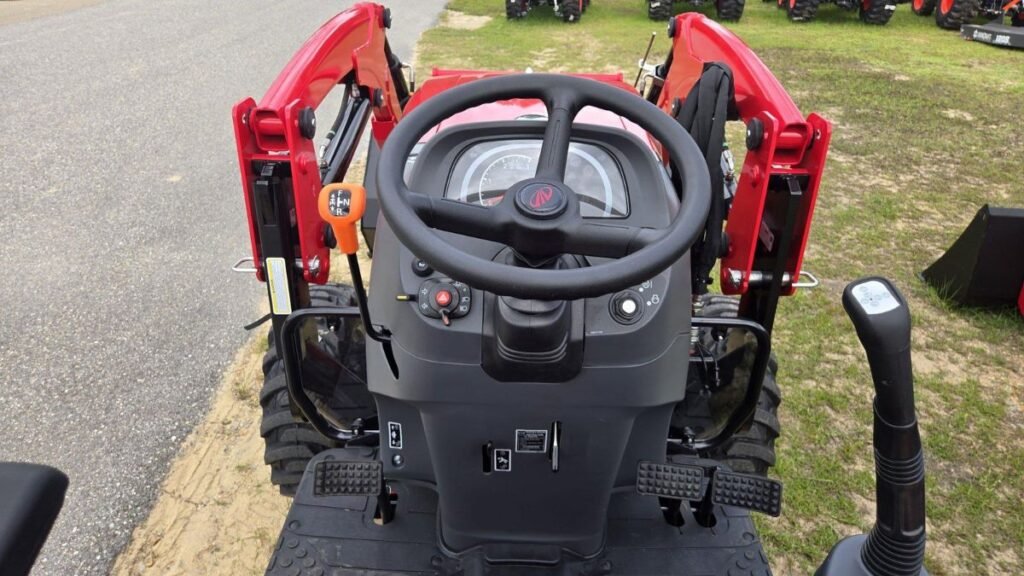
Gear and Shuttle transmissions have different strengths. Fixed gear selection provides predictable ground speed for operations such as mowing and tilling, where maintaining a suitable operating speed can improve consistency. A synchronized shuttle also makes changing direction easier than working with a conventional gearbox without that feature.
The published PTO differences between transmission versions matter when selecting powered implements. Buyers who prioritize HST convenience should check whether the lower PTO output of a particular configuration remains sufficient for their intended attachments.
Neither transmission type is automatically superior. The best choice depends on whether the owner spends more time maneuvering with a front loader, operating powered agricultural implements, or traveling between working areas.
Tractor Weight, Tires, Ground Clearance, and Maneuverability
Tractor weight influences traction, stability, and the way a machine behaves while carrying or pulling equipment. A heavier tractor can provide more grip and a more substantial platform for loader work, but additional weight can also increase soil compaction and damage finished lawns.
The John Deere 1025R has a published base machine weight of 1,556 pounds. KIOTI lists 2,678 pounds for the gear-drive CK3520 and approximately 2,734 pounds for the hydrostatic CK3520H. Mahindra lists approximately 3,075 pounds for the 1635 Shuttle, 3,086 pounds for the open-station HST, and 3,527 pounds for the HST Cab.
These are configuration-specific base figures, not necessarily the operating weight of a fully equipped tractor. Fuel, the operator, a front loader, rear attachments, ballast, and other equipment can substantially change the final weight and its distribution between the axles.
Tire selection also affects performance. Agricultural tires use deeper lugs to provide traction in soil and mud, making them suitable for fieldwork and demanding ground conditions. Their aggressive tread can damage lawns and finished surfaces.
Turf tires use a broader tread pattern designed to reduce ground disturbance, which makes them attractive for mowing and maintaining landscaped properties. Industrial tires offer a middle ground for owners who work across gravel, pavement, dirt, and mixed surfaces.
Mahindra and KIOTI offer several tire configurations, including agricultural, industrial, and turf options on the relevant models. Tire selection should reflect the surfaces where the tractor will spend most of its working time rather than simply the most demanding surface it might encounter.
Ground clearance is another distinction. The Kubota BX23S has approximately 6.5 inches of front-axle ground clearance. The KIOTI CK3520 provides 13.4 inches, while the Mahindra 1635 lists 12.2 inches. These manufacturer-published measurements are useful when evaluating rough terrain, although the measurement location, tire setup, and installed equipment should be considered before making direct comparisons.
Greater ground clearance can help when crossing uneven terrain, ruts, rocks, and rough field surfaces. However, the appropriate choice also depends on the tractor’s center of gravity, tire configuration, and the terrain where it will operate.
Maneuverability deserves equal consideration. A machine with a smaller frame and shorter wheelbase can be easier to position around buildings, garden beds, trees, and narrow gates. A larger tractor may provide more capacity but require more room to turn and more space for storage.
Buyers should measure gates, barns, garage entrances, and storage buildings using the dimensions of the exact tractor configuration they intend to purchase. Adding a loader, backhoe, cab, or mower changes overall dimensions and may affect access.
Weight and dimensions should therefore be considered together. A tractor that is powerful enough for the work but too wide for the property or too heavy for the finished ground may not be the most practical purchase.
Front Loaders, Backhoes, Mowers, and Cab Configurations
The working value of a tractor depends on more than the base machine. Its loader, mower, backhoe, tires, ballast, hydraulic options, and operator station determine how effectively it can perform different tasks.
The Kubota BX23S demonstrates this particularly well. The machine is sold as a subcompact tractor with front loader and backhoe equipment, creating a practical combination for owners who need excavation and material handling on smaller properties. Its backhoe arrangement includes a reversible operator seat, allowing the operator to change between tractor and backhoe work without using a separate machine. Its published backhoe digging depth is approximately 72.5 inches.

The compact models also provide attachment options, although compatibility depends on the exact version. KIOTI offers the KB2475L backhoe as an attachment option for the CK3520 through its configuration system. Buyers should confirm the approved mounting arrangement and the exact attachment specification for their selected tractor.
Mahindra’s 1635 also has equipment options that vary by transmission and operator-station configuration. Its HST, HST Cab, and Shuttle versions should not be assumed to accept identical backhoe packages. The approved backhoe model, subframe, and installation requirements need to match the exact tractor configuration.
New Holland has an important restriction on the Workmaster 25S. Its published build combinations show the 905GBL backhoe with the open-air ROPS configuration. The cab packages are listed with loader and mower combinations, so buyers who want both an enclosed operator station and a backhoe should verify the current approved combinations with a dealer before ordering.
Massey Ferguson similarly distinguishes between its standard 1GC.25 and the 1GC.25B loader-backhoe configuration. The manufacturer lists a backhoe digging depth of 76 inches for the 1GC.25B, while the standard 1GC.25 does not carry that same backhoe specification.
Mower compatibility requires the same attention. Mid-mount mower decks depend on the tractor’s mid PTO, mounting arrangements, dimensions, and approved equipment combinations. A rear mower or rotary cutter follows a different compatibility path because it uses the rear hitch and rear PTO.
A factory cab can improve comfort during long working sessions and seasonal snow removal, but it can also add considerable weight and cost. Some combinations of cab, loader, backhoe, and mower may not be available together.
Before purchasing, owners should request a complete configuration quote identifying the tractor version, loader model, bucket, mower, backhoe, tires, ballast, hydraulic options, and all required mounting components.
A tractor that appears affordable as a base machine can become a substantially more expensive package once the equipment needed for its intended work is included.
Ownership Costs, Maintenance, and Dealer Support
The purchase price of a tractor is only one part of the ownership cost. A buyer should evaluate the cost of the complete working package, including the loader, bucket, tires, ballast, mower, backhoe, remote valves, and any additional attachments required for regular operations.
Comparing a base tractor price against a fully equipped dealer package can produce a misleading impression of value. Every quotation should identify the included equipment and distinguish standard features from optional additions.
Maintenance is another important consideration. Diesel tractors require routine engine oil and filter service, fuel filter replacement, air filter maintenance, cooling system checks, hydraulic fluid and filter service, and regular inspections of hoses, connections, and loader pivot points.
The attachments need attention too. Mower blades, rotary cutter gearboxes, tiller drivetrains, hydraulic lines, loader pins, and three-point hitch connections all contribute to long-term operating costs.
Warranty coverage should be evaluated using the written terms that apply to the exact tractor, model year, sale date, and configuration. The length of a powertrain warranty does not necessarily mean that every attachment or hydraulic component receives the same coverage.
New Holland describes its Boomer Guard Limited Warranty as including two years of bumper-to-bumper coverage and an additional four years of powertrain protection. Mahindra advertises a seven-year limited powertrain warranty for qualifying 1600 Series tractors, including the 1635. Buyers should review the current terms and conditions on the manufacturers’ official websites, including New Holland, Mahindra, and KIOTI.
Dealer support may eventually matter more than a small difference in advertised specifications. Parts availability, service scheduling, technical support, and the distance to an authorized dealership can influence how quickly a tractor returns to work when maintenance or repairs become necessary.
A tractor that spends several weeks waiting for parts during mowing or harvesting season can create more inconvenience than one that costs slightly more at purchase but has reliable local support.
The most useful comparison is therefore between complete ownership packages, not simply the starting prices of two machines.
When a Subcompact Tractor Makes More Sense
A subcompact tractor makes sense when the majority of work involves maintaining residential properties, mowing lawns, clearing snow, landscaping, gardening, and handling relatively light materials.
Its smaller footprint can be particularly valuable around trees, fences, buildings, narrow access routes, and established garden areas. Owners who need to maintain finished lawns may also prefer the lighter weight and availability of turf tires.
The John Deere 1025R offers the familiar combination of hydrostatic operation, independent mid and rear PTO capability, and a Limited Category 1 rear hitch designed for compatible smaller implements. Its power and size suit owners who prioritize regular property maintenance over demanding agricultural work.
The Massey Ferguson 1GC.25 provides another approach, with mower compatibility, loader capability, and equipment options intended to support seasonal tasks. The availability of a 1GC.25B backhoe configuration also demonstrates that subcompact tractors can offer useful excavation capability when properly equipped.
New Holland’s Workmaster 25S provides practical loader and mower functionality for homeowners and rural property owners. Its 17.2 PTO horsepower and the 100LC loader’s published lifting ratings also establish working limits that buyers should understand before purchasing larger implements.
The Kubota BX23S is especially attractive to owners who want the combination of a front loader and backhoe in a compact machine. It can handle suitable landscaping, trenching, and smaller excavation projects while remaining considerably smaller than many compact utility tractors.
Subcompact tractors are most effective when the heaviest regular work remains within their available PTO output, hydraulic capacity, hitch rating, and loader limits. They are not intended to replace larger machines for sustained heavy fieldwork, frequent handling of large materials, or demanding ground-engaging operations.
For owners whose primary needs are mowing, seasonal maintenance, and moderate material handling, the smaller category can offer a very sensible balance of capability and cost.
When a Compact Tractor Is the Better Choice
A compact utility tractor becomes more attractive when regular work requires greater operating weight, higher PTO output, stronger lifting capability, or a wider range of agricultural implements.
Owners who regularly move gravel, transport feed, maintain pasture, grade farm roads, handle heavier attachments, or work with larger areas of land may benefit from stepping up to a compact model.
The KIOTI CK3520 offers substantially more engine and PTO power than the four subcompact examples discussed earlier. Its 30.9 PTO horsepower in the gear-drive version and 28.9 PTO horsepower in the HST version, along with the availability of different loader configurations, provide flexibility for owners with different working requirements.
Its published hydraulic pump capacity of 11.7 gallons per minute and Category I hitch capacity of 1,631 pounds also make it an interesting option for owners considering heavier implements and regular loader work. The precise performance available still depends on the transmission and attachments selected.
The Mahindra 1635 offers another practical option for small farms and larger rural properties. Its 36.2 horsepower engine, 26 to 27.6 PTO horsepower depending on transmission configuration, and 1,720-pound rear hitch rating measured 24 inches behind the lift points provide greater capacity for suitable agricultural implements.
Its 1635L loader is rated at 1,830 pounds of lift capacity, with a maximum lift height of 92 inches. The model’s available backhoe and cab configurations also broaden its usefulness, provided the buyer selects an approved equipment combination.
The additional weight of these tractors can help provide traction and a more substantial platform for demanding work, although it also increases ground pressure and the need to consider soil conditions.
Compact tractors are particularly appropriate for owners who regularly use heavier box blades, rotary cutters, tillers, and other implements that exceed the practical capabilities of many subcompact models.
The decision to move into the compact category should be based on recurring work and verified equipment requirements. Buying a larger machine simply because its specifications look more impressive does not guarantee better value.
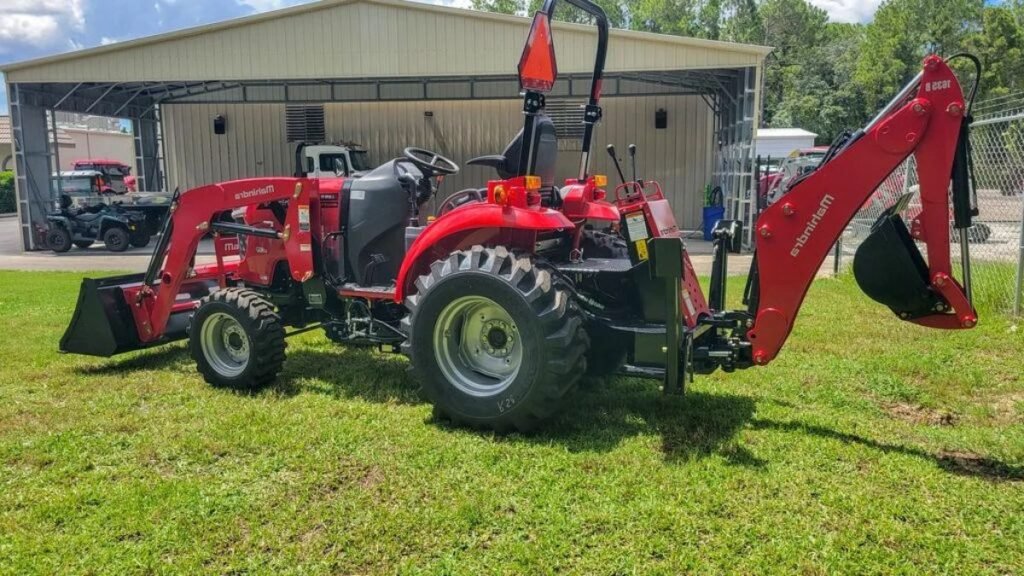
When Neither Subcompact Nor Compact Is Enough
Some operations require more power and capacity than either of these tractor categories can reasonably provide.
Frequent heavy tillage, large field implements, intensive commercial operations, substantial material handling, and repeated excavation can exceed the working limits of subcompact and compact utility tractors.
A property owner who regularly handles large round hay bales, performs demanding soil preparation, or operates heavy implements over extended periods may need a larger utility tractor with a higher PTO rating, greater operating weight, and stronger hydraulic capabilities.
Excavation is another area where specialized equipment may be more productive. A compact tractor equipped with a backhoe can handle suitable trenches, drainage work, landscaping holes, and smaller excavation projects, but it is not a substitute for a dedicated excavator during sustained or demanding excavation.
Larger tractors also provide capabilities that smaller machines cannot match economically. When the workload consistently exceeds the smaller tractor’s capacity, purchasing the correct larger machine is often more sensible than repeatedly pushing a smaller one beyond its intended operating range.
Understanding these limits prevents buyers from spending money on a machine that cannot comfortably complete their most demanding regular tasks.
Conclusion: Choosing the Right Subcompact or Compact Tractor
Choosing between subcompact vs. compact tractors ultimately comes down to matching the machine to the work it will perform throughout the year. A subcompact tractor can be the smarter investment for property owners who prioritize mowing, landscaping, snow removal, and lighter loader work, particularly when maneuverability and a smaller footprint matter. A compact utility tractor becomes more practical when heavier implements, regular material handling, demanding PTO work, and greater lifting capacity are part of the weekly routine.
Before making a purchase, look beyond engine horsepower and advertised loader capacity. Consider the PTO power available for your implements, the hydraulic flow required by your attachments, the three-point hitch capacity at the correct measurement point, and the tractor’s weight with its intended equipment installed. The transmission, tire configuration, operator station, and availability of compatible attachments can also make a significant difference in everyday ownership.
There is no single tractor size that works best for every property. The right choice is the machine that handles your most demanding regular tasks safely and efficiently without adding unnecessary size or expense to jobs that could be completed with a smaller tractor.
For a closer look at the machines discussed in this comparison, explore Haulizo’s individual tractor reviews to compare their specifications, configurations, and practical capabilities. Understanding the differences between these six models is a useful starting point, but the final decision should always come down to the work you need to accomplish and the equipment you plan to use.